June 19, 2026
Why ISR Uranium Is Having Its Moment in the Sun
The global uranium market is undergoing a structural reset. After more than a decade of post-Fukushima suppression, uranium demand is climbing again with notable urgency, driven by a wave of new reactor construction across Asia, the revival of mothballed nuclear plants in Europe, and firm policy commitments to nuclear baseload power in the United States, France, and the United Kingdom. Against this backdrop, uranium market dynamics have made the technical characteristics of individual uranium projects more important than ever to investors and utility buyers trying to identify which development-stage assets can realistically deliver fuel into an increasingly constrained supply chain.
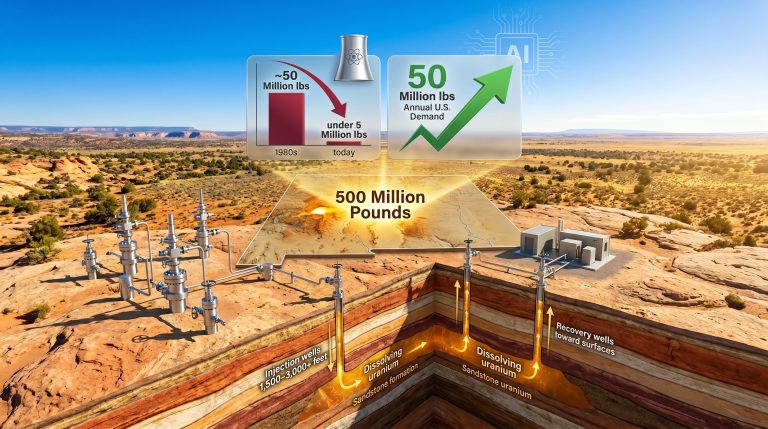
In-situ recovery, or ISR, has become the method of choice for new uranium development in geologically favourable jurisdictions. Unlike conventional open-cut or underground mining, ISR involves injecting a weak leaching solution, typically a mild acid or alkaline compound, into uranium-bearing sandstone aquifers via a network of injection and recovery wells. The uranium-laden solution is pumped to surface and processed through an ion exchange circuit, all without disturbing the host rock formation or generating large volumes of solid waste. The in-situ leaching benefits are particularly well suited to shallow, roll-front style uranium deposits hosted in porous, permeable sediments, which is precisely the geological setting that defines South Australia's Samphire uranium corridor.
It is within this framework that the Alligator Energy Samphire uranium resource increase, announced in June 2026, carries strategic weight well beyond what a simple tonnage number might suggest.
When big ASX news breaks, our subscribers know first
The Geology Behind the Numbers: What Makes Samphire's Architecture Unusual
Roll-Front Uranium Systems and Why Deposit Clustering Matters
Roll-front uranium deposits form when oxidised, uranium-bearing groundwater migrates through permeable sandstone and encounters a reducing chemical boundary, typically caused by organic matter or pyrite in the host sediment. At this redox interface, uranium precipitates out of solution and accumulates as a crescent-shaped orebody oriented perpendicular to the groundwater flow direction. Over geological time, multiple roll-fronts can develop along the same aquifer horizon, separated by varying distances but sharing the same host formation.
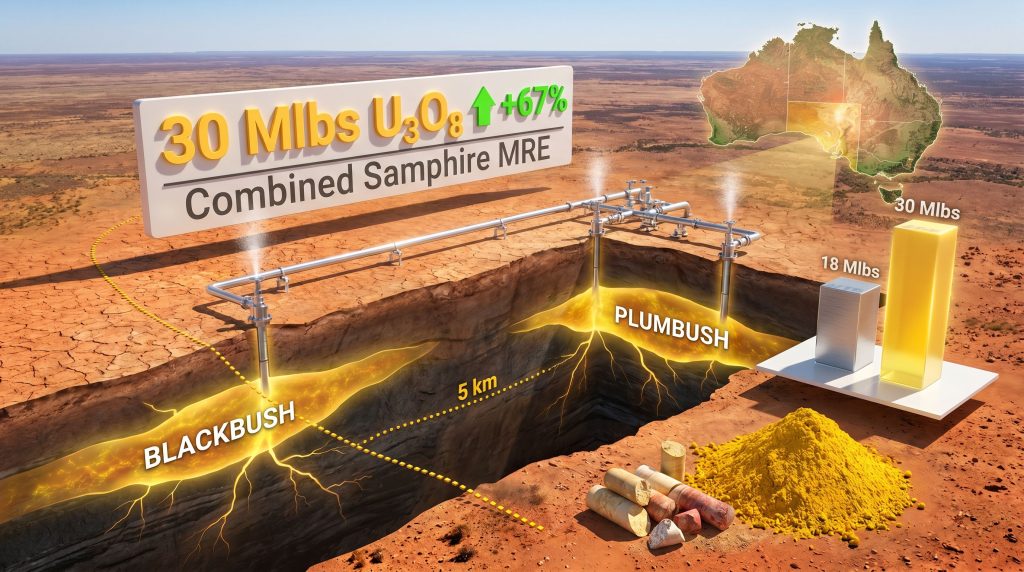
This is the geological context within which the spatial relationship between the Blackbush and Plumbush deposits becomes particularly meaningful. The two mineralised centres sit approximately 5 kilometres apart within the Samphire uranium project tenure in South Australia, both hosted in ISR-amenable sedimentary sequences. The corridor between them has seen only limited historical drilling, meaning the question of whether these two deposits represent isolated accumulations or connected segments of a larger mineralised system remains genuinely open.
The Maiden Plumbush MRE: Technical Parameters at a Glance
The unveiling of a maiden 12 million pound (Mlbs) Inferred Mineral Resource Estimate (MRE) at Plumbush in June 2026 delivered the first formal quantification of what geologists had long suspected: that the southern portion of the Samphire tenure was harbouring material uranium mineralisation. The deposit had not been drilled in over a decade before this estimate was completed, making the resource definition particularly significant from a data-gap perspective.
| Parameter | Detail |
|---|---|
| Plumbush MRE | 12 Mlbs U₃O₈ (Maiden Inferred) |
| Recovery Method | In-Situ Recovery (ISR) amenable |
| Distance from Blackbush | ~5 km south |
| Last Drilling Activity | More than 10 years prior to 2026 |
| Combined Samphire MRE | 30 Mlbs U₃O₈ |
| Previous Combined MRE | 18 Mlbs U₃O₈ |
| Total MRE Growth | +67% |
| Exploration Target Range | 14 to 75 Mlbs U₃O₈ (reported 2023) |
The fact that the entire 30 Mlbs combined resource base has been assessed as amenable to ISR extraction is not a minor technical footnote. ISR amenability is a binary determination with major economic consequences, as deposits that fail the permeability and porosity criteria required for solution injection and recovery cannot utilise this low-cost extraction method and must instead be evaluated against far more capital-intensive conventional mining approaches.
The 67% Resource Jump: What It Actually Means at the Pre-BFS Stage
Beyond the Headline Figure
A 67% resource increase sounds impressive in isolation, but the more instructive question is what it enables rather than simply what it represents. For a junior developer advancing toward a bankable feasibility study (BFS), the resource base serves as the foundational input into every economic model the project will ever produce. Larger, higher-confidence resource estimates translate directly into longer modelled mine lives, improved internal rate of return projections, greater leverage in offtake negotiations with uranium utilities, and a stronger platform for debt financing.
Key Insight: At the pre-BFS stage, resource scale functions as a multiplier on project economics rather than a linear addition. A project with 30 Mlbs and demonstrated ISR amenability across the whole inventory occupies a fundamentally different position in terms of bankability than one with 18 Mlbs, even if the additional pounds sit in the lower-confidence Inferred category.
Furthermore, understanding uranium investment trends underscores why resource scale at this stage resonates so strongly with institutional investors evaluating development-stage assets.
Understanding JORC Resource Classification: Why Category Conversion Is the Critical Next Step
Under the JORC Code 2012, which governs mineral resource reporting for ASX-listed companies, resources are classified into three categories based on geological confidence:
-
Inferred – The lowest confidence category. Sufficient data exists to estimate tonnage and grade with reasonable reliability, but geological continuity cannot be fully demonstrated. Inferred resources cannot be used directly in mine planning or BFS economic modelling without conversion to higher categories.
-
Indicated – A higher confidence category requiring tighter drill spacing and demonstrated geological continuity. Indicated resources can be used in preliminary and pre-feasibility studies and form an important input into BFS-level economic modelling.
-
Measured – The highest confidence category, typically requiring very close drill spacing and extensive sampling. Measured resources underpin mine scheduling and final investment decisions.
The Plumbush MRE is currently entirely classified as Inferred, which is appropriate for a deposit that has not been systematically drilled in over ten years. The pathway to BFS incorporation runs directly through upgrading a meaningful proportion of this resource to Indicated classification via infill drilling, which is precisely what the upcoming aggressive drilling campaign is designed to achieve. Consequently, interpreting drill results correctly will be essential for investors tracking progress toward that upgrade.
The Mullaquana Crown Lease: Unlocking Tenure That Changes the Game
What the Option Agreement Actually Opens Up
A call option to acquire the Mullaquana Crown lease from Joyce Pastoral represents more than a routine land tenure transaction. Crown leases in South Australia are pastoral tenure instruments that historically restricted access for mineral exploration and drilling. The Mullaquana lease is significant for three distinct reasons:
-
It is the host tenure for the Plumbush deposit itself, meaning drilling access to expand and upgrade the resource depends directly on the status of this tenure arrangement.
-
It covers the southern strike extension of the Blackbush mineralisation, an area where geological continuity has been interpreted from existing data but has never been adequately tested with drilling. This distinction between interpreted geology and drill-validated geology is fundamental to JORC classification.
-
It opens access to the inter-deposit corridor between Blackbush and Plumbush, approximately 5 km of prospective ground that has seen only limited historical drilling and which, if mineralised, could meaningfully change the scale narrative for the entire Samphire project.
Three Drilling Priorities That Define the Next 18 Months
The access provided by the Mullaquana option unlocks a clearly sequenced set of drilling objectives that will collectively determine the resource base that feeds into the mid-2027 BFS:
-
Plumbush infill and extension drilling – Targeting the conversion of Inferred resources to Indicated classification by tightening drill spacing and improving geological confidence. Extension drilling along strike and down-dip could also add new resource tonnage to the current 12 Mlbs base.
-
Blackbush southern strike extension testing – Testing the interpreted geological continuity of Blackbush mineralisation into ground that has been inaccessible. A successful result here would expand the better-defined Blackbush resource inventory.
-
Inter-deposit corridor drilling – The highest-risk, highest-reward program. If drilling confirms mineralisation continuity across the ~5 km gap between the two known deposits, the resulting geological model would support a materially larger and more cohesive resource system.
Strategic Scenario: Should corridor drilling confirm that Plumbush and Blackbush are connected by a continuous or semi-continuous mineralised system, the combined Samphire project could potentially move toward the upper range of its 2023 exploration target of 14 to 75 Mlbs U₃O₈. This scenario would not merely expand the resource base, it would reshape the entire geological and economic thesis of the project. This remains speculative and is contingent on drilling results.
The Road to BFS: Milestones, Dependencies, and Sequencing
A Three-Phase Development Pathway to Mid-2027
The development roadmap from current resource definition through to BFS completion involves a tightly sequenced set of interdependent milestones:
| Phase | Timeframe | Key Activities |
|---|---|---|
| Phase 1 | 2026 | Aggressive drilling campaign across Plumbush, Blackbush southern extension, and inter-deposit corridor |
| Phase 2 | Early 2027 | Updated MRE incorporating new drilling data, including resource category upgrades |
| Phase 3 | Mid-2027 | BFS release incorporating the updated MRE as the foundational resource base |
The sequencing is logical but demanding. The BFS cannot incorporate Plumbush into its economic model until sufficient drilling has been completed to upgrade the Inferred resource to Indicated status. This creates a genuine dependency chain where any delays in the drilling program flow directly through to the BFS timeline and the quality of the economic model it produces.
Multi-Deposit ISR Operations: The Infrastructure Synergy Argument
One of the less-discussed advantages of multi-deposit ISR projects is the potential for shared infrastructure to materially reduce capital intensity. In a single-deposit ISR operation, all processing infrastructure, including the central processing plant, ion exchange columns, uranium precipitation circuits, and evaporation ponds, must be sized and costed against the resource inventory of that one deposit. When a second deposit is located within a few kilometres, the incremental capital required to bring it into production can be dramatically lower than building a standalone operation.
For Samphire, the ~5 km separation between Blackbush and Plumbush is within the range where shared processing infrastructure is operationally and logistically feasible. A centralised processing plant situated between or adjacent to both deposits could theoretically service wellfields at both mineralised centres, a configuration that typically improves BFS economics relative to single-deposit scenarios and reduces the capital cost per pound of uranium produced.
Benchmarking Samphire Within the ASX Uranium Development Peer Group
Where 30 Mlbs U₃O₈ Sits in Context
| Metric | Samphire (AGE) | Typical ASX ISR Development Peer |
|---|---|---|
| Total MRE | 30 Mlbs U₃O₈ | 10 to 50 Mlbs (range) |
| Recovery Method | ISR | ISR |
| Resource Stage | Inferred + Indicated | Varies |
| BFS Status | Underway (mid-2027 target) | Pre-BFS to BFS |
| Exploration Target | 14 to 75 Mlbs | Project-specific |
| Location | South Australia | WA, NT, SA |
Note: Peer comparisons are indicative and based on publicly available ASX disclosures. Individual project economics vary significantly and direct comparisons should be treated as approximate only.
South Australia has emerged as a preferred ISR uranium jurisdiction within Australia, partly due to its established regulatory history with uranium projects and partly due to the favourable hydrogeological characteristics of its sedimentary basins. The state has hosted ISR-amenable uranium mineralisation across multiple project tenements, and the precedent regulatory work done in the jurisdiction reduces some of the permitting uncertainty that can affect projects in less-developed regulatory environments. The growing uranium supply deficit further reinforces the strategic value of projects like Samphire that can credibly advance through feasibility in this environment.
The next major ASX story will hit our subscribers first
Risk Factors Every Investor Should Understand
Resource Classification Risk
The entire Plumbush MRE sits in the Inferred category, which carries important limitations. Under JORC 2012, Inferred resources cannot be used directly in mine planning or fed into the economic modelling sections of a BFS without first being upgraded to Indicated or Measured status. This means the drilling campaign is not optional from a BFS quality standpoint; it is an essential prerequisite.
Tenure and Access Risk
The Mullaquana Crown lease arrangement is currently structured as a call option to acquire, not a completed tenure acquisition. The distinction matters because option agreements carry conditions precedent that must be satisfied before the option can be exercised and title transferred. If the option is not ultimately exercised, drilling access to both the Plumbush deposit and the southern Blackbush extension could be compromised.
Timeline and Capital Risk
Junior developers operating at the pre-BFS stage face genuine capital allocation challenges. An aggressive drilling campaign covering three distinct target areas, followed by an updated MRE and a full BFS, represents a substantial financial commitment. Any cost overruns, drilling delays, or unexpected geological complexity could push the mid-2027 BFS target and alter the company's capital requirements.
Disclaimer: All mineral resource estimates, exploration targets, and feasibility study timelines discussed in this article involve geological uncertainty and are subject to JORC 2012 compliance requirements, regulatory approvals, and drilling outcomes. This content is for informational and educational purposes only and does not constitute financial or investment advice. Past resource growth does not guarantee future resource growth or project development outcomes.
Frequently Asked Questions
What is the total Samphire uranium resource after the Plumbush MRE addition?
The combined Samphire MRE now stands at 30 Mlbs of U₃O₈, reflecting a 67% increase from the previous 18 Mlbs. The entire combined resource has been assessed as amenable to ISR extraction. Alligator Energy's investor information provides further context on how this resource milestone fits within the company's broader development strategy.
What is the difference between the 30 Mlbs MRE and the 14 to 75 Mlbs exploration target?
The 30 Mlbs MRE is a formally defined mineral resource compliant with JORC 2012 reporting standards, based on sufficient drilling data to meet the geological confidence thresholds for Inferred classification. The 14 to 75 Mlbs exploration target, reported in 2023, represents a range of potential mineralisation with geological basis but insufficient drilling data to qualify as a formal mineral resource. The Plumbush MRE delivers what management described as the initial resource component of that exploration target.
When is the Samphire BFS expected?
The BFS is targeted for release in mid-2027. An updated MRE, incorporating results from the 2026 drilling campaign, is anticipated in early 2027 and will serve as the resource base input for the BFS economic model.
Why does ISR amenability matter so much for project economics?
ISR uranium extraction avoids the capital and operating cost burden of conventional open-cut or underground mining. Projects with fully ISR-amenable resource bases typically have lower capital intensity per pound of annual production capacity, a smaller environmental footprint, shorter construction timelines, and a more attractive risk profile for both debt financiers and utility offtake partners.
What is the Mullaquana Crown lease and why is the option agreement significant?
The Mullaquana Crown lease is the pastoral tenure hosting the Plumbush deposit and covering the southern strike extension of Blackbush. Previously inaccessible for drilling due to access constraints, securing a call option over this tenure unlocks three priority drilling targets and is a prerequisite for the infill and extension drilling program that must be completed before the BFS can incorporate Plumbush into its economic modelling. The Alligator Energy Samphire uranium resource increase would not have been possible without securing this critical access, underscoring just how pivotal tenure arrangements are to resource growth at this stage of development.
Readers seeking further context on uranium project development and the broader Australian critical minerals sector can explore related market analysis and educational resources at themarketonline.com.au.
Want to Track the Next Major Uranium Discovery the Moment It Hits the ASX?
Discovery Alert's proprietary Discovery IQ model scans ASX announcements in real time, instantly identifying significant mineral discoveries — including uranium projects advancing toward major resource milestones like Samphire — and delivers actionable insights to subscribers before the broader market reacts. Explore how historic discoveries have generated substantial returns on Discovery Alert's dedicated discoveries page, and begin your 14-day free trial today to position yourself ahead of the market.