June 18, 2026
The Hub-and-Spoke Blueprint Reshaping U.S. Uranium Economics
Across the broader critical minerals landscape, one structural challenge has quietly constrained the economics of small-to-mid-scale uranium development for decades: the near-impossibility of justifying standalone processing infrastructure for individual deposit clusters. The capital burden of constructing a licensed uranium mill from scratch, navigating Nuclear Regulatory Commission (NRC) approvals, and managing tailings compliance typically makes isolated development economically unviable for junior producers. This is precisely why the Anfield uranium vanadium PEA filed in mid-2026 deserves close examination, not just as a corporate milestone, but as a case study in how strategic asset architecture can fundamentally reframe project economics.
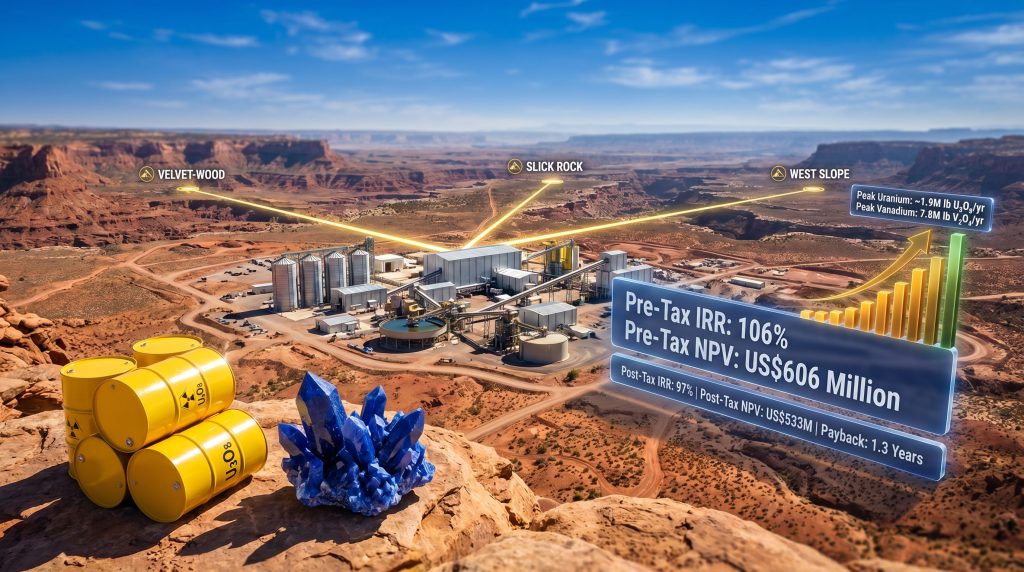
The study covers Anfield Energy's Velvet-Wood project in Utah, the Slick Rock project in Colorado, and six of nine mines within the West Slope complex, also in Colorado. Each of these assets sits within the Uravan Mineral Belt, a geologically distinctive corridor straddling the Utah-Colorado border that has been recognised as a significant uranium-vanadium producing region since the mid-twentieth century. All sites fall within trucking distance of the Shootaring Canyon Mill in southern Utah, which serves as the operational centrepiece of the entire production thesis.
When big ASX news breaks, our subscribers know first
Why the Uravan Mineral Belt Is Commercially Significant
The Uravan Mineral Belt is not simply a geographic label. It represents one of the few regions in the continental United States where uranium and vanadium consistently occur together within the same sandstone-hosted ore bodies, typically in Triassic and Jurassic sedimentary formations. This co-mineralisation is economically meaningful because it allows a single extraction and milling process to generate two separate product streams without fundamentally altering the ore treatment methodology.
Historically, the belt supplied a significant portion of U.S. uranium output during the Cold War era, with operations accelerating through the 1950s and 1960s before market and geopolitical shifts slowed activity. The geological legacy of that period left behind a substantial body of exploration data, historical resource estimates, and partially developed infrastructure that modern developers can leverage rather than reconstruct from zero.
From a commercial standpoint, the belt's importance today lies in three intersecting factors:
- The established co-location of uranium and vanadium mineralisation reduces per-unit processing complexity.
- Existing geological knowledge bases from prior exploration cycles compress the time and cost required to define modern NI 43-101 compliant resources.
- Proximity between multiple historically identified deposits and the Shootaring Canyon Mill means ore haulage distances remain commercially manageable.
Breaking Down the Anfield Uranium Vanadium PEA: Key Economic Metrics
The headline figures from the updated preliminary economic assessment are striking by any measure applicable to junior mining preliminary assessments. A pre-tax internal rate of return of 106% and a pre-tax net present value of US$606 million, calculated at an 8% discount rate, position this as one of the more economically compelling PEA-level results published by a North American uranium developer in recent years.
| Economic Metric | Pre-Tax | Post-Tax |
|---|---|---|
| Internal Rate of Return (IRR) | 106% | 97% |
| Net Present Value (NPV) | US$606 million | US$533 million |
| Discount Rate Applied | 8% | 8% |
| Payback Period | 1.3 years | 1.3 years |
The gap between pre-tax and post-tax NPV, approximately US$73 million, reflects the combined impact of U.S. federal income tax obligations alongside state-level severance taxes and royalties applicable to uranium and vanadium production in Utah and Colorado. Both states apply mineral severance taxes that, while not prohibitive, meaningfully affect net cash flow modelling over a 15-year mine life.
The 8% discount rate applied is broadly consistent with industry convention for PEA-stage studies in politically stable jurisdictions. It is neither aggressively conservative nor optimistic, which makes the resulting NPV figures a reasonable starting point for comparative analysis, though investors should apply their own sensitivity assumptions before drawing conclusions.
Important Disclaimer: A preliminary economic assessment that incorporates inferred mineral resources does not constitute a demonstration of economic viability under NI 43-101. The results presented here should not be interpreted as confirmation that the project will proceed to production or that financing arrangements are imminent. Significant additional study work, including pre-feasibility and feasibility-level engineering, is required before such conclusions can be drawn.
Capital Expenditure Architecture: Where the US$173 Million Goes
Total life-of-mine capital is estimated at approximately US$173 million, with the initial pre-production capital requirement sitting at roughly US$97 million. The single largest capital allocation within the study is the Shootaring Canyon Mill upgrade programme, which collectively accounts for US$80.1 million of the total spend.
The mill upgrade is broken down as follows:
- General facility improvements: US$31.1 million
- Vanadium circuit installation: US$34.6 million
- Tailings facility upgrades: US$14.4 million
- Total mill-side capital: US$80.1 million
Mine-site development expenditures across Velvet-Wood, Slick Rock, and the West Slope mines add approximately US$37.5 million to the total.
Key Insight: The US$34.6 million allocated to a dedicated vanadium processing circuit is arguably the most strategically significant single line item in the entire capital plan. It reflects a deliberate choice to pursue dual-commodity revenue rather than treating vanadium as a by-product afterthought. Vanadium redox flow batteries (VRFBs), which require large volumes of high-purity vanadium pentoxide (V2O5), represent a growing industrial application that could structurally support vanadium demand over the project's planned operating life. That said, vanadium prices are historically volatile and cycle with steel industry demand, which remains the dominant end-use globally.
Production Assumptions and Output Targets
| Production Parameter | Annual Average | Peak Year Estimate |
|---|---|---|
| Uranium (U3O8) | ~1.3 million lb | ~1.9 million lb |
| Vanadium (V2O5) | ~6.4 million lb | ~7.8 million lb |
| Mine Life | 15 years | N/A |
| Pre-Production Period | 12 months | N/A |
| Payback Period | 1.3 years | N/A |
A 12-month pre-production timeline is notably compressed relative to historical precedent for comparable operations in the American Southwest. Most uranium-vanadium projects of this scale have historically required 18 to 36 months of pre-production activity before first ore is processed. The ability to leverage an already-permitted mill is the primary factor enabling this compression, since the regulatory bottleneck in U.S. uranium milling typically occurs during the NRC licensing process rather than the physical construction phase.
Annual uranium output of approximately 1.3 million pounds of U3O8 would represent a meaningful, though not dominant, contribution to U.S. domestic supply. Furthermore, understanding uranium supply-demand volatility is essential context here, given that total U.S. uranium production has historically oscillated significantly, dropping to near-negligible levels during prolonged low-price periods before recovering.
Commodity Price Assumptions: Are US$100/lb Uranium and US$9/lb Vanadium Defensible?
The PEA uses a uranium price assumption of US$100 per pound and a vanadium price of US$9 per pound as its base case. These assumptions warrant scrutiny from two directions.
For uranium, the long-term contract market has generally traded at a premium to spot in periods of supply tightness, with utility buyers increasingly seeking multi-year offtake arrangements to reduce exposure to spot price volatility. The nuances of spot versus term pricing are particularly relevant here, as US$100 per pound sits within the range that many industry analysts have cited as consistent with long-run incentive pricing for new U.S. production, though it represents a significant premium to levels observed through much of the prior decade.
For vanadium, US$9 per pound of V2O5 is a moderate assumption relative to the commodity's historical price range, which has swung dramatically between approximately US$3 per pound and over US$30 per pound within the past fifteen years. The price spike of 2018, driven by Chinese rebar standards changes that mandated higher vanadium content in structural steel, illustrated how quickly supply-demand imbalances can affect vanadium pricing in either direction.
A simplified sensitivity framework illustrates the directional exposure:
- If uranium falls to US$80/lb while vanadium holds at US$9/lb, project economics deteriorate meaningfully, though the vanadium revenue stream provides partial insulation.
- If uranium rises to US$120/lb, the dual-commodity revenue model amplifies upside disproportionately given the relatively fixed cost structure.
- If vanadium compresses toward US$6/lb, the uranium stream becomes the primary economic driver, reintroducing single-commodity risk despite the dual-circuit design.
The Multi-Asset Portfolio: How Each Project Contributes
The portfolio architecture is not incidental. Each project serves a specific functional role within the hub-and-spoke framework:
- Velvet-Wood (Utah): Positioned as the primary uranium feed source. Groundbreaking occurred in 2025, signalling active physical commitment to development rather than a purely study-phase posture.
- Slick Rock (Colorado): A secondary contributor of both uranium and vanadium mineralisation within the Uravan Belt, adding volume diversification and reducing dependence on any single mine's geological continuity.
- West Slope Complex (Colorado): Six of nine mines have been incorporated into the current PEA. The three remaining mines represent embedded optionality that could either extend mine life or increase annual throughput in a subsequent study iteration.
This optionality is an underappreciated element of the study. By deliberately excluding three West Slope mines from the current Anfield uranium vanadium PEA, the company retains the ability to expand the resource base in a future pre-feasibility study without requiring new asset acquisition. The incremental resource addition from those three mines could support a mine life extension beyond the current 15-year model, or alternatively underpin higher annual throughput volumes if mill capacity permits.
The Fully Permitted Mill as a Strategic Moat
Obtaining a new uranium mill licence in the United States is not a simple administrative process. NRC licensing for uranium milling facilities involves multi-year environmental impact assessments, public comment periods, technical review cycles, and ongoing compliance obligations. The timeline from initial licence application to final approval has historically extended beyond five years in several documented cases.
The Shootaring Canyon Mill holds existing NRC source material licence approval, which means the facility bypasses the most time-consuming regulatory hurdle that any new entrant would face. This is a structural competitive advantage that cannot be replicated through capital expenditure alone. A competitor seeking to build equivalent processing capacity from scratch would face not just a capital cost disadvantage but a regulatory timeline disadvantage measured in years rather than months.
In uranium sector merger and acquisition history, permitted mill infrastructure has consistently commanded valuation premiums that exceed the replacement cost of the physical assets, precisely because of this regulatory scarcity value.
Risks and Limitations Investors Must Understand
Despite the compelling headline metrics, the Anfield uranium vanadium PEA carries important caveats that any informed investor should internalise before forming a view on the company's prospects.
PEA-Stage Limitations Under NI 43-101
Under Canadian securities regulations governed by NI 43-101, a preliminary economic assessment that incorporates inferred mineral resources cannot be used to demonstrate economic viability. Inferred resources carry the highest level of geological uncertainty within the resource classification framework, and their inclusion in economic modelling is permitted at PEA stage specifically because the study is understood to be preliminary in nature.
The progression from PEA to a pre-feasibility study (PFS) and ultimately a bankable feasibility study (BFS) requires:
- Additional infill drilling to upgrade inferred resources to the indicated or measured category.
- Detailed metallurgical testwork to confirm mill recoveries at commercial scale.
- Higher-precision engineering studies covering infrastructure, geotechnical parameters, and environmental baseline work.
- Independent audit of capital and operating cost estimates to a greater level of accuracy than is required at PEA stage.
Each of these steps carries execution risk and cost, and the economics of the project may evolve as geological uncertainty is reduced through additional work.
Analytical Note: It is common for projects to show IRR and NPV compression between PEA and PFS stages as inferred resources are reclassified, cost estimates are refined upward, and engineering assumptions are stress-tested against real-world parameters. Investors should treat PEA-level economics as directional indicators rather than precise financial forecasts.
Execution and Market Risk Factors
Beyond geological uncertainty, several external risk factors apply:
- Construction cost inflation: U.S. materials and labour costs have experienced significant escalation in recent years, and the mill upgrade capital estimate of US$80.1 million may face upward pressure as engineering design progresses.
- Vanadium price cyclicality: The vanadium market's historical volatility introduces revenue uncertainty that a uranium-only project would not face.
- Permitting at individual mine sites: While the mill holds existing permits, each mine site requires its own state and federal regulatory approvals before ore extraction can commence.
- Financing conditions: The junior mining sector's access to capital remains sensitive to broader equity market conditions, risk appetite cycles, and commodity price sentiment.
The next major ASX story will hit our subscribers first
Where the Anfield PEA Sits Within the U.S. Uranium Development Landscape
The domestic uranium production environment in the United States has undergone meaningful structural shifts in recent years, driven by bipartisan recognition that excessive dependence on foreign uranium supply chains creates energy security vulnerabilities. The Russian uranium import ban has, consequently, progressively altered the incentive structure facing domestic producers, reinforcing demand for home-grown supply solutions.
Within this context, developers holding advanced-stage assets with existing permitted infrastructure occupy a commercially privileged position relative to earlier-stage competitors. The combination of multiple mine feeds, a permitted centralised mill, dual-commodity output capability, and an active development timeline at Velvet-Wood creates a differentiated competitive profile. Moreover, broader uranium market dynamics continue to favour projects with this level of structural readiness over earlier-stage peers still navigating exploration phases.
Vanadium's concurrent designation as part of the wider critical minerals energy security agenda, particularly within grid-scale vanadium redox flow battery systems being deployed by utilities seeking long-duration storage solutions, adds a demand dimension that extends beyond traditional uranium market considerations. Whether vanadium demand from this segment reaches sufficient commercial scale within the project's operating window remains a genuinely open question, but the optionality is structurally embedded in the circuit design.
Key Takeaways: What the Anfield Uranium Vanadium PEA Signals
- A 106% pre-tax IRR and US$606 million pre-tax NPV at an 8% discount rate place this among the more economically robust uranium-vanadium PEAs filed by a junior North American developer in the current cycle.
- The hub-and-spoke model centred on a fully permitted, existing-licence mill at Shootaring Canyon provides a regulatory and capital efficiency advantage that would be difficult and time-consuming for any competitor to replicate.
- Dual-commodity exposure to both uranium and vanadium creates a natural revenue hedge within a single integrated production system, reducing dependence on any single commodity price outcome.
- A 1.3-year payback period, if validated through subsequent feasibility work, would represent an exceptionally fast capital recovery timeline for a mining project operating at this scale.
- The three West Slope mines excluded from the current study represent embedded resource optionality that could extend mine life or production volumes in future study iterations.
- Advancement to pre-feasibility study stage remains the critical near-term milestone. Converting PEA-level economics into bankable project metrics requires a materially greater investment in drilling, metallurgical testing, and engineering precision.
For investors tracking the North American uranium development sector, the Anfield uranium vanadium PEA represents a study worth understanding in structural detail rather than reducing to its headline IRR figure. The architecture of the asset portfolio, the regulatory status of the processing infrastructure, and the dual-commodity revenue model collectively define a project thesis that is more nuanced than a single return metric can capture.
Want to Catch the Next Major Uranium or Vanadium Discovery Before the Market Does?
Discovery Alert's proprietary Discovery IQ model delivers real-time alerts on significant ASX mineral discoveries — including critical commodities like uranium and vanadium — instantly translating complex data into actionable insights for investors at every experience level. Explore Discovery Alert's discoveries page to understand how major mineral discoveries have historically generated substantial returns, and begin your 14-day free trial today to position yourself ahead of the broader market.