June 17, 2026
Europe's Nuclear Supply Chain Is Being Rebuilt From the Ground Up
The global uranium market is undergoing a structural reconfiguration that few anticipated a decade ago. Across Europe, governments that once treated nuclear power as a legacy liability are now scrambling to secure domestic fuel supplies, extend reactor lifetimes, and fast-track new construction. Against this backdrop, Sweden uranium mining reclassification represents one of the most consequential single-country policy pivots in the European nuclear fuel cycle in a generation, with decisions made in individual national parliaments carrying consequences that ripple far beyond their borders.
Understanding why requires looking past the headline and into the mechanical reality of what actually changed, and what it means for the continent's uranium supply architecture.
When big ASX news breaks, our subscribers know first
From Nuclear Pariah to Strategic Asset: Sweden's Uranium Policy Reset
Sweden's journey from uranium prohibition to active development framework did not happen in a single step. It unfolded across a deliberate, multi-stage legislative sequence that began with public debate, moved through parliamentary votes, and culminated in a suite of statutory amendments taking effect on July 15, 2026.
The Three-Stage Policy Timeline
| Policy Milestone | Year | Legislative Instrument | Practical Effect |
|---|---|---|---|
| Uranium exploration and mining banned | 2018 | Environmental Code amendment | All uranium-related permits prohibited |
| Parliament votes to repeal the ban | November 2025 | Minerals Act reform | Uranium reclassified as a concession mineral |
| Uranium mines removed from nuclear facility definition | June 11, 2026 | Nuclear Activities Act (1984:3) amendment | Standard mining permitting framework applies |
| Full legislative package takes effect | July 15, 2026 | Combined statutory instruments | Operational permitting pathways open |
The critical insight here is that the 2025 ban repeal, while necessary, was not sufficient on its own. Even with the prohibition lifted, uranium mines retained their classification as nuclear facilities under the Nuclear Activities Act (1984:3). That classification carried with it a requirement for explicit municipal consent — a condition that introduced a structurally unpredictable veto point into any development process regardless of a project's technical or environmental merits.
The 2026 reclassification is the second and more operationally decisive layer of Sweden's uranium policy reset. The 2025 vote restored legal permission to mine; the 2026 amendment removed the administrative barriers that would have rendered that permission largely theoretical.
The June 11 Riksdag vote addressed this directly by amending the Nuclear Activities Act to remove uranium mines from the definition of a nuclear facility. Simultaneously, the Act on Financial Measures for the Management of Residual Products from Nuclear Activities (2006:647) was amended so that extraction waste from uranium mining and processing is no longer classified as nuclear waste, eliminating associated financial provisioning obligations that would have added significant cost and complexity to project development.
What the Reclassification Actually Changes in Swedish Mining Law
Three Legal Distinctions That Matter
Unpacking the Sweden uranium mining reclassification requires distinguishing between three concepts that are frequently conflated:
- Repeal of the ban: The 2025 parliamentary vote removed the Environmental Code prohibition on uranium-related mining permits, restoring uranium to the list of legally permissible extraction targets.
- Concession mineral classification: Uranium's new status under the Minerals Act places it within the same exploration and extraction licensing regime as other strategically significant minerals, including iron ore and base metals.
- Declassification as a nuclear facility: The June 2026 amendment to the Nuclear Activities Act removes uranium mines from the nuclear facility definition, eliminating the municipal consent requirement and aligning uranium with the standard minerals permitting framework.
What the New Permitting Pathway Looks Like in Practice
For investors and project developers, the practical significance becomes clearer when the permitting steps are laid out sequentially:
- Exploration licence application submitted under the Minerals Act concession mineral framework, assessed on the same basis as applications for base metals or industrial minerals.
- Environmental impact assessment conducted under the Environmental Code, with radiation-specific components evaluated by the Swedish Radiation Safety Authority (SSM).
- Exploitation concession application filed with the Mining Inspectorate of Sweden (Bergsstaten), with no separate nuclear facility permit required.
- Environmental permit obtained through the Land and Environment Court, with municipal consent no longer a prerequisite, though community consultation remains standard practice.
- Operational licence issued under the Minerals Act, with ongoing compliance under radiation protection and environmental legislation.
Important clarification: Reclassification does not mean deregulation. Radiation protection obligations, environmental impact assessments, and water management requirements remain fully intact. The change eliminates regulatory duplication, not regulatory oversight. The Swedish Radiation Safety Authority retains oversight of radiation-related aspects of uranium extraction throughout the process.
The removal of the municipal consent requirement is particularly significant from a commercial perspective. Under the previous nuclear facility classification, a single municipal council could effectively veto a nationally significant resource project, regardless of its compliance with all other regulatory requirements. That structural inconsistency has now been resolved.
Sweden's Uranium Resource Base: Scale, Location, and Polymetallic Complexity
The Jämtland Province as Europe's Emerging Uranium Heartland
Both of Sweden's most advanced uranium projects are situated in Jämtland, a province in central Sweden characterised by alum shale formations with a distinctly polymetallic mineralogical profile. This geological setting is not incidental to the investment case. As detailed in Sweden's uranium mining conditions, alum shales in this region host uranium alongside potash, vanadium, molybdenum, nickel, copper, and zinc, meaning any future production operation would have multiple revenue streams rather than exposure to a single commodity price cycle.
Sweden's Key Uranium Deposits
| Deposit | Operator | Location | Uranium Resource | Key Co-Products |
|---|---|---|---|---|
| Häggån | Aura Energy | Berg municipality, Jämtland | Potash, vanadium | |
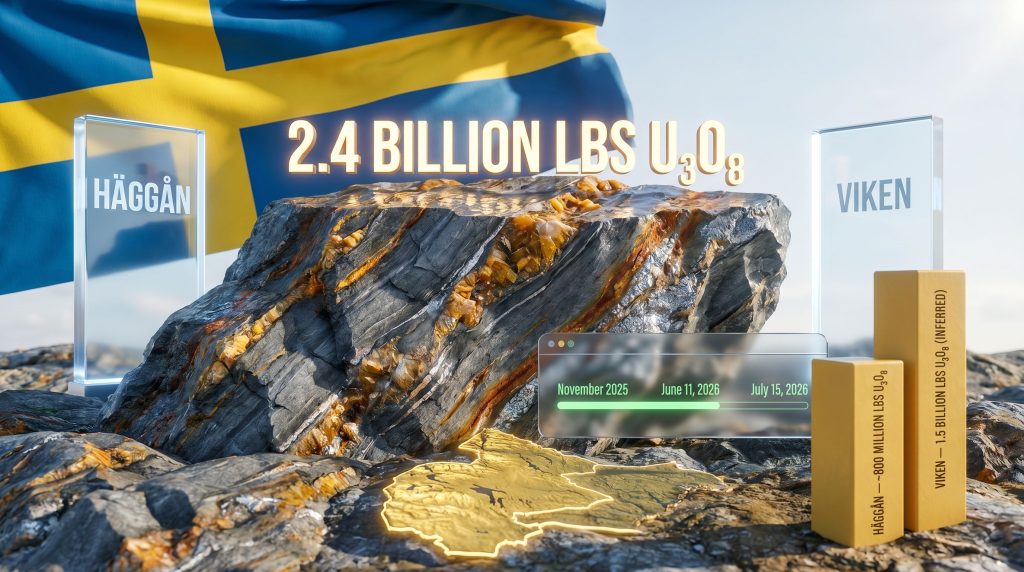
| Viken | District Metals Corp | Jämtland | 1.5 billion lbs U₃O₈ (inferred) + 176 million lbs U₃O₈ (indicated) | Vanadium, potash, molybdenum, nickel, copper, zinc |
The combined scale across just these two deposits exceeds 2.4 billion pounds of U₃O₈ in indicated and inferred resources. To contextualise that figure: global uranium consumption for nuclear power generation runs at roughly 65,000 to 68,000 tonnes of uranium per year according to World Nuclear Association data. Sweden's identified resources, if developed, would represent a material supply contribution at a European scale.
Earlier in 2026, the Geological Survey of Sweden formally proposed designating the Häggån deposit as a site of national interest for valuable materials — a designation that signals resource sovereignty has become an explicit consideration in Swedish minerals policy. It is worth noting that a proposal for national interest designation is not the same as confirmed government support or accelerated permitting, and project timelines remain subject to the standard regulatory process.
Why the Polymetallic Profile Alters the Investment Calculus
Single-commodity uranium projects are highly sensitive to uranium market volatility, which has historically created significant challenges for project developers. The alum shale deposits in Jämtland, however, introduce a different risk and return architecture:
- Vanadium and molybdenum are independently listed as critical raw materials by the European Union, adding strategic commodity value entirely separate from nuclear fuel demand.
- Potash is a strategic agricultural input with its own supply concentration dynamics, particularly relevant given recent disruptions to Belarusian and Russian potash export availability.
- Revenue diversification across uranium, potash, and critical minerals provides a structural buffer against uranium price softness, potentially supporting project economics through commodity cycles in a way that pure-play uranium development cannot.
This polymetallic dimension is frequently underappreciated in coverage of Sweden's uranium sector. The investment case is not simply a uranium price call; it is a critical minerals portfolio play anchored by uranium but supported by materials with independent strategic demand profiles.
The Drivers Behind Sweden's Legislative Reversal
Energy Security and Import Dependency
Sweden currently relies entirely on imported uranium to fuel its existing reactor fleet. Its main suppliers have historically included Kazakhstan, Russia, Canada, and Namibia — a mix that carries varying degrees of geopolitical and logistical concentration risk. The disruptions to global commodity supply chains following the 2022 conflict in Ukraine accelerated an existing debate about strategic vulnerability in nuclear fuel procurement across multiple EU member states.
Domestic uranium production would directly reduce Sweden's exposure to supply disruptions from geopolitically sensitive jurisdictions. Furthermore, Europe's uranium supply security has become an increasingly pressing concern for energy planners, and for a country simultaneously pursuing nuclear capacity expansion and deep industrial decarbonisation, the strategic logic of developing domestic uranium resources is straightforward.
The EU Critical Raw Materials Act as Contextual Framework
The European Union's Critical Raw Materials Act, which establishes benchmarks for domestic production, processing, and recycling of strategically important minerals, creates a supranational policy environment broadly aligned with Sweden's domestic legislative direction. In addition, critical minerals demand across Europe continues to intensify as the energy transition accelerates, making the timing of Sweden's legislative shift particularly relevant.
It is important to be precise here: the Critical Raw Materials Act establishes a framework and targets for the broader EU minerals sector. It does not constitute specific project-level support or guarantee accelerated permitting for individual Swedish deposits. Policy tailwinds at the EU level are relevant context, but project-specific outcomes depend entirely on national and local regulatory processes.
Nuclear Power's Role in Sweden's Decarbonisation Strategy
Sweden has set ambitious climate targets and operates one of the most carbon-efficient electricity grids in Europe, largely due to its existing combination of hydropower and nuclear generation. The political consensus has shifted decisively toward nuclear expansion as a mechanism for maintaining grid stability while phasing out fossil fuel dependency.
This alignment between uranium mining policy and climate objectives provides domestic political legitimacy for the reclassification that would not have existed under the anti-nuclear consensus of the 2010s. Consequently, legislative proposals to lift Sweden's uranium mining ban attracted considerably broader cross-party support than many observers initially anticipated.
Coastal Nuclear Siting: The Parallel Enabler
What the Riksdag Also Approved on June 11
The same parliamentary session that advanced the Sweden uranium mining reclassification also approved amendments to Sweden's Environmental Code removing blanket prohibitions on nuclear installations in specified coastal and archipelago zones. The areas where restrictions have been lifted include:
- The Bohuslän coast from the Norwegian border to Brofjorden
- The provinces of Småland and Östergötland from Simpevarp to Arkö Sound
- Storfjärden in the Ångermanälven estuary through to Skagsudde
- The island of Öland
- Additional Bohuslän coastal zones, the island of Gotland, Östergarn, Storsundet, and Fårö
Nuclear power generation is structurally dependent on access to large volumes of cooling water, making coastal and major lake sites technically preferred over inland locations in most configurations. By expanding the inventory of eligible coastal sites, Sweden substantially increases the probability of identifying locations that satisfy both technical performance criteria and environmental compatibility requirements.
The simultaneous advancement of uranium mining policy and nuclear siting policy in a single parliamentary session is not coincidental. It reflects a coordinated legislative strategy addressing both the fuel supply dimension and the infrastructure dimension of Sweden's nuclear expansion simultaneously.
These amendments remove blanket geographic prohibitions but do not override site-specific environmental protections. Any proposed nuclear installation in a newly eligible zone would still require comprehensive environmental assessment and permitting on its own merits.
The next major ASX story will hit our subscribers first
European Supply Chain Implications: Sweden's Broader Strategic Role
Comparative Positioning Within the European Uranium Landscape
| Country | Uranium Mining Status | Key Deposits | Policy Direction |
|---|---|---|---|
| Sweden | Reclassified; permitting open from July 2026 | Häggån, Viken | Active expansion |
| Czech Republic | Historical production; limited current activity | Rožná (care and maintenance) | Policy review underway |
| Finland | No active production | Exploration stage | Cautious assessment |
| France | Historically significant producer; mines closed | Largely depleted reserves | Import-dependent |
| Germany | Post-reunification legacy sites only | No commercial reserves | Nuclear phase-out policy |
France was once one of the world's significant uranium producers, with domestic mining output supporting much of its nuclear programme through the 1970s and 1980s before reserves were depleted and economic conditions shifted production offshore. Today, the EU as a whole sources the majority of its uranium from Kazakhstan, Russia, Niger, and Canada — all carrying supply chain risk profiles that have become increasingly uncomfortable for European energy security planners.
A developed Swedish uranium sector would represent the first meaningful Western European domestic uranium production capacity to emerge in decades. However, realising that potential requires uranium investment strategies that account for both the considerable resource scale and the multi-year permitting and development timelines still ahead. Given the scale of resources identified in Jämtland and the legislative architecture now in place, Sweden has positioned itself as the most credible near-to-medium term candidate for that role.
The Vanadium and Potash Dimension
The alum shale deposits of Jämtland carry strategic significance well beyond the nuclear fuel cycle. Vanadium extracted as a co-product is a critical input for vanadium redox flow batteries, a technology gaining traction as a grid-scale energy storage solution particularly suited to renewable energy integration applications.
Furthermore, Europe's critical raw materials supply challenges extend well beyond uranium, and potash's strategic role in agricultural fertiliser production gives it a food security dimension entirely distinct from energy policy. Supply concentration in potash has been a recurring concern for European agricultural planners, and domestic European production of this input would carry value independent of any uranium price cycle.
Developing Sweden's alum shale resources consequently advances objectives across energy security, critical minerals independence, and agricultural supply chain resilience simultaneously. The policy case for development is correspondingly multidimensional.
Frequently Asked Questions: Sweden Uranium Mining Reclassification
Does reclassification mean uranium mining will begin immediately?
Reclassification removes the primary legislative barriers to development, but individual projects must still complete environmental permitting, exploitation concession applications, and community consultation processes. Large-scale mining projects typically require several years from permitting completion to first production. The legislative changes create the pathway; they do not compress geological and engineering timelines.
Will uranium mines still face radiation safety requirements?
Yes, without qualification. The reclassification changes the administrative category of uranium mines, removing them from the nuclear facility framework, but does not alter obligations under radiation protection legislation. The Swedish Radiation Safety Authority retains full oversight of radiation-related aspects of uranium extraction and processing operations.
What is the practical difference between the 2025 and 2026 legislative steps?
The 2025 vote removed the prohibition on uranium mining, restoring it as a legally permissible activity. The 2026 amendment went further by removing uranium mines from the nuclear facility definition, eliminating the municipal consent requirement and placing uranium within the standard minerals permitting framework. Both steps were necessary to create a commercially viable development pathway. The 2025 action was a necessary precondition; the 2026 action was the operational enabler.
How significant is Sweden's uranium resource base in global terms?
The Viken deposit alone, with inferred resources of 1.5 billion pounds of U₃O₈ plus 176 million pounds of indicated resources, ranks among the larger undeveloped uranium deposits globally. Combined with Häggån's approximately 800 million pounds, Sweden's identified resources carry genuine European strategic significance. Resource estimates at this stage carry the inherent uncertainties typical of pre-feasibility projects, and investors should treat inferred resource figures as indicative rather than definitive.
What is the significance of the coastal siting amendments for new reactor development?
The amendments remove blanket prohibitions in specified coastal zones, substantially expanding the geographic inventory of potential reactor sites. They do not override site-specific environmental assessments, which remain mandatory for any proposed nuclear installation. The practical significance is that technically suitable coastal locations are no longer excluded from consideration on categorical grounds. According to Sweden's nuclear energy profile, the country's existing nuclear infrastructure provides a strong foundation upon which new capacity can be developed.
Key Takeaways
- Two steps, not one: The full impact of Sweden's uranium policy reset required both the 2025 ban repeal and the 2026 nuclear facility declassification. Neither was sufficient in isolation to create a workable development environment.
- Scale is genuinely significant: Sweden's identified uranium resources across Häggån and Viken exceed 2.4 billion pounds U₃O₈, with polymetallic co-products including vanadium, potash, molybdenum, nickel, copper, and zinc adding independent strategic value.
- Permitting is streamlined, not eliminated: Standard minerals licensing, environmental assessment, and radiation safety oversight all remain in place. The reclassification removes administrative duplication, not regulatory rigour.
- Coastal siting is the parallel infrastructure enabler: New reactor capacity requires suitable sites with cooling water access. The simultaneous removal of coastal prohibitions signals that Sweden's nuclear expansion is being enabled at both the fuel supply and infrastructure levels within a single coordinated legislative programme.
- European supply chain logic is the overarching driver: Domestic uranium production directly addresses EU strategic autonomy objectives in the nuclear fuel cycle, with the additional benefit of producing critical minerals with independent demand profiles.
- Effective date: July 15, 2026 for all amendments to the Nuclear Activities Act, the financial measures legislation, and the Environmental Code.
This article contains forward-looking statements and assessments based on publicly available information as of June 2026. Resource estimates cited reflect reported figures and carry the uncertainties inherent in early-stage geological assessments. Nothing in this article constitutes financial or investment advice. Readers should conduct independent research and seek professional advice before making investment decisions.
Want to Track ASX Opportunities in the Uranium and Critical Minerals Sector?
Discovery Alert's proprietary Discovery IQ model delivers real-time alerts the moment significant mineral discoveries — including uranium and critical minerals — are announced on the ASX, transforming complex data into actionable insights for investors at every level. Explore how historic discoveries have generated exceptional returns on Discovery Alert's dedicated discoveries page, and begin your 14-day free trial today to position yourself ahead of the market.