June 12, 2026
The Grid Architecture Challenge Shaping India's Energy Future
Few engineering challenges in the modern era match the complexity of powering a nation of 1.4 billion people through a once-in-a-generation technology transition. Grid architects worldwide are confronting a fundamental tension: renewable energy is becoming the cheapest source of new generation, yet its inherent variability creates systemic reliability risks at high penetration levels. Resolving this tension requires layering complementary technologies across the same grid infrastructure. India is now executing this strategy at a scale and pace that has few global precedents.
The country's approach to this challenge centres on a dual commitment: expanding firm, continuous baseload power through nuclear capacity while simultaneously deploying large-scale India nuclear power plants and battery energy storage systems to absorb and dispatch the variable output of solar and wind farms. Understanding why India is pursuing both simultaneously, and the structural barriers slowing each, reveals a great deal about the true complexity of the energy transition in mining and broader electrification.
When big ASX news breaks, our subscribers know first
Why Nuclear Power and Battery Storage Are Being Scaled Together
The Complementary Logic of Two Distinct Technologies
A common misconception in energy policy discourse is that storage and firm generation are substitutes. In practice, they solve entirely different problems. Nuclear power plants deliver stable, predictable electricity around the clock regardless of weather conditions. Battery energy storage systems do not generate power at all. They absorb surplus electricity during periods of excess generation and release it during periods of deficit, smoothing the peaks and troughs created by solar and wind variability.
India's grid planners have recognised that high-penetration renewable integration without firm backup creates dangerous reliability gaps, particularly during multi-day periods of low solar irradiance or wind lulls. Simultaneously, a grid anchored only by nuclear and thermal generation cannot efficiently absorb large renewable inputs without wasting surplus clean energy. The combination of nuclear baseload and battery storage flexibility is not a political compromise; it is a technical necessity dictated by the physics of modern electricity grids.
The AI and Data Centre Demand Surge
The urgency behind India's dual-track energy strategy has been dramatically amplified by the explosive growth in digital infrastructure. Power demand from data centres and artificial intelligence computing facilities is projected to surge from approximately 1.8 GW currently to 18 GW by 2032, according to figures presented at the 11th Governing Council meeting of Niti Aayog in June 2026. This represents a tenfold increase within a single decade.
This demand profile is uniquely demanding from a grid engineering perspective. Data centres require power that is not only abundant but continuous, high-quality, and immune to frequency fluctuations. A single voltage sag or millisecond interruption can corrupt large-scale computation workloads. This means that neither intermittent renewables alone nor slow-ramping nuclear plants alone can satisfy hyperscale computing requirements. The optimal architecture pairs nuclear baseload for continuous supply with battery storage for rapid-response power quality management. India's strategic planners have arrived at precisely this configuration.
The convergence of AI infrastructure requirements, industrial electrification, and climate commitments has created a situation where pursuing either nuclear or storage in isolation would be insufficient. Both technologies must scale in parallel to meet the reliability standards of 21st-century power demand.
India's Nuclear Power Capacity: Current Baseline and Expansion Trajectory
Where India Stands in 2026
India currently operates 22 nuclear reactors with a combined installed capacity of approximately 8,780 MW (8.78 GW), spread across facilities at Tarapur, Rawatbhata in Rajasthan, Kalpakkam, Narora, Kaiga, Kakrapar, and Kudankulam. While this represents a meaningful contribution to the national grid, nuclear power's share of India's total electricity mix has historically remained modest relative to coal and increasingly to renewables.
What makes nuclear strategically significant beyond its megawatt contribution is its capacity factor. Nuclear plants in India routinely achieve capacity factors above 80%, meaning they deliver power for the vast majority of hours in a year. Furthermore, this reliability characteristic is irreplaceable in a grid that must serve both baseline industrial demand and the growing requirements of digital infrastructure. As highlighted by India's nuclear energy storage potential, the country is increasingly recognised as a major player in the global market.
The Fast Breeder Milestone at Kalpakkam
One of the most consequential developments in India's nuclear programme in recent years was the achievement of first criticality at the Prototype Fast Breeder Reactor (PFBR) at Kalpakkam on 6 April 2026. This milestone is significant well beyond its immediate power generation implications.
Fast breeder reactors occupy a unique position in nuclear fuel cycle economics. Unlike conventional pressurised water reactors that consume enriched uranium, fast breeders can utilise plutonium from spent fuel and, crucially, can be adapted to the thorium fuel cycle. India possesses the world's largest known thorium reserves, estimated at approximately 360,000 tonnes according to the International Atomic Energy Agency. The PFBR represents the first practical step toward harnessing that resource base, potentially giving India a degree of nuclear fuel self-sufficiency that uranium-dependent programmes cannot achieve.
India becomes one of a very small group of nations, alongside Russia and China, operating fast breeder technology at demonstration scale. The technical knowledge accumulated through PFBR operation is intended to inform a fleet of commercial-scale fast breeders that could underpin the longer-term phases of the 100 GW nuclear roadmap. In addition, broader nuclear energy partnerships across the region are accelerating the transfer of fast reactor expertise between allied nations.
The Capacity Targets: Near-Term and Long-Range
The expansion ambitions stacked across India's nuclear institutions are substantial. The following table summarises the key milestones:
| Milestone | Target Capacity | Target Year |
|---|---|---|
| Current installed base | ~8.78 GW | 2026 |
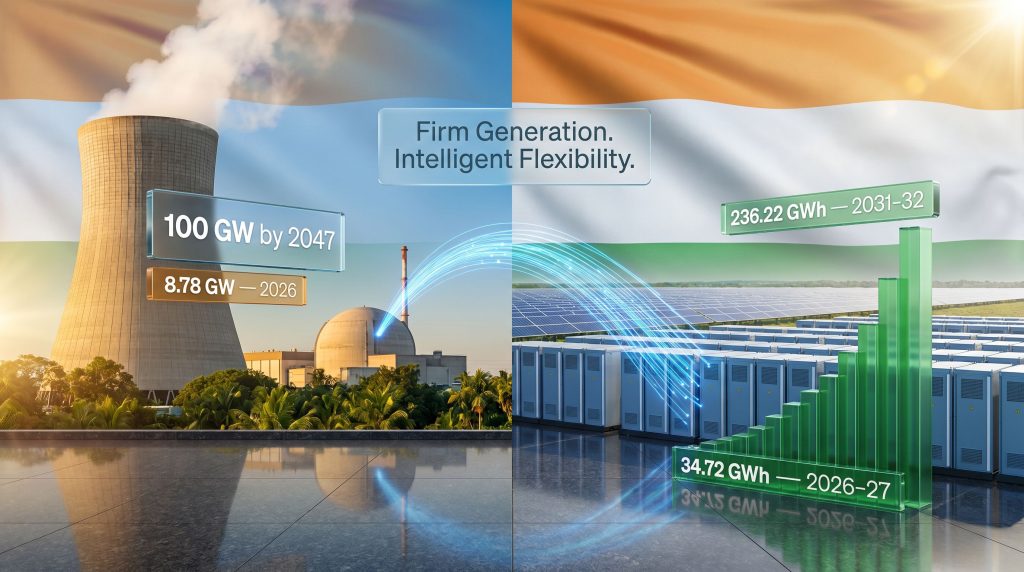
| Near-term national projection | 22.38 GW | 2031-32 |
| NPCIL standalone target | 22 GW | 2032 |
| NTPC standalone target | 30 GW | 2047 |
| National Nuclear Energy Mission | 100 GW | 2047 |
Achieving the 2031-32 target alone requires adding roughly 13.6 GW of nuclear capacity in approximately six years, starting from a base that took decades to build. This is an extraordinarily compressed timeline by historical standards of nuclear construction.
The Institutional Architecture Driving Nuclear Expansion
Three Organisations, One Strategic Direction
India's nuclear expansion is being executed through a three-entity structure, each with a distinct role:
- NPCIL (Nuclear Power Corporation of India Limited) operates all existing plants and leads near-term capacity additions, targeting 22 GW by 2032.
- NTPC has formally entered the nuclear sector, identifying 32 sites across India for potential plant development and setting a standalone target of 30 GW by 2047.
- ASHVINI, the joint venture between NTPC and NPCIL, will deploy four 700 MW reactors in Rajasthan using a fleet-mode construction approach designed to standardise the build process and compress timelines through parallel execution.
Fleet-mode construction is a relatively underappreciated concept in public discussion of nuclear timelines. Rather than treating each reactor as an individual project with bespoke engineering, fleet-mode deployment standardises design, supply chain, workforce training, and regulatory review across multiple units simultaneously. Countries that have successfully used this approach, most notably South Korea in the 1980s and 1990s, achieved construction timelines significantly shorter than the global average.
Technology Partnerships and Reactor Diversity
NTPC has signed agreements with three international technology partners, reflecting a deliberate strategy of diversification across reactor designs, supplier countries, and fuel cycle characteristics:
| Technology Partner | Country | Reactor Technology |
|---|---|---|
| EDF | France | Pressurised Water Reactors (PWR) |
| Holtec International | USA | Small Modular Reactors (SMR) |
| Rosatom | Russia | Water-Cooled Power Reactors (VVER) |
This multi-partner approach carries both advantages and complexities. On the positive side, it prevents dependence on any single supplier, provides access to different reactor designs suited to different site conditions, and creates a degree of geopolitical insurance. The complexity lies in managing multiple regulatory frameworks, fuel supply chains, and technical standards simultaneously.
The Bharat Small Modular Reactor: An Underappreciated Wildcard
The Bharat Small Modular Reactor (BSMR), a 250 MW design under development at the Bhabha Atomic Research Centre (BARC), receives considerably less attention than the headline nuclear capacity targets but may prove strategically important in a different way.
SMRs are specifically suited to applications where large grid-connected reactors are impractical. Energy-intensive industries such as aluminium smelting, cement production, chemical manufacturing, and green hydrogen production require reliable, clean power at scales that do not justify a 1,000+ MW reactor. The BSMR targets precisely this gap. If successfully developed and commercialised, it could also position India as a future SMR exporter to emerging economies, representing a long-term geopolitical and commercial asset.
The SHANTI Act and Legislative Foundation
The SHANTI Act provides the legal framework enabling India's central government to engage directly with state governments on nuclear site identification and land allocation processes. Prior to this legislation, the jurisdictional boundary between central nuclear authority and state land administration created procedural ambiguities that slowed site finalisation. The Act does not override state sovereignty but creates a formal mechanism for coordinated action, which has been used to request accelerated processing of pending approvals.
The State-Level Clearance Bottleneck
32 Sites Identified, Most Still Pending
The most immediate constraint on India's nuclear expansion timeline is not technology, finance, or engineering capacity. It is state-level administrative clearances for land allocation. NTPC has identified 32 potential nuclear plant sites across India, but approvals remain outstanding at the majority of these locations.
The 11th Governing Council meeting of Niti Aayog, attended by all Chief Ministers and senior officials in June 2026, formally raised the issue of approximately 15 states and Union Territories requiring accelerated action on both nuclear plant approvals and battery storage project completions.
The current status across key states is summarised below:
| State | Governing Alliance | Current Status |
|---|---|---|
| Andhra Pradesh | NDA | Clearances pending |
| Madhya Pradesh | NDA | Clearances pending |
| Uttar Pradesh | NDA | Clearances pending |
| Bihar | NDA | Feasibility study approved; water allocation for 2×700 MW underway |
| Odisha | NDA | Clearances pending |
| Chhattisgarh | NDA | Clearances pending |
| Karnataka | INDIA bloc | Land availability discussions ongoing |
| Tamil Nadu | INDIA bloc | Land availability discussions ongoing |
| Jharkhand | INDIA bloc | Feasibility study initiated for Deoghar site (2×700 MW) |
| Dadra and Nagar Haveli | Union Territory | Clearances pending |
A striking feature of the clearance landscape is that delays span both NDA-governed and opposition-governed states in roughly equal proportion. This strongly suggests the bottleneck is primarily administrative and procedural rather than politically motivated resistance to nuclear expansion.
Why Construction Timelines Make Early Approvals Critical
Nuclear construction lead times in India have historically ranged from 7 to 12 years for large-scale reactors, with the PFBR itself taking considerably longer from initial construction to criticality. Every month of delay in securing site approvals translates directly into compressed construction windows against the 2031-32 capacity target.
Fleet-mode approaches can partially offset the impact of sequencing delays by running design, procurement, and civil works in parallel across multiple units. However, even parallel construction cannot begin until the underlying site clearances are in place. The administrative bottleneck at the state level is therefore not a peripheral concern but the critical path variable in India's near-term nuclear expansion plan.
India's Battery Energy Storage System Strategy
What BESS Actually Does in an Indian Grid Context
It is worth pausing to clarify what India nuclear power plants and battery energy storage systems do and do not do in combination, because the technology pairing is frequently mischaracterised in public energy discussions. BESS installations do not generate electricity. They are sophisticated charge-and-discharge systems that store electrical energy during periods of surplus generation and release it during periods of high demand or low renewable output.
In India's grid context, the primary applications for utility-scale BESS include:
- Peak demand shifting to reduce evening load spikes when solar generation drops
- Frequency regulation services to maintain grid stability within the ±0.2 Hz tolerance required by Indian grid standards
- Ancillary services including spinning reserve provision
- Renewable energy time-shifting to extend the effective delivery window of solar generation beyond daylight hours
- Voltage support for grid segments with high distributed renewable penetration
The Demand Trajectory: How Much Storage Does India Need?
The projected BESS requirements across official planning horizons are substantial. Furthermore, the scale of battery raw materials procurement required to meet these targets is increasingly influencing global supply chains:
| Planning Year | Projected BESS Requirement |
|---|---|
| 2026-27 | 34.72 GWh |
| 2030 (RMI estimate) | 42 GW / 208 GWh minimum |
| 2031-32 | 236.22 GWh |
Sources: Ministry of New and Renewable Energy (MNRE); Rocky Mountain Institute
The Deployment Gap: The Central Execution Challenge
India's most pressing BESS challenge is not ambition or policy design. It is the cavernous gap between auctioned capacity and operational deployment.
Between 2022 and May 2025, India auctioned approximately 12.8 GWh of BESS capacity under various central and state programmes. Of that auctioned capacity, only approximately 219 MWh is currently operational, representing less than 2% of auctioned volume. A separate programme has added 2.1 GW of BESS and 7.2 GW of Pumped Storage Plants to support renewable energy integration, but the headline 13.85 GW BESS programme from 2023 remains substantially incomplete.
As noted by the IEEFA's analysis of India's battery storage boom, getting execution right is the defining challenge of this phase. The gap between what has been auctioned and what has been commissioned is the defining execution challenge of India's battery storage strategy. Policy frameworks have been well designed; the bottleneck lies in project delivery velocity.
The next major ASX story will hit our subscribers first
Policy Mechanisms Underpinning the BESS Rollout
Viability Gap Funding: Making the Economics Work
The central government committed to covering 40% of the capital cost of BESS projects under the 2023 programme through Viability Gap Funding. This mechanism directly addresses the core financial barrier: at current battery cell prices and Indian electricity tariff structures, standalone BESS projects without subsidy support struggle to generate returns that satisfy commercial lenders. VGF improves project bankability by reducing the equity and debt exposure of developers.
Energy Storage Obligations: Creating Mandated Demand
India introduced Energy Storage Obligations requiring distribution companies and open-access consumers to procure a minimum share of power from storage-backed sources. The obligation trajectory rises from 1% in 2023-24 to 4% by 2029-30, creating a legally mandated and growing demand signal for BESS developers independent of spot market conditions. This mechanism is analogous in design to the Renewable Purchase Obligations that drove early-stage solar and wind procurement in India.
Production Linked Incentive for Battery Manufacturing
A dedicated PLI scheme for Advanced Chemistry Cell (ACC) battery manufacturing targets the development of domestic cell production capacity. This is strategically significant because India's current BESS deployment is almost entirely dependent on imported battery cells, with Chinese manufacturers dominating the global supply chain for lithium-ion chemistries.
Domestic manufacturing capability would reduce import dependency, lower long-run costs through localised supply chains, and improve critical minerals and energy security by insulating the storage rollout from geopolitical supply disruptions. The PLI battery manufacturing programme represents a credible long-term response; however, domestic cell manufacturing at meaningful scale is likely a decade away from being a significant factor in India's BESS supply chain. Technologies such as direct lithium extraction may also play a role in securing upstream inputs for next-generation battery chemistries.
Transmission Charge Waivers for Co-located Projects
BESS installations co-located with renewable generation projects benefit from transmission charge waivers for certain configurations under current regulatory frameworks. This incentive improves the economics of hybrid solar-plus-storage and wind-plus-storage projects, which represent the most commercially viable entry point for private BESS investment in India's current market structure.
How Nuclear and BESS Form a Unified Grid Architecture
The Baseload-Flexibility Matrix
| Attribute | Nuclear Power | Battery Energy Storage |
|---|---|---|
| Primary function | Continuous baseload generation | Grid balancing and peak shifting |
| Output profile | Stable and continuously dispatchable | Variable charge and discharge cycles |
| Response speed | Hours to ramp up or down | Milliseconds to seconds |
| Renewable integration role | Firm backup enabling high RE penetration | Smooths variability in real time |
| Capital intensity | Very high | Moderate to high |
| Fuel dependency | Low once constructed | None |
| Ideal grid pairing | With high-variable renewable systems | With solar, wind, and nuclear |
India's non-fossil power share has increased from 40% to 53% over the past five years, driven primarily by solar and wind capacity additions. Sustaining this transition above the 50% threshold, and ultimately reaching the renewable-dominated grid implied by the 100 GW nuclear plus large-scale storage vision for 2047, requires that India nuclear power plants and battery energy storage systems scale in tandem. Neither alone can carry the weight of India's full energy ambitions.
Key Risks and Execution Challenges
Nuclear Construction Complexity and Historical Timelines
India's own nuclear construction history provides important calibration for assessing timeline risk. The Kudankulam plant experienced extended commissioning delays, and the PFBR itself took considerably longer from construction start to first criticality than originally projected. Internationally, large nuclear projects in Western countries including the UK's Hinkley Point C and Finland's Olkiluoto 3 have experienced multi-year delays and significant cost overruns.
Achieving 22.38 GW by 2031-32 from a 2026 baseline of 8.78 GW would require an unprecedented pace of concurrent construction in the Indian nuclear context. Fleet-mode approaches and standardised reactor designs can compress timelines; however, historical precedent suggests treating aggressive near-term targets with appropriate analytical caution.
Battery Supply Chain and Technology Dependency
BESS deployment at the scale India requires is dependent on the continued availability of lithium-ion battery cells at declining prices. Current global cell manufacturing is heavily concentrated in China, creating both supply chain concentration risk and geopolitical exposure. Alternative chemistries such as sodium-ion and iron-air batteries are progressing through commercialisation but have not yet demonstrated the cost trajectory needed to compete with lithium-ion at utility scale.
The PLI battery manufacturing programme represents a credible long-term response, but domestic cell manufacturing at meaningful scale is likely a decade away from being a significant factor in India's BESS supply chain.
State Governance as the Critical Variable
Both nuclear site approvals and BESS project completions share the same fundamental dependency: state-level administrative capacity and coordination. Maharashtra, Uttar Pradesh, Madhya Pradesh, and Telangana were specifically identified at the Niti Aayog Governing Council meeting as states yet to complete their allocated BESS projects.
Consequently, the Governing Council mechanism provides a high-level political forum for raising these issues, but translating ministerial discussion into on-ground project execution requires sustained administrative follow-through that has historically been uneven across India's state governments. India nuclear power plants and battery energy storage systems can only deliver their full strategic value once this governance gap is systematically addressed.
Disclaimer: This article contains forward-looking projections and capacity targets drawn from official planning documents and published estimates. Actual outcomes are subject to significant execution risk, regulatory developments, geopolitical factors, and market dynamics. Nothing in this article constitutes financial or investment advice.
Want To Stay Ahead of the Mineral Discoveries Powering the Energy Transition?
The technologies driving India's grid revolution — from battery storage to nuclear expansion — depend on critical mineral discoveries that can deliver extraordinary returns for well-positioned investors. Discovery Alert's proprietary Discovery IQ model scans ASX announcements in real time, instantly identifying significant mineral discoveries across the commodities underpinning this transition, with historic discoveries demonstrating the scale of potential returns. Start your 14-day free trial at Discovery Alert and position yourself ahead of the market.