June 10, 2026
The Infrastructure Gap That Vessel-Level Decarbonisation Cannot Fix
For decades, maritime emissions reduction strategies have focused almost exclusively on what happens inside a ship's engine room. Cleaner fuels, more efficient hull designs, wind-assisted propulsion, and battery hybridisation have all attracted significant investment and regulatory attention. Yet a fundamental blind spot persists: the ports, bunkering terminals, and offshore logistics networks that serve global shipping remain structurally dependent on carbon-intensive energy systems that no amount of vessel-level innovation can resolve.
This tension sits at the heart of why the China nuclear-powered floating hub for zero-emission shipping concept has captured serious attention across the maritime industry. Rather than retrofitting shoreside infrastructure or waiting for national electricity grids to decarbonise, the proposal inverts the entire model by relocating energy production offshore, directly into the operational environment where ships converge. Furthermore, the concept raises fundamental questions about how uranium market dynamics and fuel availability might shape the viability of nuclear-powered maritime infrastructure at scale.
When big ASX news breaks, our subscribers know first
Why Conventional Ports Cannot Solve the Emissions Problem Alone
Global shipping contributes approximately 2.5 to 3 percent of total annual greenhouse gas emissions, a figure that has proven stubbornly resistant to reduction despite years of regulatory pressure. The International Maritime Organization has set a net-zero target for the sector by 2050, but achieving it requires confronting an infrastructure problem that extends well beyond vessel propulsion.
Conventional port infrastructure faces three interlocking constraints that make rapid decarbonisation difficult:
- Grid dependency: Most ports rely on national or regional electricity grids, meaning their carbon intensity is determined by the broader energy mix of the host nation, not by port-level investment decisions.
- Land constraints: Retrofitting existing port terminals to incorporate large-scale renewable energy generation or green fuel production requires physical space that most established ports simply do not have.
- Bunkering infrastructure lag: Alternative marine fuels such as green ammonia, liquefied hydrogen, and synthetic methanol require entirely new storage and distribution systems that are expensive, slow to build, and commercially uncertain until fuel demand reaches viable scale.
A truly zero-emission maritime hub must simultaneously solve energy generation, fuel synthesis, and cargo logistics within a single deployable platform. Addressing only one or two of these pillars creates bottlenecks that perpetuate fossil fuel dependency across the entire shipping chain.
What Jiangnan Shipyard's Floating Hub Concept Actually Proposes
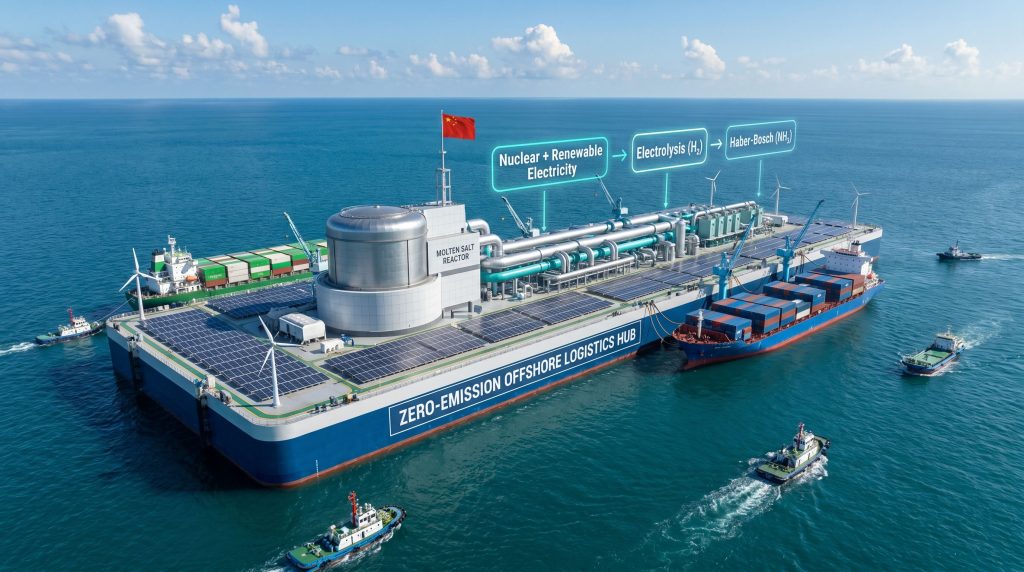
Developed by Jiangnan Shipyard, a subsidiary of China State Shipbuilding Corporation (CSSC), the floating hub concept was formally presented at the Posidonia International Shipping Exhibition in Greece in June 2026, one of the maritime industry's most globally prominent forums. The design merges three infrastructure categories that have historically been separate: a port terminal, an energy generation facility, and a fuel production plant, all within a single modular offshore platform.
It is critical to understand what this announcement represents and what it does not. As of mid-2026, this remains a design proposal and concept announcement. No floating hub has been constructed, and no international regulatory approval for deployment has been obtained. However, Jiangnan has secured manufacturing and installation licences from China's domestic nuclear safety regulatory authorities in 2026, and a related nuclear containership design unveiled in 2023 received DNV (Det Norske Veritas) approval in principle, indicating meaningful engagement from at least one major international classification society.
The Three Operational Pillars of the Platform
The hub's architecture is built around three interdependent functions:
- Continuous energy generation via a molten salt reactor supplemented by solar and wind systems, providing weather-independent baseload power regardless of sea conditions.
- Green fuel synthesis including green ammonia, hydrogen, and synthetic fuels produced onboard using nuclear-powered electrolysis and the Haber-Bosch process.
- Cargo and vessel servicing encompassing container transshipment, direct electrical charging for battery-powered coastal vessels, and operational support for short-sea shipping fleets.
The Molten Salt Reactor: Why This Reactor Type Suits Marine Deployment
The choice of a molten salt reactor (MSR) as the platform's core power source is not arbitrary. It reflects a deliberate engineering logic rooted in the specific demands of an offshore, semi-autonomous industrial environment. In addition, the growing focus on uranium resources and nuclear growth globally provides important context for understanding why advanced reactor designs are gaining commercial traction.
| Feature | Conventional Pressurised Water Reactor | Molten Salt Reactor |
|---|---|---|
| Coolant type | Water at high pressure | Liquid fluoride or chloride salt |
| Operating pressure | Very high | Near-atmospheric |
| Passive safety mechanism | Requires active cooling intervention | Salt solidifies on breach, physically containing material |
| Thermal efficiency | Approximately 33% | Potentially 40 to 50% at higher operating temperatures |
| Physical footprint | Large, due to pressurised containment systems | More compact, suited to floating platforms |
| Fuel flexibility | Primarily uranium-235 | Compatible with thorium and uranium cycles |
MSRs operate at high temperatures but near-atmospheric pressure, which eliminates the need for the massive pressurised containment structures that make conventional reactors physically large and prohibitively expensive at sea. The passive safety mechanism is particularly relevant to the maritime context: if containment is compromised, the molten salt solidifies rapidly, physically immobilising radioactive material without requiring active human intervention or backup power systems.
This safety profile addresses one of the central objections historically raised against nuclear propulsion and power at sea, which is the consequence of a serious accident in a maritime environment where evacuation, emergency response, and containment are far more complex than on land.
Thorium as a Long-Term Fuel Strategy
The broader CSSC nuclear maritime programme has explored thorium-based molten salt reactors, which use thorium-232 as a fertile material. Within the reactor, thorium absorbs neutrons and converts to fissile uranium-233, sustaining the chain reaction. This is not merely a technical curiosity. Thorium is estimated to be three to four times more abundant in the Earth's crust than uranium, with significant deposits in China, India, Brazil, and Australia.
For a floating platform concept designed to be replicated across global shipping corridors, this fuel abundance matters strategically. China's heavy dependence on imported uranium creates long-term supply chain vulnerability that thorium could substantially reduce. Chinese researchers have recently demonstrated successful thorium-to-uranium conversion within an operational MSR system, a technical milestone that validates the entire fuel cycle's real-world viability and is less widely appreciated outside specialist nuclear engineering circles.
How the Integrated Energy and Fuel Production System Would Function
Understanding the platform's energy flow requires tracing the chain from reactor output to vessel bunkering:
- The MSR generates continuous high-temperature thermal energy, converted to electricity via turbines.
- Surplus electricity drives electrolysis systems that split seawater-derived water into hydrogen and oxygen.
- Green hydrogen is combined with nitrogen extracted from the atmosphere through the Haber-Bosch process to produce green ammonia, currently considered one of the most viable zero-emission bunker fuels for deep-sea vessels due to its carbon-free combustion, liquid storage at moderate pressures, and sufficient energy density for long-haul routes.
- Alternatively, hydrogen can be combined with captured carbon dioxide to synthesise e-methanol or other synthetic fuels compatible with existing vessel engine infrastructure.
- Produced fuels are stored onboard and distributed to visiting vessels through integrated bunkering infrastructure.
For shorter-route coastal and inter-port vessels, the platform bypasses the fuel synthesis step entirely, providing direct electrical charging to battery-powered or hybrid-electric ferries, feeder vessels, tugboats, and pilot boats. This creates a nested zero-emission ecosystem in which the hub simultaneously fuels deep-sea shipping and directly powers short-sea fleets.
Comparing Floating Nuclear Infrastructure to Conventional Green Port Approaches
| Dimension | Shore-Based Green Port | Floating Nuclear Hub (Proposed) |
|---|---|---|
| Grid dependency | High | None, fully self-generating |
| Deployment flexibility | Fixed and permanent | Modular and potentially repositionable |
| Fuel production consistency | Subject to renewable intermittency | Continuous baseload via MSR |
| Emissions profile | Dependent on national grid carbon intensity | Near-zero operational emissions |
| Scalability model | Constrained by land and permitting timelines | Replicable design deployable across shipping lanes |
| Capital deployment | National or port authority investment | Potential for modular commercial rollout |
The modular replication advantage deserves particular attention. A standardised platform design could theoretically be manufactured, deployed, and operated at multiple points along major global shipping corridors, including strategically significant chokepoints such as the Strait of Malacca, the Suez Canal approaches, and the Panama Canal Pacific entrance, without requiring new land-based port construction or grid connection.
The next major ASX story will hit our subscribers first
The Engineering and Regulatory Barriers That Remain Substantial
Unresolved Technical Challenges
- Structural marine engineering: A floating nuclear platform must withstand sustained wave loading, storm surge, and seismic activity, demands that significantly exceed those of land-based reactors and have no established commercial precedent at this scale.
- Thermal management: MSRs operating at high temperatures require robust heat rejection systems. Ocean-based cooling is viable in principle but must be engineered to prevent localised thermal pollution and biofouling of intake systems.
- Fuel logistics and decommissioning: Thorium and uranium fuel loading, spent fuel interim storage, and eventual platform decommissioning present novel logistical challenges that land-based nuclear regulatory frameworks have not yet addressed for mobile or semi-mobile offshore assets.
The International Regulatory Vacuum
No international regulatory framework currently governs nuclear-powered floating logistics infrastructure operating in international waters or calling at foreign ports. Both the International Atomic Energy Agency and the International Maritime Organization would need to develop entirely new governance frameworks before any internationally deployable platform could be certified.
Russia's Akademik Lomonosov, operational since 2019 at Pevek in the Russian Arctic, represents the only real-world precedent for a floating nuclear power plant. However, it operates in a fixed location within Russian territorial waters, serves a remote onshore community with electricity, and has no maritime logistics or bunkering functions. It provides no direct regulatory pathway for a commercially mobile, internationally deployable platform.
Jiangnan's domestic progress, including manufacturing licences secured in 2026 and the earlier DNV approval in principle for the nuclear containership design, represents meaningful advancement within China's domestic regulatory framework. International deployment would, however, require entirely separate multilateral approval processes that do not yet exist in codified form.
Scenario Analysis: Realistic Development Pathways
| Scenario | Timeline | Key Conditions Required |
|---|---|---|
| Domestic pilot deployment | 2028 to 2035 | Single demonstration platform in Chinese territorial waters for operational validation |
| Regional Belt and Road deployment | 2035 to 2045 | Bilateral nuclear cooperation agreements with partner nations, IAEA safeguards arrangements |
| International commercial platform | 2045 and beyond | IMO certification, multilateral treaty framework, demonstrated operational safety record |
The most credible near-term pathway involves a single demonstration platform deployed in Chinese territorial waters, most plausibly in the South China Sea or along the Yangtze River estuary corridor. This would allow engineers to validate the MSR-at-sea concept, test green fuel production systems under real operating conditions, and generate the safety record needed to pursue international certification.
The longer-term geopolitical dimension is also worth examining carefully. A globally deployable nuclear-powered floating logistics hub could provide China with the capacity to export zero-emission port infrastructure to Belt and Road Initiative partner nations that lack the capital or grid capacity for conventional green port development. Nations with high shipping traffic but limited land-based infrastructure across Southeast Asia, East Africa, and the Pacific represent potential deployment contexts, though this would require bilateral nuclear safety agreements and careful navigation of international non-proliferation obligations.
What This Technology Signals for the Future of Maritime Decarbonisation
The China nuclear-powered floating hub for zero-emission shipping concept is significant not simply as a single project announcement, but as an indicator of where the intersection of nuclear technology, maritime logistics, and decarbonisation strategy is heading. Consequently, several broader signals emerge:
- Nuclear energy is re-entering the maritime decarbonisation conversation not merely as a propulsion technology but as an offshore energy infrastructure solution capable of addressing the port-side emissions gap that vessel innovation cannot reach.
- The MSR's passive safety characteristics and compact footprint make it meaningfully more compatible with marine deployment conditions than any previous generation of reactor technology.
- China's coordinated industrial progression, from nuclear containership designs in 2023 through to floating hub concepts in 2026, reflects a systematic long-term programme rather than isolated experimentation, underpinned by what is currently the world's most active civil nuclear construction pipeline.
- Commercial viability at international scale remains a decade or more away at minimum, constrained by engineering, regulatory, and geopolitical complexity. However, the technological trajectory is coherent, the industrial base exists, and the regulatory foundations are beginning to be laid at the domestic level.
Furthermore, the broader implications extend well beyond shipping. The energy transition in mining and other energy-intensive industries demonstrates how integrated nuclear-renewable systems may increasingly be applied to decarbonise entire industrial supply chains, not just individual vessels or facilities. The rising critical minerals demand associated with clean energy infrastructure, including the rare earths and specialty metals required for MSR components and electrolysis systems, also underscores the degree to which strategic mineral supply chains will shape the pace at which concepts like the China nuclear-powered floating hub for zero-emission shipping can move from proposal to reality.
Disclaimer: This article is for informational purposes only and does not constitute financial or investment advice. The floating hub concept described remains at the proposal and design stage as of mid-2026. Timelines, technical specifications, and deployment scenarios referenced are subject to significant uncertainty and may change materially as the programme develops.
Want To Stay Ahead of the ASX Discoveries Powering the Energy Transition?
As nuclear technology, critical minerals, and maritime decarbonisation converge into one of the most significant industrial shifts of the coming decades, Discovery Alert's proprietary Discovery IQ model delivers real-time alerts on significant ASX mineral discoveries — including uranium, rare earths, and the critical minerals underpinning next-generation energy infrastructure — ensuring subscribers can act on actionable opportunities the moment they emerge. Explore how historic mineral discoveries have generated substantial returns and begin your 14-day free trial at Discovery Alert to position yourself ahead of the market.