June 15, 2026
The Energy Commodity That Behaves Unlike Any Other
Most commodity markets respond predictably to price signals. When oil prices rise, drilling activity accelerates within months. When lithium demand spikes, brine extraction projects move quickly. Uranium operates on an entirely different timeline, and that structural reality is at the heart of why the top uranium stocks to buy now are attracting serious investor attention in 2026.
New uranium mines require between 10 and 15 years from initial discovery through exploration, permitting, construction, and first production. No amount of price motivation can compress that timeline meaningfully. This supply inelasticity, combined with a demand curve that is accelerating across multiple independent vectors, creates a commodity setup that is genuinely difficult to replicate elsewhere in the energy sector.
Understanding this dynamic is the starting point for evaluating uranium as a portfolio theme rather than a speculative trade. Furthermore, grasping uranium supply-demand volatility is essential context for any investor entering this space.
When big ASX news breaks, our subscribers know first
Why Uranium's Investment Case Has Structurally Shifted
Three Converging Forces Reshaping Nuclear Energy's Role
For roughly a decade following the 2011 Fukushima disaster, nuclear power was treated as a technology in managed decline. Exploration budgets collapsed, mine development stalled, and utilities drew down existing inventories rather than contracting new supply. That extended underinvestment cycle is now colliding with a demand surge that no one adequately modelled at the time.
Three macro forces have converged to fundamentally reposition nuclear power:
- Decarbonisation mandates requiring firm, dispatchable, zero-carbon baseload power that solar and wind cannot reliably provide without storage solutions that do not yet exist at grid scale.
- AI-driven electricity demand from hyperscale data centres operated by technology companies requiring continuous, uninterruptible power around the clock, where intermittent renewables are structurally insufficient.
- Energy sovereignty policy, particularly in the United States and Europe, driving governments to reduce dependence on fuel imports from geopolitically concentrated sources.
More than 30 nations have formally committed to expanding nuclear capacity by 2050, reflecting a policy consensus that extends well beyond any single election cycle. This political durability is a critical distinction for long-horizon investors.
What Makes Uranium Different From Oil, Gas, and Lithium
Unlike petroleum or natural gas, uranium delivers enormous energy output from an extremely small physical volume of fuel. A single uranium fuel pellet roughly the size of a fingertip contains the energy equivalent of approximately 17,000 cubic feet of natural gas.
This physical reality means that even at elevated uranium prices, the fuel cost component of nuclear electricity generation remains a relatively small share of total operating costs, making reactors highly resistant to demand destruction from price increases alone. This characteristic separates uranium from virtually every other energy commodity.
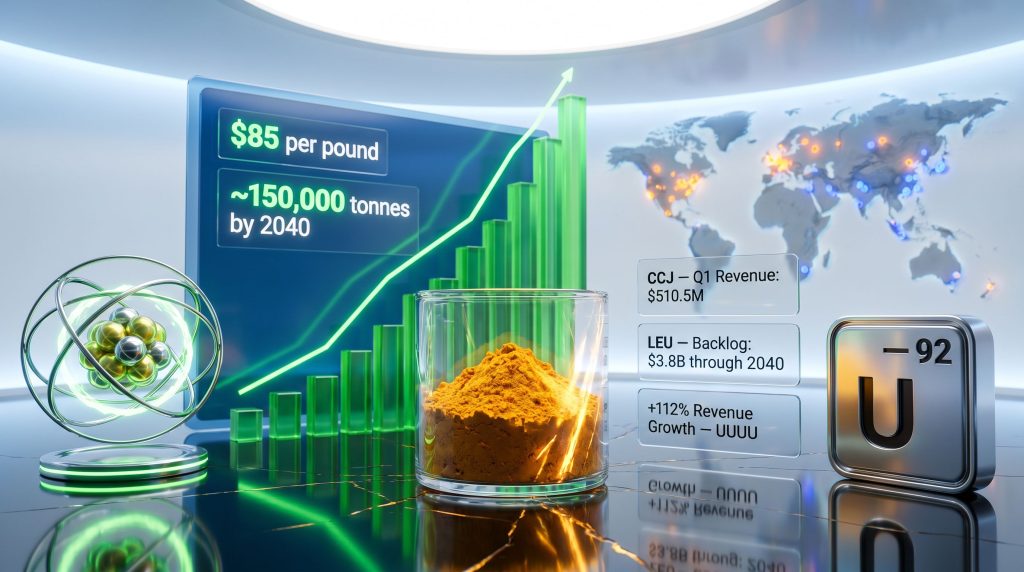
Utilities do not reduce nuclear generation in response to higher uranium prices the way industrial consumers curtail gas usage when prices spike. The fuel simply keeps being consumed, which is why the World Nuclear Association's reference scenario projects global reactor uranium requirements growing from approximately 68,920 tonnes in 2025 to more than 150,000 tonnes by 2040, representing a more than twofold increase over 15 years.
The Current State of the Global Uranium Market in 2026
Price Dynamics: Spot Volatility Against Long-Term Contract Strength
Uranium spot prices recently traded near $85 per pound according to Trading Economics data, representing year-over-year appreciation of approximately 18% despite periodic pullbacks. Earlier in 2026, spot prices briefly exceeded $100 per pound before easing back as some near-term buying activity moderated.
The more instructive signal for investors is the long-term contract market. Utilities have been progressively locking in multi-year supply agreements at firm prices, widening the gap between spot transactions and contracted volumes. This behaviour reflects growing anxiety among nuclear plant operators about future fuel availability, and it translates directly into revenue visibility for producers. In addition, developments such as the Russian uranium import ban have further tightened Western supply considerations.
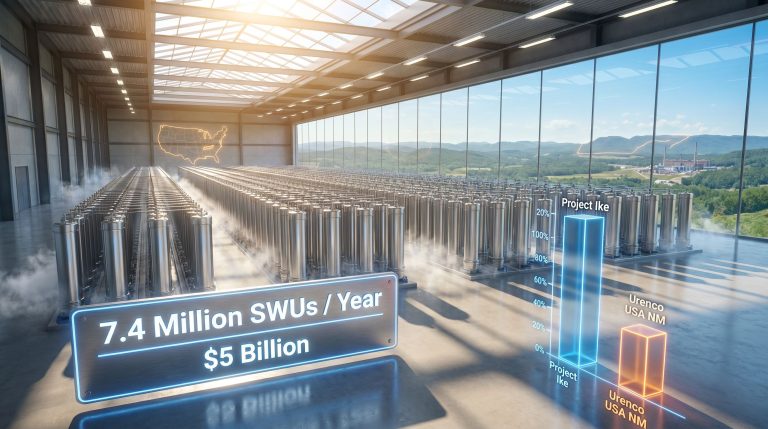
In June 2026, Urenco announced plans to expand enrichment capacity at its U.S. facility by nearly 50%, a capital commitment that only makes commercial sense if institutional actors are confident in sustained, long-duration uranium demand. Enrichment capacity expansions take years to commission, making this announcement a forward-looking signal rather than a response to current conditions.
The Demand Trajectory: Five Structural Drivers
| Demand Metric | Current (2025) | Projected (2040) | Growth Factor |
|---|---|---|---|
| Global reactor uranium requirements | ~68,920 tonnes | ~150,000+ tonnes | ~2.2x |
| Near-term demand growth (2023–2030) | Baseline | +28% | Confirmed trajectory |
| U.S. annual uranium consumption | ~50M+ lbs | Expanding | Domestic deficit |
The five demand drivers underpinning these projections are:
- Active reactor construction pipelines across Asia, Europe, and North America adding new fuel requirements.
- Life extension programmes for existing plants that were previously scheduled for retirement, preserving demand that was expected to decline.
- Small Modular Reactor (SMR) commercialisation timelines beginning to materialise, with several designs progressing toward licensing and deployment.
- Hyperscale data centre buildout by technology companies requiring 24/7 baseload power that nuclear is uniquely positioned to supply.
- National energy security programmes across multiple jurisdictions deliberately reducing dependence on fossil fuel imports.
Global nuclear electricity generation reached record levels in 2025, providing empirical confirmation that reactor utilisation is not a projection but an active reality.
Why Supply Cannot Simply Scale to Meet Demand
The United States provides the clearest illustration of the supply challenge. Domestic U₃O₈ production reached 1.04 million pounds in Q4 2025, a 217% quarterly increase from the 329,623 pounds produced in Q3 2025 according to EIA data. That recovery sounds impressive until it is placed in context: U.S. reactors consume more than 50 million pounds of uranium annually. Domestic production is covering less than 2% of that requirement.
Supply Gap Warning: The United States produces a fraction of its annual uranium consumption domestically. This dependency creates both a policy imperative and a commercial opportunity for domestic producers and enrichers operating within U.S. borders.
Even accounting for recovery in mine output, the structural import dependency of U.S. utilities cannot be resolved within a five-year horizon given the development timelines involved. This gap is the commercial foundation for the investment theses examined below.
How to Evaluate Uranium Stocks: A Framework for Investor Decision-Making
The Three Investor Archetypes for Uranium Exposure
| Investor Profile | Preferred Exposure Type | Risk Tolerance | Time Horizon |
|---|---|---|---|
| Conservative / Income-Focused | Large-cap producers with long-term contracts | Low to Medium | 3 to 7 years |
| Balanced Growth | Enrichers and fuel-chain specialists | Medium | 2 to 5 years |
| Aggressive / High-Conviction | Development-stage and diversified producers | High | 3 to 10 years |
Key Evaluation Criteria When Selecting Uranium Stocks
Before committing capital to any uranium equity, investors should assess the following dimensions. Consequently, understanding broader uranium market trends can help inform these decisions considerably.
- Contract backlog depth: Revenue secured under long-term agreements insulates producers from spot price volatility and provides earnings predictability.
- Production stage: Operating mines carry materially different risk profiles than development assets still years from first production.
- Balance sheet strength: Working capital, cash reserves, and debt levels determine whether a company can execute its growth plan without dilutive capital raises.
- Fuel-chain positioning: Whether exposure is at the mining, conversion, enrichment, or fuel fabrication stage affects how directly the investment benefits from uranium price movements.
- Jurisdictional risk: Mine locations, host government policies, and geopolitical concentration all influence the reliability of production forecasts.
- Commodity diversification: Adjacent exposure to critical minerals like rare earth elements can provide a secondary growth lever independent of uranium price cycles.
Top Uranium Stocks to Buy Now: Company-by-Company Strategic Analysis
1. Cameco (NYSE: CCJ): The Institutional-Grade Uranium Anchor
Cameco occupies a position in uranium markets that has no direct equivalent in most other commodity sectors. It combines world-scale mining operations with a 49% ownership stake in Westinghouse Electric, extending its value chain reach into reactor technology, fuel fabrication, and nuclear services. This integration means Cameco benefits not just from uranium prices but from the entire economics of nuclear power plant operation.
The company's long-term contract portfolio covers approximately 230 million pounds of committed uranium, providing multi-year cash flow predictability that is rare among mining companies. For investors exploring uranium investment strategies, Cameco represents the most accessible institutional-grade entry point.
Q1 2026 Financial Performance:
| Metric | Q1 2026 Result |
|---|---|
| Uranium segment revenue | $510.5 million |
| Uranium sales volume growth | +13% year-over-year |
| Adjusted net earnings | $145.6 million |
| Net income growth | +87% year-over-year to $93.8 million |
| 2026 delivery guidance | 29 to 32 million pounds |
| Average realised price guidance | $85 to $89 per pound |
CCJ shares recently traded near $101, below their 52-week high of $135.24, yet up approximately 50% over the preceding 12 months. The pullback from the peak creates a potentially more constructive entry point relative to the fundamental trajectory.
Scenario Analysis for Cameco:
- Base Case ($85 to $95/lb uranium): Contracted volumes deliver strong margins; Westinghouse services revenue grows steadily.
- Bull Case (above $120/lb): Long-term contract repricing accelerates; earnings growth compounds materially.
- Bear Case (temporary demand softness): Contract backlog provides an earnings floor that pure spot-price producers lack entirely.
2. Centrus Energy (NYSE: LEU): The Strategic Chokepoint in U.S. Nuclear Fuel Security
Enrichment is the least-discussed and most misunderstood stage of the nuclear fuel supply chain. Before uranium can be used as reactor fuel, it must be enriched to increase the concentration of the fissile U-235 isotope from its natural level of approximately 0.7% to the 3 to 5% range required by conventional reactors. Without enrichment, the entire downstream fuel cycle stops.
Centrus Energy is the only commercial uranium enrichment company currently operating in the United States. This structural monopoly position creates pricing power and strategic relevance that exists independently of where uranium spot prices trade on any given day.
The company's most significant growth opportunity lies in High-Assay Low-Enriched Uranium (HALEU), enriched to between 5% and 20% U-235 concentration. HALEU is the fuel specification required by virtually all advanced reactor designs and SMR concepts currently in development. Without a reliable domestic HALEU supply, the U.S. advanced nuclear programme faces a fundamental bottleneck regardless of how many reactor designs receive regulatory approval.
Centrus holds a $900 million HALEU-related task order from the U.S. Department of Energy, and its Technical Solutions segment revenue surged 47% in Q1 2026 as HALEU development activity accelerated.
Q1 2026 Financial Performance:
| Metric | Q1 2026 Result |
|---|---|
| Total revenue | $76.7 million (+5% year-over-year) |
| Adjusted diluted EPS | $1.05 (above analyst consensus) |
| Cash position | ~$1.87 billion |
| Full-year 2026 revenue guidance | $450 million to $500 million |
| Contract backlog | ~$3.8 billion through 2040 |
LEU shares recently traded near $162, significantly below the 52-week high of $464.25. The elevated volatility reflects the policy-dependent nature of parts of the business and sentiment swings around government contracting timelines rather than fundamental deterioration.
Scenario Analysis for Centrus:
- Policy Acceleration: Expanded domestic fuel security mandates increase contract backlog materially beyond current projections.
- SMR Commercialisation: Advanced reactor deployments beginning around 2030 create an inflection point in HALEU demand that current contract backlog does not fully capture.
- Geopolitical Disruption: Any interruption to Russian or European enrichment supply elevates Centrus to mission-critical infrastructure status almost immediately.
3. Energy Fuels (NYSE American: UUUU): The Dual-Commodity Growth Play
Energy Fuels occupies a genuinely unique position in the uranium equity universe. It operates the White Mesa Mill in Utah, the only conventional uranium processing facility currently operating in the United States, and it is simultaneously building a rare earth element (REE) processing business within the same facility infrastructure. No other publicly traded uranium company offers this particular combination.
The significance of the White Mesa Mill extends beyond uranium processing capacity. Conventional mills, as opposed to in-situ recovery (ISR) operations, can process ore from a wider variety of deposit types, including vanadium-uranium ores, alternate feed materials, and complex mineralisation that ISR wells cannot access. This operational flexibility gives Energy Fuels a broader feedstock funnel than most U.S. uranium producers. For a deeper perspective on uranium and nuclear growth, Energy Fuels illustrates how producers are positioning across multiple critical mineral categories.
Q1 2026 Financial Performance:
| Metric | Q1 2026 Result |
|---|---|
| Total revenue | $35.8 million (vs. $16.9M in Q1 2025) |
| Revenue growth | +112% year-over-year |
| Uranium revenue | $35.7 million |
| Net loss | $10.8 million (vs. $26.3M in Q1 2025) |
| Working capital | ~$956.6 million |
The company expects to produce approximately 1.6 million pounds of finished U₃O₈ in the first half of 2026, with full-year guidance of 1.5 to 2.5 million pounds. UUUU shares recently traded near $15, below the 52-week high of $27.90 but sharply above the 12-month low of approximately $5.24, illustrating the leverage and volatility inherent in this position.
Differentiation Note: Energy Fuels is the only uranium stock in this analysis that simultaneously provides investors with exposure to rare earth elements, a critical mineral category with its own independent demand growth story tied to electric vehicles, wind turbines, and advanced defence technology.
Side-by-Side Comparison: Top Uranium Stocks in 2026
| Metric | Cameco (CCJ) | Centrus Energy (LEU) | Energy Fuels (UUUU) |
|---|---|---|---|
| Market Position | Global large-cap producer | U.S. enrichment monopoly | U.S. mid-cap producer + REE |
| Q1 2026 Revenue | $510.5M (uranium segment) | $76.7M | $35.8M |
| Revenue Growth (YoY) | +13% (volumes) | +5% | +112% |
| Contract Backlog | ~230M lbs committed | ~$3.8B through 2040 | Production-stage |
| Balance Sheet | Strong | ~$1.87B cash | ~$957M working capital |
| Commodity Diversification | Uranium + Westinghouse | Uranium enrichment + HALEU | Uranium + Rare Earths |
| Risk Profile | Lower | Medium | Medium to High |
| Best Suited For | Core institutional holding | Policy/fuel-chain play | Growth/diversification play |
For investors seeking broader exposure beyond these three names, resources such as top ASX uranium shares offer additional perspectives on uranium equities across different markets.
The next major ASX story will hit our subscribers first
What Are the Biggest Risks Facing Uranium Stocks Right Now?
No investment framework is complete without a rigorous examination of downside scenarios. Uranium equities carry specific risks that investors must understand before allocating capital:
- Price volatility: Uranium spot prices moved from below $50 per pound to above $100 and back within a compressed two-year window. Portfolio sizing must account for this range of outcomes.
- Project execution risk: Development-stage companies face permitting delays, cost overruns, geotechnical surprises, and capital availability challenges that operating mines do not.
- Geopolitical supply concentration: A substantial portion of global uranium production originates from Kazakhstan, Namibia, and Canada. Any disruption in these jurisdictions affects the entire market simultaneously.
- Policy dependency: Companies with significant government contract exposure face revenue trajectory risk if procurement priorities shift with changes in administration or budget cycles.
- Enrichment capacity lag: Even with announced expansions like Urenco's ~50% U.S. capacity increase, enrichment infrastructure takes years to commission and cannot respond quickly to sudden demand acceleration.
- Investor sentiment cycles: Uranium equities have historically experienced sharp drawdowns unrelated to fundamental changes, driven by broader risk-off positioning or commodity rotation out of energy.
Frequently Asked Questions: Uranium Stocks and Nuclear Energy Investing
What makes uranium stocks attractive in 2026?
The combination of a structural supply deficit, a demand curve growing across multiple independent vectors — including new reactor builds, life extensions, SMRs, and AI data centre power requirements — and a pricing environment where long-term contracts are being secured at historically strong levels creates a genuinely constructive backdrop. The supply inelasticity of uranium, where new mines require 10 to 15 years to develop, means the supply response to higher prices is slow and incomplete relative to demand growth.
What is the difference between uranium miners, enrichers, and royalty companies?
The uranium fuel cycle has distinct stages, each generating returns differently:
- Miners extract uranium ore from the ground and process it into U₃O₈ concentrate (yellowcake). Revenue is directly linked to uranium prices and production volumes.
- Enrichers process uranium hexafluoride to increase U-235 concentration to reactor-usable levels. Revenue is tied to enrichment service pricing (measured in separative work units, or SWUs) rather than spot uranium prices directly.
- Royalty companies provide upfront capital to mining projects in exchange for a percentage of future production or revenue. They carry no operational risk but participate in commodity upside through their royalty streams.
What is HALEU and why does it matter for uranium investors?
High-Assay Low-Enriched Uranium is enriched to between 5% and 20% U-235, significantly above the 3 to 5% specification of conventional reactor fuel. Advanced reactor designs and SMRs require HALEU because their compact core geometries and higher power densities demand more concentrated fuel to achieve criticality. Without a reliable HALEU supply chain, the commercial deployment of advanced reactors faces a fundamental bottleneck. Centrus Energy's existing HALEU production capability and its DOE task order position it as the primary beneficiary if advanced reactor deployment timelines accelerate toward 2030.
What role does AI play in uranium demand growth?
Hyperscale data centres supporting large language models and AI inference workloads consume electricity continuously at very high densities. Unlike manufacturing or commercial facilities that follow usage patterns, AI data centres require power 24 hours a day, 365 days a year. Solar and wind generation cannot fulfil this requirement reliably without storage capacity that does not yet exist at the necessary scale and cost. Nuclear power, which generates electricity continuously regardless of weather or time of day, is increasingly being evaluated by major technology companies as the preferred long-term baseload solution for AI infrastructure. Investors tracking uranium market trends globally will find this AI-nuclear connection increasingly central to growth forecasts.
The Strategic Outlook: Three Scenarios for Uranium Markets Through 2030
Scenario 1: Measured Expansion (Base Case)
Uranium prices stabilise in the $80 to $100 per pound range as new mine supply gradually offsets demand growth. The global reactor fleet expands at projected rates, SMR deployments begin in select markets, and large-cap producers like Cameco generate consistent earnings growth driven by contracted volume delivery. Enrichers benefit from long-term contract repricing as utilities extend coverage horizons.
Scenario 2: Accelerated Nuclear Renaissance (Bull Case)
Policy acceleration drives faster-than-expected reactor approvals across the U.S., Europe, and Asia simultaneously. AI data centre electricity demand creates an unexpected demand surge that strains grid capacity and elevates nuclear baseload to priority infrastructure status. Uranium prices breach $120 to $150 per pound, development-stage companies attract significant rerating, and enrichment capacity becomes a strategic bottleneck commanding premium pricing.
Scenario 3: Delayed Transition (Bear Case)
Permitting delays, supply chain challenges for reactor components, and short-term macroeconomic weakness slow reactor construction timelines. Uranium prices retreat toward $65 to $75 per pound as utilities delay contracting. Large-cap producers with deep contract backlogs weather the cycle; development-stage companies face capital access challenges; enrichers with government contract coverage outperform pure spot-price exposed miners.
This article is intended for informational purposes only and does not constitute financial advice, investment recommendations, or an offer to buy or sell securities. Uranium markets involve significant commodity price risk, operational risk, and geopolitical uncertainty. All financial figures, stock prices, and projections referenced are based on publicly available information current at the time of writing and are subject to change. Past performance of uranium equities is not indicative of future results. Investors should conduct their own due diligence and consult a licensed financial adviser before making investment decisions.
Want to Catch the Next Major Mineral Discovery Before the Broader Market Does?
Discovery Alert's proprietary Discovery IQ model delivers real-time alerts on significant ASX mineral discoveries, instantly turning complex mineral data into actionable investment insights — ideal for investors tracking the energy commodities reshaping global markets. Explore how historic discoveries have generated substantial returns on Discovery Alert's dedicated discoveries page, and begin your 14-day free trial today to position yourself ahead of the market.