May 11, 2026
The Hidden Supply Crisis Reshaping One of Technology's Most Essential Metals
Few commodity markets reveal as much about the fragility of modern technology supply chains as tin. Quietly underpinning everything from the smartphone in your pocket to the servers powering artificial intelligence infrastructure, tin occupies a position of remarkable industrial importance that its relatively modest public profile rarely reflects. Understanding why this metal has moved from the periphery of commodity investing to its centre requires looking not at demand headlines, but at the slow, structural erosion of global supply that has been unfolding for years.
The convergence of two simultaneous production crises, one in Indonesia and one in Myanmar, has removed a substantial share of global tin output with no credible replacement in sight. Against this backdrop, Alphamin tin prices and dividend performance have attracted growing attention from investors seeking exposure to a structurally supported commodity with rare-grade assets and a compelling yield profile.
When big ASX news breaks, our subscribers know first
Why Tin Is No Longer a Legacy Industrial Metal
For most of the twentieth century, tin was associated primarily with canning and packaging. That characterisation is now fundamentally outdated. The metal's physical properties, particularly its low melting point of approximately 232 degrees Celsius and exceptional malleability, make it indispensable in modern electronics manufacturing. Tin-based solders are the primary bonding agent in printed circuit board assembly, and the transition to lead-free soldering mandated by environmental regulations such as the European Union's Restriction of Hazardous Substances Directive has, if anything, increased the concentration of tin in electronic manufacturing processes.
What makes tin particularly relevant to the current investment environment is its relationship with semiconductor manufacturing cycles. The correlation between global semiconductor demand and tin price movements is, as Alphamin CEO Eoin O'Driscoll told MiningMX in May 2026, "almost perfect" in its tracking behaviour. This is not coincidental. Every semiconductor chip requires physical connection to a circuit board, and tin solder is the medium through which those connections are made at industrial scale.
Emerging demand vectors are compounding this baseline. The global buildout of artificial intelligence data centre infrastructure requires enormous quantities of circuit boards, server components, and power management systems, all of which are tin-intensive. The deployment of fifth-generation wireless networks and the accelerating electrification of transport are adding further layers of incremental demand. Analysts tracking critical mineral supply chains have increasingly categorised tin alongside lithium, cobalt, and rare earth elements as a technology-critical commodity rather than a conventional base metal, reflecting a fundamental reappraisal of the metal's strategic role.
The Structural Supply Collapse Driving the Tin Price Thesis
The supply side of the tin market tells a story of simultaneous crises that, taken together, represent one of the more significant structural supply shocks in the base metals space in recent years.
Indonesia has historically been the world's dominant tin exporter, with production levels that once approached 80,000 tonnes annually. That output has contracted sharply, falling to closer to 50,000 tonnes in the most recent reporting period, according to commentary from Alphamin's management. This represents a decline of roughly 37% from peak levels. Critically, Indonesian producers are reported to be struggling to maintain even these reduced output levels, suggesting the contraction is not a temporary operational setback but reflects deeper geological and regulatory constraints.
Myanmar's trajectory is equally instructive, and arguably more dramatic in its implications. The country effectively emerged from obscurity in the tin market through the rapid expansion of artisanal and alluvial mining operations, climbing to represent approximately 15% of global supply at its peak. However, alluvial tin deposits, by their nature, are shallow and finite. They can be exploited rapidly but deplete just as quickly. The prevailing industry assessment, confirmed by Alphamin's CEO, is that Myanmar's artisanal resource base has been largely exhausted, and critically, no industrial-scale exploration or mine development has been initiated to replace it. The country's political instability since 2021 has made large-scale capital deployment essentially impossible for international mining companies.
The combination of Indonesian production decline and Myanmar supply depletion has removed a significant share of global tin output with no near-term replacement in sight, a supply dynamic that underpins the long-term price thesis for the metal.
The cumulative effect is a global tin market transitioning from a state of rough balance into what Alphamin's management characterises as a structural deficit. Importantly, this deficit is not easily or quickly addressed. Industrial-scale tin mining requires years of exploration, development, permitting, and capital investment. The absence of major new projects in advanced development stages means the supply gap is unlikely to be bridged in the near term.
Alphamin Tin Prices and Dividend: Understanding the Commodity Price Context
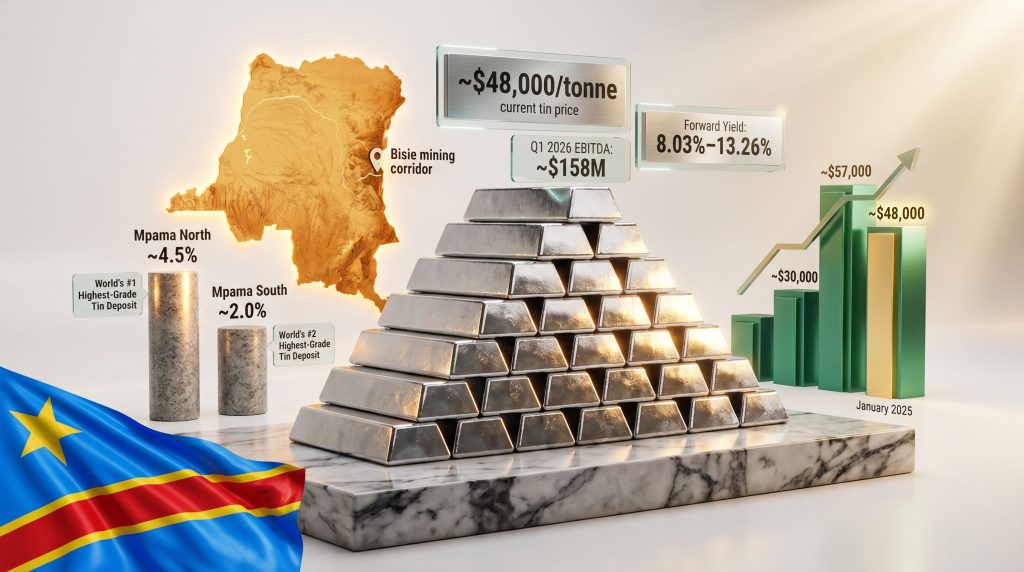
The tin price surge between January 2025 and the end of February 2025 was one of the most dramatic moves of any industrial metal in recent memory. From a base of approximately $30,000 per tonne, prices surged to just under $60,000 per tonne, an increase of close to 100% in approximately eight weeks. By mid-2026, prices have consolidated to around $48,000 per tonne following a partial unwind of speculative positioning.
| Period | Approximate Price (USD/tonne) | Primary Driver |
|---|---|---|
| January 2025 | ~$30,000 | Post-correction baseline |
| Late February 2025 | ~$59,000 (peak) | Supply deficit plus speculative positioning |
| Mid-2026 | ~$48,000 | Consolidation after speculative unwind |
| Assessed sustainable floor | >$40,000 | Structural supply-demand support |
Understanding the composition of this price move matters enormously for assessing its durability. O'Driscoll, speaking to MiningMX, described it as a confluence of factors: a weaker US dollar providing a tailwind for commodity prices generally, genuine supply constraints from Indonesia and Myanmar, growing demand from AI infrastructure and semiconductor cycles, and a degree of speculative financial positioning that amplified the move. The concern with the speculative element is well-founded. In previous tin price spikes, when financial positions were unwound, the resulting price corrections were sharp and swift.
However, management's view is that the current price environment is more structurally grounded than historical episodes. The supply deficits are real and documented. The demand drivers are durable. At a price of $40,000 per tonne, management considers the market to be in territory that structural fundamentals can sustain, even without speculative support.
For investors assessing Alphamin's earnings power, the margin arithmetic at current prices is striking. With an all-in sustaining cost of approximately $17,000 per tonne, the company generates an operating margin of roughly $31,000 on every tonne of tin sold at $48,000. Applied to annual production of approximately 20,000 tonnes, the theoretical EBITDA run-rate exceeds $600 million at prevailing prices.
Margin Sensitivity at Key Price Points
| Tin Price (USD/tonne) | AISC (USD/tonne) | EBITDA Margin/tonne | Annual EBITDA (20,000t) |
|---|---|---|---|
| $59,000 (peak) | ~$17,000 | ~$42,000 | ~$840 million |
| $48,000 (current) | ~$17,000 | ~$31,000 | ~$620 million |
| $40,000 (floor) | ~$17,000 | ~$23,000 | ~$460 million |
| $35,000 | ~$17,000 | ~$18,000 | ~$360 million |
Even at $35,000 per tonne, well below the assessed sustainable floor, the company would generate substantial positive cash flow. Furthermore, this margin resilience reflects the grade advantage of the Bisie deposits in ways that lower-grade competitors simply cannot replicate. The Bisie mine volatility context is therefore critical for understanding how the operation's exceptional grade acts as a buffer against price cycles.
Mpama North and Mpama South: Why Ore Grade Is Everything
In mining, ore grade is the single most consequential variable in determining the economics of an operation. Grade determines how much total rock must be moved and processed to extract a given quantity of metal, which in turn drives energy consumption, labour hours, reagent volumes, and capital requirements. A deposit with twice the grade of a competitor does not simply produce twice the metal per tonne of ore processed; it does so at dramatically lower unit cost, creating a competitive moat that is almost impossible to overcome.
Alphamin operates what are independently characterised as the world's two highest-grade tin deposits within the same geological corridor in the eastern Democratic Republic of Congo.
| Asset | Tin Grade | Global Ranking | Status |
|---|---|---|---|
| Mpama North | ~4.5% tin | World's highest-grade tin deposit | Operating |
| Mpama South | ~2.0% tin | World's second-highest-grade tin deposit | Production commenced 2024 |
To contextualise these grades: many commercial tin operations globally process ore with tin concentrations well below 1%. Operating a deposit at 4.5% tin means Alphamin recovers significantly more metal per tonne of rock processed compared to industry averages, fundamentally explaining the company's position in the lowest-cost quartile of global tin producers despite operating in one of the world's most logistically complex jurisdictions.
The commissioning of Mpama South in 2024 transformed Alphamin's production profile from a single-asset operation to a multi-deposit producer, lifting annual output from approximately 12,500 tonnes to around 20,000 tonnes. The geological reality that both deposits sit within the same Bisie corridor is operationally valuable, enabling shared infrastructure while doubling the ore feed into the processing circuit.
The Fuel Cost Headwind in Context
A notable development flagged in Alphamin's most recent operational update is the impact of fuel cost inflation on sustaining costs. Orders placed in the six weeks prior to management's May 2026 commentary reflected input cost increases in the range of 25% to 30%, with management estimating this adds approximately $2,000 per tonne to all-in sustaining costs. At a current EBITDA margin of approximately $30,000 per tonne, this is a manageable headwind rather than a structural threat to profitability. However, investors should monitor fuel costs closely given the remote logistics chain that makes fuel supply both critical and expensive.
Record Financial Results and the 2026 Dividend Outlook
Alphamin's Q1 2026 financial results represent a milestone in the company's operational history. Quarterly EBITDA reached approximately $158 million, a record result and a 46% increase on the prior quarter. Net cash increased by $128 million during the period, reflecting the extraordinary operating leverage the company carries at current tin prices.
| Financial Metric | Q1 2026 Result |
|---|---|
| EBITDA | ~$158 million (record) |
| QoQ EBITDA Growth | ~46% |
| Net Cash Increase | ~$128 million |
| EBITDA Margin Per Tonne | ~$30,000 |
On the dividend question, management has been notably candid. The most recently declared distribution was C$0.13 per share, payable June 5, 2026, representing the final dividend for fiscal year 2025. According to Alphamin's dividend history, the company has progressively grown its distributions in line with earnings improvements. Looking ahead, CEO O'Driscoll indicated that he would be surprised if the board does not propose a substantial dividend following the release of full-year 2026 results.
Several structural factors underpin this confidence:
- Exploration spending is not a major capital drain, with a near-term budget of $10 million to $20 million per annum
- No large capital projects are currently consuming significant cash
- A four-year offtake agreement with Gerald Metals covers 100% of production at market-linked prices, eliminating revenue execution risk
- Operating cash generation at current tin prices provides substantial headroom above both sustaining capital and exploration requirements
The forward dividend yield, depending on the valuation methodology applied, is estimated in the range of approximately 8% to 13%, a profile that is highly competitive relative to mining sector peers and broader equity benchmarks.
With a theoretical annual EBITDA run-rate exceeding $600 million at current prices, Alphamin carries substantial capacity for both capital reinvestment and shareholder distributions without compromising operational integrity.
The Gerald Metals offtake arrangement deserves particular attention from investors focused on dividend sustainability. Market-linked pricing means the company captures the full benefit of elevated Alphamin tin prices and dividend capacity rather than being locked into fixed-price arrangements that would cap earnings upside. In addition, the secured nature of the offtake reduces counterparty and sales execution risk, providing greater earnings certainty than a purely spot-market sales strategy would offer.
The next major ASX story will hit our subscribers first
Operating in the DRC: Logistics as Competitive Advantage
The eastern Democratic Republic of Congo is not an easy place to operate a world-class mine. Alphamin's management has developed a characterisation of the business that reflects this reality with unusual candour: visitors to the operation consistently describe it as a logistics business with a mine attached, rather than the other way around.
The supply chain challenge is illustrated by a single statistic. From Johannesburg to Kampala, the logistics chain is relatively manageable by regional standards. However, the final 1,000 kilometres from Kampala to the Bisie mine site represents a genuinely extreme logistics challenge. Under optimal dry-season conditions, a truck carrying critical supplies takes approximately 30 days to complete this leg. During the wet season, that transit time can exceed 60 days. The implication is that mine management must think in terms of months when planning inventory of critical spare parts and long-lead items, a planning discipline that is almost unique in the global mining industry.
The company has maintained continuous production through multiple logistics disruptions over its operating history, a track record that reflects sophisticated supply chain management rather than luck.
The Security Context: Distance Matters
Eastern DRC has experienced approximately 70 years of semi-permanent conflict across the broader region. The M23 rebel group has been the dominant security story over the past 18 months, representing a more organised and capable armed actor than the region has typically seen. The insurgent conflict risks remain a factor investors must weigh carefully, though the active conflict zones are assessed to be approximately 150 kilometres east of the Bisie mining corridor, a meaningful geographic buffer that separates the operational site from the principal areas of instability. Management reports that the mine itself has maintained an extended period without security incidents.
Critically, when tin prices spike, the company routinely receives calls from market participants asking whether it is evacuating. This reflexive concern about DRC supply disruptions is itself a market dynamic worth noting: the threat of potential disruption at Bisie influences tin price sentiment even when no actual disruption is occurring. Consistent operational delivery over multiple years has been the most effective form of jurisdiction risk mitigation available to the company.
Exploration Upside: Long-Term Vision Against Short-Term Reality
Alphamin's current reserve life, under existing definitions, supports approximately six to seven years of production at current rates. Beyond this horizon, the company's ability to sustain output depends on exploration success within the broader Bisie geological corridor.
Management is explicit that its ambition is not to operate a seven-year mine but rather a 40 to 50-year operation. The geological basis for this confidence is the Bisie corridor's status as one of the most highly prospective and least-explored tin systems anywhere in the world. The region's remoteness and the DRC's historical instability have meant that systematic industrial exploration has barely scratched the surface of what the geology might contain.
Recent drilling programs at extensions of the Mpama North deposit have produced results that management describes as underwhelming relative to initial expectations. It is worth placing this in context. The company's most productive exploration period ran from 2021 to 2022, yielding significant resource extensions at Mpama North and the discovery of the Mpama South deposit. Exploration activity in 2024 was partially disrupted by an evacuation event in March of that year. Current drilling is characterised as early-stage, and the absence of quick wins does not preclude eventual success in a system considered geologically exceptional.
A less-discussed operational constraint on exploration intensity is physical rather than financial. The Bisie deposit geometry is narrow and steeply dipping, meaning drill holes must be positioned with exceptional precision to intersect the orebody. The topography is challenging and requires road clearing before rig deployment. These factors limit the number of drill rigs that can operate simultaneously, regardless of budget. Furthermore, the cut-off grade economics of the Bisie system mean that even incremental resource extensions must meet a high threshold to be commercially meaningful. Even if exploration spending were dramatically increased, the physical throughput of drilling metres per year has a practical ceiling imposed by the terrain.
The near-term exploration budget of $10 million to $20 million per annum is therefore unlikely to constrain dividend capacity in any meaningful way, as the binding constraint is geological and logistical rather than financial.
The JSE Listing: A Sleeping Opportunity for South African Investors
Alphamin carries a dual listing on both the Toronto Stock Exchange and the Johannesburg Stock Exchange, but the two listings tell very different stories. The JSE float represents approximately 15 million shares out of total issued capital of roughly 1.3 billion shares, or approximately 1% of equity outstanding. The original listing was established in 2017 during the development phase of Mpama North, at a time when tin was trading between $15,000 and $20,000 per tonne and the company was pre-production.
The combination of pre-production risk, a relatively obscure commodity, and a challenging DRC operating address meant the JSE listing never gained meaningful traction with South African institutional investors. Management acknowledges this directly, noting that the capital-raising objectives at the time of listing were not fully met.
The investment proposition has since changed materially. According to recent earnings reports, the company now presents a fundamentally different opportunity to investors. Consequently, the company now:
- Operates two of the world's three highest-grade tin deposits
- Generates record quarterly EBITDA exceeding $150 million
- Offers a forward dividend yield estimated between 8% and 13%
- Has a seven-year production runway at current reserve definitions
- Maintains a four-year offtake agreement providing revenue visibility
Management's current position is pragmatic: the shares are transferable between the TSX and JSE, and with rand strength against the Canadian dollar creating a potentially favourable entry dynamic for South African investors seeking high-yield USD-denominated income, the listing retains optionality value. However, if meaningful investor engagement cannot be developed on the JSE, capital allocation toward South African investor relations efforts will need to be reconsidered.
Key Investment Metrics at a Glance
| Metric | Data Point |
|---|---|
| Q1 2026 EBITDA | ~$158 million (record) |
| QoQ EBITDA Growth | ~46% |
| Net Cash Increase (Q1 2026) | ~$128 million |
| Annual Production | ~20,000 tonnes |
| AISC | ~$17,000/tonne |
| EBITDA Margin Per Tonne | ~$30,000-$31,000 |
| Current Tin Price | ~$48,000/tonne |
| Assessed Sustainable Price Floor | >$40,000/tonne |
| Declared Dividend (June 2026) | C$0.13/share |
| Forward Dividend Yield | ~8%-13% |
| Reserve Life (Current) | ~6-7 years |
| Mpama North Grade | ~4.5% tin (world's highest) |
| Mpama South Grade | ~2.0% tin (world's second highest) |
| JSE Float | ~1% of total issued capital |
Frequently Asked Questions
What is the relationship between tin prices and Alphamin's earnings?
At a prevailing tin price of approximately $48,000 per tonne and an all-in sustaining cost of roughly $17,000 per tonne, Alphamin tin prices and dividend outcomes are closely linked through the operating margin of approximately $31,000 on every tonne it produces. With annual production of around 20,000 tonnes, this translates to a theoretical EBITDA run-rate exceeding $620 million at current prices. Each $1,000 move in the tin price translates to approximately $20 million of annual EBITDA impact at the current production rate.
Is the Alphamin dividend sustainable if tin prices fall?
At a price of $40,000 per tonne, which management considers structurally supportable based on supply-demand fundamentals, the EBITDA margin per tonne remains approximately $23,000. Applied to 20,000 tonnes of annual production, the implied annual EBITDA is approximately $460 million. Against an exploration budget of $10 million to $20 million and no major sustaining capital projects on the horizon, there would remain substantial capacity for dividend distributions. The board has not provided forward guidance on dividend quantum, and all forward-looking statements are subject to commodity price risk and operational assumptions that could change.
Why does Alphamin have such low production costs compared to other tin miners?
The answer lies almost entirely in ore grade. Mpama North's tin grade of approximately 4.5% and Mpama South's grade of approximately 2.0% are exceptionally high by global standards, with many commercial tin operations processing ore at grades well below 1%. Higher grades mean significantly more metal is recovered per tonne of material processed, dramatically reducing the energy, labour, and processing costs per unit of metal produced. This grade advantage is structural and cannot easily be replicated by competitors operating lower-grade deposits.
What are the main risks investors should consider?
The primary risk factors for investors assessing this company include:
- A sharp reversal in tin prices driven by speculative position unwinding or demand deterioration
- Geopolitical or security escalation in eastern DRC that disrupts production or logistics
- Extended logistics disruptions in the Kampala-to-Bisie supply chain that exceed the company's inventory buffers
- Failure to extend mine life beyond the current six to seven year reserve horizon through exploration success
- Fuel cost inflation that, while currently manageable, could become more material if sustained at significantly elevated levels
This article is intended for informational purposes only and does not constitute financial advice. Past performance and current operational metrics do not guarantee future results. Commodity prices, production outputs, and dividend decisions are subject to material uncertainty and may differ significantly from the figures discussed. Investors should conduct independent due diligence and consult a qualified financial adviser before making investment decisions.
Want to Stay Ahead of the Next Major Mineral Discovery?
Discovery Alert's proprietary Discovery IQ model scans ASX announcements in real time, delivering instant alerts on significant mineral discoveries — including critical technology metals like tin — so subscribers can identify actionable opportunities before the broader market reacts. Explore how historic discoveries have generated extraordinary returns on Discovery Alert's dedicated discoveries page, and begin your 14-day free trial today to position yourself ahead of the next major find.