May 11, 2026
The Engineering Phase That Separates Mining Ambitions From Bankable Reality
Most large-scale mining projects never make it past the feasibility stage. Not because the geology is wrong or the economics are unfavourable, but because the engineering documentation required to satisfy institutional lenders never reaches the standard that unlocks construction debt. In the world of project finance, one phase sits at the centre of this gatekeeping function: Front-End Engineering Design, universally abbreviated as FEED.
When Brazil Potash hires Wood and Promon for its US$2.5 billion Autazes potash project, the significance of that appointment extends well beyond a standard procurement announcement. It represents a formal transition from study-stage asset to active engineering development, and it sets in motion the technical process that determines whether international development finance institutions will ultimately commit capital at scale.
When big ASX news breaks, our subscribers know first
What FEED Actually Means in Large-Scale Resource Development
FEED is the engineering phase that bridges conceptual feasibility with construction-ready documentation. At feasibility stage, cost estimates typically carry accuracy ranges of plus or minus 20 to 30 percent. FEED narrows that to plus or minus 10 to 15 percent, producing the level of specificity that lenders and their independent technical advisors require before advancing construction loans.
Definitive feasibility studies form the foundation upon which FEED phases are built, however the outputs generated during a FEED phase are far more comprehensive and highly technical:
- Detailed process flow diagrams and equipment specifications
- Civil works design documentation and geotechnical inputs
- Capital cost estimates broken down to individual equipment items
- Long-lead procurement strategies identifying critical supply chain dependencies
- Construction methodology frameworks and scheduling models
- Risk registers with quantified mitigation strategies
- Preliminary operating cost projections tied to production throughput targets
For projects of the Autazes scale, FEED phases typically span 18 to 24 months and represent approximately 3 to 5 percent of total project capital cost. On a US$2.5 billion project, that implies a FEED investment in the range of US$75 million to US$125 million — an amount that is substantial but fully justified given the capital it is designed to unlock.
The FEED contract award is not a procurement milestone in the conventional sense. It is the formal entry point into the bankability process, the moment at which a project transitions from being described as promising to being described as financeable.
Development Finance Institutions (DFIs) such as the International Finance Corporation, IDB Invest, and Brazil's own BNDES classify projects into pre-bankable and bankability-ready categories. The distinction is not about geology or reserve size. It is entirely about the quality and completeness of engineering documentation. Without a credible FEED package produced by recognised firms, no project of this capital intensity advances to construction debt term sheets.
The Autazes Project: Scale, Location, and Strategic Context
The Autazes Potash Project is located in Amazonas State, Brazil, approximately 100 miles southeast of Manaus and roughly five miles from the Madeira River. These geographic parameters are not incidental. They are central to the project's cost thesis.
The core project parameters are summarised below:
| Parameter | Detail |
|---|---|
| Location | Amazonas State, Brazil |
| Proximity to Manaus | ~100 miles |
| Access to Madeira River | ~5 miles |
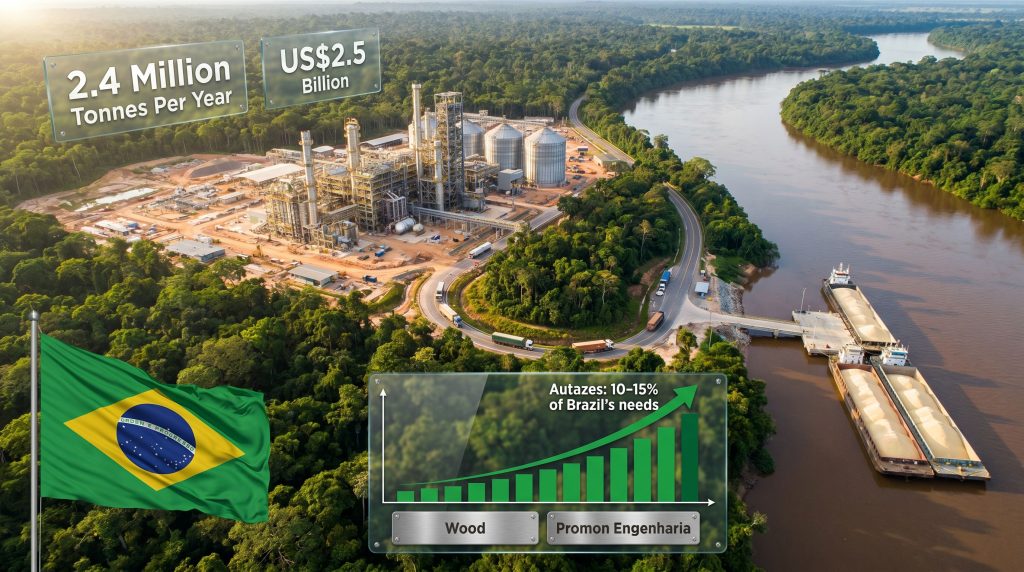
| Planned Annual Production | 2.4 million tonnes |
| Mine Life | 23 years |
| Total Capital Cost | US$2.5 billion |
| Capital Deployed to Date | ~US$270 million |
| Amazonas Basin Explored | Less than 5% |
The Madeira River is a major Amazon tributary with established barge traffic capability. Designing logistics around river transport rather than road freight provides a structural cost advantage that competing import-dependent supply chains cannot replicate. Imported potash arriving at Brazilian ports faces lengthy inland freight routes to reach agricultural production zones. A domestically produced supply delivered by barge directly into the agricultural heartland changes the delivered cost equation meaningfully.
Brazil's Potash Import Dependency: A Structural Vulnerability
Brazil imports more than 95 percent of its potash requirements, making it one of the most import-dependent agricultural economies on earth. This dependency sits awkwardly against the country's status as one of the world's largest producers and exporters of potash-intensive crops: soybeans, corn, sugarcane, and cotton collectively underpin enormous volumes of annual potash consumption.
Furthermore, the exposure this creates is multidimensional, touching on issues that align closely with Australia's own resource export challenges in a similarly concentrated global commodities landscape:
- Geopolitical risk from concentration of global potash supply in Canada, Russia, and Belarus
- Currency risk as potash is priced internationally in US dollars while Brazilian farmers earn in reais
- Freight cost volatility tied to global shipping rates and port congestion
- Sanctions-driven supply disruption following post-2022 restrictions on Russian and Belarusian potash exports
At full production, the Autazes project is projected to supply approximately 10 to 15 percent of Brazil's annual potash consumption. That displacement of import dependency, at a structurally lower delivered cost, forms the core strategic rationale for the project's development and creates a natural long-term demand anchor that reduces the market risk typically associated with greenfield resource development.
A Largely Unexplored Basin Beneath a Proven Agricultural Economy
One dimension of the Autazes opportunity that receives insufficient attention is the exploration upside embedded in the Amazonas basin itself. Less than five percent of the basin has been explored for potash mineralisation. The deposit at Autazes is not the result of exhaustive basin-wide mapping. It is the first major discovery from a dataset that remains overwhelmingly undrilled.
This matters for investors and industry observers because the project's 23-year mine life and 2.4 million tonne annual production capacity are calibrated against currently defined ore reserves, not against what further exploration might establish. The Amazonas basin's geological potential is plausibly much larger than what one project with a 23-year life captures.
Why Brazil Potash Hires Wood and Promon: The Consortium Logic
The selection of a two-firm consortium reflects a deliberate engineering strategy rather than a simple procurement decision. Wood brings globally recognised credentials in potash and fertilizer project development, including involvement in K+S's Bethune potash mine in Saskatchewan, Canada, and experience with fertilizer processing infrastructure exceeding eight million tonnes per year in capacity across multiple jurisdictions.
Promon Engenharia contributes something equally essential: more than six decades of in-country experience delivering industrial and mining projects within Brazil. Its institutional knowledge of Brazilian regulatory frameworks, Amazonian operating conditions, and local supply chain dynamics is not something a foreign engineering firm can replicate regardless of its global credentials.
The practical value of this consortium structure is that it produces a FEED package capable of satisfying two distinct and demanding audiences simultaneously: international project finance lenders requiring globally benchmarked technical standards, and Brazilian regulatory bodies requiring compliance with local permitting and construction frameworks.
This dual-audience requirement is genuinely complex. International DFI technical advisors assess FEED packages against global engineering practice benchmarks. Brazilian environmental and construction regulators assess the same documentation against domestic standards that reflect Amazonian ecological sensitivity and local industrial practice. A FEED package that satisfies one audience but not the other has limited bankability value.
The Wood-Promon consortium is structured precisely to navigate this tension. It is a model increasingly adopted across large-scale Latin American resource projects where international capital requirements and local regulatory realities must be reconciled within a single engineering deliverable. In addition, understanding grade, king, permitting fundamentals helps contextualise why permitting compliance within the FEED process is so critical to project advancement.
The Four Engineering Workstreams: A Technical Breakdown
The FEED contract for the Autazes project covers surface facilities exclusively. Underground mining engineering is managed under a separate work program. This separation is standard practice and reflects the distinct risk profiles and financing structures applicable to surface infrastructure versus underground resource extraction.
The four primary FEED workstreams are:
1. Processing Plant Design
The processing facility is engineered to achieve the project's 2.4 million tonne per year production target. Design scope covers ore handling systems, processing and beneficiation circuits, product handling, and storage. Potash beneficiation typically involves either froth flotation (used for hard rock sylvinite deposits) or solution mining approaches (used where dissolution and crystallisation are feasible). The specific method employed at Autazes has significant capital cost and operating cost implications and is central to the FEED's financial outputs.
2. Tailings Facility Engineering
Tailings management is one of the most scrutinised aspects of any mining FEED package, particularly in environmentally sensitive jurisdictions. The Amazon region's ecological profile means that tailings facility design will face intensive review from both DFI lenders (who apply global environmental and social performance standards) and Brazilian regulatory authorities. Tailings composition, storage methodology, long-term stability design, and closure planning are all components that must be addressed within the FEED scope.
3. River Barge Port Development
The barge port is the logistics lynchpin of the entire cost advantage thesis. Engineered on or adjacent to the Madeira River, the port facility must accommodate the loading, storage, and dispatch of potash product onto river barges for transport toward agricultural distribution networks. Barge capacity on major Amazon tributaries typically ranges from 2,000 to 3,000 tonnes per vessel, and annual throughput capacity must be calibrated to support the full 2.4 million tonne production profile.
4. Road Upgrade: Plant-to-Port Connectivity
Approximately 13 kilometres of road infrastructure connecting the processing facility to the river port requires upgrade to handle the continuous heavy vehicle movements associated with full-scale production. This scope covers surface preparation, load capacity design, drainage engineering, and operational reliability requirements during periods when barge access may be affected by seasonal water level variations in the Madeira system.
Global Potash Supply Concentration and Where Autazes Fits
The global potash industry is structurally concentrated, a characteristic that amplifies the strategic value of new supply sources in politically stable, agriculturally proximate jurisdictions.
| Producing Region | Estimated Global Share | Key Risk Factor |
|---|---|---|
| Canada (Saskatchewan) | ~35% | Logistics and seasonal weather dependency |
| Russia | ~20% | Geopolitical risk and sanctions exposure |
| Belarus | ~18% | Active export restrictions since 2021-2022 |
| Other (Germany, Israel, Jordan) | ~15% | Limited capacity expansion headroom |
| Brazil (Autazes, projected) | ~1-2% initially | Development-stage execution risk |
The post-2022 sanctions environment fundamentally altered global potash supply dynamics. Russian and Belarusian exports, which together accounted for roughly 38 percent of global supply, faced significant disruption. Brazilian potash buyers, entirely dependent on imported supply, experienced the price volatility and availability risk this concentration creates. Muriate of Potash (MOP) prices in the CFR Brazil range reached elevated levels well above US$300 per tonne during peak disruption periods, stress-testing the economics of Brazilian agricultural production in ways that renewed urgency around domestic supply development.
The Autazes project, at full production capacity, would represent the largest single addition to Brazilian domestic potash supply in the country's history. Even at an initial one to two percent of global supply, its impact on Brazilian import dependency is disproportionately meaningful given the direct alignment between production location and end-market geography. This positioning also reinforces a broader critical materials strategy logic, where securing domestic or proximate supply of essential agricultural inputs reduces sovereign exposure to geopolitically concentrated global markets.
The next major ASX story will hit our subscribers first
The Road From FEED to Financial Close: A Step-by-Step Framework
Understanding where the FEED award sits within the broader project finance timeline is essential for assessing the significance of this milestone. According to Brazil Potash's latest press releases, the company has made considerable progress across the following stages:
- FEED Execution — Wood and Promon deliver detailed engineering packages, cost estimates, and procurement strategies across all four workstreams
- Lender Technical Review — DFIs and ECAs engage independent technical advisors to validate FEED outputs, cost estimates, and project assumptions
- Debt Term Sheet Negotiation — Project finance lenders issue indicative term sheets based on FEED-validated capital cost estimates and risk assessments
- Financial Close — Debt and equity commitments are formalised, enabling procurement and construction contracts to be executed
- Construction Commencement — Contractor mobilisation, civil works initiation, processing plant construction, and port development begin
The quality of the FEED package is the single most important variable in determining how efficiently steps two and three proceed. Projects backed by credible engineering firms with demonstrated track records in the relevant commodity sector move through lender technical review faster than those requiring iterative revisions. The Wood-Promon appointment is explicitly calibrated to produce a FEED package that meets this standard.
Who Finances Projects of This Scale?
The financing architecture for a US$2.5 billion project in Brazil with food security dimensions typically draws from a combination of institutional sources:
- Development Finance Institutions: The IFC, IDB Invest, and BNDES are natural participants given the project's food security, economic development, and employment dimensions
- Export Credit Agencies: Agencies from Canada, the United States, or Europe may provide financing tied to equipment procurement from their respective jurisdictions, particularly relevant given Wood's Canadian potash experience
- Commercial Project Finance Banks: International commercial lenders with Latin American resource sector exposure may participate in senior debt tranches alongside DFI co-lenders
The approximately US$270 million already deployed across exploration drilling, feasibility studies, environmental assessments, land acquisition, and community engagement programmes has substantially de-risked the project against the criteria DFI lenders prioritise. Full construction permits are held, feasibility and environmental impact studies are complete, and the project now advances into active FEED execution backed by a recently closed US$63.3 million equity offering. Understanding cut-off grade economics also helps contextualise how the project's reserve definitions underpin the financial models presented to lenders at this stage.
What This Signals for Latin American Resource Investment
In the project finance cycle, FEED contract awards from credible engineering consortiums carry more informational weight than feasibility study completions. A feasibility study confirms technical viability. A FEED contract confirms that an engineering team with institutional credibility has committed to delivering the documentation required for construction debt. The distinction matters because it shifts the project from being described as viable to being described as financeable.
For the broader Latin American mining and resource sector, the Wood-Promon appointment at Autazes demonstrates an evolving model for large-scale project execution: pairing internationally credentialed technical firms with deep-rooted local engineering partners to produce deliverables that satisfy both global capital markets and domestic regulatory requirements simultaneously. The announcement on GlobeNewswire details precisely how this consortium structure has been framed as a bankability-advancing milestone.
The Autazes project's combination of full permitting status, US$270 million in prior investment, active FEED execution, and proximity to one of the world's largest agricultural markets positions it as one of the most advanced potash development projects in the Latin American pipeline. Whether that advancement translates into construction commencement and eventual production will depend on the quality of what Brazil Potash hires Wood and Promon to now deliver.
This article contains forward-looking statements and projections based on publicly available information and industry analysis. Project timelines, capital costs, production capacities, and financing outcomes are subject to change and should not be construed as investment advice. Readers should conduct independent research and seek qualified financial advice before making investment decisions.
Want to Spot the Next Major Mineral Discovery Before the Broader Market Does?
Discovery Alert's proprietary Discovery IQ model delivers real-time alerts on significant ASX mineral discoveries, transforming complex geological and market data into actionable investment insights for both short-term traders and long-term investors — explore the historic returns major discoveries have generated and begin your 14-day free trial to position yourself ahead of the market.