
June 16, 2026
The Wealth Trap Nobody Talks About: Why Most Portfolios Are Built on Borrowed Time
Every generation of investors believes it has finally solved the puzzle of permanent prosperity. The Romans debased their silver coinage gradually, century by century, until the denarius contained almost no precious metal at all. The French experiment with paper money under John Law collapsed spectacularly in 1720. Post-World War I Germany printed its way into hyperinflationary chaos. Each episode followed a recognisable pattern: expanding money supply, rising asset valuations, a growing conviction that this time was different, and then a brutal reckoning.
The question worth asking today is not whether history repeats, but whether the current generation of investors is equipped to recognise the warning signs when they appear.
Approximately 46 to 47 percent of active investment professionals entered the financial industry after 2009, according to industry observation from practitioners with decades of market experience. That single statistic carries enormous implications. The post-2009 era has been defined by near-zero interest rates, quantitative easing, and a stock market that rewarded buying every dip without exception.
For nearly half the people managing money today, that is the only environment they have ever known. They have never navigated a sustained bear market. They have never managed portfolios through a prolonged inflationary cycle. They have never experienced the compounding damage of currency debasement eroding real returns over a decade or more.
This is not a critique of individual competence. It is a structural observation about systemic blind spots, and it shapes the answer to a question that matters more than most. Understanding why own physical gold and silver in the first place is essential for any investor seeking genuine long-term capital preservation.
When big ASX news breaks, our subscribers know first
The Debt-to-GDP Problem That No One Can Print Their Way Around
The United States debt-to-GDP ratio currently exceeds 200 percent by some measures, a level that surpasses even the elevated readings recorded during and after World War II. To put that in context, it eclipses the ratios seen during the market peaks of 1929 and 1970, periods widely regarded as some of the most dangerously overextended in modern financial history.
There are realistically only two exit routes from a debt burden this large:
-
GDP growth accelerating to six or seven percent annually, sustained over many years, something few credible analysts regard as achievable in the current structural environment.
-
Inflation running persistently above interest rates, effectively repaying obligations in cheaper dollars while nominal GDP expands on paper.
The second scenario is not theoretical. It is historical precedent. Following World War II, the United States reduced its effective debt burden not through fiscal surplus but through a sustained period where the inflation rate outpaced the interest rate on government debt. Many analysts argue that the macroeconomic conditions of the 2020s bear structural similarities to that post-war period, with profound implications for the real purchasing power of cash, bonds, and other fixed-income instruments.
Official debt figures, moreover, significantly understate the true liability picture. Unfunded obligations related to Social Security and Medicare add tens of trillions of dollars to the total burden that does not appear on the standard government balance sheet. When those figures are included, the scale of the fiscal problem becomes considerably more acute.
The Policy Playbook: When sovereign debt becomes structurally unmanageable, governments historically turn to financial repression — a combination of inflation above the interest rate and regulatory pressure to direct capital into government bonds. There is precedent for compelling pension funds and tax-advantaged accounts to hold treasuries as a condition of maintaining their preferred tax status. Investors who understand this dynamic tend to hold physical assets that exist outside the financial system entirely.
What Physical Gold and Silver Actually Are (and What They Are Not)
Much of the confusion surrounding precious metals investing stems from a failure to distinguish between genuinely owning metal and holding a paper instrument that references its price. The distinction matters more than most investors appreciate. Furthermore, understanding physical gold vs ETFs is critical before committing capital to either format.
| Format | Settlement Type | Counterparty Risk | Price Relationship |
|---|---|---|---|
| Physical Bullion | Immediate, tangible | None | Benchmark + premium |
| Gold ETF | Cash-settled | Fund manager | Tracks spot price |
| Futures Contract | Paper/derivative | Exchange-dependent | Can diverge from physical |
| Allocated Vault Account | Physical, segregated | Custodian | Spot-aligned |
Physical bullion, whether coins or bars held in allocated storage, represents complete ownership with zero counterparty dependency. No institution needs to remain solvent. No exchange needs to remain open. No fund manager needs to make correct decisions. The metal exists and it belongs to its owner.
Paper alternatives introduce layers of institutional dependency that most retail investors never fully examine. A gold ETF tracks the spot price closely under normal conditions, but its settlement is ultimately cash-based. A futures contract is a derivative instrument subject to exchange rules, margin requirements, and leverage ratios that can be altered without notice.
The practical consequence: one independent financial analyst has noted that among retail investors specifically trading silver derivatives, perhaps one in a hundred generates consistent positive returns. The volatility of paper precious metals markets, where daily moves of ten dollars or more in silver have become routine, creates conditions that systematically disadvantage smaller participants.
The Synthetic Ratio and Physical Price Discovery
An emerging dynamic in global precious metals markets deserves particular attention. In certain Asian free-trade zone exchanges, including platforms operating under the Shanghai Gold Exchange framework, the requirement to own metal before it can be offered for sale creates a structurally different pricing environment than Western derivative markets.
As physical liquidity in these markets grows, the gap between derivative-based pricing and true physical value begins to compress. Bank of America has reportedly published research with silver price targets as high as $309 per ounce, a figure that only makes sense if one accounts for eventual ratio compression between paper and physical markets. That specific research note should be verified against the bank's published materials before being treated as a confirmed forecast.
The Macro Case for Physical Gold: Purchasing Power Over Millennia
The argument for why own physical gold and silver is not primarily about short-term price appreciation. It is, however, fundamentally about the preservation of purchasing power across timeframes that paper instruments cannot match. In addition, gold as a safe haven has consistently demonstrated its value during periods of monetary and geopolitical stress throughout modern history.
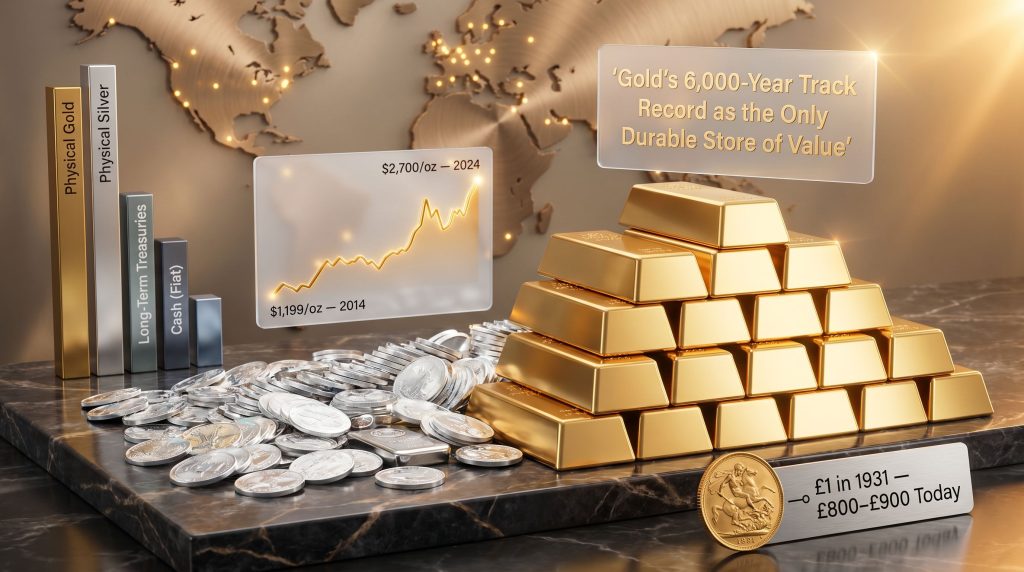
Consider a British gold sovereign. In 1931, that coin could be exchanged at any bank in the United Kingdom for one pound sterling. Today, replicating the same purchase in fiat terms requires approximately £800 to £900. No inflation chart fully captures what that number represents in lived human terms: a century of monetary debasement made tangible in a single small gold coin.
The same dynamic plays out in US dollar terms. A silver dollar, once worth exactly one dollar by legal definition, contains silver with a current market value of approximately $64. The coin has not changed. The currency around it has.
Over a twenty-year horizon in the United States, the purchasing power of gold relative to residential real estate has shifted dramatically. The quantity of physical gold required to purchase an average-priced American home twenty years ago, if held intact and applied to the same calculation today, would theoretically buy three times as much real estate at current gold-to-price ratios.
Research associated with John Hathaway of Sprott Asset Management has highlighted that gold, over the past 25 years, has outperformed the S&P 500 on a total purchasing power basis. Few mainstream financial advisers discuss it routinely, and fewer still incorporate it into client portfolio rationale.
Long-Term Benchmark: Gold appreciated from approximately $1,199 per ounce in early 2014 to over $2,700 per ounce by late 2024, representing roughly a 125 percent nominal increase over a decade. Adjusted for the actual erosion of purchasing power during that same period, the real return picture becomes even more compelling relative to asset classes that merely tracked inflation without exceeding it.
Inflation's Staying Power: Why the Long Bond Is Telling the Real Story
Central banks possess meaningful influence over short-duration interest rates, typically the zero-to-two-year range. They set policy rates, control reserve requirements, and can suppress yields at the short end through targeted asset purchases. What they cannot control with the same precision is the long end of the yield curve.
When the 30-year US Treasury yield breaches five percent, it is not the Federal Reserve making that decision. It is the collective judgment of bond markets around the world, pricing in real inflation expectations over multi-decade horizons. The long bond has recently traded at its lowest prices since 2020, a signal that the market is not yet convinced that inflation is fully contained.
The seven-year total return on a ten-year US government bond has, by some calculations, been effectively zero when accounting for the price depreciation caused by rising yields offsetting coupon income. Yet institutional capital continues flowing into long-duration government paper, partly by convention and partly because mandates require it. This inertia creates a structural misallocation that favours assets which do not depend on institutional convention to hold their value.
Why Silver Deserves Its Own Strategic Framework
Silver occupies a genuinely unique position among investable assets because it serves two distinct economic functions simultaneously. Furthermore, monitoring the gold-silver ratio can provide meaningful signals about the relative value of each metal at any given point in time.
As a monetary metal, silver shares gold's historical role as real money. The debasement story applies equally: a silver dollar that once purchased a dollar's worth of goods now contains silver worth approximately $64 at current market prices.
As an industrial commodity, silver has no equivalent substitute in many critical applications:
-
Photovoltaic solar panels require silver paste for electrical conductivity, and there is currently no commercially viable replacement at scale.
-
Electronics manufacturing depends on silver's unmatched thermal and electrical properties.
-
Medical applications exploit silver's natural antimicrobial characteristics.
-
Electric vehicle components and advanced battery technologies consume silver in quantities that are rising with each generation of design improvement.
This dual demand structure creates an industrial floor under silver prices that gold does not share. Even in periods of reduced monetary demand, industrial consumption continues absorbing supply.
A note for retail investors: silver's lower price per ounce makes physical accumulation accessible at entry points that gold cannot match. A meaningful allocation to physical silver can be built incrementally without the capital requirement of a full gold bullion purchase, making it a practical first step into tangible asset ownership. For broader guidance on getting started, this beginner's guide to precious metals investing offers a useful overview of the fundamentals.
The Bunker Hunt Lesson: Physical Ownership vs. Paper Exposure
One of the most instructive episodes in precious metals history occurred in the late 1970s when a single investor accumulated a physical silver position so large that, at peak prices, it made him arguably the wealthiest individual in the world at that time. The position was built through a combination of physical metal and derivative contracts.
When commodity exchange authorities changed the leverage rules governing silver futures contracts, the entire structure unwound catastrophically. The lesson is stark and permanent: paper-adjacent positions in precious metals, regardless of how well-conceived the original thesis, are subject to institutional rule changes that physical ownership is not. Exchange authorities can alter margin requirements overnight. They cannot alter the physical properties of metal sitting in a vault.
The distinction matters practically. Owning physical silver in an allocated account is categorically different from holding a leveraged silver futures position, even when both are responding to the same underlying price signal.
The next major ASX story will hit our subscribers first
Is Gold Better Than Stocks and Bonds Over the Long Term?
The honest answer requires separating time horizons and risk frameworks rather than declaring a categorical winner.
| Asset Class | Inflation Sensitivity | Counterparty Risk | Liquidity | Long-Term Purchasing Power |
|---|---|---|---|---|
| Physical Gold | Strong positive | None | High (global) | Proven over millennia |
| Physical Silver | Moderate positive | None | High | Strong with industrial demand |
| US Equities (S&P 500) | Mixed | Corporate/market | Very High | Valuation-dependent |
| Long-Term Treasuries | Negative | Sovereign | High | Eroded by inflation |
| Cash (Fiat) | Strongly negative | Systemic | Immediate | Structurally declining |
| Commodities Basket | Strong positive | Exchange | Moderate-High | Cyclical but resilient |
US household equity ownership is currently at or near record highs by most measures, meaning the average American portfolio has maximal exposure to the asset class at a point when valuations, by most traditional metrics, are at historically extreme levels. From a contrarian perspective, record ownership tends to coincide with limited remaining buyers rather than abundant future demand.
This does not mean equities should be abandoned. Selectively valued individual companies in sectors trading at rational multiples still offer compelling risk-adjusted returns. The argument is against undiscriminating equity index exposure at peak valuations, not against equities categorically.
The professional approach, as practised by managers focused on genuine capital preservation, typically involves a strict valuation discipline: modelling five-year earnings potential for each company, present-valuing those earnings, and purchasing only at a meaningful discount, often 20 percent or more below calculated intrinsic value.
The Commodity Supercycle Thesis: Where Hard Assets May Outperform for a Decade
Financial analysts and strategists with deep commodity expertise have articulated a framework sometimes described as heavy assets, low obsolescence, identifying a category of resources characterised by physical scarcity, limited technological displacement risk, and persistent structural demand.
The thesis holds that the next ten years may be defined by commodity outperformance relative to financial assets, a reversal of the dynamic that characterised the post-2009 equity bull market. If accurate, it has significant implications for portfolio construction.
The critical observation is this: most institutional portfolios currently hold near-zero direct commodity exposure. When an asset class is broadly underowned at the same time that supply constraints and demand growth are accelerating, the setup for significant price appreciation exists regardless of short-term sentiment fluctuations.
Geopolitical Reality: Why Central Banks Are Accumulating Gold
The de-dollarisation trend among sovereign nations is not a theoretical concern but an observable behaviour measurable in official reserve data. Consequently, central bank gold demand has become one of the most important structural forces shaping the precious metals market in the current decade.
Central banks, particularly in Asia and the Middle East, have been net buyers of gold for multiple consecutive years. The World Gold Council's quarterly demand data documents this shift in institutional terms.
The motivation is straightforward: gold is a neutral reserve asset that carries no sovereign counterparty risk. Holding US Treasuries requires trusting US institutions, US legal frameworks, and US political continuity. Holding physical gold requires none of those conditions to hold. For nations seeking independence from dollar-denominated financial architecture, gold is the logical alternative.
This sovereign accumulation creates a persistent baseline demand for physical metal that operates largely independently of retail investor sentiment, providing structural price support that was not present in earlier decades when central banks were net sellers.
How to Build a Precious Metals Position That Actually Works
The Capital Preservation Framework
Physical gold and silver function most effectively not as trading instruments but as monetary anchors within a broader portfolio designed around capital preservation. The moment an investor begins timing entries and exits on physical bullion, the discipline required to benefit from long-term purchasing power maintenance is undermined.
The practical implications for portfolio construction:
-
Allocation size: Institutional thinking generally suggests a baseline allocation of five to ten percent of total portfolio value in physical precious metals, with that percentage potentially increasing during periods of elevated systemic risk.
-
Storage diversification: Concentrating all physical metal in a single location introduces unnecessary risk. Distributing holdings across two or three secure locations, at least one of which is geographically separated from primary residence, is standard practice among serious long-term holders.
-
Gold bullion as currency, not trade: Ultra-high-net-worth investors and experienced wealth managers who genuinely understand the monetary function of gold typically do not sell their bullion positions when prices rise. They treat it as a currency reserve, not a speculative position.
-
Miners as a separate decision: Gold and silver mining equities offer leveraged exposure to metal prices and can deliver superior percentage returns during bull markets in bullion. However, they carry corporate risk, management risk, geopolitical risk, and valuation risk that physical metal does not. They warrant separate analysis and active management, including willingness to reduce or exit positions when valuations become extended.
The Generational Dimension
Physical precious metals have attributes that make them particularly suited to intergenerational wealth transfer: they are portable, globally recognised, not dependent on any institution's continued existence, and carry no ongoing administrative cost once stored securely. Unlike financial account structures that require legal documentation and institutional cooperation to transfer, physical bullion can pass between generations with minimal friction.
Teaching younger generations about the nature of real money, the history of currency debasement, and the distinction between nominal and real value is arguably one of the most durable financial education investments a family can make. For a detailed exploration of the pros and cons of gold and silver as investments, independent research provides valuable additional context. A silver dollar worth $64 in silver content, handed to a teenager with an explanation of why it no longer purchases a dollar's worth of goods, communicates monetary history more effectively than any textbook.
Frequently Asked Questions: Why Own Physical Gold and Silver
Is physical gold better than a gold ETF?
For genuine wealth preservation purposes, physical gold is structurally superior because it carries zero counterparty risk. A gold ETF tracks the price of gold but is ultimately a financial instrument dependent on fund manager solvency, cash settlement mechanics, and ongoing institutional operation. In systemic stress scenarios, precisely the environment where gold is most valuable, financial instruments can behave unexpectedly. Physical metal does not.
How much of my portfolio should be in physical gold and silver?
Conservative institutional frameworks typically suggest five to ten percent as a baseline, with allocations adjusted upward during periods of elevated monetary or geopolitical risk. The appropriate figure depends on individual risk tolerance, time horizon, and the composition of the rest of the portfolio.
Does silver outperform gold during precious metals bull markets?
Historically, silver tends to outperform gold during the later and more accelerated phases of precious metals bull markets, but it also tends to experience more severe drawdowns during corrections. Silver's dual monetary and industrial identity creates more price volatility than gold, which is primarily a monetary metal. This makes silver potentially more rewarding for actively managed positions but potentially more challenging for purely passive holders.
What happens to gold prices during a recession or market crash?
Gold in a recession does not behave uniformly across all economic contractions. During sharp liquidity crises, gold can initially sell off as investors raise cash across all asset classes. However, in sustained downturns accompanied by monetary easing, gold has historically performed strongly as central bank responses increase the money supply. The 2008 to 2011 period is a relevant case study, during which gold ultimately rose significantly even after an initial dip during the acute crisis phase.
What is the difference between allocated and unallocated gold storage?
Allocated storage means specific, individually identified bars or coins are held on behalf of the owner, legally separate from the custodian's balance sheet. Unallocated storage means the custodian holds a general pool of gold and the investor has a claim on a quantity of metal rather than specific identifiable pieces. Unallocated storage introduces custodian credit risk and, in theory, allows the custodian to use or lend the metal. Allocated, segregated storage is the only form of custody that eliminates counterparty exposure entirely.
Is now a good time to buy physical gold given current prices?
This is not financial advice. The appropriate question for long-term wealth preservation is not whether today's price is the optimal entry point but whether the structural conditions that support gold's purchasing power maintenance role remain intact. Those conditions — including monetary expansion, elevated debt levels, and persistent inflation pressures — are measured over years and decades, not days. Investors who delayed purchasing physical gold waiting for a better price have frequently watched the opportunity cost accumulate as the monetary backdrop continued to deteriorate.
Key Takeaways: The Strategic Case for Physical Gold and Silver
-
Millennia-tested store of value with no counterparty risk and no dependency on institutional solvency
-
Inflation and currency debasement hedge backed by structural monetary dynamics that show no signs of reversing under current fiscal trajectories
-
Portfolio anchor that has outperformed the S&P 500 over the past 25 years on a total purchasing power basis, according to analysis from Sprott Asset Management
-
Geopolitical insurance as sovereign reserve accumulation of gold accelerates globally and confidence in dollar-denominated instruments faces structural headwinds
-
Generational wealth vehicle that transfers real value across time without dilution, institutional dependency, or administrative complexity
-
Physical ownership removes exposure to the paper derivative risks, leverage rule changes, and institutional counterparty failures that cause most retail precious metals traders to lose capital
-
Silver's industrial demand floor provides a structural price support mechanism that monetary metals alone do not possess, making it a strategically distinct allocation alongside gold
For Further Context: Practitioners and investors seeking additional perspective on gold, silver, and macro wealth preservation frameworks can explore the Live from the Vault series produced by Kinesis Money, available on YouTube. The series features market commentary from industry professionals and provides ongoing context on precious metals markets from active trading and long-term investment perspectives.
This article is intended for informational and educational purposes only. Nothing contained herein constitutes financial, investment, legal, or tax advice. Past performance of any asset class, including precious metals, is not indicative of future results. Investors should conduct independent research and consult qualified financial professionals before making investment decisions. All price references and performance data should be verified against current market sources before reliance.
Want To Know Which ASX Mineral Discoveries Could Be the Next Wealth-Building Opportunity?
Discovery Alert's proprietary Discovery IQ model delivers real-time alerts on significant ASX mineral discoveries, instantly translating complex mineral data into actionable investment insights for both short-term traders and long-term investors. Explore how historic discoveries have generated extraordinary returns on Discovery Alert's dedicated discoveries page, and begin your 14-day free trial today to position yourself ahead of the broader market.