May 11, 2026
When Geopolitics Rewrites the Rules of Mineral Exploration Investing
For most of modern financial history, exploration-stage mining companies occupied a niche corner of capital markets, attracting specialist investors comfortable with geological uncertainty, long development timelines, and zero near-term cash flow. Institutional mandates rarely touched pre-revenue miners. Risk committees flagged them. Generalist funds avoided them entirely.
That framework is quietly fracturing. A structural shift in how governments, defence agencies, and technology manufacturers view mineral supply chains has begun redirecting serious institutional capital toward companies that would have been considered uninvestable a decade ago. The Rare Earths Americas IPO on NYSE American is one of the clearest examples yet of this transition playing out in real time on a major US exchange.
When big ASX news breaks, our subscribers know first
Understanding the Heavy Rare Earth Supply Chain Problem
Before analysing REA's market debut, it is worth understanding why heavy rare earth elements occupy a fundamentally different risk category to light rare earths, and why that distinction matters profoundly to investors. The strategic importance of rare earths has never been more pronounced than in the current geopolitical environment.
Rare earth elements are not actually rare in the geological sense. Cerium, lanthanum, and neodymium are more abundant in the earth's crust than many commonly mined metals. What creates supply vulnerability is not geological scarcity alone, but the combination of:
- Highly concentrated geographic distribution of economically viable deposits
- The technical complexity of separating individual rare earth elements from each other during processing
- Decades of Chinese investment in refining and separation infrastructure that Western nations largely chose not to replicate
- The physical characteristics of heavy rare earth elements, which are genuinely less abundant and occur in different geological environments to their lighter counterparts
Heavy rare earths such as dysprosium, terbium, holmium, europium, and gadolinium sit at the apex of strategic value within the rare earth family. They are essential to the highest-performance permanent magnets used in electric vehicle motors, precision-guided defence systems, and next-generation wind turbine generators. Unlike light rare earths, where some Western and allied-nation production capacity exists, the global supply of heavy rare earths is overwhelmingly controlled by a single nation.
This is the structural backdrop against which the Rare Earths Americas IPO on NYSE American must be evaluated.
The IPO Structure and What the Numbers Actually Reveal
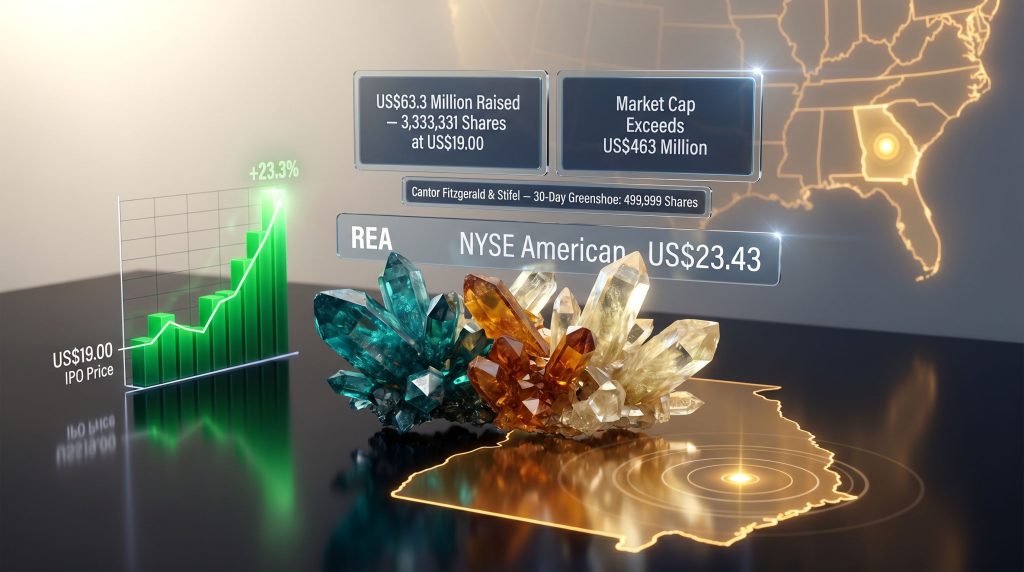
The mechanics of REA's capital raise tell an unusually compelling story for an exploration-stage company. The offering was initially sized at approximately US$50 million, a target that would already have been ambitious for a pre-revenue miner listing on a major US exchange. Instead, the final outcome significantly exceeded expectations.
| IPO Metric | Detail |
|---|---|
| Gross Proceeds Raised | US$63.3 million |
| Shares Issued | 3,333,331 |
| IPO Price per Share | US$19.00 |
| Pricing Position | Top of disclosed range |
| Overallotment Option | 499,999 additional shares (30-day window) |
| Underwriters | Cantor Fitzgerald and Stifel |
| Exchange | NYSE American |
| Trading Commencement | May 6, 2026 |
The upsizing from US$50 million to US$63.3 million represents a 26.6% increase in proceeds, which required expanding the share count, repricing assumptions, and managing additional allocations across the underwriting syndicate. For a company with zero revenue and a net loss of approximately US$9.93 million over the preceding 12 months, this outcome is genuinely unusual. Furthermore, the critical minerals demand surge sweeping Western markets has clearly contributed to the appetite investors showed for this offering.
The retention of a greenshoe option covering an additional 499,999 shares by Cantor Fitzgerald and Stifel signals that demand management remained a priority even after the upsizing. Greenshoe options exist precisely to stabilise post-IPO trading when demand exceeds supply, suggesting the underwriters were managing continued buying pressure at launch.
"An oversubscribed IPO at the top of the pricing range, for a pre-revenue exploration company, is a forward-looking market signal. The price being paid reflects strategic optionality and geopolitical positioning, not discounted cash flow analysis."
Company Profile: What REA Is Building and Where
Rare Earths Americas was founded in 2021 and is headquartered in Manchester, Georgia. At the time of its NYSE American listing, the company employed approximately 13 people and held no commercial production assets. Its classification as an exploration-stage company means that all value currently resides in the potential of its geological holdings rather than any existing production capacity.
The company operates a dual-asset strategy across two jurisdictions:
- The Shiloh Exploration District in Georgia, USA, its primary discovery-stage target
- The Alpha Project in Bahia, Brazil, its most technically advanced asset approaching initial economic assessment
REA's deliberate focus on heavy rare earth elements rather than the broader rare earth group is a strategic positioning choice that carries both higher potential rewards and a more complex geological and processing challenge.
Why Heavy Rare Earths Command a Structural Premium
The distinction between light and heavy rare earth elements is not merely academic. It has direct implications for pricing, supply availability, and strategic classification.
| Element Category | Key Members | Market Characteristics |
|---|---|---|
| Light Rare Earths (LREEs) | Cerium, Lanthanum, Neodymium, Praseodymium | More abundant; greater global supply diversity; lower per-unit strategic premium |
| Heavy Rare Earths (HREEs) | Dysprosium, Terbium, Holmium, Europium, Gadolinium | Geologically scarcer; supply heavily concentrated; highest strategic premium |
Heavy rare earth deposits occur in fundamentally different geological environments to light rare earths. Ionic clay deposits in southern China and certain other regions host disproportionate HREE concentrations. Outside China, confirmed, economically viable HREE deposits are extremely limited, which is precisely why the Shiloh district in Georgia is generating the level of investor attention it has received.
Post-IPO Trading Performance and Market Psychology
The trading behaviour of REA's shares in the days following its NYSE American debut offers insight into the type of investor participating in this equity story.
| Performance Metric | Figure |
|---|---|
| IPO Price | US$19.00 |
| First-Day Return | Effectively flat (stable open) |
| Post-IPO Trading Price | US$23.43 |
| Gain vs. IPO Price | +23.3% |
| Intraday High Recorded | Above US$24.00 |
| Maximum Implied Gain | +26% |
| Market Cap at IPO | ~US$349-379 million |
| Post-Rally Market Cap | Exceeds US$463 million |
The absence of a dramatic first-day price spike followed by a sustained, measured appreciation over subsequent trading sessions is a behavioural signature worth examining. Retail-driven IPO mania tends to produce sharp first-day moves followed by significant pullbacks as early holders lock in profits. The pattern observed with REA — a flat open followed by gradual accumulation to a 23-26% premium within the first week — is more consistent with institutional investors building positions deliberately and at disciplined price levels.
"When an exploration company with no revenue trades at a market capitalisation exceeding US$463 million, the price discovery process is entirely forward-looking. The market is assigning probability-weighted value to a potential discovery outcome, not current financial metrics. This creates legitimate upside scenarios alongside meaningful downside risk if drilling results disappoint."
For context, at US$463 million in market capitalisation, REA already exceeds the valuations of many small-cap mining companies with active production and positive operational cash flow. This inversion reflects a pure strategic asset premium, one that assumes exploration success, processing pathway execution, and sustained geopolitical tailwinds in Western rare earth supply chain development.
Investors should note that exploration-stage valuations of this magnitude carry inherently elevated downside risk if resource estimates fail to meet market expectations.
The Shiloh District: Georgia's 40-Year Geological Opportunity
The centrepiece of REA's investment thesis is the Shiloh exploration district in Georgia, a project targeting monazite-rich sand deposits and near-surface mineralisation that management believes could reshape the domestic US rare earth supply chain.
CEO Don Swartz has publicly noted that no genuinely novel rare earth discovery has occurred in the United States for approximately four decades. This statement frames the Shiloh project not simply as a mineral exploration programme, but as a potential generational discovery in a country that has allowed its domestic rare earth exploration capacity to atrophy significantly since the Cold War era.
Why Monazite Sand Deposits Are Geologically Attractive
Monazite is a phosphate mineral that naturally concentrates rare earth elements, particularly in heavy-mineral sand deposits formed through geological weathering and sedimentary sorting processes. Several characteristics of monazite-rich sand deposits make them strategically interesting for development:
- Near-surface occurrence reduces the capital intensity of extraction compared to deep hard-rock mining
- Sedimentary deposit types are often amenable to established mineral processing flowsheets used in the heavy mineral sands industry
- Processing compatibility with existing North American infrastructure, particularly facilities already equipped to handle phosphate-bearing minerals
- Reduced development timelines relative to underground or bulk-tonnage hard-rock rare earth projects
REA's management has articulated a capital allocation philosophy that prioritises Georgia over Brazil despite the Brazilian asset being more technically advanced. CEO Swartz described this as a deliberate asymmetry trade: the risk-adjusted return potential of a major discovery at Shiloh is significantly higher than the incremental value of progressing an already de-risked but lower-upside Brazilian deposit. In investor terms, this is a high-variance, high-expected-value bet concentrated in the US jurisdiction where a discovery would carry the greatest geopolitical and commercial premium.
The Domestic Processing Pathway
One of the more underappreciated elements of REA's strategy is its focus on producing rare earth concentrates compatible with existing North American processing infrastructure. Specifically, the company has referenced Energy Fuels' White Mesa Mill in Utah as a potential processing pathway for future REA concentrate production. The Energy Fuels critical minerals strategy has positioned White Mesa as a cornerstone of the emerging US rare earth processing ecosystem.
This approach is strategically significant for several reasons:
- It eliminates the need for REA to construct its own downstream refining and separation facility, which typically costs hundreds of millions of dollars and requires specialised expertise
- It provides a defined market pathway from exploration through to saleable product without requiring greenfield infrastructure investment
- It aligns REA's strategy with the existing North American rare earth processing ecosystem, which is attempting to rebuild capacity outside Chinese supply chains
- It makes the company's path to first revenue substantially shorter than vertically integrated rare earth development projects
The next major ASX story will hit our subscribers first
The Alpha Project in Brazil: De-Risking the Portfolio
While Georgia commands the majority of exploration capital based on its discovery asymmetry, REA's Alpha Project in Bahia, Brazil provides the portfolio with a technically de-risked counterbalance. This asset is REA's most advanced project and is progressing through engineering studies toward an SK-1300 preliminary economic assessment, the US securities standard equivalent of an initial economic scoping study.
The Ionic Clay Rare Earth Deposit Model
The Alpha project shares geological characteristics with ionic clay rare earth deposits, a deposit type that has attracted substantial attention within the rare earth development community for its processing simplicity. In ionic clay systems, rare earth elements are adsorbed onto clay mineral surfaces in weathered granites and can be recovered through relatively straightforward ion-exchange leaching processes, bypassing the energy-intensive cracking and separation steps required for primary mineral concentrates like monazite or bastnäsite.
CEO Swartz has drawn direct comparisons between Alpha's geological profile and projects developed by Aclara Resources and Serra Verde, two Brazilian ionic clay rare earth developers operating at different stages of development.
| Company | Country | Deposit Type | Current Stage |
|---|---|---|---|
| Rare Earths Americas (Alpha) | Brazil | Ionic clay / monazite | Engineering studies, pre-PEA |
| Aclara Resources | Brazil | Ionic clay | Advanced exploration / PEA stage |
| Serra Verde | Brazil | Ionic clay | Production stage |
Serra Verde's successful progression to production in Brazil is particularly relevant here. It validates the geological viability, regulatory pathway, and processing economics of the ionic clay model in the same country where REA's Alpha project is located. For institutional investors familiar with the South American rare earth narrative, Serra Verde's existence substantially de-risks the Brazilian regulatory and technical pathway that Alpha would need to follow.
Key Risk Factors: Balancing the Narrative with Financial Reality
The strategic narrative surrounding REA is compelling, however the financial reality demands clear-eyed assessment. Investors evaluating exposure to this stock should understand the following risk factors:
- Zero revenue and ongoing losses: REA reported no revenue and a net loss of approximately US$9.93 million in the 12 months preceding the IPO, implying an annualised cash consumption rate of roughly US$827,000 per month
- Short operating history: Founded only in 2021, REA has a limited track record across commodity cycles
- Exploration uncertainty: The Shiloh district's geological potential has not yet been confirmed through a complete drilling programme; resource estimates do not currently exist
- Single-outcome dependency: The post-IPO valuation is heavily influenced by Shiloh discovery expectations; disappointing drilling results would disproportionately impact the share price
- Further capital raises likely: Pre-revenue exploration companies with meaningful programmes in two jurisdictions will almost certainly require additional equity or debt financing beyond IPO proceeds
- Permitting timelines: Both US and Brazilian regulatory processes can extend project timelines unpredictably
| Factor | Nature | Assessment |
|---|---|---|
| US-China supply chain tensions | Tailwind | Elevates strategic value of Western HREE projects |
| Pre-revenue status | Risk | No operational cash flow; dilution risk from future raises |
| Shiloh discovery dependency | Risk | Valuation concentrated in unconfirmed geological outcome |
| Near-surface monazite geology | Tailwind | Reduces extraction complexity and capital requirements |
| White Mesa Mill processing pathway | Tailwind | Eliminates greenfield refinery capital requirement |
| 40-year US discovery drought | Tailwind | First-mover premium if discovery confirmed |
| Permitting and regulatory timelines | Risk | Both jurisdictions carry regulatory uncertainty |
| Ionic clay Brazilian precedents | Tailwind | Serra Verde validates Alpha's technical pathway |
Why the NYSE American Listing Strategy Matters
Most comparable exploration-stage rare earth developers have historically accessed capital through the Australian Securities Exchange (ASX) or the Toronto Stock Exchange (TSX), exchanges with established retail and institutional investor bases familiar with mining exploration risk. REA's decision to list directly on NYSE American represents a deliberate strategic departure from this convention.
The NYSE American listing is designed to target a specific category of US institutional investor: those with mandates tied to domestic supply chain security, defence-related critical materials, or clean energy transition infrastructure. These investors often face regulatory or ESG-framework constraints that limit their ability to invest in foreign-listed mining explorers, making a US exchange listing a meaningful access enabler.
China currently controls an estimated 60-70% of global rare earth mining output and a substantially higher proportion of separation and processing capacity. China's rare earth strategy has long leveraged this dominance as both an economic and geopolitical instrument. The US and European Union have both formally designated rare earth elements as critical minerals, establishing policy frameworks aimed at incentivising domestic and allied-nation supply development.
This designation creates a category of institutional investor for whom HREE exposure is not a speculative bet but a strategic portfolio requirement aligned with broader supply chain resilience mandates. REA is positioning itself precisely at this intersection of geological optionality and institutional mandate alignment.
Frequently Asked Questions: Rare Earths Americas IPO on NYSE American
What exchange does Rare Earths Americas trade on?
Rare Earths Americas, ticker symbol REA, trades on the NYSE American exchange, with trading commencing on May 6, 2026.
How much did Rare Earths Americas raise in its IPO?
The company raised US$63.3 million in gross proceeds through the issuance of 3,333,331 shares at US$19.00 per share, representing an upsizing from an initial target of approximately US$50 million.
What is the Shiloh district and where is it located?
The Shiloh exploration district is REA's flagship heavy rare earth project, located in Georgia, USA. It targets near-surface, monazite-rich sand deposits and represents the primary discovery-stage asset within REA's portfolio.
Does Rare Earths Americas generate any revenue?
No. At the time of its IPO, REA was an exploration-stage company with zero revenue, reporting a net loss of approximately US$9.93 million over the prior 12-month period.
Who underwrote the REA IPO?
The offering was underwritten by Cantor Fitzgerald and Stifel, with a 30-day overallotment option retained for an additional 499,999 shares.
What will proceeds from the IPO be used for?
Funds are allocated toward land acquisition at and around Shiloh, drilling programmes, metallurgical test work, permitting activities across both US and Brazilian projects, and general corporate and operational expenses.
Why is a rare earth discovery in the US considered so strategically significant?
Management has indicated that no new heavy rare earth discovery has occurred in the United States for approximately 40 years. A confirmed, commercially viable deposit at Shiloh would provide a domestic feedstock option for existing North American processing infrastructure and could catalyse further exploration investment across the southeastern United States. The rare earth processing challenges that have historically limited Western supply chain development make this domestic processing pathway all the more valuable.
What the REA Listing Tells Us About the Broader Rare Earth Investment Cycle
The Rare Earths Americas IPO on NYSE American is more than a single company's capital raise. It represents a data point in a larger pattern: institutional capital is increasingly willing to fund pre-revenue, exploration-stage companies in strategic mineral categories at valuations that would have been considered extraordinary under conventional fundamental analysis.
Several structural conclusions can be drawn from how this IPO was received:
- Oversubscription and upsizing at the top of the pricing range signals that institutional demand for Western HREE exposure is outpacing available investable vehicles
- Sustained post-IPO appreciation toward 23-26% above the IPO price within the first week reflects continued accumulation rather than speculative flipping
- A market capitalisation exceeding US$463 million for a zero-revenue explorer reflects pure strategic asset valuation, with investors pricing probability-weighted discovery outcomes
- REA's dual-asset structure provides exposure to both a high-variance US discovery play and a more technically progressed Brazilian ionic clay project, offering two distinct risk-return profiles within a single listed vehicle
- The explicit strategy of producing concentrates for existing North American processing infrastructure materially reduces the capital barrier to first production and compresses the theoretical timeline from exploration to revenue
Investors seeking further detail on REA's stock performance and current trading data can access live market information through dedicated financial platforms.
This article is for informational purposes only and does not constitute financial advice. Exploration-stage companies carry significant investment risk, including the possibility of total capital loss. Investors should conduct their own due diligence and consult qualified financial advisers before making investment decisions. Past trading performance does not guarantee future results.
Want to Track the Next Major Mineral Discovery Before the Broader Market?
Discovery Alert's proprietary Discovery IQ model delivers real-time alerts on significant ASX mineral discoveries, transforming complex geological data into actionable investment insights for both short-term traders and long-term investors — explore historic discovery returns on Discovery Alert's dedicated discoveries page to understand the magnitude of returns major finds can generate, then begin your 14-day free trial to position yourself ahead of the market.