May 11, 2026
When Geopolitics Becomes the Market: Understanding Oil's New Pricing Regime
Energy markets spent decades building sophisticated models around supply fundamentals, inventory cycles, and demand elasticity. Spare capacity calculations, refinery utilisation rates, and seasonal consumption patterns formed the bedrock of price discovery. What the sustained disruption to Strait of Hormuz transit has exposed in 2026 is that these frameworks, while not obsolete, have been subordinated to something far less predictable: the daily rhythm of diplomatic signalling between Washington and Tehran.
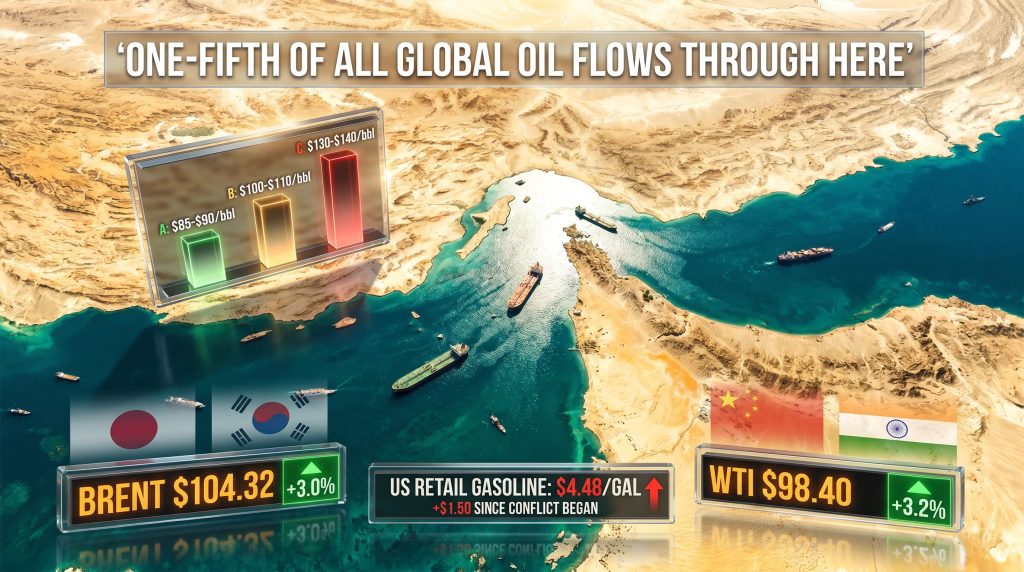
The week ending 9 May 2026 saw Brent crude fall roughly 6% on optimism that a ceasefire framework was within reach. Oil rises after Trump rejects Iran's response to the US peace proposal, and a single public statement declaring it unacceptable reversed that entire move in a single session. Brent climbed $3, or 3%, to $104.32 a barrel by mid-morning London time on 11 May. WTI followed closely, rising $3, or 3.2%, to $98.40 a barrel, after touching intraday highs of $105.99 and $100.37 respectively. This is not conventional oil market behaviour. It is something closer to political options pricing, where the underlying asset is a diplomatic outcome rather than a physical barrel.
"The prior week's 6% price decline was not driven by any actual improvement in supply conditions. It was driven entirely by diplomatic sentiment. The subsequent reversal illustrated, with uncomfortable clarity, how completely geopolitical narrative has displaced physical fundamentals as the primary driver of near-term crude pricing."
Furthermore, for a broader perspective on how trade disputes compound these dynamics, the trade war oil impact on global energy markets provides important context for understanding how quickly sentiment can shift prices.
When big ASX news breaks, our subscribers know first
The Strait of Hormuz: Geography as Destiny
To understand why oil rises after Trump rejects Iran's response to the US peace proposal with such immediate force, one must first appreciate the structural reality of the waterway at the centre of the conflict. The Strait of Hormuz, at its narrowest point measuring approximately 33 kilometres between Oman and Iran, functions as the single most concentrated energy transit corridor on the planet.
According to US Energy Information Administration data, roughly one-fifth of all globally traded petroleum liquids pass through this passage under normal conditions, alongside approximately 30% of the world's seaborne LNG trade. The latter figure reflects Qatar's dominant position as a Gulf-based exporter. No alternative routing exists at commercial scale for Persian Gulf producers.
The Suez Canal's maximum throughput capacity sits at approximately 2 million barrels per day for oil traffic, against Persian Gulf export volumes exceeding 20 million barrels per day. The economics of double-transshipment via alternative routes are prohibitive even before factoring in the insurance implications of conflict-zone rerouting. In addition, the global LNG supply outlook illustrates just how exposed seaborne LNG trade has become under these conditions.
The hierarchy of exposed nations reflects decades of accumulated import dependency:
- Japan sources approximately 75–80% of crude requirements from the Middle East
- South Korea draws roughly 70% of its oil imports from the region
- India relies on Middle Eastern origins for approximately 60–65% of crude supply
- China sources 45–50% of crude from the Gulf, with diversification ongoing
- Pakistan depends on Gulf producers for approximately half of its energy mix
This concentration of critical import dependency among Asia's largest economies through a single 33-kilometre bottleneck represents a structural vulnerability that energy security planners have long flagged but never fully resolved. The 2026 conflict has transformed that theoretical vulnerability into an operational crisis.
The Hidden Cost of No Bypass: War Risk Insurance and Tanker Economics
One dimension of the Hormuz disruption that receives insufficient attention in headline price analysis is the functioning of maritime war risk insurance markets. When a vessel transits a conflict-designated zone, hull and cargo insurers apply war risk premiums that can multiply standard coverage costs by factors of five to ten or more. These elevated premiums do not disappear the moment a ceasefire is announced.
Underwriters require demonstrated safety track records, typically measured over weeks or months of incident-free transit, before repricing downward. This insurance premium dynamic creates a structural cost floor for Gulf crude delivered to Asian buyers that persists well beyond any diplomatic breakthrough.
Three tankers carrying crude exited the strait during the final days before 11 May with their tracking systems disabled, according to Kpler shipping data, including one loaded with Iraqi crude bound for Vietnam. The decision to disable vessel tracking, while operationally understandable given the threat environment, introduces additional freight and insurance complications that compound the baseline cost increases already embedded in Gulf oil delivery.
Ten Weeks of Conflict: Quantifying the Supply Damage
Saudi Aramco's chief executive stated on 11 May that global energy markets had lost approximately 1 billion barrels of cumulative oil supply over the roughly ten weeks of conflict, and that stabilisation would take time even after flows resumed. Saudi Aramco separately confirmed it could reach 12 million barrels per day of production capacity within three weeks if circumstances required — a deliberate signal of latent reserve capacity designed to anchor price expectations from above.
The scale of the cumulative shortfall places this disruption in rare historical company. The 1973 Arab oil embargo removed approximately 5 million barrels per day for several months, producing roughly 50% real price increases and triggering a global recession. The 1979 Iranian Revolution effectively eliminated Iranian export capacity temporarily, causing prices to roughly triple from their pre-revolution baseline.
However, the market signal is complicated by a simultaneous contradiction. Saudi Arabia, the world's swing producer and the entity best positioned to partially offset Gulf supply losses, is experiencing declining crude export volumes to China in June. Trade sources cited by Reuters noted that Chinese buyers were cutting purchase nominations due to elevated conflict-linked pricing and reduced availability. The world's largest bilateral crude trade relationship is contracting precisely when it would be needed most.
The Anatomy of a Failed Peace Framework
Why Did Talks Collapse?
Understanding why the US-China oil tensions and broader geopolitical fault lines matter here requires examining what each party actually proposed and why the gap proved unbridgeable in the near term.
The US framework centred on a 30-day partial suspension of its port blockade on Iran, structured as a tactical confidence-building measure rather than a comprehensive settlement. Pakistan was proposed as a neutral facilitating party, drawing on historical precedent from the 1979–1981 hostage crisis negotiations.
Iran's reported counter-demands reflected a fundamentally different assessment of what the conflict had already established:
- Complete cessation of hostilities rather than a temporary operational pause
- Compensation for war-related damages accumulated during the conflict period
- Full removal of oil export sanctions as a precondition to negotiation, not an outcome
- Explicit recognition of Iranian sovereignty over the Strait of Hormuz corridor
The structural incompatibility is evident. Washington offered a tactical pause leading toward eventual strategic negotiation. Tehran demanded strategic outcomes as prerequisites for any tactical pause. According to Reuters, analysts at PVM Oil Associates characterised the positions as being as far apart as when ceasefire discussions first began, noting no meaningful change was likely before Trump's Beijing visit.
This negotiating gap reflects a pattern well-documented in conflict resolution literature. Parties that believe their leverage will diminish through de-escalation resist tactical confidence-building measures that do not lock in their current positional advantages.
JPMorgan's Sticky Price Thesis: Why a Ceasefire Is Not a Price Reset
The market assumption embedded in the prior week's 6% decline was straightforward: ceasefire equals reopening, reopening equals price normalisation. JPMorgan analysts have explicitly challenged this linear framing, projecting that oil prices will remain in the low $100s for most of the remainder of 2026, averaging approximately $97 per barrel for the full year.
The sticky price argument rests on several converging mechanisms:
| Recovery Factor | Estimated Timeline | Price Implication |
|---|---|---|
| Physical inventory rebuild cycles | 2–4 months post-reopening | Sustained import demand at premium prices |
| Tanker repositioning and scheduling | 4–8 weeks | Elevated freight costs reduce netback prices |
| War risk insurance premium normalisation | 2–6 months minimum | Structural cost floor on delivered Gulf crude |
| Supply contract renegotiation | Multi-month cycles | Buyers locked into alternative sources at premium terms |
| Speculative positioning unwind | Weeks to months | Gradual rather than sudden price compression |
The cumulative inventory deficit of approximately 1 billion barrels cannot be replenished instantaneously even at maximum production rates. If global spare capacity could theoretically supply an additional 3–4 million barrels per day above current output, closing that deficit at that rate would still require six to twelve months. During that period, buyers competing for available supply maintain persistent upward price pressure.
"JPMorgan's framework explicitly cautions that reopening the Strait of Hormuz will not produce immediate price normalisation. The supply chain dislocations, inventory deficits, and rerouting costs built up over ten weeks will take months to unwind regardless of the diplomatic outcome."
Diamondback's Hedge: What US Producers Know That Markets Are Not Pricing
Among the more technically significant market developments of the disruption period is a hedging position taken by US independent producer Diamondback Energy. The company purchased options to sell the WTI-Brent price differential at approximately minus $42 per barrel in coming months, according to Reuters reporting. Consequently, monitoring WTI-Brent spread dynamics has become essential for any investor tracking this environment.
This trade structure reveals sophisticated scenario modelling occurring within the US producer community. Under normal conditions, WTI trades at a modest discount to Brent, typically $2–$6 per barrel. A minus $42 WTI-Brent spread would represent a historically extreme divergence, only achievable through a specific policy intervention: a ban on US crude oil exports.
The mechanism would function as follows:
- A US export ban prevents domestic crude from reaching international markets
- US refiners face accumulating domestic inventories
- Excess domestic supply depresses WTI prices relative to internationally-traded Brent
- The WTI-Brent spread widens dramatically, potentially to minus $40 or beyond
- Diamondback's option position profits proportionally to this spread widening
The existence of this hedge signals that sophisticated US energy producers are modelling a domestic export ban as a credible policy scenario. With US retail gasoline averaging $4.48 per gallon by May 2026 — up approximately $1.50 since the conflict began — the administration faces intensifying domestic pressure to take visible action on fuel costs.
The next major ASX story will hit our subscribers first
The Beijing Variable: China's Leverage and Its Limits
President Trump's scheduled arrival in Beijing on Wednesday, 13 May, introduces the most significant diplomatic variable remaining in the near-term resolution framework. US officials confirmed that Iran would be among the topics raised with President Xi Jinping, elevating the summit into a potential trilateral pressure mechanism on Tehran.
China's leverage over Iran is structural and multi-dimensional:
- China has functioned as Iran's largest crude oil customer throughout the sanctions period
- Chinese financing and infrastructure investment under Belt and Road frameworks created durable economic interdependencies
- China participated in JCPOA negotiation history, establishing institutional familiarity with Iranian negotiating positions
- China's own energy security depends on Gulf stability, creating convergent interests with a resolution
However, Beijing's willingness to pressure Iran is constrained by its broader strategic interest in maintaining relationships with non-Western actors and its resistance to being seen as an instrument of US foreign policy objectives.
Three Scenarios for the Road Ahead
| Scenario | Brent Price Range | Timeline | Key Condition |
|---|---|---|---|
| A: Beijing-Mediated Ceasefire Framework | $85–$90/bbl | 4–6 weeks post-agreement | China applies sustained pressure; US offers meaningful economic relief to Tehran |
| B: Prolonged Diplomatic Stalemate | $100–$110/bbl | Through Q3 2026 | Back-channels active but no framework agreement |
| C: Military Escalation, Full Closure | $130–$140/bbl | Immediate upon trigger | Infrastructure strike forces both parties into irreversible positions |
Scenario B currently carries the highest probability weight based on the negotiating gap analysis. The distance between a 30-day partial blockade suspension and full sanctions removal as a precondition is not closeable through confidence-building sequencing alone.
Asian Supply Diversification: The Structural Reshaping Underway
While diplomatic scenarios play out, the physical supply chain is being rewired in real time. Japan's industry ministry confirmed that a tanker carrying Azerbaijani crude was expected to arrive as early as 13 May, marking the first Central Asian cargo received since the conflict began. Azerbaijani crude transits via the Baku-Tbilisi-Ceyhan pipeline to Turkish Mediterranean terminals, a routing that completely bypasses the Persian Gulf.
These diversification flows carry both immediate and long-term implications:
- Immediate: Alternative supply sources command significant premiums over pre-conflict Gulf pricing
- Medium-term: Buyers locking in multi-month alternative supply contracts will not immediately revert to Gulf sources even after reopening
- Long-term: The demonstrated vulnerability of Gulf-dependent supply chains is accelerating strategic reserve investments and energy transition timelines among the most exposed importing nations
For a comprehensive view on how pricing is evolving across grades and regions, the current crude market overview provides essential context. As reported by The Guardian, the contraction of Saudi crude flows to Chinese buyers is particularly telling from a market structure perspective, as the traditional price-clearing mechanism for excess Gulf supply is being impaired at precisely the wrong moment.
The Domestic US Energy Paradox and Its Investment Implications
The $4.48/gallon average US retail gasoline price as of May 2026 represents more than a consumer inconvenience. It is a direct political liability for the administration sustaining the military posture driving the disruption. Historically, US presidential approval ratings show strong negative correlation with retail gasoline prices exceeding $4/gallon, a relationship documented across multiple administrations since the 1970s.
For investors, the practical takeaways from this environment extend beyond directional crude positioning:
- Energy producer hedging strategies now incorporate explicit policy scenario modelling, as demonstrated by Diamondback's spread options trade
- Refinery margin dynamics in the US versus Europe and Asia have diverged significantly, creating cross-regional equity valuation spreads worth monitoring
- Tanker and shipping equities are experiencing elevated earnings from war-risk premium freight rates that will persist beyond any ceasefire due to insurance market lag dynamics
- Alternative supply geography equities, including Azerbaijani and Central Asian producers and their pipeline infrastructure operators, are seeing structural demand increases that may persist even after Gulf flows normalise
The broader lesson the 2026 disruption is delivering to energy markets is that the geopolitical risk premium, long treated as a temporary overlay on fundamental price discovery, has become a semi-permanent structural component of crude pricing. In a world where a 33-kilometre strait can simultaneously impair supplies to Japan, South Korea, India, China, and Pakistan, the vulnerability is not a tail risk to be hedged around. It is the central operating condition of global energy markets.
This article is intended for informational purposes only and does not constitute financial advice. Oil price forecasts and diplomatic scenario projections involve significant uncertainty and should not be relied upon as the basis for investment decisions. Past price movements during geopolitical disruptions are not necessarily indicative of future outcomes. Readers should conduct independent research and consult qualified financial advisers before making investment decisions.
Want To Stay Ahead of Market-Moving Discoveries in the Energy and Resources Sector?
Discovery Alert's proprietary Discovery IQ model delivers real-time alerts on significant ASX mineral discoveries — cutting through the complexity of 30-plus commodities into clear, actionable insights for both short-term traders and long-term investors. Explore how historic discoveries have generated substantial returns and begin your 14-day free trial at Discovery Alert to secure a market-leading edge before the broader market moves.