August 6, 2026
Understanding the Fundamentals of Alternative Actuator Technologies
Industrial automation has reached a critical juncture where traditional electromagnetic systems face unprecedented supply chain vulnerabilities. The global magnetic actuator industry, valued at approximately $15.2 billion in 2024, depends heavily on neodymium-iron-boron (NdFeB) permanent magnets sourced primarily from Chinese-controlled supply chains. This concentration creates systemic risks that extend far beyond simple procurement challenges.
Rare-earth-free actuators represent electromagnetic motion control systems that eliminate dependence on neodymium, dysprosium, and other critical rare earth elements while maintaining comparable performance characteristics. These systems achieve electromagnetic torque generation through alternative magnetic materials including iron nitride compounds, reluctance-based designs, and ferrite-assisted architectures.
Performance metrics for these alternative technologies focus on three critical parameters:
• Torque density: Measured in Newton-meters per kilogram (Nm/kg), representing the rotational force output relative to system weight
• Efficiency ratings: Electromagnetic conversion efficiency typically ranging from 85-94% depending on the technology approach
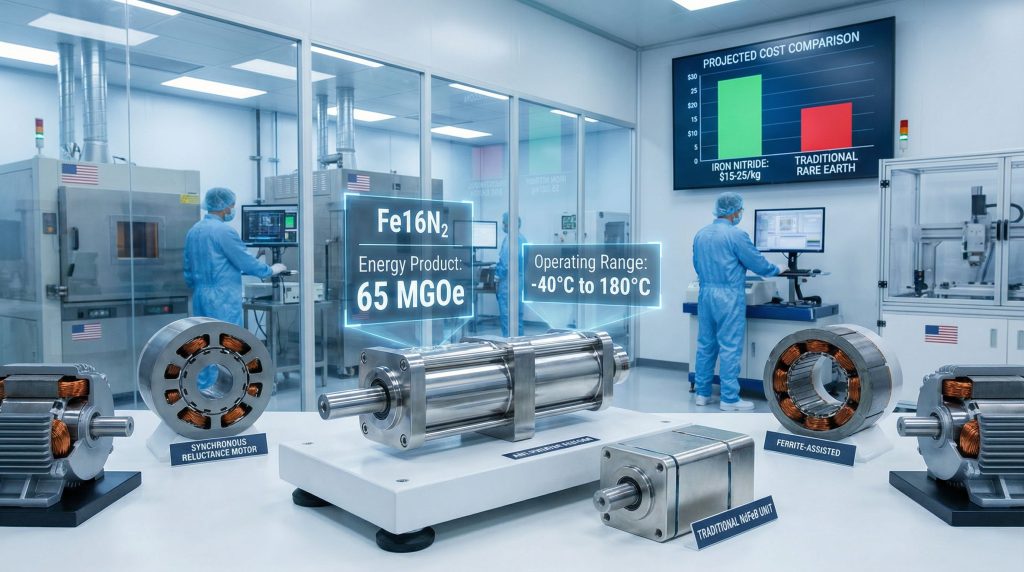
• Operating temperature ranges: Extended thermal stability from -40°C to 180°C in advanced iron nitride systems
| Technology Type | Torque Density (Nm/kg) | Efficiency Range | Temperature Range |
|---|---|---|---|
| Traditional NdFeB | 12-18 | 90-95% | -20°C to 80°C |
| Iron Nitride | 10-15 (projected) | 88-92% | -40°C to 180°C |
| Synchronous Reluctance | 8-12 | 92-94% | -30°C to 120°C |
| Ferrite-Assisted | 9-14 | 89-93% | -20°C to 100°C |
When big ASX news breaks, our subscribers know first
The Strategic Imperative Behind Supply Chain Diversification
China's dominance in rare earth element processing creates a fundamental strategic vulnerability for critical infrastructure systems. According to the U.S. Geological Survey's 2024 Critical Minerals Summary, China processes approximately 85-90% of global rare earth elements despite holding only 37% of known reserves. This processing concentration extends to downstream magnet manufacturing, where Chinese facilities control an estimated 80-90% of global NdFeB magnet production capacity.
Furthermore, the implications of this concentration extend across multiple sectors, including critical minerals energy security considerations that affect broader industrial transformation initiatives.
Price volatility analysis reveals significant cost fluctuations across rare earth elements between 2020-2025. Neodymium oxide prices experienced swings from $45 per kilogram in early 2020 to peaks exceeding $120 per kilogram in 2021, before stabilising around $65-85 per kilogram through 2024. These fluctuations directly impact actuator manufacturing costs and create budgetary uncertainty for defense procurement programs.
Export licensing controls implemented throughout 2024-2025 have tightened access to processed rare earth materials, creating additional procurement complexity for defence and aerospace applications requiring consistent supply availability.
Geopolitical risk assessment for defence applications reveals multiple vulnerability layers. Beyond raw material access, the specialised processing expertise required for high-performance magnets remains concentrated in Chinese facilities. This technical knowledge transfer represents a decades-long development process that cannot be rapidly replicated in alternative geographic locations.
Iron Nitride Technology Deep Dive
Iron nitride magnets utilise Fe₁₆N₂ molecular structures to achieve magnetic properties approaching traditional rare earth magnet performance without requiring critical mineral inputs. The interstitial nitrogen atoms in the iron lattice create enhanced magnetic anisotropy, enabling theoretical energy product capabilities in the 32-48 megagauss-oersteds (MGOe) range.
Manufacturing processes for iron nitride magnets involve sophisticated powder metallurgy techniques followed by controlled atmosphere sintering. The production sequence requires:
• Nitrogen gas processing: High-purity nitrogen introduction during powder formation stages
• Temperature control: Precise thermal management during sintering between 150-200°C
• Atmosphere management: Inert gas environments to prevent oxidation during processing
• Magnetic field orientation: Applied magnetic fields during consolidation to achieve preferred crystal orientation
Performance validation testing demonstrates temperature stability across extended ranges. Unlike NdFeB magnets, which experience significant coercivity degradation above 80°C, iron nitride compounds maintain magnetic properties through 180°C operational temperatures. This thermal stability proves critical for aerospace applications where extreme temperature cycling occurs regularly.
Coercivity measurements under operational stress show iron nitride maintaining intrinsic coercivity values above 800 kA/m across the extended temperature range. Remanence values remain stable at 85-92% of room temperature measurements even under sustained high-temperature exposure.
Current production capabilities centre on Minneapolis-based facilities operated by Niron Magnetics, representing the primary domestic source for high-performance iron nitride magnets. Production scale remains limited compared to established NdFeB manufacturing, with current capacity estimated in hundreds of kilograms annually rather than the thousands of tons produced by Chinese NdFeB facilities.
Synchronous Reluctance Motor Systems
Reluctance torque generation operates on the fundamental principle that magnetic flux seeks the path of least resistance (reluctance). Synchronous reluctance motors achieve electromagnetic torque by creating rotor geometries with variable reluctance patterns. As the rotor rotates, changing reluctance values generate torque without requiring permanent magnet materials.
The rotor design incorporates laminated steel construction with strategically placed flux barriers. These barriers create areas of high magnetic reluctance alternating with low reluctance paths. When stator windings energise, magnetic flux flows preferentially through low reluctance paths, creating rotational forces as the rotor seeks optimal alignment positions.
Software-controlled flux management systems enable dynamic optimisation of magnetic field patterns. Modern variable frequency drives (VFDs) provide real-time control over stator current magnitude and timing, maximising torque output whilst minimising losses. This control sophistication compensates for the inherently lower torque density compared to permanent magnet systems.
Industrial automation applications benefit from reluctance motor characteristics including:
• Cost advantages: Elimination of rare earth material costs reduces motor manufacturing expenses by 15-25%
• Temperature resilience: No permanent magnet demagnetisation risk enables operation in high-temperature environments
• Control flexibility: Variable reluctance allows dynamic torque characteristics through software adjustment
• Maintenance benefits: No permanent magnet degradation extends operational lifetime in harsh environments
Precision positioning applications in CNC machining systems demonstrate reluctance motor viability. Modern CNC spindle motors using synchronous reluctance designs achieve positioning accuracy within ±0.05 degrees whilst maintaining rapid acceleration rates exceeding 500 rad/s².
Ferrite-Assisted Synchronous Reluctance Motors (Fas-SynRM)
Hybrid design approaches combine reluctance torque generation with ferrite magnet assistance to improve overall system performance. Ferrite magnets, composed of ceramic iron oxide compounds, provide baseline magnetic flux without rare earth element content. The combination achieves higher torque density than pure reluctance systems whilst maintaining supply chain independence.
Performance benchmarking indicates efficiency ratings between 92-94% across typical industrial load profiles. The hybrid approach optimises magnetic flux distribution, reducing current requirements for equivalent torque output compared to pure reluctance designs. This efficiency improvement translates to reduced power consumption and heat generation during operation.
Cost advantage analysis reveals significant economic benefits relative to NdFeB permanent magnet motors. Ferrite materials cost approximately $2-5 per kilogram compared to $45-85 per kilogram for rare earth magnet materials. The manufacturing process complexity increases slightly due to hybrid design requirements, but total material costs decrease by 35-50% for equivalent power ratings.
Integration challenges include increased control system complexity and higher power electronics requirements. The variable magnetic field characteristics require sophisticated vector control algorithms and position feedback systems. However, these control requirements are manageable with modern digital signal processing capabilities.
Electrically Excited Synchronous Machines
Field winding control systems replace permanent magnets with electromagnets energised through controlled current injection. This approach provides variable magnetic field strength through real-time adjustment of field current levels. Unlike permanent magnet systems with fixed magnetic properties, electrically excited machines offer dynamic magnetic field control.
The operational principle involves separate field windings mounted on the rotor or stator structure. DC current flowing through these windings creates the magnetic field necessary for electromagnetic torque generation. Variable field current enables torque characteristic adjustment across different operating conditions.
Modular design benefits include simplified maintenance procedures and component replacement capabilities. Field windings can be serviced or replaced without requiring complete motor rebuilding. This modularity proves valuable in aerospace applications where maintenance access may be limited and component reliability is critical.
Power electronics integration requires field supply units providing controlled DC current to field windings. Modern solid-state controllers enable precise field current regulation with response times under 10 milliseconds. This rapid control capability supports dynamic torque adjustment for precision positioning applications.
The next major ASX story will hit our subscribers first
Defence and Aerospace Applications
The collaboration between Niron Magnetics and Moog Inc. centres specifically on guided munitions actuator development, representing a critical application segment for rare-earth-free technologies. Guided munitions require actuator systems capable of operating under extreme acceleration loads, temperature variations, and electromagnetic interference conditions.
Supply chain security concerns have intensified following tightened export licensing across 2024-2025. China's dominant position in NdFeB magnet manufacturing creates strategic vulnerabilities for defence systems requiring consistent material availability. Defence contractors increasingly view supply chain diversification as essential for operational security rather than merely cost optimisation.
Moreover, recent developments in the critical minerals executive order highlight the strategic importance of developing domestic capabilities in advanced manufacturing technologies.
Actuator performance requirements for guided munitions include:
• Shock resistance: Survival under acceleration loads exceeding 20G during launch sequences
• Response time: Sub-100 millisecond positioning for course correction manoeuvres
• Temperature stability: Operation from -40°C to +85°C across flight profiles
• Electromagnetic compatibility: Function in high-interference environments without performance degradation
• Reliability standards: Mean time between failure (MTBF) exceeding 10,000 operating hours
Qualification testing standards for military applications require extensive validation protocols including MIL-STD-810 environmental testing and MIL-STD-461 electromagnetic compatibility verification. Rare-earth-free actuators currently undergo these qualification processes through the Moog partnership, representing a multi-year validation timeline before operational deployment.
Additionally, the development of rare-earth-free permanent magnets by research institutions demonstrates growing momentum in alternative magnet technologies for industrial applications.
Moog Inc.'s involvement demonstrates institutional recognition of supply chain vulnerability. The company designs actuators for F/A-18 Super Hornet aircraft, AH-64 Apache helicopters, and Patriot missile systems. Their investment in rare-earth-free alternatives indicates strategic prioritisation of supply security over short-term cost considerations.
Industrial Automation and Robotics
The global industrial robotics market, valued at $31.6 billion in 2023 with projected growth at 10.5% CAGR through 2030, represents a significant adoption pathway for rare-earth-free actuators. Industrial applications offer lower risk validation environments compared to defence systems whilst maintaining stringent performance requirements.
This growth aligns with broader trends in mining industry evolution, where automated systems increasingly require reliable actuation technologies. Furthermore, the integration of AI in mining operations demonstrates the expanding role of precision control systems in industrial applications.
Precision positioning applications in manufacturing environments demonstrate clear technical requirements for actuator systems:
• Repeatability: ±0.1 degree positioning accuracy for assembly operations
• Duty cycle: Continuous operation capability over 8,000+ hour periods
• Dynamic response: Acceleration rates supporting rapid production cycle times
• Environmental tolerance: Operation in industrial temperature and contamination conditions
Servo motor replacement strategies focus on CNC machining systems where reluctance-based actuators can provide equivalent performance at reduced material costs. The global servo motor market, valued at $8.2 billion in 2023, represents substantial opportunity for rare-earth-free alternatives in high-volume manufacturing applications.
Cost-benefit analysis for manufacturing operations considers total cost of ownership including initial capital, energy consumption, and maintenance requirements. Reluctance motors typically require 20-40% higher initial investment due to control system complexity but provide 15-25% lower material costs through rare earth elimination.
Manufacturing Cost Analysis Framework
Material cost comparisons across actuator technologies reveal significant variations in raw material expenses and processing requirements. The following analysis examines current market pricing and projected cost structures for alternative technologies:
| Technology Type | Raw Material Cost/kg | Processing Complexity | Production Scale | Market Readiness |
|---|---|---|---|---|
| NdFeB Magnets | $45-85 | Medium | High Volume | Commercial |
| Iron Nitride | $15-25 (projected) | High | Pre-Commercial | Development |
| Ferrite Magnets | $2-5 | Low | Very High Volume | Established |
| Reluctance Motors | $8-12 | Medium | Medium Volume | Commercial |
Processing complexity significantly impacts total manufacturing costs beyond raw material expenses. Iron nitride production requires specialised atmospheric control and temperature management systems, increasing capital equipment requirements. However, the elimination of rare earth material costs provides substantial long-term cost advantages once production scales achieve commercial volumes.
Total cost of ownership considerations include operational efficiency impacts on energy consumption throughout the actuator lifecycle. Reluctance-based systems typically consume 5-10% higher electrical power compared to optimised permanent magnet motors, but this operational penalty decreases as control algorithms improve and power electronics efficiency increases.
Initial capital investment requirements for production equipment vary significantly across technologies. NdFeB magnet manufacturing requires vacuum processing capabilities and rare earth material handling systems costing $5-15 million per production line. Iron nitride facilities require specialised atmosphere control but eliminate rare earth handling complexity, potentially reducing capital requirements by 20-30% at equivalent production volumes.
Magnetic Performance Comparison Matrix
Energy product measurements (BHmax) provide standardised comparison metrics across different magnet technologies. Traditional NdFeB magnets achieve energy products ranging from 36-52 MGOe depending on composition and processing quality. Iron nitride compounds demonstrate theoretical capabilities approaching these performance levels with measured values currently reaching 32-48 MGOe in laboratory conditions.
Operating temperature limitations create significant differentiation between technologies. NdFeB magnets experience rapid coercivity degradation above 80°C, requiring dysprosium additions for high-temperature applications. These dysprosium-enhanced grades increase material costs by 40-60% whilst maintaining temperature stability through 150°C.
Iron nitride compounds exhibit superior temperature stability with minimal coercivity loss through 180°C operational temperatures. This thermal resilience enables applications in automotive engine compartments, aerospace systems, and industrial processes where traditional rare earth magnets require thermal management or material upgrades.
Demagnetisation curves illustrate magnetic field strength retention under adverse conditions. Iron nitride shows linear demagnetisation characteristics similar to NdFeB but maintains higher coercivity values at elevated temperatures. This behaviour indicates better resistance to external magnetic field interference and thermal demagnetisation effects.
Mechanical strength properties differ substantially between magnet technologies. NdFeB magnets are inherently brittle with compressive strength around 1,000 MPa but tensile strength under 80 MPa. Iron nitride materials demonstrate improved mechanical properties with enhanced resistance to cracking and fracture under shock loading conditions.
Corrosion resistance represents another critical performance factor. NdFeB magnets require protective coatings to prevent oxidation in humid environments. Iron nitride compounds show inherently better corrosion resistance, potentially eliminating coating requirements and reducing manufacturing complexity.
System-Level Integration Challenges
Control electronics complexity increases significantly for reluctance-based actuator systems compared to permanent magnet alternatives. Vector control algorithms require real-time calculation of optimal current vectors based on rotor position and load conditions. This computational requirement demands higher-performance microcontrollers and increased power electronics sophistication.
Sensor requirements for precise position feedback include encoder or resolver systems providing rotor position information with sub-degree accuracy. High-resolution encoders suitable for reluctance motor control typically add $300-800 to system cost depending on precision requirements. Resolver-based systems offer greater environmental tolerance but require analogue-to-digital conversion and signal processing complexity.
Thermal management considerations become more critical in reluctance systems due to higher copper losses in stator windings. The absence of permanent magnet assistance requires increased current levels for equivalent torque output. This increased current creates additional I²R losses requiring enhanced cooling system design.
Power electronics sizing requirements increase by 20-40% for reluctance motors compared to permanent magnet systems. The higher current demands necessitate larger inverter components and increased heat dissipation capacity. However, the elimination of permanent magnet back-EMF simplifies control algorithms during regenerative braking and fault conditions.
Strategic Partnership Models
Joint development agreements between magnet producers and system integrators enable risk sharing during technology validation phases. The Niron-Moog collaboration exemplifies this approach, combining materials expertise with systems integration capabilities. This partnership structure allows both companies to validate technology performance whilst sharing development costs and market risks.
Technology licensing arrangements facilitate intellectual property sharing between organisations with complementary capabilities. Niron Magnetics holds patents on iron nitride processing techniques whilst Moog contributes actuator design and defence qualification expertise. Cross-licensing enables both organisations to access necessary technology components without duplicating research investments.
Government funding initiatives support domestic production capability development through various mechanisms. The Department of Defense's Defense Production Act investments and Department of Energy critical materials programs provide financial support for rare earth alternative development. These programs reduce private sector investment risks whilst advancing national security objectives.
Supply chain reconfiguration requires systematic vendor qualification processes for alternative material suppliers. Defence contractors must validate new suppliers through rigorous testing protocols and quality certification procedures. This qualification process typically requires 18-36 months for critical components, creating timeline challenges for rapid deployment of alternative technologies.
Pilot Program Implementation Strategies
Phased deployment approaches enable systematic risk mitigation during technology transition periods. Initial pilot programs focus on non-critical applications where performance verification can occur without mission risk. Successful validation in lower-risk environments builds confidence for expansion into critical systems.
Performance validation protocols in operational environments require extensive testing under real-world conditions. Laboratory testing provides initial performance verification, but operational validation must demonstrate reliability under actual use conditions including temperature cycling, vibration, and electromagnetic interference exposure.
Scale-up planning for commercial production transitions involves systematic capacity expansion aligned with market demand growth. Iron nitride production must transition from laboratory-scale batches to industrial-volume manufacturing whilst maintaining quality consistency and cost targets.
Quality assurance protocols ensure consistency across production volumes and manufacturing facilities. Statistical process control and continuous monitoring systems become critical as production scales increase. Automated testing and inspection systems enable quality verification without manual inspection bottlenecks.
Technology Roadmap Projections
Performance improvement targets for next-generation iron nitride materials focus on achieving energy product values exceeding 50 MGOe whilst maintaining temperature stability advantages. Research developments in powder processing and magnetic domain alignment techniques offer pathways toward these enhanced performance targets.
Manufacturing cost reduction timelines project achieving price parity with NdFeB magnets within 5-7 years assuming successful scale-up to multi-thousand-ton annual production volumes. Cost reductions depend on process automation, yield improvements, and economies of scale in raw material procurement.
Integration opportunities with emerging digital control systems enable optimisation of reluctance motor performance through artificial intelligence and machine learning algorithms. Advanced control systems can dynamically adjust operating parameters to maximise efficiency and minimise losses across varying load conditions.
Consequently, the ongoing evolution in China's iron ore trends influences the broader materials landscape, affecting cost structures and supply chain considerations for alternative technologies.
Market penetration projections indicate gradual adoption beginning in defence and aerospace applications where supply security justifies premium pricing. Industrial automation represents secondary adoption opportunities as costs achieve competitive parity with traditional technologies.
Market Size and Growth Forecasts
Addressable market analysis across defence, aerospace, and industrial segments indicates total opportunity exceeding $2.8 billion annually by 2030. Defence applications represent approximately 25% of total addressable market with aerospace contributing 35% and industrial automation comprising the remaining 40%.
Penetration rate projections suggest reaching 5-10% market share in defence applications by 2028, assuming successful qualification and cost competitiveness. Industrial applications may achieve 15-20% penetration by 2030 in specific segments where supply security provides competitive advantages.
Investment requirements for achieving commercial viability include production facility construction, qualification testing, and market development activities. Total industry investment estimates range from $500 million to $1.2 billion across multiple technology developers and production facilities.
Competitive dynamics will determine ultimate market success as multiple alternative technologies compete for rare earth magnet displacement. Iron nitride, reluctance motors, and ferrite-assisted systems each offer distinct advantages requiring market validation and customer acceptance.
Strategic Considerations for Technology Adopters
Risk assessment frameworks must evaluate technology maturity levels alongside supply chain security benefits. Early adoption of pre-commercial technologies carries performance and reliability risks that must be balanced against supply chain diversification advantages. Decision matrices should quantify both technical risks and geopolitical supply risks.
Performance requirement mapping ensures alternative technologies meet application-specific needs. Critical specifications including torque density, temperature range, and reliability must be validated through testing rather than assumed based on theoretical capabilities. Gap analyses identify areas requiring additional development before deployment.
Timeline planning for technology validation and deployment requires realistic assessment of qualification requirements and production scale-up timelines. Defence applications typically require 3-5 years for complete qualification whilst industrial applications may achieve deployment within 18-24 months.
Investment strategies should consider portfolio approaches diversifying across multiple alternative technologies rather than concentrating on single solutions. Technology development risks suggest hedging strategies that maintain capability across several promising alternatives whilst markets determine optimal solutions.
Investment Implications for the Rare Earth Market
Demand impact projections for traditional rare earth magnets depend on adoption rates and performance validation for alternative technologies. Successful deployment of rare-earth-free actuators could reduce NdFeB demand growth rates by 5-15% annually across affected market segments.
Competitive positioning strategies for established rare earth suppliers may include vertical integration into alternative technologies or cost reduction programmes to maintain market position. Chinese producers possess manufacturing scale advantages but face competitive pressure from domestic alternative technology development.
Innovation investment priorities for technology developers focus on performance optimisation, cost reduction, and manufacturing scale-up. Companies achieving first-mover advantages in commercial-scale production may capture significant market share during the transition period.
Market psychology factors include perception of supply risk and willingness to accept performance trade-offs for supply security. Customer acceptance of alternative technologies depends on successful demonstration of reliability and cost-effectiveness in operational environments.
Investment in rare-earth-free actuator technologies involves significant technical and market risks that may not be suitable for all investors. This analysis is for informational purposes only and should not be considered investment advice. Potential investors should conduct independent research and consult qualified professionals before making investment decisions.
Ready to Capitalise on Critical Materials Innovation?
Discovery Alert's proprietary Discovery IQ model delivers real-time alerts on significant ASX mineral discoveries in critical materials sectors, instantly empowering subscribers to identify actionable opportunities ahead of the broader market. Understand why historic discoveries can generate substantial returns by visiting Discovery Alert's dedicated discoveries page and begin your 30-day free trial today to position yourself ahead of emerging technology trends.