June 24, 2026
When Commodity Markets Shift Gear, the Whole Economy Feels It
Commodity super cycles do not announce themselves with press releases or fanfare. They emerge from the convergence of supply constraints built over years of underinvestment, structural demand shifts driven by technological transformation, and geopolitical disruptions that redraw trade routes overnight. For investors watching the Australian share market, the week ending 9 May 2026 offered a compelling window into what such a transition looks like in practice, with ASX 200 mining shares smash multi-year highs across iron ore, lithium, copper, and gold simultaneously.
This was not a single-commodity story. It was a broad-based repricing of Australian resource assets, and understanding why it happened requires looking well beyond the weekly price movements themselves.
When big ASX news breaks, our subscribers know first
What Is Actually Driving the ASX 200 Materials Surge?
The S&P/ASX 200 Index (ASX: XJO) closed the week at 8,744.4 points, ending a three-week losing streak with a 0.91% weekly gain. Of the eleven market sectors tracked within the index, only four finished in positive territory. The Materials sector (ASX: XMJ) was the decisive leader, advancing 4.26% for the week, a margin that dwarfed every other segment of the Australian economy.
That degree of outperformance does not emerge from short-term trading activity alone. It reflects three structural pillars that have been reinforcing each other across global commodity markets. Furthermore, each of these forces operates on a multi-year timeframe, meaning the weekly price movements are merely the visible surface of something considerably deeper:
- China's industrial demand stabilisation, with manufacturing PMI remaining in expansion territory and policymakers continuing efforts to steady the property sector, sustaining raw material consumption across key commodity classes.
- The accelerating energy transition, which demands exponentially greater volumes of lithium, copper, and rare earth elements for EV manufacturing, grid-scale battery storage, and renewable energy infrastructure.
- Geopolitical supply disruption, with the ongoing Iran conflict creating both cost pressures and revenue tailwinds for Australian producers, while simultaneously restricting competing supply chains elsewhere.
The Commodity Price Scorecard: Week Ending 9 May 2026
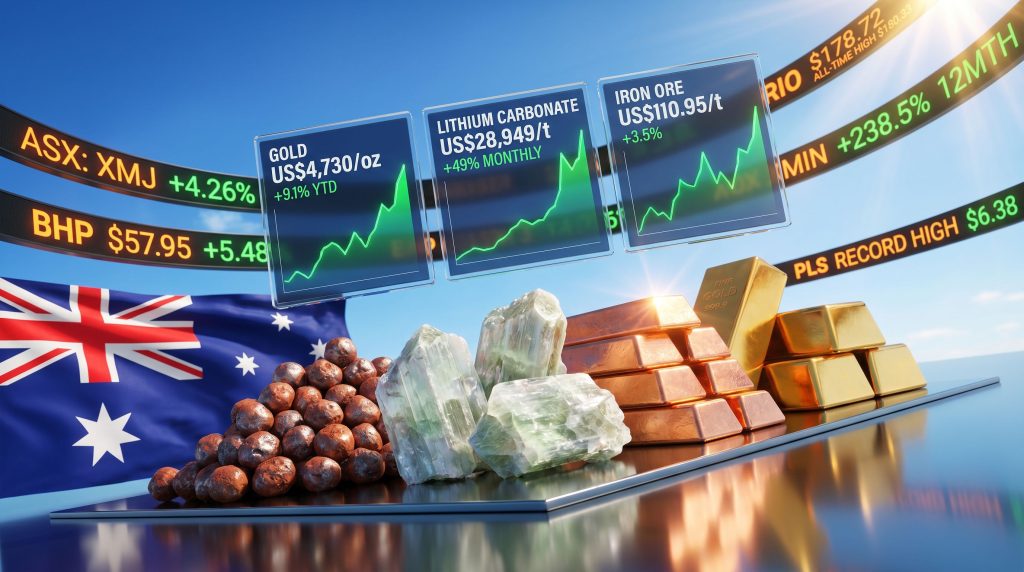
Across the major commodity classes underpinning ASX 200 mining shares smash multi-year highs narratives, price movements for the week were meaningful and broadly positive, though each market is being driven by distinct dynamics.
| Commodity | Price (9 May 2026) | Weekly Change | Key Driver |
|---|---|---|---|
| Iron Ore | US$110.95/tonne | +3.5% | Seven-week steel inventory drawdown in China |
| Gold | US$4,730/oz | +2.2% | 9.1% year-to-date advance; safe-haven and central bank demand |
| Silver | US$80.61/oz | +6.3% | Converging industrial and safe-haven demand |
| Copper | US$6.25/lb | +3.7% | Electrification infrastructure and EV production growth |
| Lithium Carbonate | US$28,949/tonne | +3.5% | Highest level since 2023; supply constraints post-downturn |
| Lithium Spodumene | US$2,792/tonne | Multi-quarter recovery | More than quadrupled from mid-2025 trough |
Iron Ore: Why the Inventory Signal Matters More Than the Price
The iron ore price rising to US$110.95 per tonne is notable, but the more significant data point lies beneath the headline number. Steel inventories in China have declined for seven consecutive weeks, a sustained drawdown pattern that historically precedes an active restocking cycle. The China steel and iron ore market dynamics are particularly relevant here, as Chinese steel mills transitioning from passive inventory management to deliberate raw material procurement creates a demand impulse that flows directly and disproportionately to Australian iron ore exporters.
Seven consecutive weeks of drawdown is not noise. In commodity market analysis, a sustained inventory decline of this duration typically signals a genuine shift in mill operating conditions rather than opportunistic price positioning. Historical precedent suggests that drawdowns sustained beyond six weeks tend to translate into above-average import volumes in the subsequent quarter.
The Lithium Recovery: From Catastrophic Bust to Structural Rebalancing
Of all the commodity narratives embedded in this week's data, the lithium price recovery carries the greatest structural significance. The prolonged lithium market downturn that began in late 2022 saw markets endure nearly three years of cascading price declines driven by oversupply, demand disappointments in key EV markets, and a wave of project cancellations and deferrals across the global mining industry.
The price bottom arrived in mid-2025. What has followed is one of the more dramatic recoveries in recent commodity market history:
- Lithium spodumene prices have more than quadrupled from their 2025 trough to US$2,792 per tonne.
- Lithium carbonate reached US$28,949 per tonne, the highest level since 2023.
- A 49% monthly surge in lithium carbonate prices preceded the week ending 9 May 2026.
The speed of this recovery warrants careful scrutiny. Recoveries of this velocity in commodity markets frequently contain a speculative component that amplifies price moves beyond what underlying supply-demand fundamentals alone can justify. This does not invalidate the structural bull case, but it does mean investors should differentiate between the genuine rebalancing story and short-term positioning momentum.
The structural case for higher lithium prices is credible. Years of underinvestment during the price downturn have constrained the pipeline of new supply projects. Meanwhile, EV adoption is accelerating across multiple major markets, and grid-scale battery storage deployment is growing rapidly. The collision of constrained supply with accelerating demand creates a genuine rebalancing dynamic. The pace, however, suggests that some portion of the current price level reflects futures market positioning and speculative buying alongside genuine demand.
ASX 200 Mining Shares Hitting New Records and Multi-Year Highs
BHP Group Ltd (ASX: BHP)
BHP shares advanced 5.48% across the week, closing at $57.95. The intraweek peak of $58.71 on Thursday represented a 10-week high, approaching the company's all-time record of $59.39 set on 3 March 2026. Perhaps the most striking contextual detail is BHP's proximity to reclaiming the title of Australia's largest listed company, with the gap between BHP and Commonwealth Bank of Australia (ASX: CBA) narrowing to just $2.6 billion in market capitalisation.
The prospect of a mining company displacing a bank at the top of the ASX 200 says something important about the current macro environment. When resources companies close that gap, it typically signals that commodity price strength is being taken seriously as a sustained, rather than transient, phenomenon by institutional investors. Consequently, the ASX market performance under commodity pressure in recent quarters has laid important groundwork for this shift in market leadership.
Rio Tinto Ltd (ASX: RIO)
Rio Tinto delivered a 3.93% weekly gain, closing at $178.72 after setting a new all-time high of $180.33 on Friday. Over the past twelve months, Rio shares have appreciated by 53.6%, a return that reflects both the uplift in iron ore prices and genuine operational improvements across the company's asset base. For long-term investors, the new all-time high matters because it represents the market pricing in sustained rather than cyclical commodity demand. Indeed, ASX 200 mining shares smash multi-year highs narratives like Rio's performance are increasingly capturing broader institutional attention.
Mineral Resources Ltd (ASX: MIN)
Mineral Resources rose 4.27% to close at $69.55, after reaching a two-year high of $71.62 during the week. The twelve-month return of +238.5% is extraordinary by any measure and reflects the company's dual exposure to both the iron ore and lithium price recoveries. Few ASX 200 companies carry that kind of leveraged exposure to two simultaneously recovering commodity cycles, which partly explains the amplified return profile.
Pilbara Minerals Ltd / PLS Group Ltd (ASX: PLS)
As the ASX 200's most prominent dedicated lithium producer, PLS Group set a new record high of $6.38 during the week before closing at $6.26, representing a 1.95% weekly gain. PLS functions as the primary benchmark through which institutional investors express a view on the lithium price recovery, making its share price behaviour a useful proxy for broader market sentiment toward the battery metals complex.
Copper and Base Metal Shares: The Electrification Premium
The copper price reaching US$6.25 per pound (+3.7% for the week) created strong momentum across ASX-listed copper producers. The emerging copper supply crunch makes this particularly relevant from a structural perspective, as the scale of demand growth driven by the energy transition is often underappreciated even by informed investors.
Each electric vehicle requires approximately 2.5 to 4 times more copper than an equivalent internal combustion engine vehicle. Grid infrastructure for renewable energy generation and transmission is similarly copper-intensive. With global mine supply constrained by declining ore grades at existing deposits and a decade of insufficient investment in new project development, the structural demand-supply imbalance is likely to persist well beyond any near-term price volatility.
| ASX Mining Share | Weekly Return | Closing Price | Commodity Exposure |
|---|---|---|---|
| IGO Ltd (ASX: IGO) | +8.59% | $8.34 | Nickel and Lithium |
| Sandfire Resources Ltd (ASX: SFR) | +7.33% | $18.01 | Copper |
| Fortescue Ltd (ASX: FMG) | +6.30% | $21.27 | Iron Ore |
| Capstone Copper Corp (ASX: CSC) | +4.30% | $12.37 | Copper |
| Lynas Rare Earths Ltd (ASX: LYC) | +1.57% | $19.44 | Rare Earths |
IGO Ltd's 8.59% weekly gain stands out as the strongest performer in the group, reflecting the dual tailwind of both lithium and nickel price recovery. For investors seeking leveraged exposure to the battery metals theme within the ASX 200, dual-commodity producers like IGO offer a different risk-return profile compared to pure-play lithium companies like PLS.
Gold Shares and the Vault Minerals-Regis Resources Merger
Gold at US$4,730 per ounce represents a 9.1% calendar year-to-date advance, an environment that should theoretically be broadly positive for all ASX gold producers. However, the reality is more nuanced, as the growing role of central bank gold demand continues to underpin prices in ways that do not always translate uniformly across individual producers.
| ASX Gold Share | Weekly Return | Closing Price |
|---|---|---|
| Evolution Mining Ltd (ASX: EVN) | +7.4% | $13.05 |
| Newmont Corporation CDI (ASX: NEM) | +4.33% | $160.35 |
| Northern Star Resources Ltd (ASX: NST) | -0.05% | $21.16 |
| Vault Minerals Ltd (ASX: VAU) | +3.98% | $4.70 |
| Regis Resources Ltd (ASX: RRL) | -2.97% | $6.85 |
The divergent performance between Regis Resources and Vault Minerals illustrates a classic merger arbitrage dynamic. When Regis and Vault announced their combination, creating an entity valued at approximately $1.1 billion, the market applied a familiar pattern: the target's shareholders captured an immediate price premium while the acquirer's shareholders absorbed integration risk and deal execution uncertainty.
The consolidation logic is sound. Rising operating costs driven by elevated energy prices make scale advantages in procurement, infrastructure, and capital allocation materially more valuable. In an environment where oil price volatility is compressing margins throughout the mining sector, mergers of this nature are a rational strategic response rather than opportunistic deal-making.
The next major ASX story will hit our subscribers first
The Full Sector Scorecard: A Bifurcated Market
The week's sector performance data reveals an ASX 200 that is deeply bifurcated, with commodity-exposed sectors dramatically outperforming while consumer-facing and defensive sectors faced significant pressure. According to recent materials sector analysis, the divergence between resource and non-resource segments of the market is becoming an increasingly defining feature of Australian equities.
| S&P/ASX 200 Sector | Weekly Performance |
|---|---|
| Materials (ASX: XMJ) | +4.26% |
| Industrials (ASX: XNJ) | +1.02% |
| Information Technology (ASX: XIJ) | +0.79% |
| Communication Services (ASX: XTJ) | +0.08% |
| Financials (ASX: XFJ) | -0.19% |
| A-REIT (ASX: XPJ) | -0.97% |
| Consumer Discretionary (ASX: XDJ) | -2.64% |
| Healthcare (ASX: XHJ) | -2.92% |
| Consumer Staples (ASX: XSJ) | -3.56% |
| Utilities (ASX: XUJ) | -4.46% |
| Energy (ASX: XEJ) | -7.62% |
The Energy sector's -7.62% weekly decline is the most counterintuitive result in an environment where geopolitical tensions are elevated. The apparent paradox resolves when you consider that the structural headwinds facing traditional oil and gas producers extend well beyond any single geopolitical event. Accelerating renewable energy adoption, shifting capital allocation priorities among major institutional investors, and the policy trajectory across developed economies all create sustained pressure on the long-term earnings outlook for fossil fuel producers.
Balancing the Bull Case Against Real Risks
For investors assessing whether ASX 200 mining shares smash multi-year highs momentum can be sustained, the honest answer requires separating cyclical from structural forces.
Near-term risks deserve serious consideration:
- Elevated oil prices driven by the Iran conflict directly increase fuel and energy costs for mining operations, compressing margins even as commodity revenue rises.
- The broader ASX 200 had experienced three consecutive weeks of losses before this week's recovery, indicating underlying market fragility that has not fully resolved.
- The pace of the lithium price recovery, particularly the 49% monthly surge in carbonate prices, raises legitimate questions about the role of speculative positioning in amplifying the fundamental rebalancing story.
- China's property sector stabilisation remains uneven, and any deterioration in policy effectiveness could reverse the demand signals currently supporting iron ore prices.
Structural tailwinds operating over longer timeframes:
- The global energy transition creates sustained, growing demand for lithium, copper, and rare earth elements at scales that Australia's resource endowment is uniquely positioned to serve.
- Seven consecutive weeks of Chinese steel inventory drawdown reflects genuine operational demand rather than speculative positioning, historically a reliable precursor to restocking cycles.
- Gold's 9.1% year-to-date advance reflects central bank accumulation and institutional demand for inflation protection, both of which represent durable rather than transient sources of buying pressure.
- A weaker Australian dollar amplifies the USD-denominated revenue of Australian resource exporters, providing an additional tailwind that operates independently of commodity price movements.
This article contains general information only and does not constitute financial advice. Commodity prices, share prices, and market conditions can change rapidly, and past performance is not indicative of future results. Investors should consider their own financial circumstances and consult a licensed financial adviser before making investment decisions.
Want to Catch the Next Major ASX Mineral Discovery Before the Market Does?
When commodity cycles shift as dramatically as the current materials surge demonstrates, the investors who benefit most are those positioned ahead of the move — Discovery Alert's proprietary Discovery IQ model delivers real-time alerts on significant ASX mineral discoveries, instantly turning complex mineral data into actionable insights for both short-term traders and long-term investors. Explore how historic discoveries have generated substantial returns on Discovery Alert's dedicated discoveries page, and begin your 14-day free trial today to secure a market-leading edge during one of the most significant commodity repricing periods in recent memory.