June 24, 2026
The Uranium Discovery Clock: Why Most Investors Are Measuring Time With the Wrong Watch
There is a fundamental mismatch at the heart of uranium exploration investing, and it operates entirely on geological time rather than market time. While commodity prices respond to news cycles within hours, uranium deposits respond to capital on a timeline measured in decades. This structural reality has confounded a generation of retail investors who entered the sector expecting spot price appreciation to flow through to their junior exploration holdings, only to find that the mechanisms governing exploration value creation operate on an entirely different axis.
Understanding the uranium exploration discovery lag is not simply an academic exercise. It is the single most important conceptual framework for anyone attempting to allocate intelligently to this sector, and it is one that the majority of promotional material produced by exploration companies actively obscures.
When big ASX news breaks, our subscribers know first
Fifty Years of Price Cycles, One Consistent Pattern
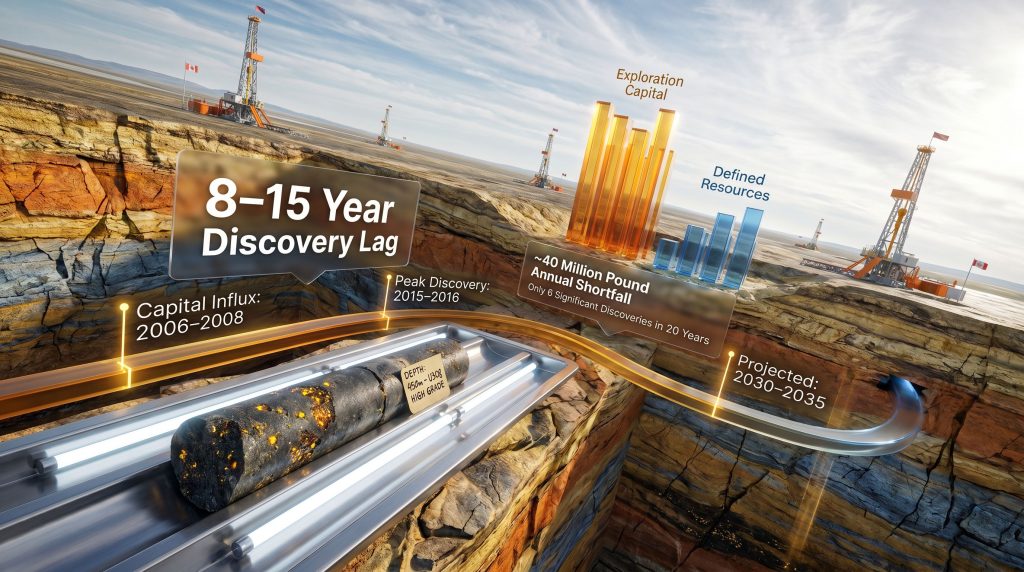
The historical record of uranium exploration in the Athabasca Basin, which encompasses approximately two billion pounds of identified uranium across roughly 40 deposits, produces a remarkably consistent finding across every major price cycle of the past half century: capital deployed at price peaks takes between eight and fifteen years to manifest as a formally defined resource.
This is not a marginal observation. It is a structural feature of the uranium market that has repeated itself with enough regularity to qualify as predictive. Furthermore, uranium supply-demand volatility has historically amplified the misalignment between investor expectations and geological timelines.
| Price Cycle Era | Capital Influx Period | Peak Discovery Period | Observed Lag |
|---|---|---|---|
| 1970s Uranium Boom | Mid-1970s | Late 1980s | 10–15 years |
| 2007 Spot Price Peak | 2006–2008 | 2015–2016 | ~8–9 years |
| Post-2020 Recovery | 2021–present | Estimated 2030–2035 | 8–12 years (projected) |
What makes this pattern particularly counterintuitive is that the highest volumes of new resource discovery have historically coincided not with strong uranium prices, but with price troughs. The explanation is mechanical. Capital floods the sector at the top of the price cycle, but converting that capital into a formally defined resource requires years of systematic drilling, laboratory assay work, geological modelling, and regulatory processing. By the time those resources are defined, the commodity cycle has frequently moved into a downturn.
This timing mismatch is the defining structural challenge for uranium exploration investors. The value creation event is the discovery and resource definition, not the commodity price movement that preceded the exploration campaign by nearly a decade.
For investors who entered uranium exploration companies between 2021 and 2023, expecting spot price gains to produce corresponding equity appreciation, the historical data suggests that expectation was misaligned with how exploration value is actually generated. This is structurally predictable, not a temporary anomaly.
The Fukushima Decade and Its Compounding Supply Consequences
The 2011 Fukushima disaster triggered one of the most severe and prolonged capital withdrawals in uranium exploration history. Global exploration budgets contracted by approximately 80% over the following decade, creating a compounding problem that extends well beyond the simple absence of drilling activity. Consequently, the uranium market deficit that emerged from this withdrawal continues to shape supply conditions today.
The erosion of the geological knowledge base during this period is a less-discussed but critically important consequence. Systematic exploration produces not just drill holes, but geological models, structural interpretations, and technical understanding that inform future targeting. A decade of minimal activity degraded that accumulated knowledge, meaning the capital re-entering the sector from 2021 onward is in some respects starting from a less informed baseline than the exploration community of 2010.
The practical consequences of the post-Fukushima withdrawal are stark:
- Global uranium exploration budgets fell by approximately 80% in the decade following 2011
- The current annual supply shortfall is estimated at approximately 40 million pounds, a figure that reflects years of underinvestment in both exploration and production capacity
- Exploration capital re-entering the sector from 2021 onward will, under historical timing models, produce first meaningful resource estimates no earlier than 2029–2033
- The projected supply deficit intensifying around 2030 cannot be closed by greenfield exploration currently underway, regardless of the quality or pace of current drilling programmes
This last point carries significant weight for investors calibrating expectations about when the current price cycle will translate into new supply. The answer, based on the historical discovery lag, is: not within the timeframe most investors are contemplating.
Modern Permitting Has Lengthened an Already Long Timeline
The eight-to-fifteen-year discovery lag discussed above reflects historical averages. Contemporary exploration in jurisdictions like the Athabasca Basin now operates under significantly more demanding regulatory and social frameworks, which are systematically extending the early-stage exploration timeline beyond those historical baselines.
The drilling threshold required before a resource estimate can be formally completed has roughly doubled compared to earlier decades. Where approximately 40 to 50 drill holes were once sufficient to support a resource estimate, the current standard in the Athabasca Basin is closer to 80 holes. This is not a bureaucratic inefficiency; it reflects legitimate requirements for statistical confidence in resource definition, increased environmental data collection, and more rigorous independent review processes.
| Development Milestone | Historical Standard | Modern Requirement |
|---|---|---|
| Drill holes before resource estimate | ~40–50 holes | ~80 holes |
| Time to complete formal resource estimate | ~18 months | ~2.5 years |
| Athabasca Basin discovery-to-production | ~15 years (pre-ESG baseline) | 15+ years (modern standard) |
Indigenous consultation requirements, expanded environmental baseline data collection, and social licence processes have each added layers of time and cost to exploration programmes that were already lengthy by any commodity standard. Understanding mining project feasibility stages within this context is essential for investors. For investors, this means the already-extended historical discovery lag should be treated as a floor, not a ceiling, for planning purposes.
What Analysing 650 Press Releases Reveals About Market Efficiency
One of the most practically useful insights to emerge from systematic analysis of uranium exploration communications is how efficiently the market actually prices drill result announcements, despite the promotional framing that typically surrounds them.
Analysis of approximately 650 press releases from 40 uranium companies over a five-year period, paired with corresponding stock price data, produced a consistent and instructive pattern across the sample:
- Day one: Positive announcements generate measurable share price increases on the trading day of release
- Day three: The majority of initial gains have reversed
- Day five: Prices stabilise at a level reflecting the actual informational content of the release rather than its promotional framing
- Approximately 60% of press releases citing encouraging handheld gamma readings never followed up with formal laboratory assay results, implying the initial count-per-second figures did not ultimately support the implied discovery narrative
This pattern held regardless of the promotional language deployed. Terms such as spectacular, off-scale, or peak mineralisation did not produce lasting price premiums. The market processed the underlying geological information within approximately one week and priced it accordingly.
How Should Investors Interpret Drill Announcements?
A secondary pattern also emerged: volume spikes around press release dates provided existing shareholders with a convenient exit opportunity, which contributed mechanically to the short-term price reversal before stabilisation. Recognising this dynamic reframes the press release event from a buying signal into a liquidity event that primarily benefits those looking to reduce exposure.
The practical implication is modest but useful: investors who allow two to three days of post-announcement trading before establishing a position may access a more representative entry price than those who react on the day of release.
Interpreting drill results correctly is, however, a skill that separates informed investors from those who react purely to promotional language. Results framed as technical successes by exploration companies warrant particular attention. This terminology typically signals that a drill hole produced geological information of value for understanding the deposit system, without necessarily confirming economic mineralisation. The market, the data suggests, interprets this framing accurately and prices such announcements as neutral to modestly negative events regardless of how they are framed operationally.
Six Discoveries in Twenty Years: The Athabasca Basin Track Record
Examining the full record of uranium resource discoveries in the Athabasca Basin over the past two decades produces a sobering numerator. Despite extensive exploration activity across one of the world's most prospective uranium jurisdictions, only six significant resources were placed on the books during this period. Every one of them was initially discovered by a junior exploration company.
| Discovery | Acquiring Company (Post-Discovery) | Key Characteristic |
|---|---|---|
| Phoenix Deposit | Denison Mines | Large basin-wide land position |
| Roughrider Deposit | Rio Tinto, subsequently Uranium Energy Corp | Junior discovery, major acquisition |
| Kiana Deposit (Shea Creek) | UEX / Orano joint venture | Extended pre-discovery drilling programme |
| Triple R Deposit | Fission Uranium, now Paladin Energy | Multi-year exploration before discovery |
| Arrow Deposit | NexGen Energy | Sustained capital deployment, large land package |
| Hurricane Deposit | IsoEnergy | Junior explorer, basin-scale land holdings |
Examining what these six companies shared at the time of their discoveries reveals a consistent set of operational characteristics:
- All held land positions in excess of 200,000 hectares distributed across the basin rather than concentrated on a single project area
- All drilled dozens of holes and deployed millions of dollars before achieving a significant intercept
- None made a rapid or low-cost discovery
- All demonstrated sustained capital commitment over multi-year exploration programmes before their defining intercepts
The critical nuance in this data set is that geological merit is necessary but not sufficient. Even a well-positioned company with excellent geological targeting and disciplined capital allocation requires geological fortune to be positioned directly above an undiscovered deposit. No screening framework eliminates that residual uncertainty. What the data does confirm is that no company made a significant Athabasca Basin discovery from a small, concentrated land position, and no company made one cheaply or quickly. The uranium mining overview published by the World Nuclear Association provides useful context for understanding why these discovery constraints are consistent across jurisdictions.
The next major ASX story will hit our subscribers first
Shareholder Returns: The Uncomfortable Five-Year Picture
Examining a broader sample of 16 uranium exploration companies over a five-year period that included a meaningful recovery in uranium spot prices produces a picture that challenges the intuitive assumption that commodity appreciation flows through to explorer valuations.
Of those 16 companies, only three delivered positive returns to shareholders over the measurement period. The gains among that minority were modest relative to the geological risk and time horizon involved. Multiple companies in the sample were forced into share consolidations, a structural signal with specific diagnostic value.
What Does a Share Rollback Actually Signal?
A share rollback in an exploration-stage uranium company typically indicates that equity issuance over an extended exploration programme has grown the share count to a level where further capital raising at viable terms is impractical. This is distinct from geological failure. The underlying asset may retain genuine potential, but the capital structure has become a barrier to continued progress. Investors who treat a rollback as a temporary technical adjustment, rather than a warning about the fundamental economics of the company's exploration programme, frequently compound their losses.
Equity dilution is the hidden structural risk in uranium exploration investing. A rising commodity price does not reverse the dilution that accumulates across years of pre-discovery capital raising, and a rollback is the visible symptom of a dilution problem that has reached its practical limit.
The disconnect between rising uranium spot prices and flat-to-negative explorer returns over the same period is not a paradox once the uranium exploration discovery lag framework is applied. Producers benefit immediately and directly from higher commodity prices. Developers with advanced projects gain optionality value. Exploration-stage companies, however, create shareholder value primarily through discovery and resource definition, a process that runs on its own geological timeline and is largely insulated from near-term commodity price movements.
Building a Uranium Exploration Portfolio With Eyes Open
For investors who understand the structural realities outlined above and still wish to allocate to exploration-stage uranium companies, a disciplined construction framework significantly improves the statistical probability of holding at least one discovery-stage winner. In addition, sound uranium investment strategies at the portfolio level require sequencing allocations by development stage.
Step 1: Establish commodity conviction before allocating to exploration
Assess the supply-demand thesis independently. The structural annual deficit of approximately 40 million pounds, tightening long-term contracting, and constrained production from major producers form the macro backdrop. Only allocate to exploration if this thesis is well understood and accepted.
Step 2: Sequence allocation by development stage
- Producers: first allocation priority, with direct commodity price leverage
- Advanced developers: second tier, offering nearer-term production optionality
- Exploration-stage companies: third tier, carrying the highest risk and longest timeline
Step 3: Diversify across three to five exploration companies
Concentration in a single exploration name amplifies geological risk without improving expected returns. Distributing exposure across multiple well-screened companies improves the likelihood of participating in a discovery-stage re-rating event.
Step 4: Apply a structured screening framework
| Screening Criterion | What to Look For |
|---|---|
| Management track record | Prior discovery or development experience in the jurisdiction |
| Land position scale | Minimum ~200,000 hectares across the basin |
| Capital structure health | Low share count, no recent rollbacks, disciplined treasury management |
| Geological targeting quality | Basin-scale rationale, not single-project concentration |
| Drilling commitment evidence | Sustained pre-discovery capital deployment over multiple seasons |
Step 5: Monitor actively and exit when the criteria deteriorate
A passive buy-and-hold approach is poorly matched to the dynamics of exploration-stage uranium companies. When management quality, capital discipline, or geological focus no longer meets the original selection criteria, reallocating to a company that does meet those standards is preferable to maintaining a static position. Active portfolio management, with a willingness to make difficult exit decisions, separates investors who generate returns from those who absorb the sector's structural losses.
Where Does the Current Cycle Stand?
If the exploration capital that re-entered the uranium sector between 2021 and 2023 follows the historical timing patterns established across prior cycles, the first wave of resource-stage discoveries should begin emerging between approximately 2029 and 2035. Those resources would realistically enter production no earlier than the late 2030s to mid-2040s, well beyond the supply deficit window that is projected to intensify around 2030.
This does not mean the sector lacks investment merit. It means the investment thesis must be calibrated accurately. Early-stage intercepts grading at meaningful levels, such as the upward-of-8% uranium reported by some operators in the current cycle, warrant continued monitoring as indicators of potential discovery-stage progression. However, the gap between an encouraging intercept and a formally defined resource remains years wide even under optimistic assumptions. Analysis of uranium's exploration drought and its fragile supply consequences further reinforces why this gap should not be underestimated.
The productive framing for investors entering the uranium exploration sector today is not whether prices will rise in the next twelve months. It is whether the companies they select are positioned to be among the handful that will define the next generation of Athabasca Basin resources over the coming decade.
The historical record is clear on one point: the companies that achieve those discoveries will share the characteristics outlined above. Large land positions. Sustained drilling programmes. Disciplined capital management. Experienced teams who understand that geological reality operates on its own schedule, entirely independent of the promotional calendar.
This article is for informational purposes only and does not constitute financial or investment advice. Uranium exploration investments carry substantial risk, including the possibility of total capital loss. Past performance of geological discovery cycles does not guarantee future results. Readers should conduct their own due diligence and consult a qualified financial adviser before making any investment decisions.
Want to Know Which ASX Mineral Discoveries Are Happening Right Now?
While uranium exploration operates on geological timelines measured in decades, Discovery Alert's proprietary Discovery IQ model delivers real-time notifications on significant ASX mineral discoveries the moment they are announced — transforming complex mineral data into actionable insights for investors at every experience level. Explore historic discovery returns on Discovery Alert's dedicated discoveries page and begin a 14-day free trial to position yourself ahead of the broader market.