June 17, 2026
The Race to Reinvent Alumina: Why Processing Technology Is Becoming the New Frontier in Critical Minerals
The aluminium industry is quietly undergoing one of its most significant structural shifts in decades. While attention has historically focused on upstream mining and downstream smelting, the midstream processing layer, where raw rock becomes refined industrial material, is emerging as the most strategically contested segment of the entire value chain. The reason is straightforward: whoever controls the technology to convert raw mineralogy into battery-grade, defence-grade, or smelter-grade materials controls access to a supply chain that Western governments are increasingly desperate to secure outside of Chinese jurisdiction.
It is within this context that the Greenland Mines stake in AnorTech demands serious analytical attention. This is not simply a junior mining company making a bolt-on acquisition. It represents a deliberate pivot toward proprietary processing technology at a moment when the alumina market is being reshaped by environmental regulation, geopolitical realignment, and the surging critical minerals demand for high-purity materials that conventional refining cannot economically or cleanly produce.
When big ASX news breaks, our subscribers know first
Understanding the Deal Architecture and What the Numbers Reveal
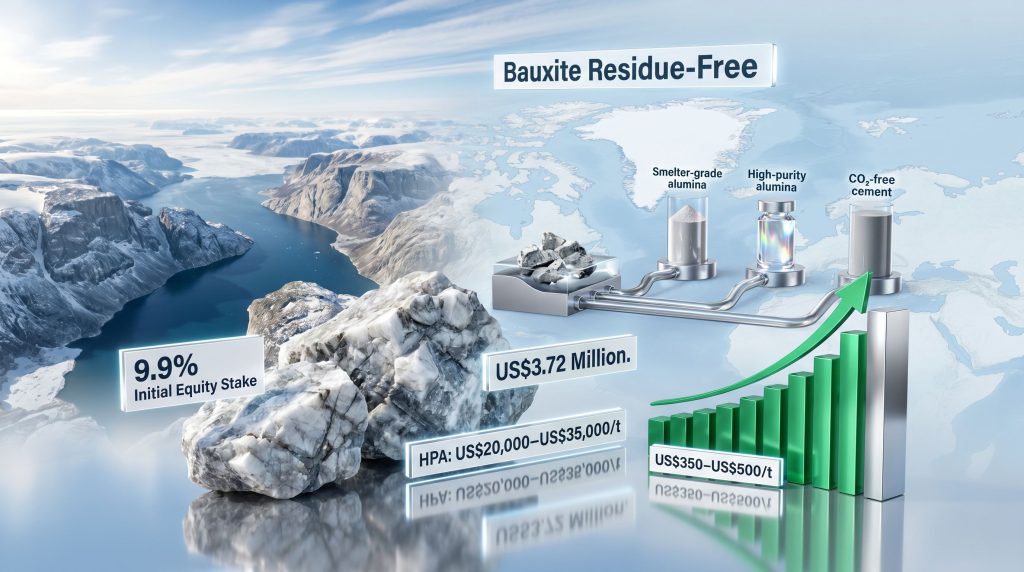
The transaction between Greenland Mines and AnorTech is structured as a share exchange, a capital-efficient mechanism that avoids cash outflows while creating a binding strategic relationship between two companies with complementary assets. Greenland Mines issues 12,400,000 of its own common shares in exchange for an initial block of 19,958,503 AnorTech shares, representing a 9.9% equity position in AnorTech at an implied value of approximately US$3.72 million (C$5.2 million).
| Deal Parameter | Detail |
|---|---|
| Initial equity stake acquired | 9.9% of AnorTech |
| AnorTech shares in initial tranche | 19,958,503 shares |
| Consideration paid | 12,400,000 Greenland Mines common shares |
| Implied transaction value | ~US$3.72 million (C$5.2 million) |
| Option to expand ownership | Up to 19.9% total |
| Additional shares under option | Up to 25,168,669 AnorTech shares |
| Option exercise window | Six months from closing |
| Maximum ownership cap | 19.9% of AnorTech |
| Expected closing deadline | On or before June 30, 2026 |
| Regulatory approval required | TSX Venture Exchange acceptance |
The 19.9% ceiling on total ownership is not arbitrary. Under Canadian securities regulation, crossing the 20% threshold in certain circumstances can trigger mandatory bid obligations or significant governance implications. By capping participation at 19.9%, Greenland Mines retains strategic influence without assuming the compliance obligations that come with a more dominant shareholding position.
Lock-Up Provisions and Their Strategic Significance
A detail that investors should not overlook is the staggered lock-up structure applied to the Greenland Mines shares issued to AnorTech. Specifically, 50% of those shares are locked for 12 months and the remaining 50% are locked for 24 months from the date of closing.
According to the strategic share exchange agreement, this staggered release mechanism serves two important functions: it limits near-term selling pressure on Greenland Mines shares, and it signals that both parties are entering this relationship with a long-term commercial horizon rather than a short-term trading orientation.
This kind of structural alignment is meaningful in the junior resources space, where opportunistic capital flows can destabilise share prices following deal announcements.
Anorthosite: The Rock Few Have Heard Of That Could Reshape Alumina Supply
At the centre of this transaction is a mineral that sits well outside the mainstream conversation around aluminium supply chains. Anorthosite is a coarse-grained igneous rock composed predominantly of plagioclase feldspar, specifically the calcium-rich variety known as anorthite. It is geologically distinct from bauxite, which forms through the tropical weathering of aluminium-bearing rocks over millions of years.
What makes anorthosite interesting as an industrial feedstock is precisely what makes it unusual: it contains aluminium in silicate form rather than hydroxide form, which means it cannot be processed using the conventional Bayer process. This has historically made it economically unattractive compared to bauxite. However, proprietary hydrometallurgical and acid-leaching technologies are increasingly capable of extracting alumina from silicate sources at commercially relevant efficiencies, and it is this processing innovation that AnorTech is developing through its work at the Gronne Bjerg anorthosite project in Greenland.
The potential product slate from AnorTech's technology includes:
- Smelter-grade alumina (SGA) for primary aluminium production
- High-purity alumina (HPA) at levels suitable for EV battery separators, LED substrates, and semiconductor components
- CO₂-free cement as a co-product, derived from the silica-rich gangue material
- Elimination of bauxite residue (red mud) tailings, which represent one of the most environmentally problematic byproducts in global industrial processing
The Red Mud Problem: Why Eliminating Bauxite Residue Is a Genuine Competitive Advantage
The conventional Bayer process, which has dominated alumina refining since the late nineteenth century, generates approximately 1.5 to 2 tonnes of caustic red mud for every tonne of alumina produced. With global alumina output exceeding 130 million tonnes annually, the cumulative volume of red mud stockpiled worldwide now exceeds several billion tonnes.
Red mud presents multiple challenges that are becoming increasingly acute for refiners operating under tighter environmental frameworks:
- It is strongly alkaline, with pH levels typically between 10 and 13, posing leaching risks to surrounding soil and groundwater
- Storage requires engineered containment facilities that are expensive to build, operate, and remediate
- Catastrophic failures, such as the 2010 Ajka spill in Hungary, have demonstrated the scale of environmental damage that red mud containment breaches can cause
- Regulatory frameworks in the European Union and several allied jurisdictions are progressively tightening standards around industrial waste storage
A processing pathway that eliminates this waste stream entirely is not merely an environmental selling point. It represents a fundamental reduction in long-term liability for any company or jurisdiction seeking to develop alumina capacity without inheriting decades of remediation obligation.
How Anorthosite Processing Compares to the Bayer Process
| Dimension | Conventional Bayer Process | AnorTech Anorthosite Process |
|---|---|---|
| Primary feedstock | Bauxite ore | Anorthosite rock |
| Residue generated | ~1.5 to 2t red mud per tonne of alumina | Claimed elimination of bauxite residue tailings |
| Geographic feedstock dependency | Tropical bauxite belts (Guinea, Australia, Brazil) | Arctic/sub-Arctic geology (Greenland) |
| CO₂ profile | High energy-intensive calcination | Potentially CO₂-free cement co-product |
| HPA production capability | Requires additional refining steps | Integrated into proprietary process |
| Technology maturity | Commercially proven at scale | Proprietary, development and pilot stage |
Investor Consideration: The comparative advantages of AnorTech's technology are compelling in principle, but moving from a pilot-stage proprietary process to commercial-scale alumina production involves substantial capital investment, technical execution risk, and regulatory pathway uncertainty. The initial 9.9% entry stake allows Greenland Mines to gain meaningful exposure to this upside while limiting balance sheet risk at this stage of the technology's development.
The Alumina Market Forces Driving This Investment's Timing
The Greenland Mines stake in AnorTech is not occurring in a vacuum. Three converging structural forces are accelerating demand for alternative alumina production pathways in 2026.
1. Clean Energy Materials Demand
Aluminium is foundational to the clean energy transition. Solar panel mounting systems, electric vehicle body structures, and high-voltage grid infrastructure all require substantial aluminium inputs. As downstream manufacturers face growing Scope 3 emissions scrutiny from investors and regulators, demand for demonstrably low-carbon alumina, the precursor to primary aluminium, is intensifying.
2. The High-Purity Alumina Premium
The price differential between commodity alumina and high-purity alumina is extraordinary. Standard smelter-grade alumina trades at roughly US$350 to US$500 per tonne, while HPA at 99.99% purity (4N grade) commands prices between US$20,000 and US$35,000 per tonne, representing a premium of forty to one hundred times the SGA price. Battery separator films for lithium-ion cells require 4N or higher purity alumina, and the EV market's trajectory makes this one of the most structurally attractive product categories in industrial minerals.
| Alumina Product Type | Approximate Price Range | Primary End Use |
|---|---|---|
| Smelter-Grade Alumina (SGA) | US$350 to US$500/t | Primary aluminium smelting |
| High-Purity Alumina (HPA) 4N | US$20,000 to US$35,000/t | EV battery separators, LEDs, semiconductors |
| Specialty Calcined Alumina | US$800 to US$2,500/t | Ceramics, refractories |
3. Supply Chain Diversification Pressure
China currently dominates both bauxite refining and HPA production capacity at a global level. Allied industrial policy in the United States, Canada, the European Union, and Australia is actively seeking to develop or support processing capacity within trusted jurisdictions. Greenland, situated geographically between North America and Europe, occupies a potentially valuable position in any North Atlantic critical minerals logistics architecture. The processing challenges associated with non-bauxite feedstocks are considerable, however, and should not be underestimated by investors assessing this space.
Greenland Mines' Corporate Architecture: Where AnorTech Fits
To understand why the AnorTech investment is structurally significant, it is necessary to map it against Greenland Mines' existing divisional framework. Furthermore, the alumina refinery partnership landscape is evolving rapidly, making Greenland Mines' midstream positioning increasingly timely.
Mining Division:
- Skaergaard Project in southeast Greenland, a precious metals asset providing exposure to gold and palladium
- Sarfartoq Nd-Pr Rare Earth Project in southwest Greenland, targeting the neodymium-praseodymium magnet metals essential to EV drivetrains and wind turbine generators, subject to completion of a previously announced transaction
Biotech Division:
- Klotho's KLTO-202 programme, a clinical-stage asset investigating treatment pathways for amyotrophic lateral sclerosis (ALS), providing portfolio diversification outside the resources sector entirely
New Strategic Layer: Midstream Processing Exposure
- The AnorTech stake introduces a technology and processing dimension that bridges upstream resource development and downstream industrial supply chains, a layer that was previously absent from the company's value chain participation
This vertical integration ambition reflects a broader trend among junior critical minerals companies seeking to differentiate themselves by demonstrating not only resource access but processing capability, a quality that investors and offtake partners increasingly require before committing to project financing.
The next major ASX story will hit our subscribers first
Three Scenarios for the AnorTech Option Window
The six-month window to exercise the option to increase ownership from 9.9% to 19.9% creates a decision point with meaningfully different outcomes depending on how technology milestones and market conditions evolve.
Scenario 1: Full Option Exercise
Greenland Mines acquires the full additional 25,168,669 AnorTech shares, reaching a near-20% ownership position. This would likely be accompanied by deeper operational integration, possible board-level representation, and a formalised collaboration framework around the Gronne Bjerg development timeline. This scenario signals high conviction in AnorTech's technology progress and commercial roadmap.
Scenario 2: Partial Exercise
Greenland Mines acquires a portion of the option entitlement, balancing capital efficiency against the desire to deepen strategic influence. This approach preserves financial flexibility while maintaining a credible signal of continued partnership commitment.
Scenario 3: Option Lapses
If TSX Venture Exchange conditions, market dynamics, or AnorTech's technology benchmarks do not meet expectations within the six-month period, the option may expire unexercised. Greenland Mines retains its 9.9% position as a passive strategic holding, with limited downside relative to the initial transaction value.
Frequently Asked Questions: The Greenland Mines and AnorTech Transaction
What exactly did Greenland Mines acquire?
Greenland Mines acquired an initial 9.9% equity stake in AnorTech Inc. through a share exchange involving 19,958,503 AnorTech shares, with consideration of 12,400,000 Greenland Mines common shares at an implied value of approximately US$3.72 million (C$5.2 million).
What is anorthosite and why does it matter for alumina production?
Anorthosite is a silicate igneous rock rich in plagioclase feldspar that contains recoverable aluminium but cannot be processed using the conventional Bayer process. Proprietary processing technologies targeting anorthosite as a feedstock are significant because they offer a potential pathway to producing smelter-grade and high-purity alumina without generating bauxite residue, the caustic red mud waste stream that represents one of the aluminium industry's most persistent environmental and regulatory liabilities. Analysts reviewing why Greenland's anorthosite matters have noted the mineral's unique position in addressing these structural supply chain challenges.
What regulatory approval is required before the deal closes?
The transaction requires acceptance from the TSX Venture Exchange, with closing expected on or before June 30, 2026, subject to customary closing conditions.
Why is Greenland significant for critical minerals supply chains?
Greenland's geology hosts some of the world's largest undeveloped deposits of rare earth elements, precious metals, and industrial minerals. Its Arctic location places it geographically between North America and Europe, making it a potentially important node within any allied-nation supply chain architecture designed to reduce dependence on Chinese-controlled mineral processing capacity. In addition, the bauxite production leaders are predominantly concentrated in tropical regions, making Arctic alternatives strategically significant for supply chain diversification.
Key Structural Takeaways for Critical Minerals Investors
Several dimensions of this transaction carry analytical weight beyond the immediate deal terms. Consequently, aluminium industry leaders and investors alike are watching midstream technology developments with growing interest.
- The share exchange structure demonstrates capital-efficient deal-making at the junior mining level, preserving Greenland Mines' liquidity while establishing a meaningful strategic position
- The 19.9% ownership ceiling reflects a deliberate governance decision designed to avoid mandatory bid thresholds under Canadian securities law
- The staggered lock-up arrangement on issued shares reduces near-term dilution pressure and aligns the commercial interests of both parties over a multi-year horizon
- AnorTech's bauxite residue-free technology pathway addresses one of the most structurally significant environmental and regulatory pressure points in global alumina production
- The HPA price premium, at forty to one hundred times the SGA price, represents a compelling value creation opportunity if AnorTech's proprietary process can be scaled and validated at commercial volumes
- The North Atlantic Critical Metals Corridor framing positions the Greenland Mines stake in AnorTech within a larger industrial and geopolitical narrative, though investors should note that strategic frameworks of this kind carry their own execution and realisation risks
This article contains forward-looking analysis and references to market conditions, technology development timelines, and strategic scenarios. These do not constitute financial advice. Investors should conduct independent due diligence and consult qualified advisers before making investment decisions. Technology-stage companies carry inherent commercialisation and capital risks that may differ materially from expectations.
Want to Stay Ahead of the Next Major ASX Mineral Discovery?
Discovery Alert's proprietary Discovery IQ model scans ASX announcements in real time, instantly identifying significant mineral discoveries across more than 30 commodities and translating complex data into clear, actionable investment insights — begin your 14-day free trial today, or explore historic discovery returns to understand the scale of opportunity that major finds can generate.