August 1, 2026
When Smelters Become Strategic Assets: The New Logic of Industrial Policy
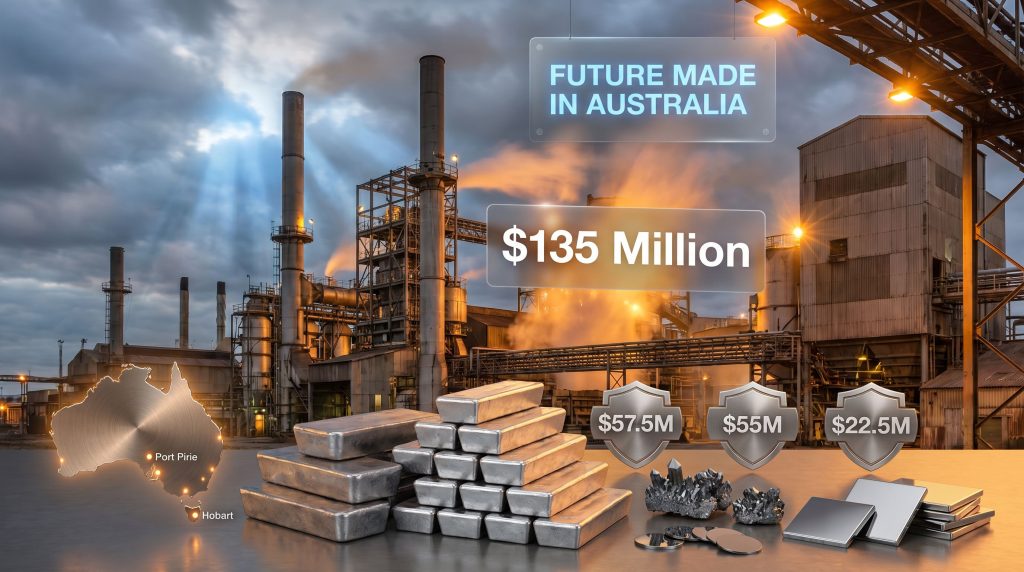
For most of the past two decades, base metal smelters in developed economies have been treated as relics of an earlier industrial era, steadily losing ground to cheaper offshore processing and squeezed by rising energy costs. That framing is now changing rapidly. Across Australia, North America, and Europe, governments are reassessing what domestic smelting capacity is actually worth — not just in economic output, but in supply chain sovereignty, workforce preservation, and critical minerals processing capability. The $135 million Nyrstar smelters government funding commitment, shared across three levels of Australian government, is one of the clearest expressions of this shift yet seen in the Australian context.
When big ASX news breaks, our subscribers know first
Australia's Smelting Sector Under Structural Pressure
Why Margins Have Narrowed to Breaking Point
Zinc and lead smelting is an energy-intensive business. In practical terms, power costs can represent between 20 and 30 percent of total operating expenditure at a modern smelter, meaning that the economics of Australian facilities are acutely sensitive to domestic electricity pricing. Over the past decade, Australian industrial electricity costs have climbed substantially, compressing margins that were already thin during periods of subdued commodity pricing.
Simultaneously, treatment charges — the fees smelters earn from miners for processing concentrate into refined metal — have faced sustained downward pressure globally. When mine supply tightens, miners gain negotiating leverage, and treatment charges fall. When energy prices spike, smelter costs rise. These two dynamics can and often do converge, creating periods where smelting operations generate negligible returns or operate at a loss.
Zinc smelting also involves meaningful capital intensity. Furnaces, acid plants, and electrolytic circuits require continuous maintenance investment, and deferred maintenance compounds quickly into structural deterioration that can render a facility commercially unviable.
The Dual Role of Zinc, Lead, and Their By-Products
Australia's position as a globally significant zinc and lead producer is well-established, with major operations including the McArthur River and Mount Isa deposits feeding into the global concentrate market. What is less widely appreciated is the by-product complexity of processing these streams. Zinc and lead concentrates frequently carry meaningful concentrations of metals including silver, antimony, germanium, indium, and bismuth — each of which has distinct and increasingly important end-use markets.
Smelters with the right configuration to extract and refine these by-products can generate significant incremental revenue. Without that infrastructure, these metals are either lost in the processing circuit or exported within concentrate to offshore refiners who capture the value-added margin. Furthermore, bismuth export controls from China have made domestic recovery of these by-products an increasingly urgent strategic priority.
What the $135 Million Package Actually Involves
The commitment of $135 million across three governments to support Nyrstar's Port Pirie and Hobart facilities is structured as transitionary support rather than a permanent operational subsidy. This distinction matters for how the funding should be interpreted. According to the official government announcement, the allocation breaks down as follows:
| Government | Funding Commitment |
|---|---|
| Commonwealth (Federal) | $57.5 million |
| South Australia | $55 million |
| Tasmania | $22.5 million |
| Total | $135 million |
The practical application of this funding spans several distinct objectives:
- Maintenance and asset-integrity works to prevent irreversible deterioration of smelting circuits
- Feasibility studies assessing smelter rebuild and technology modernisation pathways
- Workforce continuity programs to retain the skilled metallurgical labour force during the assessment period
- Preliminary investigation into expanded critical minerals recovery from existing process streams
Port Pirie and Hobart: Complementary Facilities With Distinct Profiles
Port Pirie, located in South Australia's Spencer Gulf region, is one of the world's largest polymetallic smelters, processing not only zinc and lead but also recovering silver, gold, and a range of by-product metals. Its multi-metal capability is a key part of the strategic rationale for the funding. Hobart's Risdon zinc smelter, operated under the Nyrstar brand, produces refined zinc metal and has historically been a significant employer in northern Hobart's industrial corridor.
Together, these facilities represent a domestic processing capability that would take many years and billions of dollars to rebuild from scratch if they were to close permanently.
The Strategic Rationale: Why Three Governments Are Co-Funding a Private Operator
Onshore Processing as an Industrial Policy Imperative
The central argument underpinning the Nyrstar smelters government funding is that Australia currently exports a disproportionate share of the value embedded in its mineral resources. Australia mines ore, produces concentrate, and ships it offshore for refining, with foreign processors capturing the transformation margin. Retaining domestic smelting infrastructure is one mechanism for arresting that value leakage.
This framing reflects a broader shift in industrial policy thinking — one that has accelerated following pandemic-era supply chain disruptions and growing geopolitical concerns about the concentration of critical materials processing in a small number of countries. Australia's critical minerals strategy is increasingly central to how policymakers frame these infrastructure decisions.
Regional Employment and the Cost of Closure
The workforce dependencies around both Port Pirie and Hobart are significant. Smelter closures do not only eliminate direct employment; they typically trigger cascading effects through local supply chains, contractors, and service businesses. Port Pirie, in particular, has a long history of industrial employment concentrated around its smelting operations, and the social cost of permanent closure would extend well beyond the direct headcount.
Rebuilding a skilled metallurgical workforce after a closure is not simply a matter of rehiring. Smelter operations require operators with years of process-specific experience, and that institutional knowledge dissipates quickly once a workforce disperses.
The Critical Minerals Dimension: Antimony, Germanium, and Indium
Perhaps the most compelling strategic argument for the Nyrstar smelters government funding lies in the critical minerals potential embedded within existing process infrastructure.
Antimony has attracted intense attention from defence and energy storage sectors. It is used in lead-acid battery alloys, flame retardants, and increasingly in next-generation energy storage technologies. However, the antimony supply risks are significant — China controls an estimated 48 percent of global antimony production and a higher share of refining capacity, making alternative supply chains a priority for Western governments.
Germanium is a critical semiconductor material used in fibre optic cables, infrared optics, and solar cells. Global supply is highly concentrated, with China implementing export controls on germanium in 2023 that immediately disrupted downstream industries.
Indium, primarily recovered as a by-product of zinc smelting, is essential for the production of indium tin oxide — a transparent conductor used in flat panel displays, touchscreens, and thin-film solar cells.
Australia produces mineral streams containing all three of these metals, yet currently lacks the downstream processing infrastructure to recover them at scale domestically. Nyrstar's existing facilities represent a potential foundation for building that capability.
Precedent and Pattern: Other Australian Smelter Interventions
The Nyrstar case does not exist in isolation. A clear pattern of government intervention to preserve smelting infrastructure is emerging across Australia:
- The Boyne Aluminium Smelter in Gladstone secured its future to 2040 via a combined $2 billion commitment from Rio Tinto, the federal government, and Queensland — an aluminium smelter precedent that reflects the same logic of treating smelting capacity as strategic rather than purely commercial infrastructure.
- Rio Tinto's commissioning of its AP60 low-carbon aluminium smelter in Quebec, representing a $2.1 billion private investment, demonstrates the direction of technology modernisation globally and the capital requirements involved in next-generation smelting.
- Federal Resources Minister Madeleine King's backing of the potential reopening of Tasmania's Mount Lyell copper mine, which has been under care and maintenance since 2014, signals a broader disposition toward preserving and restoring Australia's domestic processing and mining capacity.
These precedents collectively suggest that smelting infrastructure is being systematically reclassified as strategic national capacity, with financial exposure increasingly shared between private operators and public balance sheets.
Evaluating the Policy: Arguments For and Against
The Case for Intervention
- Domestic refining reduces Australia's vulnerability to offshore processing bottlenecks and geopolitical supply disruptions
- Skilled metallurgical workforces represent accumulated human capital that is genuinely difficult to replace
- Retaining processing infrastructure enables Australia to capture value-added revenue from mineral streams it already controls at the mine level
- Critical minerals recovery from existing smelting circuits offers asymmetric upside relative to the cost of transitionary support
The Case Against
- Transitionary support for structurally challenged facilities carries the risk of becoming permanent without achieving genuine viability
- The opportunity cost is real: the same capital could potentially seed new-build critical minerals processing infrastructure with better long-term economics
- Publicly funding a privately owned operator raises questions about how risk and reward are shared between taxpayers and shareholders
- Establishing this precedent may encourage other smelter operators to seek similar support arrangements rather than investing their own capital in modernisation
The most intellectually honest position acknowledges both dimensions. Industrial policy interventions of this type carry genuine risks, but so does passively allowing critical processing infrastructure to close in an era of increasing supply chain fragmentation.
The next major ASX story will hit our subscribers first
What the Feasibility Studies Must Resolve
The transitionary funding is explicitly designed to buy time for detailed feasibility assessment. The questions these studies need to answer are consequential:
- What is the actual capital requirement for a meaningful smelter rebuild or technology upgrade at each facility?
- Can existing circuit configurations be modified cost-effectively to recover antimony, germanium, and indium at commercial scale?
- What energy supply arrangements would be needed to restore acceptable operating margins?
- What concentrate supply agreements are available to underwrite investment decisions?
- What is the realistic timeline from feasibility completion to final investment decision?
The answers will determine whether these facilities transition into genuinely modernised critical minerals processing assets or remain dependent on ongoing public support.
Australia's Broader Critical Minerals Processing Gap
The Nyrstar situation illuminates a structural issue that extends well beyond two smelters. Australia is among the world's most resource-rich nations, yet the country's refining and processing capacity for the metals that matter most to clean energy and defence technology remains underdeveloped relative to its upstream production.
The federal government's Future Made in Australia policy framework explicitly targets this gap, seeking to shift value capture further downstream. Whether that ambition translates into viable commercial outcomes will depend significantly on whether feasibility assessments for facilities like Port Pirie and Hobart produce investment cases that stack up under realistic assumptions about energy costs, commodity pricing, and capital availability.
Comparing Australia's approach to frameworks in the United States, the European Union, and Canada reveals a common thread: all are attempting to rebuild or preserve domestic processing capacity for critical materials that spent decades being outsourced to lower-cost jurisdictions. In particular, Europe's supply chain push has demonstrated how urgently Western economies are moving to secure domestic refining capability. The difference is that Australia starts with a genuine endowment advantage in the upstream, making the case for investment in downstream processing capability arguably stronger here than in most comparable economies.
Frequently Asked Questions: Nyrstar Smelters Government Funding
What is the total government funding committed to Nyrstar's smelters?
Three levels of Australian government have collectively committed $135 million to support the continued operation and feasibility assessment of Nyrstar's Port Pirie and Hobart smelting facilities. Reporting from the ABC confirms the breakdown and timing of those commitments.
Which governments are contributing to the Nyrstar funding package?
The Commonwealth government ($57.5 million), the South Australian government ($55 million), and the Tasmanian government ($22.5 million) are jointly funding the package.
Why are governments funding a privately operated smelter?
The funding is structured as transitionary support to prevent near-term closures, preserve regional employment, maintain asset integrity, and advance feasibility studies into smelter modernisation and critical minerals production.
What critical minerals could Nyrstar's smelters produce?
Existing infrastructure at both facilities has the potential to support the recovery of antimony, germanium, and indium — metals with significant applications in defence technologies, semiconductors, and clean energy systems.
What happens after the transitionary funding period ends?
Outcomes will depend on the results of feasibility studies. Longer-term decisions on smelter rebuilds, modernisation investments, or expanded critical minerals recovery will be assessed against those findings.
Key Signals for Industry Observers and Investors
The Nyrstar smelters government funding commitment carries implications that extend beyond the immediate operational question of whether two facilities remain open.
It signals that Australian governments at both the federal and state level are now treating smelting infrastructure through the lens of strategic industrial policy rather than pure commercial viability assessment. That shift has meaningful implications for how investors, mining companies, and downstream processors should think about the value of domestic refining capacity.
Disclaimer: This article contains analysis and commentary related to industrial policy, government funding, and smelting operations. It does not constitute financial advice. Readers should conduct their own due diligence before making investment decisions. Forecasts and assessments of future feasibility outcomes involve inherent uncertainty.
For ongoing coverage of Australia's critical minerals processing landscape and smelter operations, the Australian Mining Review at australianminingreview.com.au provides detailed reporting on resources sector developments and government investment announcements.
Want to Stay Ahead of ASX Mineral Discoveries Tied to Australia's Critical Minerals Boom?
Discovery Alert's proprietary Discovery IQ model delivers real-time alerts on significant ASX mineral discoveries — instantly converting complex data across 30-plus commodities into actionable investment insights, so subscribers can act before the broader market catches on. Explore why historic discoveries have generated exceptional returns on Discovery Alert's dedicated discoveries page, and begin your 14-day free trial today to secure a market-leading edge.