June 17, 2026
The Hidden Signal Behind Gold Producers Buying Their Own Stock
When a mining company generating substantial free cash flow at historically elevated gold prices decides to purchase its own equity rather than hunt for the next acquisition or drill out the next deposit, it communicates something far more instructive than a routine capital management exercise. It tells the market that management, with full visibility into operational performance, reserves quality, and forward cash projections, believes the external market has significantly mispriced the company's worth.
This phenomenon is particularly telling in the gold sector, where mid-tier producers operating in West Africa have benefited from a convergence of high spot prices, relatively low-cost jurisdictions, and expanding margins. For investors trying to decode the strategic intentions of ASX-listed gold producers, few signals carry as much weight as a sustained, multi-hundred-million-dollar Perseus Mining share buy-back program executed consistently over nearly two years.
When big ASX news breaks, our subscribers know first
Why Capital Allocation Decisions Reveal More Than Financial Results
In resource investing, the financial statements tell you where a company has been. Capital allocation decisions tell you where management believes the business is heading, and more importantly, what they think it is worth.
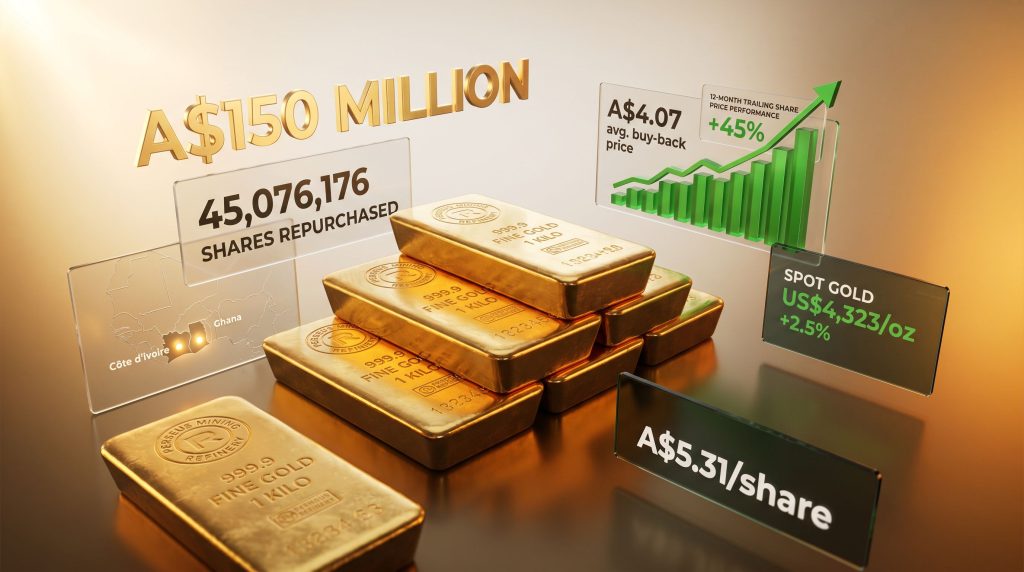
Perseus Mining's decision to expand its buy-back authorization by a further A$50 million in June 2026 is not an isolated event. It is the latest chapter in a disciplined, high-conviction capital return framework that has now seen the company deploy A$183.5 million repurchasing approximately 45.1 million shares since August 2024, at a blended average acquisition price of A$4.07 per share.
Against a share price of A$5.31 at the time of the announcement, that blended cost basis implies the company has already generated significant unrealised value for continuing shareholders through disciplined execution alone, without any requirement for additional gold production or resource expansion.
Understanding the Accretion Mechanic in Mining Buy-Backs
The concept of an accretive buy-back is frequently misunderstood, particularly among retail investors more familiar with dividend income models. In mining, where per-share metrics such as net asset value per share, free cash flow per share, and reserves per share carry enormous analytical weight, reducing the share count has compounding effects that are not immediately visible in headline profit figures.
When shares are repurchased below the company's estimated intrinsic value, each remaining share absorbs a larger proportion of the company's total asset base, future earnings stream, and resource endowment. Over time, this mechanical improvement in per-share metrics can exceed the returns achievable from capital deployed into marginal exploration programs or expensive acquisitions priced at premium valuations.
Furthermore, the gold equities sensitivity to these per-share improvements is well documented, meaning that even modest reductions in share count can trigger meaningful re-ratings in a supportive commodity environment.
This is why experienced mining analysts pay close attention not just to whether a company is buying back stock, but at what price relative to independently assessed net asset value. The spread between the buy-back execution price and intrinsic value is the true measure of accretion quality.
Perseus Mining Share Buy-Back Program: Full Statistical Breakdown
The following table consolidates the key metrics from the current program and the broader repurchase history since inception:
| Metric | Detail |
|---|---|
| Original program authorization | A$100 million |
| Program renewal date | August 2025 |
| Program expiry | 28 August 2026 |
| Buy-back expansion (June 2026) | A$50 million |
| Total current authorization | A$150 million |
| Shares repurchased (current program) | 19,077,751 shares |
| Average price paid (current program) | A$5.24 per share |
| Total shares repurchased since Aug 2024 | 45,076,176 shares |
| Total capital deployed since Aug 2024 | A$183.5 million |
| Blended average price since Aug 2024 | A$4.07 per share |
| Shares repurchased as % of total issued | approximately 3.3% |
| Share price at announcement | A$5.31 per share |
| Intraday share price reaction | +8% |
The 8% intraday surge following the Perseus Mining announcement reflects genuine market surprise, suggesting that even well-informed participants had not fully anticipated the scale of the program expansion. This kind of positive price shock often indicates that institutional positioning was underweight relative to the strength of the underlying capital return signal.
In addition, the broader gold market outlook for 2025 and beyond has reinforced investor confidence in producers with the financial capacity to execute sustained repurchase programmes at scale.
West African Gold Operations and the Cost Structure Advantage
Understanding why Perseus can fund a program of this magnitude requires appreciating the operational economics of low-cost West African gold production. The company's asset base in Côte d'Ivoire and Ghana sits within a geological belt that has historically delivered high-grade, near-surface mineralisation amenable to open-pit or shallow underground extraction methods, which keeps all-in sustaining costs structurally below the global industry average.
With spot gold trading above US$4,300 per ounce at the time of the announcement, the margin environment for a low-cost West African producer is exceptional by any historical benchmark. The operating leverage embedded in this cost structure means that even modest gold price increases translate into disproportionately large free cash flow gains, providing the financial capacity to simultaneously fund:
- Ongoing capital expenditure at existing operations
- Organic exploration and growth project development
- Strategic minority investments in adjacent exploration companies
- A rolling, large-scale share repurchase program
The Sissingué Complex and the Aurum Resources Connection
Perseus's Sissingué Gold Complex in northern Côte d'Ivoire represents one of the core production pillars underpinning the company's cash generation capacity. Its geological setting within the Birimian greenstone belt, a major gold-hosting geological formation extending across much of West Africa, provides a well-understood host environment for mineralisation.
The A$23.7 million investment in Aurum Resources, securing a 9.9% strategic stake in April 2026, is notable precisely because Aurum operates near Bagoé, a satellite asset connected to the Sissingué complex. This represents a low-cost, optionality-preserving approach to resource expansion, securing adjacency rights and exploration upside without committing to a full acquisition premium at elevated gold prices.
Gold Price Context: What Drove the June 2026 Commodity Rally
The timing of the buy-back expansion announcement coincided with a significant upward move in the precious metal. Spot gold climbed 2.5% to US$4,323 per ounce, its strongest level since June 9 and the third consecutive session of gains, while US gold futures for August delivery rose an equivalent 2.5% to US$4,343.80 per ounce, according to Reuters.
| Instrument | Price | Session Move |
|---|---|---|
| Spot gold | US$4,323/oz | +2.5% |
| US gold futures (Aug delivery) | US$4,343.80/oz | +2.5% |
The rally was driven by a convergence of macro developments:
- A US-Iran agreement on reopening the Strait of Hormuz reduced acute geopolitical risk premiums in energy markets
- Softer crude oil prices eased inflationary pressure expectations
- US dollar weakness created a supportive pricing environment for USD-denominated commodities
- Receding fears of aggressive monetary tightening provided a tailwind for non-yielding assets
Tim Waterer, Chief Market Analyst at KCM Trade, noted in comments reported by Reuters that lower energy prices and a weaker dollar, both stemming from reduced geopolitical tension and the anticipated resumption of Strait of Hormuz shipping activity, were working together to suppress inflation expectations and deliver the strongest near-term tailwind gold had experienced in several weeks. He also cautioned, however, that how durable the underlying peace agreement proves to be will ultimately determine whether the price support is sustained.
The current gold price outlook remains a critical variable for producers such as Perseus, where free cash flow generation is directly leveraged to spot prices above a relatively low cost base.
Capital Discipline Over Scale: What the Predictive Discovery Decision Reveals
Perhaps the most instructive data point in Perseus's recent capital allocation history is not the buy-back program itself, but rather what the company chose not to do. In late 2025, Perseus terminated a proposed A$2.1 billion takeover of Predictive Discovery, another West African gold developer, before the transaction was completed.
The decision to walk away from an acquisition of that scale, followed almost immediately by the acceleration of share repurchases and smaller strategic investments, reveals a capital discipline framework that prioritises value per share over headline growth metrics. In an industry where empire-building instincts often lead management teams to overpay for acquisitions at cyclical price peaks, this behaviour is genuinely differentiated.
Companies that decline large acquisitions and redirect capital toward buying their own equity are effectively telling the market that no available external asset offers better risk-adjusted value than their own underpriced stock. This is a high-conviction signal that sophisticated investors should not overlook.
Consequently, observers of gold M&A activity in the Australian market have noted that Perseus's approach stands in contrast to peers who have pursued aggressive consolidation strategies at elevated valuations.
The next major ASX story will hit our subscribers first
Comparing Shareholder Return Mechanisms: Why Buy-Backs Win at This Stage of the Cycle
Gold miners operating at peak margins face a recurring capital allocation decision. The three primary mechanisms for returning surplus cash to shareholders each carry distinct characteristics:
| Mechanism | Pros | Cons |
|---|---|---|
| Special dividends | Immediate income for shareholders | Does not reduce share count; one-time in nature |
| Ordinary dividend increases | Predictable income stream | Creates ongoing commitment; constrains balance sheet flexibility |
| On-market share buy-backs | Reduces share count permanently; improves per-share metrics; flexible | Market timing risk; value-destructive if executed above intrinsic value |
For a company like Perseus, which explicitly reserves the right to redirect capital toward acquisitions if compelling opportunities emerge, the flexibility of the buy-back mechanism is particularly valuable. Dividends, once increased, carry an implicit commitment that is costly to reverse without damaging investor confidence. Buy-backs can be suspended without the same reputational penalty.
Furthermore, the extent to which gold miners outperform broader ASX benchmarks is often tied directly to their capacity to execute disciplined capital return frameworks at the right point in the commodity cycle.
Risks and Investor Considerations
While the strategic logic underpinning the Perseus Mining share buy-back expansion is compelling, investors should evaluate the program within a balanced risk framework.
Key risks to monitor include:
-
Gold price sensitivity: A sustained correction from current levels above US$4,300/oz would compress operating margins and free cash flow, potentially constraining the company's capacity to continue repurchases at scale
-
Suspension risk: Perseus has explicitly disclosed that the program may be terminated at management's discretion based on evolving conditions, share price movements, or competing capital requirements
-
Valuation convergence: If the market re-rates Perseus shares materially higher and closes the perceived discount to intrinsic value, the accretive case for continued buy-backs weakens significantly, with purchases conducted at or above intrinsic value becoming value-destructive
-
West African operational risk: Jurisdictional factors inherent to operating in Côte d'Ivoire and Ghana, including geopolitical dynamics, regulatory changes, and community relations considerations, can affect production continuity
-
M&A re-emergence: If a compelling large-scale acquisition opportunity surfaces, buy-back capital could be redirected quickly, as nearly occurred with the Predictive Discovery proposal
Share price performance context at announcement:
| Timeframe | Perseus Share Price Performance |
|---|---|
| Year-to-date | -5% |
| 12-month trailing | +45% |
| Price at announcement | A$5.31/share |
The year-to-date underperformance relative to the trailing 12-month gain is itself instructive. It suggests the market may have partially faded a strong prior-year move, creating the very valuation gap that management is seeking to exploit through accelerated repurchases.
FAQ: Perseus Mining Share Buy-Back Program
What is the total size of the current Perseus buy-back authorization?
Following the A$50 million expansion announced in June 2026, the current program carries a total authorized capacity of A$150 million, running until 28 August 2026.
How many shares has Perseus repurchased in total since the program began?
Since August 2024, Perseus has repurchased approximately 45.1 million shares at a blended average price of A$4.07 per share, representing roughly 3.3% of total shares in issue.
Can the buy-back be cancelled early?
Yes. Perseus has disclosed that the program may be suspended or terminated at management's discretion based on market conditions, share price levels, or the emergence of competing capital priorities.
What does the buy-back mean for existing shareholders?
Each share repurchased and cancelled increases the proportional ownership of remaining shareholders in the company's total asset base, earnings stream, and resource endowment, without requiring any additional operational output or capital contribution from those shareholders.
What drives Perseus's free cash flow capacity to fund these repurchases?
Perseus's ability to sustain a large-scale Perseus Mining share buy-back reflects its low-cost West African production base, which generates significantly higher margins at elevated gold prices. With spot gold above US$4,300 per ounce, the company's operating leverage produces substantial surplus cash flow beyond what is required for sustaining capital and growth investment.
This article is for informational purposes only and does not constitute financial advice. Past share price performance and buy-back execution data are not reliable indicators of future results. Investors should conduct independent research and consult a qualified financial adviser before making investment decisions. Forward-looking statements involve risks and uncertainties that could cause actual outcomes to differ materially from those described.
Want to Capitalise on the Next Major ASX Mineral Discovery Before the Market Moves?
Discovery Alert's proprietary Discovery IQ model scans ASX announcements in real time, instantly identifying significant mineral discoveries and turning complex data into actionable investment insights — the same kind of capital allocation signals that sophisticated investors track in producers like Perseus Mining. Explore historic discovery returns that demonstrate why early positioning matters, and begin your 14-day free trial at Discovery Alert to secure your market-leading edge.