June 17, 2026
Geopolitics and the Price of Metal: Understanding the LME Aluminium Shock
Commodity markets have always had an intimate relationship with geopolitical risk. When conflict threatens critical shipping routes, traders price in supply chain disruption risks before a single tonne of metal goes missing. When diplomatic progress reduces that threat, the premium unwinds just as quickly. This mechanism explains why a single headline about a preliminary peace agreement between the United States and Iran can move aluminium prices by more than four percent in a single trading session, and why Hindalco NALCO and Vedanta shares fall after LME aluminium prices drop in sympathy.
Understanding how this chain reaction unfolds, and what it reveals about the structural differences between India's three largest aluminium-exposed companies, is essential for investors navigating the volatile intersection of geopolitics and industrial metals.
When big ASX news breaks, our subscribers know first
The Mechanism Behind the LME Aluminium Price Collapse
How Geopolitical Risk Premiums Are Built Into Metal Benchmarks
When supply chain disruption risks rise, commodity traders embed a forward-looking risk premium into benchmark prices. For aluminium, this means that even when physical inventories are adequate, the expectation of future scarcity can push LME prices significantly above their fundamental equilibrium. Over recent months, rising tensions in the Middle East, particularly surrounding the Strait of Hormuz, had systematically injected such a premium into aluminium pricing.
The Strait of Hormuz is not just strategically important for oil. It also serves as a critical transit corridor for alumina shipments, bauxite cargoes and other raw materials that feed global aluminium smelters. Approximately 10 percent of global aluminium supply originates from Middle Eastern production facilities, according to Bank of America analysts, making the region's stability a material variable for global price setting.
The 4.4% Single-Session Drop: What the Numbers Mean
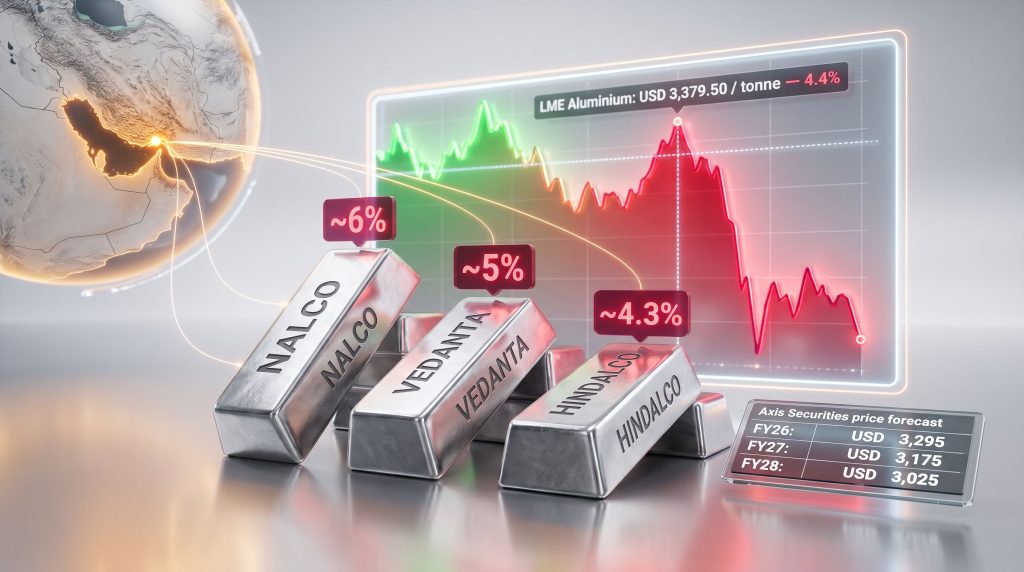
On June 17, 2026, LME aluminium prices fell 4.4 percent to approximately USD 3,379.50 per tonne, their lowest level since March. The catalyst was a reported preliminary peace agreement between the United States and Iran, which traders interpreted as a signal that Strait of Hormuz shipping disruptions would ease, supply chains would normalise and previously delayed inventory would re-enter global circulation.
A 4.4 percent single-session decline in a major industrial metal benchmark is not a routine market fluctuation. It represents approximately a 10 percent correction from the recent highs that had been supported by Middle East supply-risk premiums. For producers whose revenue realisations are directly benchmarked to LME spot prices, this kind of move translates almost immediately into compressed per-tonne earnings.
The speed of the price correction illustrates a core dynamic in commodity markets: geopolitical risk premiums inflate gradually as tensions build, but they can deflate almost instantaneously when diplomatic signals emerge, regardless of whether physical supply has actually changed.
Why Indian Aluminium Producers Cannot Escape Global Price Movements
The LME Benchmark Pricing System Explained
Indian aluminium producers, regardless of their scale or domestic market position, use LME benchmark pricing as the primary reference point for determining their sales realisations. This means that when LME aluminium falls, the effective revenue per tonne that these companies receive on their primary metal sales declines in near-lockstep.
This pricing linkage creates a structural earnings sensitivity that differs from a purely domestic business whose revenues are insulated from global spot markets. For India's aluminium sector, the LME is not an abstract financial benchmark. It is the mechanism through which global supply-demand dynamics and geopolitical risk appetite are directly transmitted into corporate income statements.
The Nifty Metal Index as a Sector Sentiment Barometer
The Nifty Metal Index, which aggregates share price performance across India's listed metals companies, reflected the sell-off broadly. The index was among the weakest-performing sectoral indices during the June 17 session, confirming that the LME aluminium decline was not merely affecting individual stocks but creating a sector-wide repricing event. When institutional investors reassess earnings forecasts for the largest components of a sector index, the rerating tends to be swift and broad.
Comparing the Damage: NALCO, Vedanta and Hindalco
Stock Performance and Business Model Exposure
The intraday declines across the three companies were not uniform, and the variation in magnitude directly reflects the differences in their underlying business model exposure to primary aluminium pricing. Leading aluminium producers globally have similarly varied responses to benchmark price shocks depending on their degree of downstream integration.
| Company | Intraday Decline | Primary Exposure | Q4 FY26 Revenue |
|---|---|---|---|
| NALCO | ~5.7% to ~6% | Alumina and primary aluminium | INR 51B (USD 540M) |
| Vedanta | ~5% (lower circuit) | Diversified metals including aluminium | INR 515B (USD 5.4B) |
| Hindalco | ~4.3% to ~4.4% | Upstream, downstream and Novelis | INR 781B (USD 8.3B) |
Why NALCO Sustained the Steepest Decline
NALCO's approximately six percent intraday fall was the sharpest of the three, and the reason is structural rather than coincidental. The company derives the majority of its revenue from alumina and primary aluminium sales, both of which are directly and tightly correlated to LME benchmark movements. There is limited downstream processing, limited product diversification and no equivalent to a Novelis-style buffer.
When primary aluminium prices fall sharply, NALCO's revenue model absorbs the impact with very little cushioning. This concentrated exposure is a double-edged characteristic. During commodity upswings, NALCO's earnings leverage to rising LME prices can be among the strongest in the sector. During corrections, however, that same leverage operates in reverse.
Vedanta's Position: Diversified but Still Correlated
Vedanta's aluminium business triggered its five percent lower circuit, the maximum single-session decline permitted under exchange trading rules. While Vedanta operates a more diversified metals portfolio than NALCO, its aluminium division remains closely linked to global benchmark pricing. The company's scale, with Q4 FY26 revenues of INR 515 billion (USD 5.4 billion), provides some operational resilience, but it does not structurally insulate earnings from LME price moves in the way that downstream processing can.
Aluminium and alumina markets have faced similar dynamics globally, where diversified operators still experience meaningful earnings compression when LME benchmark moves are this sharp.
Hindalco's Structural Advantage Through Novelis
Hindalco's comparatively smaller decline of approximately 4.3 to 4.4 percent reflects a meaningful structural difference. The company operates a vertically integrated business model that includes rolled products, aluminium foil and, most significantly, its Novelis subsidiary, a global leader in aluminium rolling and recycling. Novelis generates revenue from value-added, downstream aluminium products whose pricing is not purely determined by LME spot rates.
Companies with concentrated exposure to primary aluminium production face disproportionate earnings pressure during LME price corrections, while vertically integrated operators with downstream processing capacity absorb price shocks more effectively due to margin diversification across the value chain.
Hindalco's Q4 FY26 revenue of INR 781 billion (USD 8.3 billion) is the largest of the three by a considerable margin, and furthermore, a substantial portion of that revenue base is less directly tethered to daily LME movements.
The Strait of Hormuz: Why a Shipping Chokepoint Moves Metal Markets
What Makes the Strait Systemically Important for Aluminium
The Strait of Hormuz is one of the world's most strategically critical maritime chokepoints, typically associated with oil flows. Less widely appreciated is its significance for industrial metals. Alumina refineries in the Middle East, particularly in countries like Bahrain and the UAE, depend on the strait for both raw material imports and finished product exports.
Disruption to shipping through this corridor directly threatens the supply of both alumina and primary aluminium. A less commonly discussed dimension is that Middle Eastern aluminium smelters benefit from heavily subsidised energy costs, making them among the lowest-cost producers globally. When their output is threatened by geopolitical instability, the market cannot simply replace that volume with higher-cost production elsewhere without accepting structurally higher input costs.
What Supply Chain Normalisation Actually Means for Prices
A reduction in Strait of Hormuz risk does not merely remove a supply disruption premium. It also implies that inventories which were building up due to shipping delays and diverted cargoes could re-enter the market. This inventory overhang effect can compound the downward price pressure beyond the simple removal of the geopolitical premium itself, which partly explains why the June 17 sell-off was as sharp as it was.
Near-Term Analyst Views and the China Production Variable
Bank of America's Caution on Near-Term Price Vulnerability
Bank of America flagged near-term price vulnerability following the LME sell-off, noting that supply risks are easing while demand concerns persist. The bank highlighted that Middle Eastern production represents close to 10 percent of global aluminium supply, and that accelerating Chinese output could compound downward pressure if Middle Eastern supply simultaneously recovers.
This intersection of recovering Middle Eastern supply and rising Chinese production represents a potential double-supply shock scenario that the market may not have fully priced in. Furthermore, China's industrial demand outlook remains a key variable, as its aluminium smelting capacity has been expanding and production discipline, when it wavers, can add millions of tonnes to global supply in a relatively short time frame.
Indonesia's Emerging Role in Global Aluminium Supply
A factor receiving growing attention from analysts is Indonesia's expanding role in global aluminium supply chains. The country holds significant bauxite reserves, which form a critical part of the global bauxite supply equation, and has been moving up the value chain through policies encouraging domestic processing rather than raw material exports. As Indonesian refining and smelting capacity continues to develop, it represents an additional source of incremental supply that could structurally influence global price dynamics over the medium term.
The next major ASX story will hit our subscribers first
Long-Term Price Floor: What Analyst Forecasts Suggest
Axis Securities' Multi-Year Price Projections
Despite the near-term correction, Axis Securities maintained a constructive longer-term view on aluminium pricing, arguing that prices are structurally unlikely to return to historical lows below USD 2,500 per tonne.
| Fiscal Year | Axis Securities Aluminium Price Estimate |
|---|---|
| FY26 | USD 3,295 per tonne |
| FY27 | USD 3,175 per tonne |
| FY28 | USD 3,025 per tonne |
The brokerage retained positive coverage on both Hindalco and NALCO, indicating that despite near-term earnings pressure, the longer-term fundamental case remains intact.
Structural Demand Drivers That Support a Price Floor
The argument for a structural price floor rests on several converging demand trends that are unlikely to reverse:
- Electric vehicle adoption drives demand for lightweight aluminium components, battery enclosures and structural panels
- Grid infrastructure expansion globally requires substantial aluminium in transmission cables and wiring systems
- Aerospace and defence growth sustains demand for high-specification aluminium alloys
- Packaging and sustainability transitions support ongoing downstream consumption, particularly in beverage and food segments
- Recycling economics create a floor in the form of energy cost advantages for secondary aluminium production
These demand pillars do not prevent cyclical corrections, but they do establish a structural floor beneath which sustained price declines become economically self-correcting, as marginal production becomes unviable and supply adjusts downward.
Scenario Analysis: Multiple Pathways for Prices and Stocks
| Scenario | LME Aluminium Trajectory | Indian Producer Impact |
|---|---|---|
| Sustained U.S.-Iran Peace | Continued softness toward USD 3,000-3,100 range | Margin compression for NALCO and Vedanta |
| Partial Deal Breakdown | Price recovery toward USD 3,400-3,500 | Earnings stabilisation across sector |
| Full Re-Escalation | Potential spike above USD 3,600+ | Short-term revenue boost, supply chain complexity |
The above scenarios are speculative projections for analytical purposes and should not be interpreted as investment advice or price forecasts.
Key Variables Investors Should Monitor in H2 2026
Four factors will likely determine whether Indian aluminium stocks recover or face extended pressure through the second half of 2026:
- LME aluminium price trajectory and whether the correction deepens toward the USD 3,000 threshold cited in analyst forecasts
- Chinese production volumes, which remain the single largest bearish risk variable given the scale of China's smelting capacity relative to global supply
- Strait of Hormuz shipping activity, where any renewed disruption would rapidly reinstate geopolitical premiums and reverse the June 17 correction
- Indonesian supply expansion, representing a structural medium-term addition to global supply that could gradually suppress price ceilings even in a stable geopolitical environment
Frequently Asked Questions
Why did Hindalco, NALCO and Vedanta shares fall on June 17, 2026?
The three companies experienced sharp intraday declines after LME aluminium prices dropped 4.4 percent to USD 3,379.50 per tonne, their lowest level since March. The trigger was a reported preliminary peace agreement between the United States and Iran, which reduced expectations of supply disruptions through the Strait of Hormuz. Consequently, this unwound the geopolitical risk premium that had previously supported aluminium prices.
Which company was most affected by the LME aluminium price drop?
NALCO experienced the steepest decline of approximately 5.7 to 6 percent, reflecting its concentrated exposure to alumina and primary aluminium sales. Vedanta hit its five percent lower circuit, while Hindalco fell approximately 4.3 to 4.4 percent, partially cushioned by its downstream and Novelis operations. As reported across financial media, the sell-off was swift and broad across the sector.
What is the long-term outlook for aluminium prices?
Axis Securities forecasts aluminium at USD 3,295 per tonne for FY26, USD 3,175 for FY27 and USD 3,025 for FY28, maintaining that prices are structurally unlikely to fall below the USD 2,500 per tonne historical floor. The brokerage retained positive long-term views on both Hindalco and NALCO despite near-term headwinds.
How does Hindalco differ from NALCO in terms of price risk exposure?
Hindalco operates a diversified business model incorporating downstream aluminium products and its global Novelis subsidiary, revenues that are less directly tied to LME spot prices. NALCO, by contrast, derives the majority of its revenue from primary aluminium and alumina sales, making it significantly more sensitive to benchmark price movements.
Summary: What the LME Aluminium Sell-Off Reveals
- LME aluminium's 4.4 percent single-session decline to USD 3,379.50 per tonne on June 17, 2026 triggered sector-wide selling pressure across Indian metal equities
- NALCO's approximately 6 percent decline reflects its structural vulnerability as a primary aluminium-focused producer
- Hindalco NALCO and Vedanta shares fall after LME aluminium prices drop illustrates how differently integrated business models absorb the same benchmark shock
- The Strait of Hormuz remains a critical geopolitical variable for global aluminium supply chain risk pricing
- Bank of America flagged near-term price vulnerability, while Axis Securities maintained a longer-term constructive view with a USD 3,025 to 3,295 range through FY28
- China's industrial demand outlook and Indonesian supply expansion represent the two most significant structural bearish variables for aluminium prices in the medium term
- Structural demand from electrification, grid infrastructure and lightweight automotive applications continues to underpin a long-term price floor
This article is for informational purposes only and does not constitute financial or investment advice. Past price movements and analyst forecasts are not reliable indicators of future performance. Investors should conduct independent research before making investment decisions.
Want to Spot the Next Major ASX Mineral Discovery Before the Market Does?
Whilst geopolitical shocks like the LME aluminium sell-off highlight how quickly commodity prices can shift, Discovery Alert's proprietary Discovery IQ model scans ASX announcements in real time, instantly identifying significant mineral discoveries and turning complex data into actionable insights — explore historic discoveries and their returns to see what early positioning can mean, and begin your 14-day free trial to secure a market-leading edge.