
June 17, 2026
When Refinery Economics Meet Geopolitical Realignment
The global refining industry has rarely operated in a more complex environment. Since 2022, a cascade of structural disruptions — from sanctions-driven crude rerouting to OPEC+ supply management strategies and accelerating energy transition mandates — has fundamentally altered how refinery operators approach feedstock procurement. The old model of long-term, single-origin crude supply contracts is giving way to something more sophisticated: structured multi-party facilities that blend commodity trading expertise, working capital optimisation, and supply chain resilience into a single financial architecture.
Furthermore, OPEC's market influence on global pricing dynamics has made feedstock cost volatility a persistent operational challenge for independent refiners. It is within this context that the Essar IRH $500 million crude sourcing deal deserves serious analytical attention. This is not simply a procurement agreement. It is a window into the emerging logic of refinery finance in a post-fragmentation energy world.
When big ASX news breaks, our subscribers know first
What the Essar IRH $500 Million Crude Sourcing Deal Actually Involves
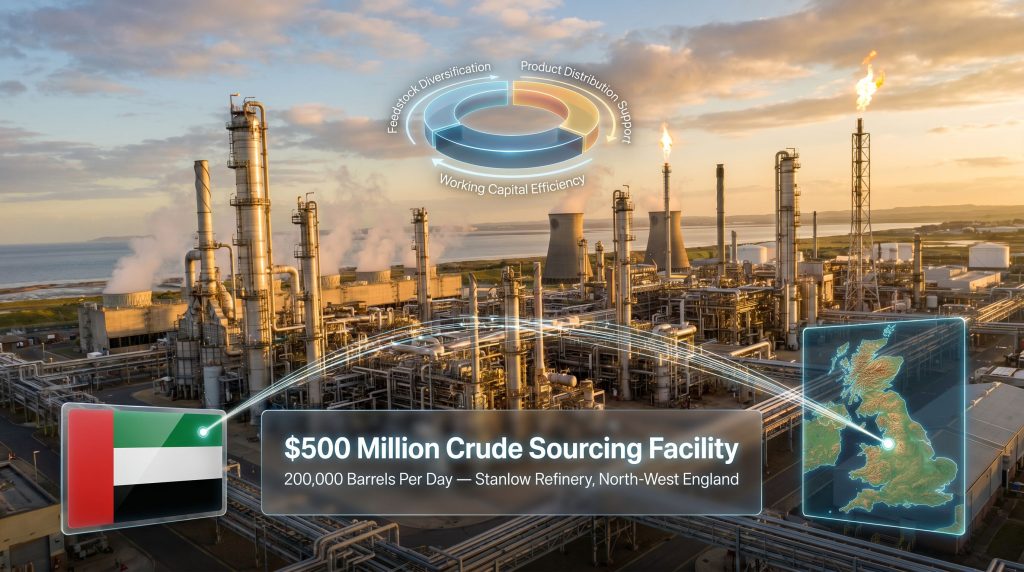
The agreement, announced in June 2026, establishes a $500 million structured facility between Essar Energy Transition Fuels (EETF) and IRH Global Trading, a wholly owned subsidiary of International Resources Holding (IRH), the Abu Dhabi-headquartered commodity platform. At its core, the facility serves three distinct but interlocking commercial functions for the Stanlow refinery in north-west England.
| Deal Component | Details |
|---|---|
| Total Facility Value | $500 million |
| Announcing Parties | Essar Energy Transition Fuels and IRH Global Trading |
| IRH Parent Entity | International Resources Holding, Abu Dhabi |
| Asset Supported | Stanlow Refinery, North-West England |
| Refinery Capacity | 200,000 barrels per day |
| Primary Functions | Crude diversification, product marketing, working capital optimisation |
| Announcement Date | June 16–17, 2026 |
The three pillars of the facility are:
-
Feedstock diversification — accessing IRH's global trading network to reduce dependency on any single crude origin or supply corridor
-
Product marketing support — broadening the commercial reach for refined products leaving Stanlow, improving price discovery and off-take flexibility
-
Working capital optimisation — restructuring the cash conversion cycle to reduce liquidity pressure and improve operational headroom
What makes this arrangement noteworthy from a structural finance perspective is that it bundles functions that were traditionally handled separately. Crude procurement, refined product marketing, and working capital management each historically involved distinct banking or trading counterparties. Consolidating them into a single facility with a commodity-linked trading partner reflects a broader shift in how sophisticated refinery operators are engineering their balance sheets.
Understanding the Parties: Who Is IRH Global Trading?
International Resources Holding operates as what the industry describes as a mine-to-market platform, meaning its scope spans the full commodity value chain from resource extraction through logistics to end-market distribution. The company's primary strategic focus has been on minerals considered critical to the global energy transition, giving it deep operational experience in commodity logistics, procurement structures, and international trading relationships.
IRH Global Trading functions as the company's commodity trading arm, and it is through this vehicle that the Stanlow facility is being executed. The expansion from critical minerals into crude oil procurement and product supply represents a meaningful broadening of IRH's mandate, reflecting a strategic calculation that energy commodity trading and transition-critical minerals are increasingly converging markets.
"Abu Dhabi-based commodity platforms are uniquely positioned to bridge Gulf-origin crude supply networks with European refining demand, offering counterparties both geographic reach and trading sophistication that traditional Western banking arrangements often cannot replicate."
This positioning matters enormously for a UK refiner like Stanlow. Access to a trading counterparty with established relationships across multiple crude-producing geographies provides genuine supply optionality that simple bank-financed procurement cannot deliver. In addition, the use of commodity hedging strategies alongside such structured facilities can further insulate refinery margins from short-term price swings.
Stanlow's Strategic Significance Within UK Energy Infrastructure
The Stanlow refinery is not a marginal industrial asset. Processing approximately 200,000 barrels of crude per day, it ranks among the largest refining complexes in the United Kingdom and plays a disproportionate role in supplying refined petroleum products to the north-west England market, including jet fuel, diesel, and petrochemical feedstocks.
What makes Stanlow particularly significant within Essar's broader corporate strategy is its dual identity: it is simultaneously a conventional hydrocarbon processing facility and a designated anchor site for EETF's low-carbon energy transition ambitions. Essar has publicly positioned Stanlow as the nucleus of a planned energy transition infrastructure hub in north-west England, with investment programmes targeting low-carbon fuel production and industrial decarbonisation infrastructure.
This duality creates an interesting tension in capital allocation terms. Transition-era infrastructure investments — whether hydrogen production, sustainable aviation fuel capacity, or carbon capture integration — carry long payback horizons and require patient capital. Simultaneously, the refinery must continue generating operating cash flows to sustain itself and fund those future-facing investments. Feedstock reliability and working capital efficiency are therefore not merely operational concerns; they are strategic prerequisites for the transition investment agenda.
The Financial Logic: Why Working Capital Matters More Than It Appears
Crude oil refining is a capital-intensive, low-margin business where working capital dynamics can make the difference between profitable operation and financial distress. The mechanics are worth understanding in some depth.
A refinery typically purchases crude oil weeks before the refined products derived from that crude are sold and payment received. This gap — the cash conversion cycle — requires continuous financing. In a high-price crude environment, the financing requirement balloons proportionally. For a facility processing 200,000 barrels per day at prevailing crude prices, the working capital requirement at any given moment can run into hundreds of millions of dollars.
Traditional approaches to this problem involve revolving credit facilities from commercial banks. However, structured commodity trading facilities — like the one IRH is providing — offer several advantages:
- They can be calibrated directly to cargo-level crude procurement, matching financing to physical supply flows rather than requiring general corporate credit
- Trading counterparties with their own crude origination capabilities can potentially offer better pricing access than pure financing arrangements
- Consolidated crude-plus-working-capital facilities reduce administrative complexity and counterparty relationships
- Product marketing support from the same counterparty closes the loop, aligning incentives across the full purchase-to-sale cycle
The Geopolitical Backdrop: Gulf Capital and European Refining Assets
The Essar IRH $500 million crude sourcing deal does not exist in isolation. It reflects a structural trend that has been building since the energy market dislocations of 2022, when the post-Ukraine sanctions environment scrambled established crude trade flows across the globe.
European refiners, accustomed to processing specific crude grades from specific origins, found their feedstock assumptions overturned almost overnight. The resulting trade war impacts and broader geopolitical tensions created openings for trading counterparties with access to diversified crude origins, particularly those with strong Gulf region relationships.
| Trend | Pre-2022 Approach | Post-2022 Approach |
|---|---|---|
| Crude Sourcing | Long-term single-origin contracts | Diversified multi-source structured facilities |
| Trading Partners | Primarily Western banking majors | Expanded to Gulf and Asian commodity platforms |
| Working Capital | Traditional revolving bank credit | Commodity-linked structured trading facilities |
| Strategic Focus | Volume optimisation and cost minimisation | Resilience, origin flexibility, and ESG alignment |
Gulf-based commodity trading firms have moved aggressively to fill this gap, leveraging their proximity to major producing regions, sovereign relationships across OPEC+ economies, and growing sophistication in structured finance. IRH's move into European refinery support through the Stanlow deal is consistent with this broader capital flow pattern.
"The convergence of Gulf trading capital with European refining infrastructure represents one of the less-discussed structural shifts in the post-2022 energy market. It is reshaping not just who finances European refineries, but how those refineries access crude supply at a fundamental level."
The next major ASX story will hit our subscribers first
Connecting Feedstock Security to the Low-Carbon Investment Thesis
One dimension of the Essar IRH deal that deserves closer scrutiny is how feedstock security and transition investment are linked in EETF's strategic logic. The connection is less obvious than it might appear.
Refinery decarbonisation projects — which at Stanlow include aspirations around low-carbon fuels and industrial emissions reduction — require sustained capital commitment over multi-year timeframes. That capital must come from somewhere, and for a privately held refining business without public equity capital markets access in the conventional sense, the primary source is operating cash flow.
When feedstock supply is interrupted, or when working capital costs spike due to financing constraints, operating margins compress. Compressed margins reduce the investable surplus available for transition projects. Conversely, a well-structured feedstock facility that stabilises supply costs and reduces working capital drag directly protects the financial capacity to invest in decarbonisation infrastructure.
This is the less-discussed logic behind why EETF describes the IRH deal as supporting its low-carbon energy ambitions. The connection is not symbolic; it is mechanistic. The broader energy security debate across the UK and beyond similarly hinges on this interplay between operational continuity and long-term clean energy investment.
What Other European Refiners Can Learn From This Structure
The Stanlow-IRH facility offers a template that other European refining operators may find instructive, particularly those facing similar combinations of feedstock exposure, capital constraints, and transition investment pressures.
Several structural features stand out as potentially replicable:
- Commodity counterparty selection: choosing a trading partner with genuine crude origination capabilities rather than a purely financial intermediary
- Consolidated facility design: bundling crude procurement, product marketing, and working capital into a single structured agreement rather than managing three separate relationships
- Transition alignment framing: positioning feedstock security explicitly as an enabler of decarbonisation investment, which may improve the facility's reception among ESG-focused stakeholders
- Gulf capital access: engaging Abu Dhabi and broader Gulf-region commodity platforms whose capital deployment timelines and risk appetites differ from traditional European bank financing
The competitive pressure on European independent refiners from lower-cost Middle Eastern and Asian refining capacity makes supply-chain efficiency and working capital management genuinely existential concerns. Facilities structured along the lines of the Essar IRH arrangement may increasingly represent the frontier of competitive refinery finance.
UK Energy Security and the Role of Private Capital Partnerships
Stanlow's importance to UK energy security extends beyond its processing capacity. The refinery supplies a substantial portion of the aviation and road transport fuel consumed across north-west England, making its continued operation a matter of genuine national infrastructure significance.
In a period where public capital for energy infrastructure faces competing political priorities, the role of private commercial partnerships in sustaining critical refining assets has grown considerably. The Essar IRH $500 million crude sourcing deal is, in part, an example of private capital arrangements stepping into the feedstock security role that policy frameworks identify as strategically important but do not directly fund.
It is worth noting, however, that private capital partnerships of this nature also introduce their own risk considerations:
- Counterparty concentration: reliance on a single trading partner for a large portion of crude supply creates bilateral dependency
- Geopolitical exposure: facilities routed through Gulf-headquartered entities carry exposure to regional geopolitical dynamics that may differ from Western market risks
- Commercial alignment: trading counterparties have their own commercial objectives that may not always align perfectly with the refinery operator's long-term interests
These are not reasons to view the deal negatively, but they are dimensions that a sophisticated observer of the UK energy security landscape would weigh carefully. Essar's official press materials offer additional context on how the company frames these strategic partnerships within its broader corporate narrative.
Frequently Asked Questions: Essar IRH $500 Million Crude Sourcing Deal
What is the Essar IRH $500 million crude sourcing deal?
It is a structured facility agreement between Essar Energy Transition Fuels and IRH Global Trading, designed to diversify crude oil procurement, support refined product marketing, and optimise working capital arrangements for the Stanlow refinery in north-west England.
What is the Stanlow refinery's processing capacity?
Stanlow processes approximately 200,000 barrels of crude oil per day, making it one of the largest refining complexes operating in the United Kingdom.
Who owns IRH Global Trading?
IRH Global Trading is a wholly owned subsidiary of International Resources Holding, headquartered in Abu Dhabi. The parent company operates as a mine-to-market commodity platform with expertise spanning critical minerals and expanding into broader energy commodity trading.
How does feedstock security relate to Essar's energy transition goals?
Stable crude supply and improved working capital efficiency reduce the financial drag on Stanlow's operations, directly preserving the investable cash flow that EETF requires to fund low-carbon fuel production and industrial decarbonisation projects at the site.
Why is crude sourcing diversification important for UK refineries right now?
Since 2022, global crude trade flows have been significantly rerouted by geopolitical events and sanctions regimes. European refiners dependent on single-origin crude supply face heightened interruption risk. Diversified sourcing facilities provide supply continuity across a wider range of geopolitical scenarios.
The Bigger Picture: Structured Facilities as the New Refinery Finance Standard
The Essar IRH $500 million crude sourcing deal captures something important about where refinery finance is heading. The era of simple bank-financed crude procurement is giving way to more sophisticated structures that embed trading expertise, supply diversification, and working capital management into a unified commercial relationship.
For refinery operators navigating the twin pressures of near-term operational profitability and medium-term decarbonisation investment, these structures offer genuine advantages over traditional approaches. They convert what were previously separate financing and procurement challenges into a single, integrated facility with aligned commercial incentives across the full crude-to-product cycle.
Whether this particular deal delivers on its strategic promise will ultimately depend on execution, market conditions, and the durability of the EETF-IRH commercial relationship. However, as a structural innovation in how European refining assets are securing feedstock in an era of persistent supply-chain fragmentation, it merits close attention from the broader energy finance community.
This article is intended for informational purposes only and does not constitute financial, investment, or legal advice. Forward-looking statements and market assessments reflect analytical perspectives and are subject to material uncertainty. Readers should conduct independent due diligence before making any investment or commercial decisions related to the companies or assets discussed.
Want to Stay Ahead of the Next Major Commodity Discovery?
While structured refinery finance reshapes global energy supply chains, Discovery Alert's proprietary Discovery IQ model is scanning ASX announcements in real time — instantly identifying significant mineral discoveries and turning complex commodity data into actionable investment insights. Start your 14-day free trial at Discovery Alert and explore historic discoveries that have delivered exceptional market returns.