June 17, 2026
The Commodity Cycle Has Changed Shape, and BHP Is Positioned at Its Core
For most of investing history, the instinct to sell after a major price run has felt like common sense. When a stock climbs 75% in twelve months and prints a fresh all-time high, the rational voice in your head says the easy money is gone. But this logic, while emotionally satisfying, often causes investors to exit positions just as the structural case for holding them becomes most compelling.
The global commodity landscape is undergoing a fundamental transformation. The forces reshaping energy systems, digital infrastructure, and industrial supply chains are not short-term disruptions. They represent a generational shift in what the world needs from the ground beneath it, and which companies are best positioned to extract value from that shift over the coming decade.
With BHP shares at a record high buy or sell questions dominating investor conversations, the more useful starting point is not the share price itself, but the underlying architecture of demand that is driving it.
When big ASX news breaks, our subscribers know first
Understanding What the Record High Actually Reflects
Why All-Time Highs Are Often Misread as Sell Signals
Investor psychology around price highs is well documented. Research in behavioural finance consistently shows that humans anchor to past price levels and perceive assets near or above those levels as risky relative to historical entry points. This anchoring bias causes investors to conflate a high price with an expensive valuation, which are two entirely different things.
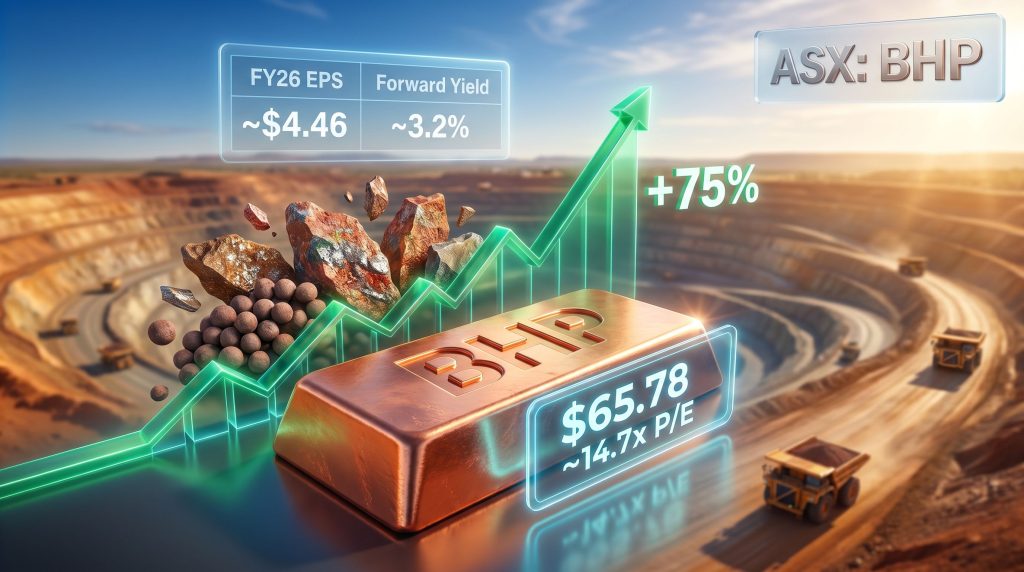
A stock trading at $65.78 on a given day is simply reporting what the market is willing to pay. Whether that price is justified depends on what the company earns, what it pays in dividends, and what structural tailwinds or headwinds it faces. The number alone tells you very little.
The 75% share price increase BHP has delivered over the past twelve months reflects a combination of improved commodity price expectations, a rotation back toward hard assets in an inflationary environment, and a growing conviction among institutional investors that the next commodity cycle will favour different materials than the last one did.
A Forensic Look at BHP's Valuation at Peak Prices
Setting aside the price level, the valuation picture for BHP Group Ltd (ASX: BHP) is more measured than the dramatic share price movement might suggest. Furthermore, understanding where the valuation sits relative to peers provides important context for any buy or sell decision.
Key Valuation Snapshot: FY26 and FY27 Consensus Estimates
| Metric | FY26 Estimate | FY27 Estimate |
|---|---|---|
| Earnings Per Share (EPS) | ~$4.46 | ~$4.48 |
| Price-to-Earnings (P/E) Ratio | ~14.7x | ~14.7x |
| Fully Franked Dividend Per Share | ~$2.12 | ~$2.02 |
| Forward Dividend Yield | ~3.2% | ~3.1% |
Source: CommSec consensus estimates
A forward P/E of approximately 14.7 times places BHP in a range that is neither deeply discounted nor obviously stretched for a company of its scale and earnings quality. For context, the broader ASX 200 has historically traded at forward P/E multiples in the 15 to 18 times range during periods of moderate growth.
A major global diversified miner sitting just below that band, with strong cash generation and a fully franked yield above 3%, is not flashing obvious overvaluation signals. The fully franked dividend is a particularly important consideration for Australian investors, as when franking credits are included, it represents a meaningful after-tax return.
The Structural Forces Reshaping Commodity Demand
Why This Cycle Is Structurally Different From the 2000s Boom
The commodity supercycle of the early 2000s was predominantly a China story. Rapid urbanisation, mass infrastructure construction, and the migration of hundreds of millions of people from rural areas into cities created voracious demand for bulk materials: iron ore, metallurgical coal, and oil in particular.
The cycle emerging now is driven by a different set of forces, and it favours a different set of commodities. Broker research from Bell Potter has highlighted several megatrends converging simultaneously with a resource base that has been chronically underinvested in for years — a combination that could establish structurally higher price floors across key materials. The scale of critical minerals demand adds further urgency to this structural shift.
Supercycle Comparison: China-Led Boom vs. Electrification-Led Cycle
| Factor | 2000s China Boom | 2020s Electrification Cycle |
|---|---|---|
| Primary Demand Driver | Urbanisation and Infrastructure | AI Infrastructure, EVs, and Green Energy |
| Key Commodities | Iron Ore, Coal, Oil | Copper, Aluminium, Lithium |
| Supply Response Time | Moderate | Slow (permitting and capital constraints) |
| Duration Potential | Approximately 10 Years | Structurally Open-Ended |
| BHP Positioning | Strong | Strong, especially in Copper |
The electrification-driven cycle is notable for one critical difference: supply response is far slower. During the 2000s boom, mining companies could ramp capacity with relative speed. Today, permitting constraints and the sheer geological complexity of developing new tier-one copper deposits mean that even high commodity prices take many years to translate into new production.
The Structural Demand Drivers Favouring BHP's Commodity Portfolio
| Megatrend | Primary Commodity Beneficiary | BHP Exposure Level |
|---|---|---|
| Global Electrification | Copper, Aluminium | High (Copper) |
| AI Data Centre Build-Out | Copper | High (Copper) |
| Energy Security and Deglobalisation | Iron Ore, Uranium | Moderate |
| Renewable Energy Transition | Copper, Nickel, Lithium | High (Copper) |
| China Industrialisation Continuation | Iron Ore, Coal | Moderate to Declining |
The Copper Thesis: BHP's Most Critical Strategic Advantage
Why Copper Is Now Overtaking Iron Ore as the Defining Commodity for BHP's Future
For much of the past two decades, BHP's earnings profile was dominated by iron ore, a commodity where the company holds genuinely world-class Pilbara assets. That remains true today. However, the investment community is increasingly looking through the iron ore contribution and focusing on what BHP is building in copper, and for good reason.
Copper is the metal at the intersection of almost every major structural trend shaping the global economy. Every electric vehicle requires substantially more copper than an internal combustion engine vehicle. Every solar panel and wind turbine installation requires copper wiring. Every hyperscale data centre supporting artificial intelligence workloads is copper-intensive in its power distribution and cooling infrastructure.
The scale of this demand build is not trivial. Wood Mackenzie and other commodity research organisations have estimated that the energy transition alone could require a doubling of annual copper supply by the mid-2030s — an extraordinary ask given current production trajectories.
Why Supply Cannot Keep Pace With Rising Demand
The copper supply crunch is perhaps the most consequential structural dynamic shaping BHP's long-term investment case. Large-scale copper projects routinely take ten to fifteen years from initial discovery through to first production. The permitting process alone, across multiple jurisdictions, environmental assessments, and community consultation requirements, can consume five or more years before a single dollar of construction capital is committed.
A few additional dimensions of the supply problem are worth understanding:
- Ore grade decline: The average grade of copper ore being mined globally has been falling steadily for decades. In 1900, ore grades of 4% to 5% copper were common. Today, major producing mines frequently operate on grades below 0.5%, meaning significantly more rock must be processed to yield the same amount of copper.
- Geographic concentration: A significant proportion of global copper production is concentrated in politically complex jurisdictions, including Chile and Peru, where regulatory uncertainty and community opposition have repeatedly disrupted production and deterred new investment.
- Capital starvation: After commodity prices fell sharply between 2012 and 2016, the global mining industry dramatically reduced exploration and development expenditure, creating a project pipeline that is far thinner than demand growth requires.
BHP's Escondida operation in Chile is the world's largest copper mine by production volume. Alongside the OZ Minerals assets acquired in 2023, which significantly expanded BHP's copper footprint in South Australia, the company has built one of the most enviable copper portfolios of any publicly listed miner globally.
Buy, Hold, or Sell BHP Shares at a Record High? A Framework for Every Investor Type
Matching Your Time Horizon to the Right Decision
The buy or sell question for BHP shares at a record high does not have a universal answer. The right response depends heavily on your investment objectives, time horizon, and risk tolerance. Investors can also review current BHP price data to better contextualise where the stock sits within its trading range.
Decision Framework by Investor Profile
| Investor Type | Time Horizon | Recommended Approach | Key Rationale |
|---|---|---|---|
| Long-Term Investor | 5+ Years | Buy or Hold | Copper exposure, supercycle thesis, reasonable P/E valuation |
| Medium-Term Investor | 1 to 3 Years | Hold or Buy on Weakness | Mixed analyst consensus; risk of near-term consolidation |
| Short-Term Trader | Under 12 Months | Wait for Pullback | Momentum indicators less reliable after large runs |
| Income-Focused Investor | Ongoing | Hold | Fully franked yield of approximately 3.1% to 3.2% remains competitive |
For long-term investors, the structural copper thesis provides a durable foundation that transcends short-term price volatility. For those with shorter time frames, however, caution is warranted simply because a 75% run in twelve months mathematically invites a period of consolidation or profit-taking, regardless of the underlying fundamentals.
What Buying on Weakness Actually Means in Practice
For investors who want exposure to BHP but feel uncomfortable initiating a full position at an all-time high, the concept of dollar-cost averaging provides a practical path forward. Rather than committing a full position at $65.78, spreading purchases across several tranches over three to six months reduces the risk of being fully invested at a temporary peak.
This approach acknowledges that analyst consensus on BHP is not uniformly bullish at current levels. Some brokers maintain hold ratings, reflecting the view that the near-term upside is already captured in the price even if the long-term thesis remains intact. For a deeper look at the sell or hold debate, Motley Fool's analysis provides additional perspective worth considering.
Real Risks That Cannot Be Dismissed
The Factors That Could Derail BHP From Current Levels
Intellectual honesty about BHP's investment case requires acknowledging the risks that sit alongside the opportunity. These are not hypothetical concerns.
Risk vs. Opportunity Summary
| Risk Factor | Severity | Offset or Mitigant |
|---|---|---|
| Iron Ore Price Decline | High | Copper diversification is growing in weight |
| China Economic Slowdown | High | Electrification demand is partially independent |
| Rising Operating Costs | Moderate | Scale advantages and tier-one asset quality |
| Profit-Taking After Rally | Moderate | Fundamental earnings support at current P/E |
| Commodity Cycle Reversal | High | Structural supply constraints limit downside duration |
China iron ore demand remains BHP's most significant macro risk factor. Despite the electrification narrative, iron ore still contributes substantially to BHP's earnings, and iron ore pricing is overwhelmingly driven by Chinese steel production. Any material deterioration in Chinese construction activity, property sector distress, or broader economic weakness flows directly into BHP's earnings.
Currency movements are another risk that receives insufficient attention. BHP's revenues are predominantly denominated in US dollars, while a significant portion of operating costs are in Australian dollars. A strengthening Australian dollar reduces the translated value of commodity revenues, compressing margins even when US dollar commodity prices are holding steady.
The next major ASX story will hit our subscribers first
How BHP Compares to Other ASX Resources Stocks
Peer Comparison Across the ASX Resources Sector
| Company | Primary Commodity | Approx. P/E | Dividend Yield | Copper Exposure |
|---|---|---|---|---|
| BHP Group (ASX: BHP) | Iron Ore and Copper | ~14.7x | ~3.2% | High |
| Rio Tinto (ASX: RIO) | Iron Ore and Aluminium | Comparable | Comparable | Moderate |
| South32 (ASX: S32) | Diversified Metals | Varies | Varies | Growing |
| Mineral Resources (ASX: MIN) | Lithium and Iron Ore | Varies | Lower | Low |
BHP's principal competitive advantages over peers are scale, asset quality, and balance sheet strength. The company operates tier-one assets across multiple jurisdictions, maintains a low-cost production profile in its core iron ore business, and carries a balance sheet capable of sustaining both growth investment and attractive capital returns simultaneously.
The Rio versus BHP debate is a perennial one for ASX resources investors. Rio Tinto offers a broadly comparable valuation and dividend profile but with heavier aluminium exposure and more limited copper growth optionality. For investors specifically seeking copper exposure at institutional quality, however, BHP remains the clearest expression of that thesis on the ASX.
Frequently Asked Questions: BHP Shares at a Record High
Is BHP a Good Buy at an All-Time High Price?
At approximately 14.7 times forward earnings with a fully franked yield above 3%, BHP's valuation is not extreme by historical standards. For long-term investors aligned with the copper and electrification thesis, the investment case remains credible even at record prices. Short-term traders should exercise caution given the scale of the recent run.
What Is BHP's Forward Dividend Yield for FY26 and FY27?
Based on CommSec consensus estimates, BHP is expected to pay fully franked dividends of approximately $2.12 per share in FY26 and $2.02 per share in FY27, implying forward yields of roughly 3.2% and 3.1% respectively at the record high price level.
What Would Cause BHP's Share Price to Fall From Current Levels?
The most significant downside catalysts include a sharp deterioration in Chinese economic activity reducing iron ore demand, a broad commodity cycle reversal driven by recession in developed economies, a sustained rise in the Australian dollar against the US dollar, or a significant increase in operating costs across BHP's asset base.
What Is the Commodities Supercycle and How Does It Affect BHP?
A commodities supercycle refers to an extended period, typically spanning a decade or more, during which commodity prices trend structurally higher due to demand growth that meaningfully outpaces the supply response. Bell Potter has argued that the convergence of AI capital expenditure, global electrification, and deglobalisation with years of underinvestment in new supply could be establishing the foundations of a new such cycle — one that is particularly favourable for copper-exposed miners like BHP.
Key Takeaways: Making a Rational Decision on BHP at Peak Prices
The instinct to sell a stock that has just hit a record high is understandable but frequently wrong. The more productive question is whether the underlying earnings, dividend, and structural commodity case supports the current valuation, and whether the long-term thesis remains intact. For BHP Group Ltd (ASX: BHP), with BHP shares at a record high buy or sell pressure pulling in different directions, the answers to those questions are largely affirmative, with meaningful caveats.
BHP Investment Decision Checklist
- Valuation remains within a reasonable range at approximately 14.7 times forward earnings
- Fully franked dividend yield of approximately 3.1% to 3.2% provides meaningful income support
- Copper exposure aligns with multi-decade electrification, renewable energy, and AI infrastructure demand
- World-class asset base and strong cash generation provide fundamental resilience
- Short-term traders should be cautious after a 75% twelve-month run
- China iron ore dependency remains a meaningful and ongoing downside risk
- Analyst consensus is mixed at current levels, reflecting genuine uncertainty about near-term upside
The five most important factors shaping BHP's investment case right now are copper supply constraints, the structural demand shift toward electrification-driven materials, the scale and quality of its tier-one asset portfolio, a valuation that has not yet become extreme, and the durability of its dividend in an environment of elevated commodity revenues.
Whether the next twelve months replicate the extraordinary performance of the past twelve is unknowable. What is more knowable is that the structural case for copper demand growth, the physical impossibility of rapidly expanding global copper supply, and BHP's position at the intersection of both dynamics provide a compelling foundation for long-term investors prepared to tolerate the volatility that commodity exposure inevitably delivers.
This article contains general information only and does not constitute personal financial advice. Investors should consider their own circumstances and, where appropriate, seek independent professional advice before making investment decisions. Past performance is not indicative of future results. Share prices and dividend estimates referenced are based on information available at the time of writing and are subject to change.
Want to Spot the Next Major Copper or Mineral Discovery Before the Market Does?
Discovery Alert's proprietary Discovery IQ model delivers real-time alerts on significant ASX mineral discoveries, instantly transforming complex geological and commodity data into actionable investment insights — ideal for investors seeking exposure to the structural copper and electrification themes reshaping global markets. Explore historic discoveries and their extraordinary returns to understand why positioning early in a major find can be transformative, then begin your 14-day free trial to gain a genuine market-leading edge.