June 17, 2026
The Anatomy of a Market-Moving Diplomatic Announcement
Energy markets have a long memory when it comes to diplomatic announcements that never became operational realities. The history of Strait of Hormuz tension cycles follows a recognisable rhythm: escalation, back-channel signalling, a headline agreement, a brief sentiment rally, and then the slow grind of implementation failure as structural complexities resurface. Understanding why this pattern repeats itself is the most important analytical lens through which to assess the current US-Iran peace framework and what a genuine Strait of Hormuz reopening near an Iran-US peace deal would actually mean for global energy markets in 2026.
The distinction between a signed agreement and a functioning one is not semantic. It is the space where real economic outcomes diverge from market expectations, and where investors who conflate diplomatic momentum with physical supply recovery consistently pay a price.
When big ASX news breaks, our subscribers know first
What Is the Current Status of the Strait of Hormuz Reopening?
As of mid-June 2026, the Strait of Hormuz has not fully reopened. The US and Iran announced a peace framework over the weekend, with a formal signing ceremony scheduled in Switzerland. The agreement, in its current form, is better characterised as an initial memorandum of understanding than a comprehensive final settlement.
The table below captures the operational and diplomatic reality as it stands today:
| Status Category | Current Condition |
|---|---|
| Diplomatic Framework | Initial framework signed; full agreement pending formal ceremony |
| Formal Signing Ceremony | Scheduled in Switzerland/Geneva |
| Strait Traffic | Severely restricted; safe passage protocols not yet issued |
| Nuclear Provisions | Deferred into a 30 to 60-day follow-on negotiating window |
| US Naval Blockade | Removal contingent on formal signing completion |
| Iranian Implementation | Stated as conditional on completed signing |
Key unresolved elements include Iran's nuclear commitments, which have been pushed into a separate negotiating window, and the sequencing standoff in which both Washington and Tehran are conditioning their own implementation steps on the other party moving first. This is not a minor administrative detail. Historically, this exact dynamic has been the primary mechanism by which diplomatically announced agreements fail at the operational level.
Lebanon adds a further layer of complexity. As an autonomous escalation variable outside the direct control of either capital, a flashpoint involving Lebanese actors could collapse bilateral momentum at any stage of the implementation process, regardless of what is signed in Switzerland.
Critical Note: Reporting across major outlets remains inconsistent on timing and operational status. Some sources characterise the reopening as imminent; others confirm the Strait remains effectively closed pending finalisation of technical passage protocols. Investors and market participants should treat current sentiment as reflecting optimism about a process, not confirmation of an outcome.
The Global Inflation Context: Why the Timing of This Deal Matters Enormously
The Energy-Inflation Transmission Mechanism
The reason a Strait of Hormuz restriction carries outsized macroeconomic consequences comes down to a transmission chain that moves faster in one direction than the other. When energy supply is constrained through a single chokepoint, the sequence unfolds as follows:
-
Tanker rerouting around the Cape of Good Hope adds approximately 10 to 14 days of transit time and significant additional fuel costs.
-
Freight premiums inflate as shipping capacity tightens and war-risk insurance surcharges are applied.
-
Refinery input costs rise as delivered crude prices incorporate both the commodity premium and the logistics surcharge.
-
Pump prices accelerate, often within days of a supply signal entering the forward market.
-
CPI readings reflect the energy component first, followed by second-round effects through freight-exposed goods and services.
The asymmetry in this chain is significant: energy price increases embed into consumer expectations and cost structures within weeks, while the reversal of a supply shock, even a genuine one, takes months to fully transmit back through the system. Furthermore, the oil price shock this disruption has generated has reverberated well beyond the immediate region, as energy executives across major producing nations have noted.
The Macro Dashboard: Numbers That Raise the Stakes
The current macro environment makes this diplomatic moment unusually consequential. The system entered this disruption with materially less policy buffer than in previous Hormuz tension cycles.
| Economic Indicator | Current Reading | Context |
|---|---|---|
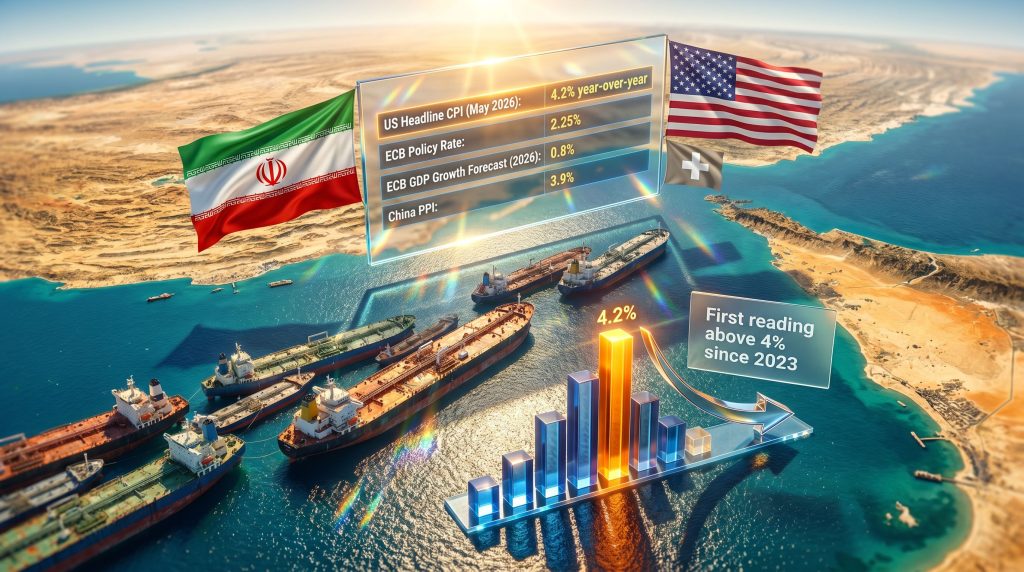
| US Headline CPI (May 2026) | 4.2% year-over-year | First reading above 4% since 2023 |
| US Real Wage Growth | Negative (2nd consecutive month) | Household purchasing power under sustained pressure |
| ECB Policy Rate | 2.25% | Raised 25bps explicitly in response to energy shock |
| ECB Inflation Forecast (2026) | 3.0% average | Projected to ease to 2.3% in 2027 |
| ECB GDP Growth Forecast (2026) | 0.8% | Near-stagnation driven by energy cost burden |
| China PPI (year-over-year) | 3.9% | Margin compression rather than broad demand inflation |
| China CPI (year-over-year) | 1.2% | Reflects weak domestic consumption dynamics |
| University of Michigan Sentiment | Rebounded from record low | Supported by stabilising gasoline prices |
The European Central Bank's position is particularly instructive. It raised rates unanimously by 25 basis points to 2.25% in direct response to the energy shock, while simultaneously forecasting GDP growth of just 0.8% for 2026. This is the definition of tightening into stagnation, a position that leaves virtually no capacity to absorb further supply-side disruptions without triggering a more severe economic contraction.
China's data tells a different but equally concerning story. Producer prices running at 3.9% year-over-year while consumer inflation sits at just 1.2% signals that energy-related cost increases are being absorbed at the production level rather than passed through to consumers, compressing margins across Chinese manufacturing and adding further drag to an already subdued domestic consumption environment.
According to Claudio Galimberti, Chief Economist at Rystad Energy, a credible reopening of the Strait of Hormuz would represent one of the most significant developments for the global economy at this particular juncture, precisely because the macro system is operating with so little remaining capacity to absorb further supply disruption. He has noted that every barrel previously constrained through the Strait represents inflationary pressure that would begin to unwind at the margin following a genuine reopening.
Why Both Parties Have Structural Reasons to Follow Through
The United States: Political Economy of Gasoline Prices
The connection between pump prices and voter sentiment is one of the most reliable correlations in US political history. With headline CPI above 4% for the first time since 2023 and real wages declining for a second consecutive month, the political cost of sustained energy-driven inflation heading into midterm elections is substantial. A naval blockade that was strategically justifiable during an acute confrontation becomes increasingly difficult to sustain when it is directly contributing to the inflationary environment that is eroding household purchasing power. These dynamics are further complicated by the broader trade war and oil prices relationship, which has added another layer of market uncertainty throughout this period.
Iran: Sanctions Relief and Export Revenue Restoration
Iran's energy sector has experienced structural deterioration under prolonged sanctions. Restored export revenues represent the primary economic driver of Tehran's negotiating posture, and the current framework offers a rare convergence of acceptable terms. The longer Iran delays, the more its productive capacity erodes, making future production ramp-ups incrementally more expensive and technically complex.
The Global Economy: Systemic Vulnerability
-
Central banks across major economies have exhausted significant policy capacity after back-to-back tightening cycles.
-
The ECB is caught in a position where further tightening risks deepening the growth slowdown, while pausing risks entrenching energy-driven inflation above target.
-
Every incremental barrel of previously constrained supply that reaches global markets represents a marginal deflationary release in an environment where deflationary inputs are acutely scarce.
Galimberti has characterised this alignment of incentives as the strongest structural argument that the current diplomatic cycle may prove more durable than previous attempts. The convergence of domestic political pressure on both leaderships simultaneously, combined with the systemic cost of continued disruption, creates a different incentive architecture than prior Hormuz standoffs. Consequently, a thorough geopolitical oil price analysis is essential context for understanding the full scope of these pressures.
What Happens to Oil Markets If the Strait Fully Reopens?
Supply Recovery Is Not Instantaneous
Even a successful signing in Switzerland would not produce immediate normalisation in physical energy markets. The reasons are operational rather than political:
-
Production ramp-up timelines: Iranian output cannot return to pre-disruption levels within weeks. Infrastructure that has been effectively mothballed or operating below capacity requires staged restart procedures.
-
Logistics reconstruction: Tanker routing networks, port clearance procedures, and cargo insurance frameworks all require recalibration that takes place over weeks to months, not days.
-
Risk premium unwinding: Geopolitical premiums embedded in crude prices dissolve gradually as confidence in sustained access builds. A single signing ceremony does not eliminate uncertainty; it reduces it at the margin.
-
UAE's OPEC+ departure: This structural market shift occurred independently of the current diplomatic cycle and no agreement between Washington and Tehran reverses its effects on global supply dynamics.
Galimberti has been explicit on this point, noting that sentiment and physical supply are categorically different things, and that meaningful crude price relief is measured in weeks to months following a genuine reopening rather than in the hours following a diplomatic announcement.
Scenario Modelling: Three Possible Paths Forward
| Scenario | Conditions | Likely Market Impact |
|---|---|---|
| Full Reopening + Stable Implementation | Signing completed; sequential compliance begins | Gradual crude price decline; CPI relief over 60 to 90 days |
| Partial Reopening + Sequencing Dispute | Signing occurs but implementation stalls | Continued risk premium; markets price in prolonged delay |
| Deal Collapse Post-Signing | Lebanon escalation or nuclear terms breakdown | Sharp crude spike; renewed inflation pressure; sentiment reversal |
The historical pattern identified by Rystad Energy's analysis is worth internalising: markets tend to price diplomatic announcements optimistically at the headline stage, then recalibrate as implementation complexity surfaces. This sequence provides a useful baseline for interpreting current sentiment movements and positioning accordingly.
The Structural Significance of the Hormuz Chokepoint
Approximately 20% of global oil trade transits the Strait of Hormuz annually, making it the single most consequential maritime energy chokepoint in the world. No viable alternative routing fully compensates for a Hormuz closure at scale. The Strait of Malacca handles Southeast Asian volumes; the Suez Canal serves Atlantic-Mediterranean flows; but Hormuz serves the Persian Gulf producers whose volumes have no comparable bypass for the quantities involved.
What distinguishes this closure episode from prior Hormuz tension cycles is the duration of restriction combined with the macroeconomic context into which it landed. Previous standoffs typically occurred when central banks retained substantial policy flexibility, when real wage growth was positive, and when the global system had not already absorbed multiple consecutive supply shocks. The current episode involves all three compounding vulnerabilities simultaneously, which explains why Rystad Energy has characterised a credible Strait of Hormuz reopening as among the most important potential macro developments of the year.
The insurance and shipping industries have recalibrated significantly during this period. War-risk premiums applied to Hormuz-transiting vessels have been elevated for months, and the normalisation of those premiums following a genuine reopening will represent a secondary deflationary benefit beyond crude prices alone, flowing through to freight costs across a wide range of globally traded goods. In addition, the broader geopolitical trade tensions surrounding this episode have meaningfully altered global shipping patterns and supply chain strategies across multiple industries.
The next major ASX story will hit our subscribers first
Frequently Asked Questions: Strait of Hormuz Reopening and the Iran-US Peace Deal
Is the Strait of Hormuz Open Right Now?
As of mid-June 2026, the Strait of Hormuz remains severely restricted. Full operational reopening depends on the formal signing of the US-Iran peace framework in Switzerland, with maritime operators still awaiting technical safe-passage protocols before resuming normal transit volumes.
What Does the Current Iran-US Agreement Actually Include?
The current framework is structured as an initial memorandum of understanding. PBS NewsHour reports that confirmed provisions include the toll-free reopening of the Strait of Hormuz and removal of the US naval blockade. However, nuclear-related commitments have been deferred into a separate 30 to 60-day negotiating window, meaning the agreement remains materially incomplete even as momentum builds toward signing.
When Will Oil Prices Respond to a Reopening?
Even a successful signing would not produce immediate price normalisation. Production ramp-ups, logistics reconstruction, and gradual unwinding of geopolitical risk premiums mean that meaningful crude price relief is likely measured across weeks to months rather than days.
What Is the Sequencing Problem and Why Does It Matter?
Both Washington and Tehran have indicated they expect the counterparty to take the first concrete implementation step. This standoff, where each side conditions its own compliance on prior action by the other, has historically been the primary failure mechanism for diplomatically announced agreements at the operational level.
The Credibility Test: What Makes or Breaks This Agreement
Factors That Could Sustain the Deal
-
Convergent domestic political pressures operating simultaneously on both leaderships, creating a narrower window in which delay is more costly than compliance.
-
Switzerland's role as a neutral signing venue provides soft institutional credibility that purely bilateral announcements lack.
-
The unusually high economic cost of continued disruption relative to prior standoffs, with both parties facing tangible and immediate consequences from ongoing restriction.
Factors That Could Still Derail It
-
Lebanon's status as an autonomous escalation variable that neither Washington nor Tehran can fully manage or predict.
-
Nuclear sequencing disputes entering the 60-day window without pre-agreed resolution frameworks or enforcement mechanisms.
-
Domestic political opposition within Iran to any agreement perceived as disproportionately concession-heavy.
-
The persistent historical pattern in which headline sentiment rallies are followed by operational retreat as implementation complexity becomes apparent to market participants.
Key Takeaways: Reading the Hormuz Situation Accurately in 2026
The US-Iran framework represents the most structurally credible diplomatic alignment in the Hormuz context in recent years. However, credibility is not certainty, and the distance between a signed agreement and a functioning one remains the central analytical variable for anyone assessing the energy market implications.
Several key points deserve emphasis for anyone tracking this situation:
-
Physical supply recovery will lag sentiment improvement by a meaningful margin regardless of signing outcomes, given production, logistics, and risk premium dynamics.
-
The macro environment, characterised by 4.2% US CPI, declining real wages, ECB tightening into near-stagnation, and compressed Chinese manufacturing margins, amplifies the consequence of every implementation delay.
-
The 60-day nuclear negotiating window introduces a sustained uncertainty horizon that markets will need to continuously re-price as provisions either clarify or break down.
-
Lebanon and the sequencing standoff remain the two highest-probability failure modes for an otherwise incentive-aligned agreement.
-
The UAE's departure from OPEC+ represents a structural market shift that operates independently of the Iran-US diplomatic cycle and should not be confused with the temporary supply effects of the Hormuz restriction itself.
Furthermore, the global recession risks that analysts have flagged throughout this period mean that a prolonged Strait of Hormuz reopening delay could prove far more damaging to economic stability than prior Hormuz tension cycles, given how little policy buffer remains across major economies.
For a diplomatic announcement that has already generated significant market optimism, the more important question is not whether both parties want a deal to work. The structural incentives suggest they do. The question is whether the operational architecture required to translate intent into functioning supply flows can be assembled quickly enough, and without external disruption, to justify the sentiment premium that markets are currently pricing in.
Readers seeking continued coverage of the Strait of Hormuz reopening, the Iran-US peace deal progress, and the broader implications for global energy markets can follow ongoing reporting and analysis at Petroleum Australia, which has been tracking this developing situation across multiple coverage cycles.
Want to Know Which ASX Resource Stocks Could Benefit From Shifting Energy Markets?
Discovery Alert's proprietary Discovery IQ model scans ASX announcements in real time, instantly identifying significant mineral discoveries and actionable opportunities across more than 30 commodities — including those most sensitive to global energy and geopolitical shifts. Explore historic discoveries and their market returns, then begin your 14-day free trial to position yourself ahead of the broader market.