June 17, 2026
Why Battery-Grade Nickel Is Reshaping the Economics of Indonesia's Mining Sector
The global transition toward electrified transport has fundamentally altered the value hierarchy within nickel processing. For decades, nickel pig iron and ferronickel were the dominant outputs from Indonesian ore bodies, feeding steelmakers rather than battery manufacturers. That dynamic is now shifting with considerable speed. High Pressure Acid Leach (HPAL) technology has emerged as the decisive processing pathway for producers seeking to supply the electric vehicle battery supply chain, converting laterite ores into battery-grade Mixed Hydroxide Precipitate (MHP), nickel sulphate, and nickel cathode. The economics are compelling: battery-grade products command meaningfully higher margins than their industrial-grade counterparts, and the addressable market is expanding in direct proportion to global EV adoption rates.
Against this backdrop, the Nickel Industries operating update and Excelsior HPAL progress released in June 2026 carries significance well beyond a routine earnings disclosure. It marks a critical juncture where near-term EBITDA performance, balance sheet strengthening, and transformational project commissioning are converging within the same reporting window. Furthermore, understanding Indonesian nickel price trends provides essential context for evaluating what this update means for investors.
When big ASX news breaks, our subscribers know first
Understanding HPAL Technology and Why It Matters for Nickel Investors
Before examining the specifics of the Nickel Industries operating update and Excelsior HPAL progress, it is worth understanding the technical distinction between the two dominant nickel processing pathways currently operating in Indonesia.
RKEF vs HPAL: A Processing Technology Comparison
| Technology | Primary Output | EV Battery Suitability | Relative Carbon Intensity | End Market |
|---|---|---|---|---|
| Rotary Kiln Electric Furnace (RKEF) | Nickel pig iron / matte | Low | Higher | Stainless steel / industrial |
| High Pressure Acid Leach (HPAL) | MHP / nickel sulphate / cathode | High | Lower | EV battery cathode manufacturing |
HPAL processing involves subjecting nickel laterite ore slurry to temperatures exceeding 250 degrees Celsius under high pressure in autoclave vessels, combined with sulphuric acid, to selectively leach nickel and cobalt from the ore matrix. The process is technically demanding and capital intensive, which is precisely why successful commissioning represents a meaningful barrier to entry. Autoclave vessel integrity, acid recovery circuits, and neutralisation stages all require precise engineering calibration before stable production can be achieved.
HPAL projects globally have a well-documented history of commissioning delays and cost overruns, making a structured capex guarantee framework and phased milestone approach particularly valuable as risk management tools.
The shift from RKEF to HPAL is not merely a technological upgrade. It represents a fundamental repositioning of a producer's customer base, moving from steel mills to battery manufacturers, and from commodity nickel pricing toward a premium product segment with structurally tighter supply. In addition, the Indonesian nickel in energy transition context underscores why this repositioning is strategically timely.
Breaking Down the April and May 2026 EBITDA Performance
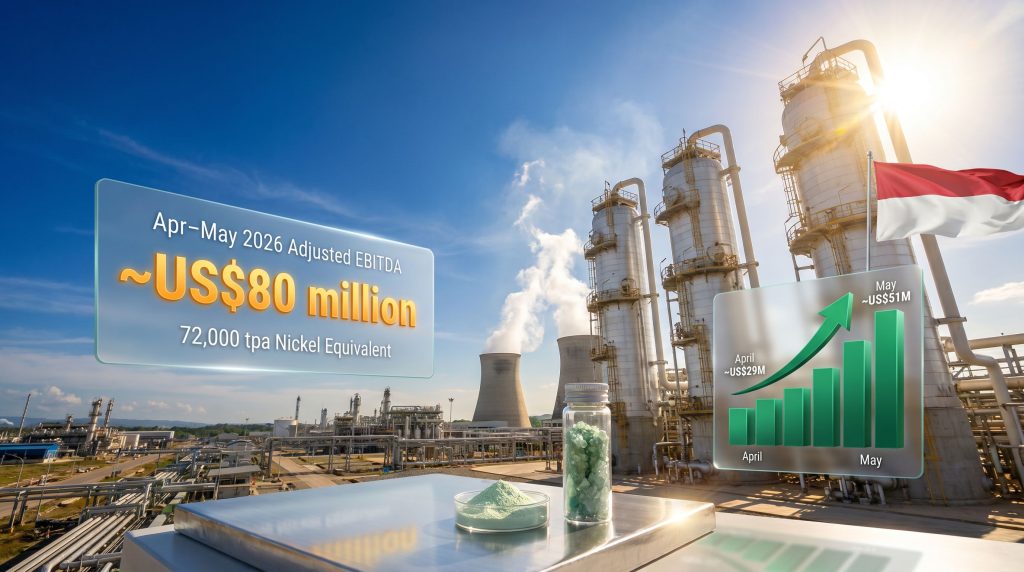
The combined adjusted EBITDA of approximately US$80 million across April and May 2026 from Nickel Industries' existing operations tells two distinct stories within a single figure.
Two-Month EBITDA Composition
| Month | Adjusted EBITDA | Primary Drag Factor |
|---|---|---|
| April 2026 | ~US$29 million | Hengjaya Mine downtime + scheduled RKEF maintenance |
| May 2026 | ~US$51 million | Full operational recovery across asset base |
| Combined | ~US$80 million | Two-month consolidated result |
April's softer result was driven by two concurrent disruptions: temporary production downtime at the Hengjaya Mine, which supplies ore feedstock to downstream processing operations, and scheduled maintenance across the RKEF production lines. These are inherently transitory in nature. The ~US$22 million swing from April to May within a single month demonstrates the underlying earnings leverage embedded in the asset base when operating at full capacity.
What makes May's recovery particularly instructive is the speed of the rebound. RKEF operations are characterised by relatively short restart cycles compared to more complex hydrometallurgical facilities, meaning scheduled downtime rarely creates prolonged earnings erosion. The May result essentially validates the run-rate potential of the existing production base.
The volatility between April and May also highlights a less-discussed aspect of Indonesian nickel production economics: ore supply continuity from captive mines like Hengjaya is a critical operational variable that directly amplifies or compresses EBITDA within any given period.
Excelsior HPAL Progress: Milestone by Milestone
The Excelsior Nickel Cobalt (ENC) HPAL project sits at the centre of Nickel Industries' long-term strategic transformation. Located within the Indonesia Morowali Industrial Park (IMIP) in Central Sulawesi, the project reached its Final Investment Decision in October 2023 and has been progressing through construction and commissioning phases since.
ENC Project Commissioning Tracker
| Milestone | Status |
|---|---|
| Final Investment Decision | Completed October 2023 |
| All three autoclaves installed | Completed |
| Slurry pipeline engineering and design | Completed |
| In-pit tailings engineering and design | Completed |
| First ore received at limonite feed preparation plant | Completed May 2026 |
| Slurry delivery to ENC Smelter | Imminent at time of update |
| Refinery and leach-circuit commissioning | Targeted late June 2026 |
| First MHP production | Targeted mid-July 2026 |
| First nickel cathode production | Targeted mid-August 2026 |
| LME and SHFE nickel cathode registration | Targeted H2 2026 |
The receipt of first ore at the limonite feed preparation plant in May 2026 is a particularly significant operational marker. Limonite is the higher-moisture, lower-magnesium fraction of laterite ore, and it is the preferred feedstock for HPAL processing due to its higher nickel and cobalt grades relative to the saprolite fraction typically used in RKEF operations. The ability to now feed ore directly into the preparation plant signals that the upstream-to-downstream circuit is operationally connected.
What Does MHP Production Actually Enable?
Mixed Hydroxide Precipitate is a nickel-cobalt intermediate product typically containing 35 to 45 percent nickel and 2 to 5 percent cobalt by dry weight, though exact grades vary by project. MHP serves as a direct precursor to nickel sulphate used in the manufacture of NMC (Nickel Manganese Cobalt) and NCA (Nickel Cobalt Aluminium) cathode materials for lithium-ion batteries.
For Nickel Industries, first MHP output in July 2026 would represent its formal entry into the battery materials supply chain — a transition from being a nickel commodity producer to a battery precursor materials supplier. This distinction carries meaningful implications for:
- Pricing mechanisms: MHP pricing is linked to nickel and cobalt content with premiums or discounts based on impurity profiles
- Customer composition: Battery manufacturers and cathode precursor producers replace steel mills as primary offtakers
- Traceability requirements: Battery supply chain customers increasingly require certified supply chain documentation, which IMIP-based production is well positioned to accommodate
- ESG differentiation: Lower carbon intensity versus RKEF-produced nickel opens access to customers with Scope 3 emissions reduction commitments
The Strategic Significance of Abandoning the ONI Matte Converter
One of the more analytically interesting elements of the mid-2026 operating update is the decision to exit the ONI matte converter investment, resulting in a US$15 million option fee refund from Shanghai Decent.
Matte conversion involves processing nickel pig iron or intermediate products into nickel matte, which can then be further refined into battery-grade products. However, matte conversion carries a higher carbon footprint than direct HPAL processing and adds complexity without the clean margin profile of native HPAL output.
The decision to forgo this pathway in favour of pure HPAL technology reflects several converging considerations:
- The ENC HPAL project is already progressing through commissioning, making a parallel matte converter investment redundant from a strategic diversification perspective
- Battery manufacturers and cathode producers are increasingly scrutinising the carbon provenance of their supply chain inputs, creating a structural preference for lower-intensity processing routes
- The US$15 million capital recovery improves near-term liquidity without any corresponding production sacrifice
- The cooperative refund arrangement with Shanghai Decent, Nickel Industries' largest shareholder, reinforces alignment between major stakeholders on the strategic direction of the business
Balance Sheet Dynamics: Three Concurrent Cash Flow Catalysts
The mid-2026 period is notable for the convergence of multiple cash flow events that collectively strengthen Nickel Industries' financial position concurrent with the ENC commissioning phase.
Non-Operational Cash Inflows in Mid-2026
| Cash Flow Source | Amount | Expected Timing |
|---|---|---|
| RKEF working capital unwind | ~US$70 million | By early July 2026 |
| ONI option fee refund | US$15 million | Confirmed |
| Combined non-operational inflows | ~US$85 million | Mid-2026 window |
The US$70 million working capital release from RKEF operations warrants specific attention. Working capital in nickel processing operations accumulates through the ore-to-product cycle: ore inventory, work-in-progress materials, and receivables on shipped product can collectively represent substantial tied-up capital. As RKEF operations unwind this working capital, the cash moves from operational balance sheets to corporate-level liquidity, available for deployment toward debt service, project support, or other capital allocation priorities.
The deliberate timing alignment between these cash inflows and the ENC commissioning ramp-up suggests considered treasury management rather than coincidental scheduling. Consequently, the broader nickel market recovery narrative adds further tailwinds to this favourable financial positioning.
The next major ASX story will hit our subscribers first
Ownership Structure and Project Economics
Nickel Industries holds approximately 46% of the ENC project following the completion of strategic partner Sphere Corp's acquisition of a 10% interest. The broader consortium structure is characteristic of large-scale HPAL development, where capital costs in the range of US$2.3 billion under the capex guarantee framework necessitate risk distribution across multiple participants.
The 15-year corporate income tax holiday associated with the ENC project, facilitated through Indonesia's industrial park investment incentive framework, meaningfully improves the post-tax economics of the project over its early operating life. It is important to note that this incentive is a function of Indonesia's established industrial park regulatory framework and not a project-specific government endorsement.
The ENC project's nameplate capacity of 72,000 tonnes per annum of contained nickel equivalent across three product streams would, upon reaching full capacity, position it among the larger individual HPAL operations globally. For context, the global HPAL industry has historically struggled with ramp-up timelines, with most large-scale projects requiring 12 to 24 months post-first-production to approach nameplate capacity consistently.
Market and Macro Risk Factors Investors Should Monitor
The positive commissioning trajectory and strong EBITDA performance must be assessed alongside a set of risk variables that carry genuine near-term relevance. Indeed, those familiar with the Indonesian nickel industry challenges will recognise several of these dimensions.
Key Risk Dimensions
- Commissioning sequence dependency: The late June leach-circuit commissioning underpins the July MHP target and August cathode target. Any single-stage slippage creates a cascading delay across subsequent milestones
- HPAL ramp-up yield reality: First production from HPAL facilities routinely operates well below nameplate capacity during the commissioning phase, as autoclave temperatures, acid concentrations, and residence times are progressively optimised. Recovery rates during this period typically range from 50 to 75 percent of design specifications before stabilising
- Nickel price and Class I premiums: The spread between Class I nickel products (cathode, MHP) and Class II material (NPI, ferronickel) is subject to demand-side dynamics tied to EV adoption trajectories and cathode chemistry evolution. A structural shift toward lithium iron phosphate (LFP) batteries represents a longer-term compositional risk to battery-grade nickel demand
- Indonesian regulatory continuity: Ore production quotas (RKAB approvals) and industrial use permits (IUI) are recurring regulatory touchpoints that directly affect throughput across both RKEF and HPAL operations
- Currency dynamics: The operational cost base in Indonesian Rupiah, combined with revenues denominated predominantly in US dollars and Chinese Yuan, creates embedded currency exposure that affects reported margins
What LME and SHFE Registration Would Mean for ENC's Commercial Profile
The targeted registration of ENC-produced nickel cathode on the London Metal Exchange and the Shanghai Futures Exchange represents more than a commercial milestone. It functions as a quality certification event.
LME and SHFE registered brands must meet strict chemical composition standards, including minimum nickel purity thresholds of 99.8 percent for full-plate cathode products. Registration confers several commercial advantages:
- Allows cathode to be delivered against exchange contracts, creating a globally recognised pricing benchmark
- Enables hedging of nickel price exposure through futures and options contracts, reducing earnings volatility
- Signals product quality to institutional offtake counterparties, facilitating formal long-term supply agreements
- Supports participation in battery supply chain traceability frameworks where exchange-registered material carries enhanced provenance credentials
Share Price Performance and the Market's Strategic Read
Nickel Industries shares have appreciated approximately 38% over the prior 12 months to the date of the operating update, substantially outperforming the S&P/ASX 200 Index, which returned approximately 4% over the same period. This performance divergence reflects market recognition of the strategic repositioning underway, rather than simply a response to near-term earnings momentum.
The market appears to be pricing in a probability-weighted scenario where ENC commissioning proceeds broadly on schedule and the transition to battery-grade production materially expands the company's earnings quality and revenue diversification. Furthermore, the battery metals investment landscape provides broader context for understanding why this repositioning resonates with institutional investors. Whether that implied scenario is fully reflected in current valuations, or whether commissioning execution risk remains insufficiently discounted, is a judgment each investor must make independently. For additional perspective, Bell Potter's research coverage of Nickel Industries offers detailed independent analysis of the company's evolving strategic profile.
This article is general in nature and does not constitute financial advice. Investments in mining and resources companies involve significant risks, including commodity price volatility, operational uncertainties, and project execution risk. Past share price performance is not indicative of future returns. Readers should seek independent financial advice before making any investment decisions.
Frequently Asked Questions: Nickel Industries Operating Update and Excelsior HPAL Progress
What is the ENC HPAL project's nameplate production capacity?
The Excelsior Nickel Cobalt project is designed for 72,000 tonnes per annum of contained nickel equivalent, spanning three product streams: MHP, nickel sulphate, and nickel cathode.
When is first MHP production expected?
Based on the commissioning sequence outlined in the June 2026 operating update, first MHP output is targeted for mid-July 2026, with first nickel cathode production expected by mid-August 2026.
What is Nickel Industries' ownership stake in ENC?
Nickel Industries currently holds approximately 46% of the ENC project following the completion of Sphere Corp's 10% interest acquisition.
Why did Nickel Industries exit the ONI matte converter investment?
The decision reflects a strategic preference for lower-carbon, higher-margin HPAL technology over matte conversion pathways. The move aligns with battery supply chain customer requirements and avoids investment duplication given ENC's commissioning progress.
What does the US$70 million RKEF working capital release represent?
It reflects the unwinding of inventory, work-in-progress, and receivable balances tied up within the RKEF production cycle, converting operational assets into corporate-level liquidity available for balance sheet management or capital deployment.
Why is LME registration important for nickel cathode?
LME registration certifies product quality to international standards, enables exchange-based pricing and hedging, and facilitates institutional offtake contracting — all of which are critical for commercial-scale battery supply chain participation.
Want to Stay Ahead of the Next Major Battery Metals Discovery on the ASX?
Discovery Alert's proprietary Discovery IQ model delivers real-time alerts on significant ASX mineral discoveries across nickel, lithium, and other battery metals, turning complex announcement data into clear, actionable insights for investors at every level. Explore historic discoveries and their returns to understand the scale of opportunity, then begin your 14-day free trial to position yourself ahead of the broader market.