
June 17, 2026
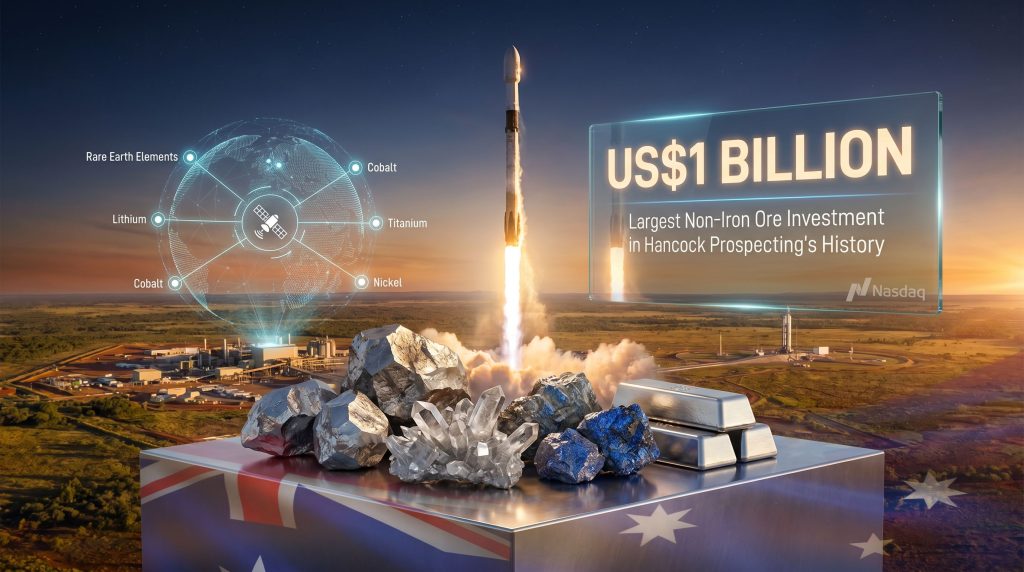
When Mining Capital Meets the Space Economy
The boundaries separating extractive industries from advanced technology sectors have been dissolving for years, but capital flows tell the story more clearly than any analyst report. Across the global investment landscape, resource-driven wealth accumulated over decades of commodity cycles is increasingly finding its way into deep-technology infrastructure. This convergence is not accidental. It reflects a structural thesis: that the materials economy and the technology economy are no longer parallel tracks but intersecting ones.
Few single transactions have illustrated this convergence more vividly than the Hancock Prospecting investment in SpaceX IPO, which saw the privately held Australian resources giant deploy more than US$1 billion into one of the most anticipated equity offerings in recent memory.
When big ASX news breaks, our subscribers know first
What the Transaction Actually Involved
Understanding the weight of this move requires context. Hancock Prospecting is not a listed company subject to quarterly earnings calls or activist shareholders. It is one of Australia's most consequential privately held resource enterprises, built on iron ore exploration and shaped by the pioneering work of Lang Hancock before passing to his daughter, Gina Rinehart, who has led the group to its current scale.
The SpaceX IPO, listed on the Nasdaq, attracted institutional demand that substantially exceeded available share allocations, making it one of the most competitively subscribed offerings in recent years. Securing a meaningful allocation in that environment is itself a statement of institutional standing.
| Parameter | Detail |
|---|---|
| Investor | Hancock Prospecting (private, controlled by Gina Rinehart) |
| Target Company | SpaceX (Elon Musk's aerospace and satellite infrastructure company) |
| Investment Size | Over US$1 billion |
| Exchange | Nasdaq |
| Transaction Type | IPO allocation (primary market) |
| Historical Significance | Largest single investment outside iron ore in Hancock Prospecting's history |
| IPO Demand | Oversubscribed; demand significantly exceeded available shares |
Hancock Prospecting's chief executive Garry Korte noted publicly that securing an allocation in a heavily oversubscribed offering was a meaningful outcome. He cited SpaceX's ambition to build a vertically integrated infrastructure business, combined with its world-class engineering capability and relentless focus on reducing costs through manufacturing innovation, scale, and development speed, as central to the investment case.
Furthermore, according to Reuters, the transaction was widely regarded as one of the most significant non-US allocations in the offering, underscoring the global appetite for SpaceX equity.
The Hancock Prospecting leadership has explicitly flagged the potential for mutually beneficial arrangements between SpaceX's technological capabilities and Hancock's significant critical minerals holdings, pointing to a deliberate convergence strategy rather than a passive financial allocation.
Why Oversubscription Matters More Than It Appears
The Mechanics of an Oversubscribed IPO
When institutional demand for an IPO exceeds the number of shares on offer, underwriters and company advisors hold considerable discretion over which investors receive allocations and in what quantity. This process is not random. Investors with long-standing relationships with underwriting banks, demonstrated financial capacity, and credible long-term intentions tend to receive preferential treatment.
For Hancock Prospecting to receive an allocation exceeding US$1 billion in this environment signals several things simultaneously:
- The company's institutional credibility was recognised at the highest level of the global capital markets
- The size of the allocation reflected genuine conviction, not a token position
- Competing for shares against sovereign wealth funds, pension allocators, and major asset managers requires significant standing
- A successful allocation at IPO provides cost-basis advantages unavailable to secondary market buyers
This is not a passive bet placed through an index. It is a deliberate, primary-market commitment at a scale that few non-U.S. resource companies have historically attempted in the American technology sector.
SpaceX's Structural Investment Case: Beyond the Headline Valuation
What Makes SpaceX Architecturally Different From Traditional Aerospace
SpaceX occupies a structurally unusual position in the global technology landscape. Unlike traditional aerospace contractors, which operate as government-dependent cost-plus businesses with limited incentive to reduce per-unit expenses, SpaceX has rebuilt the economics of space access from first principles.
The key structural pillars underpinning its investment thesis include:
- Vertical integration across the entire aerospace stack, from engine manufacturing to launch operations, eliminating supplier margins and enabling rapid iteration
- Reusable rocket technology, which has dramatically compressed the cost per kilogram to orbit compared to legacy systems
- Starlink's satellite broadband network, which is transitioning from a capital-expenditure phase into a recurring revenue model with global reach
- Manufacturing velocity, an approach that prioritises building and testing at speed over extended pre-production engineering cycles
These characteristics collectively explain why SpaceX commands premium valuations relative to traditional aerospace peers and why institutional investors competed intensely for exposure at IPO. Indeed, the Wall Street Journal reported that the scale of Rinehart's stake reflected a high-conviction view on SpaceX's long-term infrastructure dominance.
SpaceX's competitive positioning rests on three structural pillars: vertically integrated engineering, cost reduction through manufacturing scale, and an accelerating pace of technological iteration. These characteristics make it structurally distinct from traditional aerospace contractors.
The Critical Minerals Nexus: Why This Is More Than a Financial Bet
What Advanced Space Infrastructure Actually Needs From the Ground
The strategic logic articulated by Hancock Prospecting's leadership goes beyond financial return. The explicit reference to potential future arrangements between SpaceX's technology requirements and Hancock's critical minerals portfolio reveals a forward-looking convergence thesis that deserves careful examination.
Space technology, satellite infrastructure, electric propulsion systems, and advanced manufacturing all draw on a specific basket of materials that are neither abundant nor easily substitutable. The growing critical minerals demand from sectors like aerospace and clean energy is reshaping how resource companies position themselves strategically. The table below maps these materials to their primary applications:
| Material Category | Primary Application in Space and Tech Infrastructure |
|---|---|
| Rare Earth Elements | Satellite components, electric propulsion systems, permanent magnets |
| Lithium | Onboard battery storage, power management systems |
| Cobalt | High-performance alloys, energy density applications |
| Titanium | Structural aerospace components, pressure vessels |
| Nickel | Rocket engine alloys, thermal management systems |
| Beryllium | Satellite optics, lightweight structural components |
Demand for these materials is expected to grow in proportion to the expansion of satellite constellations, reusable launch vehicles, and ground-based infrastructure supporting the space economy. A resource company with meaningful positions in critical minerals is not merely a financial bystander in this growth story. It is a potential upstream supplier to the very industries it is now investing in.
Why This Dual Exposure Is Strategically Unusual
Very few companies globally hold the capacity to simultaneously own equity in a transformative technology company and control the upstream material inputs that technology will increasingly depend upon. Concerns around the critical minerals supply chain have become central to corporate strategy across aerospace, technology, and defence sectors. Hancock Prospecting's portfolio, which spans iron ore at scale alongside growing critical minerals exposure, positions it at both ends of this value chain.
This dual positioning creates optionality that purely financial investors cannot replicate. If the space technology sector expands as projected, Hancock benefits both from equity appreciation and from rising demand for the physical materials underpinning that expansion.
Private Capital's Structural Advantage in Long-Duration Bets
Why Listed Mining Companies Cannot Easily Replicate This Move
Publicly listed resource companies such as BHP and Rio Tinto operate under a fundamentally different set of constraints. Shareholder mandates, ESG reporting frameworks, quarterly earnings guidance, and capital return expectations all create pressure toward predictable, core-business allocation. A US$1 billion investment in a technology company's IPO would face substantial internal governance scrutiny in most listed miners.
Privately held groups like Hancock Prospecting face none of these pressures in the same way. The ability to take high-conviction, long-duration positions without navigating external shareholder approval is a genuine structural advantage. It allows the organisation to act with the speed and decisiveness that public market participants rarely can.
This dynamic is increasingly relevant as the frontier of value creation shifts toward companies operating at the intersection of materials and technology. Private resource capital, unconstrained by short-termism, may be structurally better suited to capture this transition than its listed peers.
The next major ASX story will hit our subscribers first
What the SpaceX Nasdaq Listing Signals for Global Capital Markets
Non-U.S. Institutional Participation in American Deep-Tech
The SpaceX IPO attracted a global institutional audience well beyond American borders. Hancock Prospecting's participation is one visible example of a broader trend: non-U.S. capital pools, including sovereign wealth funds, family offices, and large private companies, actively seeking primary-market exposure to American deep-technology infrastructure.
This cross-border capital flow reflects several macroeconomic realities:
- The concentration of transformative technology development in the United States creates geographical imbalances in investment opportunity
- Institutional investors outside the U.S. are increasingly willing to navigate regulatory and currency complexities to access high-growth technology equity
- The Nasdaq, as a listing venue, retains unmatched global brand recognition for technology offerings
- An oversubscribed IPO in the current macroeconomic environment signals unusually strong institutional conviction in a single name
For Australia specifically, this transaction marks a notable moment. It demonstrates that Australian resource wealth, historically reinvested domestically or into adjacent commodity sectors, is now being directed toward global technology infrastructure at scale.
Frequently Asked Questions: Hancock Prospecting and the SpaceX IPO
What is Hancock Prospecting?
Hancock Prospecting is a privately held Australian resources company with roots in iron ore exploration. It is currently led by Gina Rinehart and is among the most significant privately owned resource enterprises in Australia.
How much did Hancock Prospecting invest in SpaceX?
The reported allocation exceeded US$1 billion, representing the largest single investment Hancock Prospecting has made outside its core iron ore operations.
Why did Hancock Prospecting invest in SpaceX?
The company cited SpaceX's leadership in aerospace innovation, its vertically integrated infrastructure model, and the potential for future strategic alignment between SpaceX's technology requirements and Hancock's critical minerals portfolio. Consequently, the energy security minerals dimension of this thesis adds a further layer of strategic rationale beyond pure financial return.
Was the SpaceX IPO oversubscribed?
Yes. The SpaceX IPO on the Nasdaq attracted demand that substantially exceeded the available share allocation, making it one of the most competitive institutional offerings in recent memory.
What is the connection between SpaceX and critical minerals?
Advanced space technology, satellite infrastructure, and propulsion systems require critical materials including rare earths, lithium, cobalt, titanium, and specialty alloys. In addition, rare earth supply chains have emerged as a central geopolitical and commercial concern for companies operating across aerospace and defence sectors alike.
Is this Hancock Prospecting's first major technology investment?
Based on available reporting, the SpaceX allocation represents the largest investment Hancock Prospecting has made outside its iron ore and resources core, indicating a meaningful shift in capital deployment strategy. However, given the growing interest in space resource extraction as a long-term frontier, this move may signal the beginning of a broader technology-facing strategy.
What This Investment Signals for Australia's Resource Sector
The Blurring Line Between Commodity Capital and Technology Capital
The Hancock Prospecting investment in SpaceX IPO is not an isolated event. It is a visible signal of a structural transition underway in how Australia's resource wealth is being deployed. The thesis that commodity producers are merely cyclical businesses waiting to be disrupted by clean technology is giving way to a more nuanced reality: that resource companies with critical minerals exposure are becoming integral to the technology supply chain, not obsolete remnants of it.
The decade ahead will likely see more Australian resource capital pursuing positions in companies that will drive future demand for energy, minerals, and connectivity infrastructure. The Hancock Prospecting investment in SpaceX IPO establishes a template, demonstrating that the gap between digging materials from the ground and powering the satellites above it is narrower than most investors have assumed.
Key takeaways from this transaction include:
- The US$1 billion-plus stake is the largest non-iron ore investment in Hancock Prospecting's corporate history
- Leadership has explicitly identified potential synergies between SpaceX's technology needs and Hancock's critical minerals holdings
- Securing an allocation in a heavily oversubscribed IPO reflects both institutional standing and the depth of investment conviction
- Australia's resource sector is increasingly deploying capital toward companies driving future demand for energy, minerals, and connectivity infrastructure
- The investment embodies a forward-looking view that the materials economy and the space-technology economy are on a structural convergence course
Disclaimer: This article contains forward-looking statements and analysis based on publicly available information. It does not constitute financial advice. Readers should conduct their own independent research before making any investment decisions. Past performance of any company or investment vehicle is not indicative of future results.
Want to Capitalise on the Next Major Mineral Discovery Before the Market Does?
As the convergence of resource capital and advanced technology reshapes investment landscapes, Discovery Alert's proprietary Discovery IQ model delivers real-time alerts on significant ASX mineral discoveries — instantly translating complex data across 30-plus commodities into clear, actionable opportunities for both traders and long-term investors. Explore Discovery Alert's discoveries page to understand how historic mineral finds have generated substantial returns, and begin your 14-day free trial today to position yourself ahead of the broader market.