June 17, 2026
The Capital Architecture Behind a 30-Year Supply Gap
North America has not opened a new underground salt mine in roughly three decades. That supply stagnation exists against a backdrop of steady and structurally growing demand, ageing incumbent operations, and virtually no new feasibility-stage projects capable of filling the gap. Understanding why the Atlas Salt bought deal for Great Atlantic Salt Project matters requires understanding this supply dynamic first, because it is the commercial foundation upon which the entire financing logic rests.
When institutional underwriters agree to commit capital before a share offering is fully distributed, they are making a calculated judgement about asset quality, project timing, and investor appetite. The fact that the Atlas Salt offering upsized by 50% within a single business day is not a footnote; it is a market signal that deserves careful examination.
When big ASX news breaks, our subscribers know first
What the Bought Deal Structure Reveals About Institutional Conviction
A bought deal is structurally different from a marketed equity offering. In a conventional marketed deal, the company and its advisors test investor appetite, gather indications of interest, and then price and size the transaction accordingly. In a bought deal, the underwriting banks commit to purchasing the entire offering at a fixed price before distribution begins. The underwriters carry inventory risk, which means they only agree to this structure when they have strong confidence in placing the paper.
Atlas Salt (TSXV: SALT; OTCQX: SALQF; FRA: 9D00) announced an initial C$10 million offering on May 31, 2026. By the following day, demand had been sufficient to justify a 50% upsize. The transaction closed on June 11, 2026 with the following terms:
| Term | Detail |
|---|---|
| Total proceeds | C$15,153,600 |
| Shares issued | 12,628,000 common shares |
| Issue price | C$1.20 per share |
| Base deal size | 12,500,000 shares |
| Option exercise | 128,000 additional shares |
| Co-lead underwriters | Ventum Financial Corp. and Raymond James Ltd. |
| Underwriter commission | C$929,216 aggregate cash consideration |
| Resale restrictions | None under Canadian securities law |
The partial exercise of the overallotment option, combined with the upsizing from the initial announcement, reflects active institutional demand rather than passive retail participation. For a junior developer at this stage of project advancement, that distinction carries meaningful weight. Furthermore, understanding the broader context of capital raising methods helps explain why institutional interest at this level is significant for a pre-construction asset.
Great Atlantic Salt Project: Why This Asset Is Structurally Differentiated
Location, Infrastructure, and Mine Design
The Great Atlantic Salt Project sits near St. George's on the western coast of Newfoundland and Labrador, 100% owned by Atlas Salt. Its proximity to a deep-water port is not merely a logistical convenience; it is a structural cost advantage that directly influences the project's position on the industry cost curve. Most inland salt operations face substantially higher transportation costs per tonne, which compresses margins at every price point.
The mine design itself incorporates several features that reduce both capital intensity and long-term operating costs. Rather than sinking vertical shafts, the project uses inclined ramp access, which lowers development capital, simplifies material handling, and improves the operational efficiency of the underground fleet. The adoption of battery-electric mining fleets is an industry-wide trend driven by ventilation savings alone; electric fleets dramatically reduce the diesel exhaust load underground, which in turn reduces the air handling infrastructure required.
The 2025 Updated Feasibility Study: Economics That Withstand Scrutiny
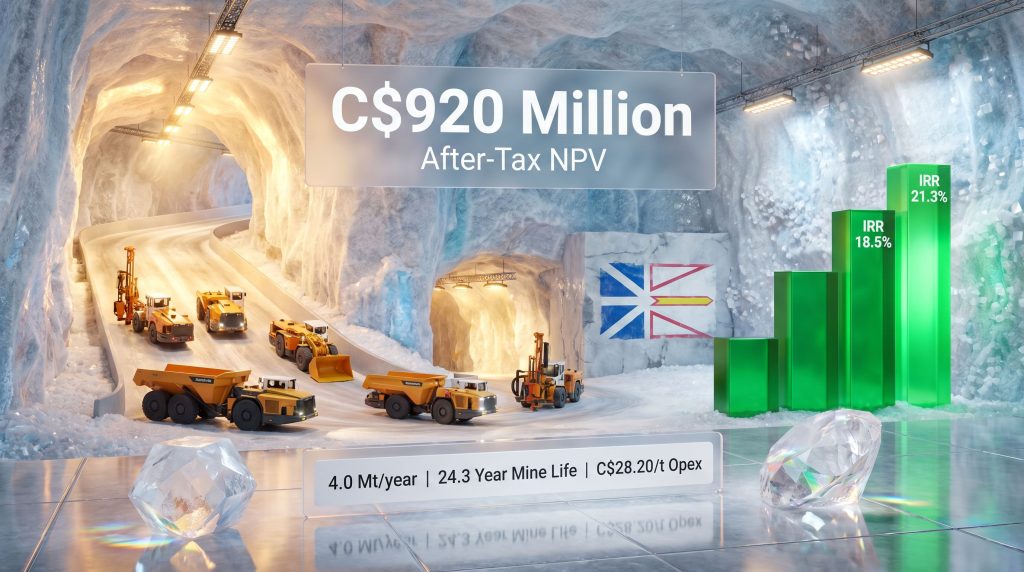
Completed by SLR Consulting (Canada) Ltd. in September 2025, the updated definitive feasibility study represents a meaningful improvement over the 2023 study across nearly every economic metric:
| Metric | 2023 Feasibility Study | 2025 Updated Feasibility Study |
|---|---|---|
| After-tax NPV | Not disclosed | C$920 million |
| After-tax IRR | 18.5% | 21.3% |
| Upfront construction capital | C$480 million | C$589 million |
| Total sustaining capital (life-of-mine) | Not disclosed | C$609 million |
| Average annual after-tax cash flow | C$121 million | C$188 million (+55%) |
| Average annual operating cash flow (EBITDA) | Not disclosed | C$325 million |
| Payback period | Not disclosed | 4.2 years |
| Annual production rate | 2.5 million tonnes | 4.0 million tonnes |
| Mine life | Not disclosed | 24.3 years |
| Operating cost per tonne shipped | Not disclosed | C$28.20 |
| Base salt price assumption | Not disclosed | C$81.67 per tonne |
A common concern when capital costs increase is whether the economics justify the additional expenditure. In this case, the upfront construction cost rose from C$480 million to C$589 million, but average annual after-tax cash flow improved by 55%, from C$121 million to C$188 million. The after-tax IRR improved from 18.5% to 21.3%, and the payback period sits at 4.2 years. The capital increase was absorbed by substantially better economics, driven primarily by the scale-up in annual production from 2.5 million tonnes to 4.0 million tonnes.
The operating cost of C$28.20 per tonne shipped against a base salt price of C$81.67 per tonne implies a gross operating margin of approximately 65% at the base case. That cost-to-price relationship is what drives the project's C$325 million average annual EBITDA and underpins the debt service capacity that construction lenders will model.
The Salt Commodity Market: A Demand Story Investors Frequently Underestimate
Salt demand is commonly associated with winter road de-icing, but the market is considerably more complex. Chemical manufacturing represents the largest and fastest-growing demand segment, accounting for approximately 42% of global salt consumption according to industry data. Chlor-alkali production, which produces chlorine and caustic soda used across petrochemicals, plastics, and water treatment, is among the primary chemical drivers. This demand profile is structurally different from de-icing, which is weather-dependent and cyclical.
The base salt price of C$81.67 per tonne used in the feasibility study was derived from an independent third-party marketing study. Salt prices have been compounding at approximately 4.2% annually in recent years, driven by rising extraction and logistics costs at ageing incumbent operations. A new, low-cost, port-adjacent producer entering at the bottom of the cost curve would occupy a structurally advantaged position regardless of near-term price fluctuations.
How the Capital Assembly Strategy Works for a C$589 Million Build
The Five Pre-Construction Workstreams
Closing a C$15 million equity raise does not fund a C$589 million mine. What it funds is the work that makes a C$589 million construction financing possible. Atlas Salt has allocated proceeds across five parallel workstreams, each of which is a prerequisite for advancing the project financing process:
- Early works and site preparation — land clearing, grubbing, and initial site development already commenced February 27, 2026
- Detailed engineering and mine development planning — translating the feasibility study into contractor-ready drawings and specifications
- Permitting and environmental workstreams — advancing the remaining mining permits required before full site mobilisation
- Procurement planning and equipment studies — finalising equipment specifications and supply chain arrangements
- Advancement of project financing — the formal process of engaging construction lenders, preparing due diligence materials, and negotiating facility terms
Operating five workstreams simultaneously is the operational signature of a company in execution mode rather than study mode. Each workstream gates or enables the others, which is why sequential execution would materially extend the timeline to a construction decision.
The Sandvik MOU: Strategic Leverage Beyond Equipment Supply
One of the less-discussed but strategically important elements of the Great Atlantic capital structure is the expanded equipment supply memorandum of understanding with Sandvik Mining. The original agreement, announced in September 2024, covered C$73 million of underground mining equipment. The expanded agreement, announced February 13, 2026, covers approximately C$132 million across the construction and ramp-up phases, reflecting the updated mine plan targeting 4.0 million tonnes per year.
The strategic significance extends beyond equipment procurement. Sandvik has indicated a separately non-binding vendor financing component, subject to internal approvals. In the context of project finance, vendor financing performs a specific function: it reduces the quantum of senior secured debt that Atlas Salt needs to source from traditional construction lenders.
Equipment supplier financing is not simply a procurement arrangement. When formalised, it reduces the debt requirement presented to senior lenders, which can improve both the probability and the terms of closing a construction finance facility. A C$132 million vendor finance component, if binding, would represent roughly 22% of total upfront construction costs.
De-Risking Milestones: What Is Complete and What Remains
Completed Before the June 2026 Financing
- Updated Feasibility Study completed, September 2025 (SLR Consulting)
- Early Works Development Plan approved by the Government of Newfoundland and Labrador, February 27, 2026
- Environmental Management Plans approved
- Benefits Agreement with the Province of Newfoundland and Labrador executed following Cabinet approval
- Letter of Release confirming satisfaction of environmental conditions received
- Land clearing, grubbing, and site preparation commenced, February 27, 2026
- Sandvik equipment supply MOU expanded to C$132 million, February 13, 2026
- C$15 million bought deal closed, June 11, 2026
Remaining Risk Variables
| Risk Category | Status | Investor Relevance |
|---|---|---|
| Construction financing | Actively advancing | Primary re-rating catalyst |
| Remaining construction permits | In progress | Required before full mobilisation |
| Offtake agreements | Not publicly confirmed | Strengthens lender due diligence case |
| Sandvik vendor financing | Non-binding, subject to approval | Reduces senior debt quantum if formalised |
| Execution risk | Inherent in C$589M underground build | Requires experienced project delivery |
| Equity dilution | Ongoing as pre-construction capital deployed | Monitor issue price relative to C$1.20 |
Why Provincial Alignment Matters to Construction Lenders
The Benefits Agreement with the Government of Newfoundland and Labrador required Cabinet-level approval, which elevates it beyond a departmental administrative arrangement to an executive government commitment. The agreement establishes frameworks for local employment, procurement, training programmes, and community participation across both construction and operational phases.
From a project finance perspective, demonstrated government cooperation addresses one of the most common causes of construction cost overruns: regulatory delays and community opposition. Lenders pricing a C$589 million facility will model downside scenarios that include timeline extensions and cost blowouts. Evidence that the host government is aligned and that community commitments are formalised reduces the probability weighting assigned to those adverse scenarios.
Newfoundland and Labrador also offers a specific geographic advantage relative to salt demand centres. The province's Atlantic coastline provides direct maritime access to northeast and mid-Atlantic North American markets, which are among the highest-volume de-icing and chemical salt consumption regions on the continent. The deep-water port adjacent to the Great Atlantic site eliminates the inland logistics premium that constrains many competing operations.
The next major ASX story will hit our subscribers first
Scenario Modelling: Three Pathways to Construction Capital
Given the C$589 million construction cost, no single financing structure is predetermined. Three credible pathways exist, each with distinct risk and return characteristics:
Scenario A: Senior Project Finance with Sandvik Vendor Supplement
A senior secured project finance facility covers the majority of construction costs, with Sandvik's vendor financing component providing supplementary equipment capital. This structure maximises NPV per share through minimal equity dilution but requires intensive lender due diligence and carries longer execution timelines.
Scenario B: Hybrid Structure Including Strategic Offtake Partner
A creditworthy industrial counterparty co-funds construction in exchange for long-term supply agreements, reducing the senior debt requirement and providing lenders with contracted revenue certainty. Salt markets have established offtake structures in both the de-icing and chemical segments. The trade-off is potential pricing concessions in offtake contract terms.
Scenario C: Staged Equity and Phased Construction
Atlas Salt stages capital deployment across construction phases, using equity markets to fund early phases while the primary debt package is finalised. This approach reduces financing dependency but carries higher dilution risk and is sensitive to equity market conditions at the time of each raise.
The current trajectory, with Sandvik vendor financing in discussion and proceeds explicitly allocated to project financing advancement, suggests Scenario A or Scenario B is the preferred path. However, the junior mining risks and rewards associated with pre-construction financing remain a key consideration for investors evaluating exposure at this stage.
Key Catalysts Investors Should Monitor
The construction financing close is the single event most capable of triggering a material re-rating, given the gap between the C$920 million after-tax project NPV and Atlas Salt's current enterprise value. Secondary catalysts that either accelerate or support the primary event include:
- Formal lender engagement announcements — mandated financial advisors or term sheet disclosures signal active financing negotiations
- Remaining construction permit approvals — required before drawdown of any construction facility
- Offtake or strategic partnership agreements — contracted revenue strengthens the lender case materially
- Sandvik vendor financing formalisation — conversion from non-binding to binding reduces senior debt requirement
- Detailed engineering completion milestones — contractor-ready drawings enable tender processes to commence
- Additional equity or hybrid capital — monitor issue pricing relative to C$1.20 as a sentiment indicator
Junior mining developers typically trade at a discount to independently assessed project value, reflecting the gap between a feasibility study and a producing mine. Each resolved risk category narrows that discount. For Great Atlantic, regulatory risk is substantially resolved. Funding risk is the active variable, and the construction financing close is the catalyst that converts this from a development story into a construction one.
The Investment Case in Context: Valuation Gap and Re-Rating Logic
The analytical framework most applicable to Atlas Salt at this stage is the valuation gap model. The project carries an independently assessed after-tax NPV of C$920 million. The company's enterprise value is a fraction of that figure, as is standard for junior developers at pre-construction stage. That discount is not irrational; it reflects genuine uncertainties around financing execution, construction delivery, and the time value of capital deployed years before first production.
What changes the discount is resolved risk. The completed feasibility study, environmental clearances, provincial government alignment, early works commencement, and equipment supply agreement have collectively addressed the regulatory and technical risk categories. The financing risk category is the remaining variable with the largest potential impact on the valuation gap.
Atlas Salt is targeting commercial production by 2030, contingent on construction financing and project execution. The 4.2-year payback on C$589 million of upfront capital, at an average annual EBITDA of C$325 million, represents a debt service profile that is well within the parameters of conventional project finance for underground mining operations. The 21.3% after-tax IRR exceeds the 15–20% threshold that institutional lenders typically apply as a minimum viability screen.
The Atlas Salt bought deal for Great Atlantic Salt Project is not the construction announcement investors are ultimately watching for. It is the capital that funds the work required before that announcement can be made, and every workstream it finances moves the construction decision closer to resolution.
This article is for informational purposes only and does not constitute financial advice. Investors should conduct their own due diligence and consult a qualified financial adviser before making investment decisions. Statements regarding project economics, timelines, and financing outcomes involve forward-looking assumptions that are subject to material risks and uncertainties.
Want to Catch the Next Major Resource Discovery Before the Market Does?
Discovery Alert's proprietary Discovery IQ model delivers real-time alerts on significant ASX mineral discoveries, cutting through complex data to surface actionable opportunities the moment they are announced — explore the historic returns major discoveries have generated and begin your 14-day free trial today to position yourself ahead of the broader market.