August 6, 2026
The Recovery Curve: Why Tertiary Extraction Could Redefine American Shale Economics
The story of unconventional oil production is often told through the lens of the drilling boom, the fracking revolution, and the rapid output gains that transformed the United States into the world's largest crude producer. What receives far less attention is what happens after the initial surge, when decline curves steepen, sweet spots become saturated, and operators face a fundamental question: how do you extract more from a reservoir that has already been extensively drilled?
That question sits at the heart of the current push for North Dakota Bakken enhanced oil recovery, a multi-billion-dollar technical and policy challenge that could either catalyse a second production boom or stall out against the harsh economics of tight shale geology.
When big ASX news breaks, our subscribers know first
Why Only 15% of the Bakken Has Ever Been Produced
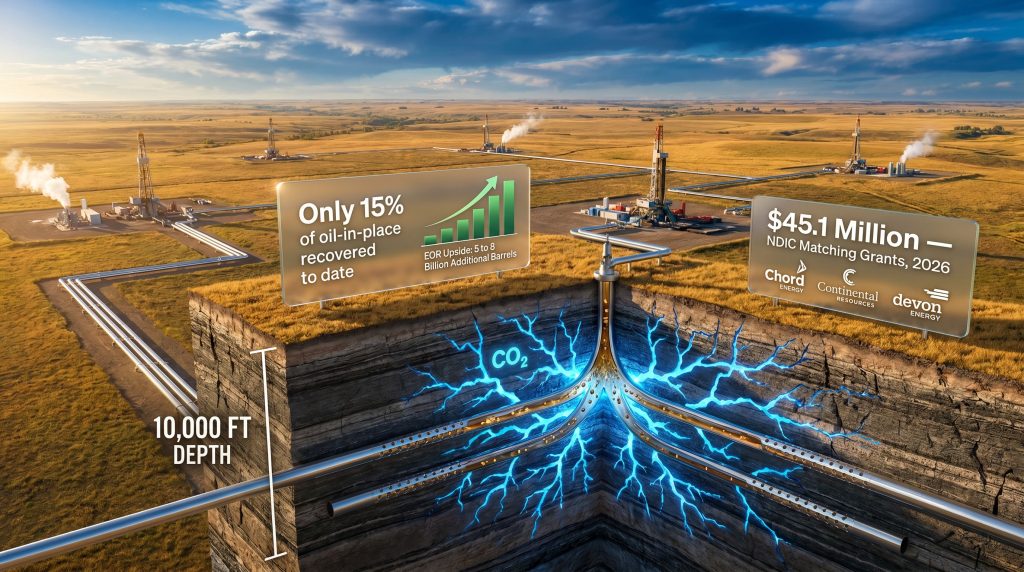
To understand the scale of what remains untapped, it helps to start with a number that surprises most people outside the industry: roughly 85% of the total oil-in-place across the Bakken and Three Forks Formation is still physically locked within the reservoir rock. Despite producing more than 5 billion barrels since the U.S. shale revolution began in 2007, the formation has barely scratched the surface of its theoretical resource base.
This is not a failure of drilling technology. Hydraulic fracturing unlocked an enormous volume of previously inaccessible crude. However, the problem is structural: tight shale reservoirs distribute oil through extremely low-permeability rock, and even the most aggressive horizontal drilling and fracturing programmes leave the vast majority of hydrocarbons in place. Bakken wells typically lose 60 to 70% of their peak production rate within the first two years, a decline profile that forces continuous capital reinvestment just to maintain flat output.
As the most productive zones in the Bakken approach saturation, operators face compounding economics. Rising equipment and labour costs have lifted the average drilling breakeven price to approximately $60 per barrel, materially higher than equivalent costs in the Permian Basin. The combination of steepening decline curves and rising breakevens is pushing the industry toward a logical conclusion: the next chapter of Bakken productivity will depend less on drilling new wells and more on extracting more from existing ones. Furthermore, understanding the US oil production decline across major formations helps contextualise why operators are increasingly turning to tertiary recovery methods.
North Dakota's Governor Kelly Armstrong framed the opportunity in stark terms at a major oil industry conference in May 2026, noting that successfully unlocking even an additional 15% of the Bakken's trapped resource through enhanced recovery methods would effectively trigger an entirely new production boom comparable in scale to the original shale surge.
State-backed research has put numerical weight behind that ambition. Projections suggest that a successful CO2-EOR programme could generate between $2.9 billion and $9 billion in incremental North Dakota oil and gas production tax revenue over the life of active programmes, while potentially recovering an additional 5 to 8 billion barrels of oil across a 30-to-50-year development horizon.
The Three-Stage Recovery Framework Explained
To appreciate why enhanced oil recovery represents such a distinct challenge from conventional drilling, it is worth understanding how extraction progresses through distinct stages.
| Recovery Stage | Mechanism | Typical Recovery Rate |
|---|---|---|
| Primary Recovery | Natural reservoir pressure drives oil to surface | 5–15% of oil-in-place |
| Secondary Recovery | Water or gas injection maintains reservoir pressure | 15–30% of oil-in-place |
| Tertiary (EOR) | Chemical, thermal, or gas injection alters oil properties | Additional 5–20%+ of oil-in-place |
Each stage addresses progressively more resistant oil. By the time a reservoir reaches tertiary status, the crude that remains is not simply inaccessible due to depth or pressure — it is physically trapped by interfacial tension between oil molecules and surrounding rock surfaces, or held in pore spaces too small or disconnected for conventional flow. EOR works by fundamentally changing the physics of that interaction, either by reducing viscosity, restoring pressure, or chemically breaking the adhesion between oil and rock.
Enhanced oil recovery does not simply pump harder at a depleted reservoir. It changes the conditions inside the rock itself, altering the thermodynamic and chemical relationship between crude oil and its host formation to release hydrocarbons that would otherwise remain permanently stranded.
The Geological Complexity of EOR in Tight Shale Formations
One of the most underappreciated challenges in the North Dakota Bakken enhanced oil recovery discussion is that the formation's geology creates both the opportunity and the obstacle simultaneously.
The Bakken's target zones typically exceed 10,000 feet in depth, which immediately eliminates thermal recovery as a practical option. Steam injection, the dominant EOR method globally by total production volume, is most effective in shallow reservoirs (generally under 5,000 feet) containing heavy crude with API gravity below 20 degrees. The Bakken produces light-to-medium gravity crude from formations far too deep and too light for steam-based approaches to be economically rational.
The presence of hydraulically fractured horizontal wells introduces a further complication that conventional EOR literature does not fully address. Traditional enhanced recovery methods were engineered for high-permeability, conventional reservoirs where fluid flow is relatively predictable. In a densely fractured shale formation, injected gases or chemicals can travel through fracture networks to adjacent wells in unintended ways, a phenomenon known as well interference or channelling, which can dramatically complicate recovery projections and reduce programme efficiency.
This is precisely why the Energy & Environmental Research Center (EERC) is operating a dedicated Bakken CO2 EOR and Storage Field Laboratory in McKenzie County, North Dakota, in partnership with Chord Energy. The laboratory specifically tests CO2 injection performance in hydraulically fractured horizontal wells, generating the field data necessary to validate or revise theoretical recovery models. Results from this programme represent one of the most important datasets in shaping the commercial future of Bakken EOR.
Gas Injection and CO2-EOR: The Leading Technical Pathway
Among the available EOR technologies, gas injection has emerged as the dominant approach for the Bakken's specific geological profile. Gas injection currently accounts for approximately 60% of all active EOR projects in the United States, far exceeding the project count of thermal or chemical methods.
The technical logic is straightforward for deep, light-oil reservoirs. When CO2 is injected at sufficient pressure and depth, it achieves miscibility with the crude oil, meaning the gas and oil mix completely at reservoir conditions rather than forming separate phases. This miscible flooding eliminates the capillary forces that keep oil locked in pore throats and dramatically improves the mobility of trapped hydrocarbons toward production wells. The Bakken's depth profile is actually advantageous in this respect, as the high pressures found at 10,000+ feet are necessary to achieve the miscibility threshold that makes CO2-EOR effective.
Beyond recovery efficiency, CO2-EOR carries a dual-purpose appeal: captured carbon dioxide is permanently sequestered underground as a byproduct of the oil recovery process, creating a potential pathway for operators to monetise both the incremental crude production and carbon storage credits simultaneously.
The U.S. Department of Energy has committed $36 million linked to University of North Dakota research into Bakken CO2-EOR, while the North Dakota Industrial Commission approved $45.1 million in matching grants for EOR pilot programmes in 2026, covering multiple operators across different counties. In addition, the US shale drilling slowdown has accelerated interest in these alternative recovery strategies as operators seek to maintain output without relying solely on new well completions.
Active EOR Operators and Pilot Programmes as of 2026
| Operator | EOR Activity | Location |
|---|---|---|
| Chord Energy | CO2 injection pilot with EERC Field Laboratory | McKenzie County |
| Continental Resources | 2026 NDIC matching grant recipient | North Dakota Bakken |
| Devon Energy | 2026 NDIC matching grant recipient | North Dakota Bakken |
| Cobra Oil & Gas | 2026 NDIC matching grant recipient | North Dakota Bakken |
| EERC | Research and field testing operations | McKenzie County |
Chemical EOR: High Potential, High Cost
Chemical injection represents a technically viable but economically demanding alternative to gas-based approaches. Two primary mechanisms are deployed:
-
Polymer flooding: Long-chain polymer molecules are dissolved into injection water, raising its viscosity to more closely match that of the target crude oil. This creates a more uniform displacement front across the reservoir, reducing the tendency for water to bypass pockets of trapped oil through high-permeability channels.
-
Surfactant and alkaline injection: Surface-active chemical agents dramatically reduce the interfacial tension between oil and the surrounding rock matrix. By lowering this tension, the chemical effectively releases oil droplets that adhesion forces would otherwise hold permanently in place.
North Dakota's 2026 NDIC grant programme notably includes surfactant-based EOR pilots alongside CO2 programmes, signalling that state authorities are not yet committed to a single dominant technology and are funding comparative field data collection. At current commodity prices, chemical EOR carries higher per-barrel lifting costs than gas injection, but could outperform in specific sub-basin conditions where reservoir characteristics favour chemical sweep efficiency.
The next major ASX story will hit our subscribers first
The Infrastructure Problem: CO2 Supply at Scale
The single largest logistical barrier to large-scale North Dakota Bakken enhanced oil recovery is not technology selection or regulatory structure. It is CO2 supply infrastructure.
As of 2026, no dedicated CO2 pipeline directly connects major industrial emission sources to the core Bakken production zone in western North Dakota. The existing CO2 transportation network in the United States is concentrated elsewhere:
-
Occidental Petroleum operates 34 CO2-EOR projects across the Permian Basin, sourcing CO2 from ethanol facilities and integrating Direct Air Capture technology into its production model.
-
ExxonMobil's LaBarge/Shute Creek facility in Wyoming functions as one of the largest carbon capture and processing operations in the world, piping CO2 to oil fields across the Rocky Mountains and Great Plains for EOR use.
-
ExxonMobil's 2023 acquisition of Denbury Resources added a 1,300+ mile CO2 pipeline network connecting Gulf Coast and Rocky Mountain industrial sources to depleted oil fields, representing the most extensive dedicated CO2 transport infrastructure in the country.
While this network's geographic corridor reaches toward North Dakota, significant additional pipeline capacity would be required to serve the Bakken's core production zones at commercial scale. Building that infrastructure requires capital investment decisions that are themselves contingent on demonstrated pilot performance and sustained crude price levels capable of supporting project economics.
Economic Viability: The Oil Price Dependency
The economic case for Bakken EOR is acutely sensitive to crude oil prices. Unlike conventional drilling programmes that can be optimised at a relatively defined cost-per-barrel threshold, EOR economics involve a more complex interplay of CO2 supply costs, infrastructure capital, and incremental recovery rates that vary by reservoir. Consequently, monitoring crude oil price trends remains essential for any operator evaluating the commercial case for EOR investment.
| WTI Price Scenario | EOR Project Viability Assessment |
|---|---|
| Below $50/bbl | Most projects uneconomic without substantial subsidy coverage |
| $50–$65/bbl | Marginal viability; grant funding and tax incentives become critical |
| $65–$80/bbl | Improved commercial case; pilot programme expansion becomes attractive |
| Above $80/bbl | Strong commercial incentive; potential for rapid basin-wide scale-up |
North Dakota's state tax framework has been deliberately structured to narrow the effective cost gap between state and federal CO2 utilisation tax credits to less than $10 per ton, a policy adjustment designed to improve project-level economics without requiring federal legislative action. This kind of granular tax architecture reflects the state's awareness that EOR viability sits on a financial knife-edge where relatively small changes in the cost stack can determine whether projects proceed or stall.
Senior industry executives have been candid that enthusiasm, whether political or institutional, does not override financial fundamentals. Pam Heatherington, general manager of ExxonMobil's Americas division and CEO of Denbury, has emphasised that market economics will ultimately determine which technologies and which projects advance to commercial scale. This perspective reflects a widely held view across the sector that EOR is not a policy-driven programme so much as a market-driven one that policy can either accelerate or impede at the margins. The broader commodity price impact on capital allocation decisions further reinforces why operators remain cautious about committing to large-scale EOR expenditure without greater price certainty.
Three Scenarios for Bakken EOR Through 2030
The trajectory of North Dakota Bakken enhanced oil recovery through the end of the decade hinges on a convergence of technical, economic, and logistical factors that remain genuinely uncertain. Three distinct pathways are plausible:
Scenario 1: Accelerated Commercialisation
EERC and Chord Energy pilot programmes return strong CO2-EOR performance data from hydraulically fractured horizontal wells. Federal and state incentives together attract CO2 pipeline investment into western North Dakota. Multiple operators transition from pilots to full field programmes by 2028–2029, producing a measurable step-change in statewide output volumes.
Scenario 2: Gradual and Uneven Expansion
Pilot results vary significantly by sub-basin and well vintage, with no single technology delivering consistent basin-wide performance. CO2 supply constraints limit scale-up pace. EOR adoption proceeds on a project-by-project basis, contributing incremental production gains rather than a transformative new boom.
Scenario 3: Structural Stall
Extended crude prices below $60 per barrel undermine project economics despite grant support. CO2 infrastructure investment fails to materialise at sufficient scale. Enhanced recovery remains a research and pilot-stage activity through 2030, with commercial production gains deferred to the following decade.
Disclaimer: The scenarios described above are analytical projections based on currently available data and are not investment recommendations. Actual outcomes will depend on commodity prices, technological performance, infrastructure investment decisions, and regulatory conditions that are subject to change.
What a True Second Boom Would Actually Require
Unlocking the Bakken's remaining 85% is not a single-variable problem. A genuine production resurgence through enhanced recovery would require all of the following to align:
-
Positive pilot results from EERC, Chord Energy, and the broader 2026 NDIC grant cohort that validate commercial recovery rates in fractured horizontal wells.
-
CO2 supply infrastructure capable of delivering sufficient volumes at competitive cost to western North Dakota's production core.
-
Sustained oil prices above the EOR project breakeven threshold without full dependence on subsidy structures that could shift with political cycles.
-
Technology convergence around the most cost-effective EOR method for Bakken-specific geology, whether that proves to be CO2 miscible flooding, chemical surfactant injection, or a hybrid approach.
-
Continued federal incentive structures for both EOR projects and broader carbon capture and utilisation programmes that improve the economics of CO2 sourcing and transport.
The Bakken's geological reality — a formation containing multiples more oil than has ever been produced from it — ensures that the enhanced recovery question will not go away regardless of short-term price cycles. However, the more pertinent question for investors, operators, and policymakers alike is not whether EOR will eventually play a major role in North Dakota production. Rather, it is whether the combination of technology maturity, infrastructure investment, and price conditions will align within the current decade or the next. For those tracking the oil price volatility guide closely, the answer to that question may ultimately be determined as much by macro market forces as by the ingenuity of the engineers working in McKenzie County.
Want to Stay Ahead of the Next Major Resource Discovery?
Discovery Alert's proprietary Discovery IQ model delivers real-time alerts on significant ASX mineral discoveries, transforming complex resource data into actionable investment insights for both new and experienced investors — explore historic discovery returns on Discovery Alert's dedicated discoveries page to understand the scale of opportunity, then begin your 14-day free trial to position yourself ahead of the market.