June 17, 2026
The Hidden Economics Behind Queensland's Mining Investment Retreat
Across global commodity cycles, there is a recurring pattern that analysts frequently underestimate: the moment when strong production volumes begin to mask a deteriorating investment pipeline. History shows that output and investment confidence are not the same metric, and when they diverge, the consequences for a region's economic future can be severe. Queensland mining investment costs and coal royalties are at the centre of this dynamic in 2026, and understanding why requires looking beyond headline export figures to the structural cost forces reshaping investment calculus from the ground up.
When big ASX news breaks, our subscribers know first
The Dual Pressure Compressing Queensland Mining Economics
When Multiple Cost Vectors Rise Simultaneously
The concept of cost compounding is distinct from inflation in a single input category. When diesel prices, labour rates, contractor fees, consumables, and specialist service costs all escalate within the same operating cycle, the combined effect is qualitatively different from managing an isolated price spike. Operators cannot offset one rising input against a stable counterpart because every counterpart is also moving upward.
This is the operating reality for Queensland mining companies in 2026. The Queensland Resources Council's State of the Sector report, incorporating a first-half CEO Sentiment Survey across coal, gas, metals, and minerals industries, has quantified the resulting confidence deterioration in stark terms. Furthermore, these commodity price pressures extend well beyond any single cost category, reflecting a commodity price pressures environment that is reshaping operator decision-making at every level.
| Sentiment Indicator | H1 2026 Result |
|---|---|
| CEOs reporting lower growth confidence vs. prior 12 months | 48% |
| CEOs describing themselves as much less confident | 19% |
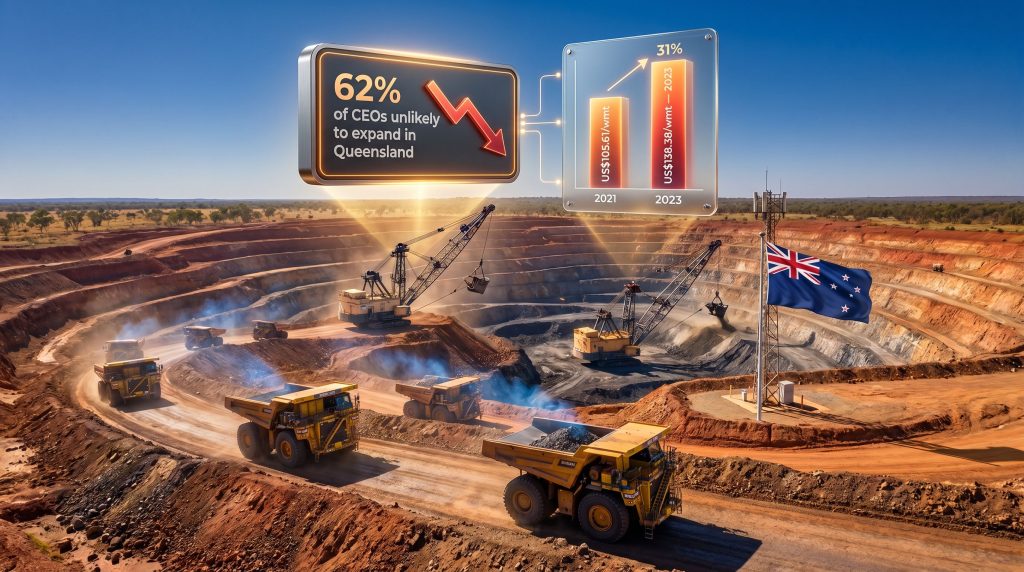
| CEOs unlikely to expand or pursue new Queensland opportunities | 62% |
These figures represent a structural pullback, not a cyclical hesitation. When nearly two-thirds of sector leaders are actively stepping away from expansion planning, the investment pipeline consequences extend well beyond the current reporting period.
Diesel as the Most Acute Operational Pressure
Among all input costs, diesel occupies a unique position in Queensland mining economics. It is not simply a fuel cost — it is an embedded operational dependency that transmits through every tier of mining activity: haul truck operations, processing facilities, remote site power generation, and logistics infrastructure. Because diesel is present throughout the cost stack, price volatility does not affect one budget line; it compounds across an operator's entire cost structure simultaneously.
The geopolitical dimension of this problem is particularly important for investors to understand. Escalating conflict in the Middle East, specifically tensions involving Iran, has introduced sustained disruption to global energy pricing. The resulting oil price shock travels directly into Australian diesel pricing through international oil market linkages, creating a real-time transmission mechanism between geopolitical events thousands of kilometres away and Queensland mining operating costs.
Industry survey respondents have described the current cost environment as one where pressure is arriving from every direction simultaneously, with diesel remaining the most acute concern but labour, contractors, consumables, and specialist services all rising at the same time.
Labour, Contractors, and the Skills Scarcity Premium
Beyond diesel, Queensland's tight mining workforce is sustaining elevated wage structures that show limited signs of easing. Key labour cost drivers include:
- Direct workforce wages sustained by persistent skills shortages in specialist technical roles
- Contractor and maintenance service pricing inflated by concurrent project demand across multiple commodity sectors
- Consumables and materials costs driven by global supply chain dynamics and Australian dollar exposure
- Specialist technical and engineering services commanding significant premium rates as qualified professionals remain scarce
The interaction between these categories is critical. An operator facing diesel cost escalation simultaneously faces contractor rate increases and specialist service premiums, making it structurally impossible to compensate for one category with savings in another.
Queensland Mining Investment Costs and Coal Royalties: Understanding the Structural Debate
How Queensland's Progressive Royalty System Actually Functions
One of the most frequently misrepresented aspects of Queensland mining investment costs and coal royalties is the distinction between the top marginal royalty rate and the effective rate applied across total revenue. These two figures are substantially different, and conflating them leads to significant analytical errors.
Queensland applies a tiered, progressive royalty structure in which escalating marginal rates apply only to the portion of coal revenue falling within each successive price band. The system functions conceptually as follows:
- A base royalty rate is applied to coal revenue below the first price threshold
- Progressively higher marginal rates apply only to revenue generated within each higher price band
- The top marginal rate of 40% applies exclusively to the portion of coal revenue derived from prices above A$300 per tonne
This architecture means the 40% figure, while technically accurate as a marginal rate, is not the rate applied to total coal revenue. The effective royalty burden across total production is materially lower, and this distinction is essential for anyone modelling Queensland coal project economics.
Pre-2022 Versus Post-2022: What the Restructure Changed
| Parameter | Pre-2022 Structure | Post-2022 Structure |
|---|---|---|
| Highest marginal rate | 15% (above A$150/t) | 40% (above A$300/t) |
| Tier design | Progressive, fewer bands | Progressive, additional higher-price tiers |
| Policy intent | Baseline resource revenue capture | Windfall profit capture during price spikes |
The 2022 restructure was introduced during an exceptional period of global coal price elevation following the disruption to European and Asian energy markets. The additional tiers were framed explicitly as a mechanism to capture extraordinary profits that would otherwise accrue entirely to producers during market conditions unlikely to persist indefinitely.
The current policy debate centres on whether those additional tiers remain appropriate as coal prices moderate toward longer-term norms and the revenues from the highest tier become less significant in practice.
Effective Royalty Rates in Practice: The Numbers That Matter for Investment
Understanding effective versus marginal rates is the foundation of credible project economic analysis. Several independent data points help establish the real-world royalty burden:
- At a coal price of approximately A$189.65 per tonne, the effective royalty rate under the tiered system is approximately 16%, according to Argus Media analysis
- Analysis by the Institute for Energy Economics and Financial Analysis (IEEFA) indicated Queensland's average effective royalty rate was approximately 20% of average coal prices in 2024
- As coal prices moderate through 2025–2026, the effective rate declines further because fewer tonnes attract the highest-tier marginal rates
Worked Illustration of Effective vs. Marginal Rate Dynamics:
Consider a simplified scenario at A$200 per tonne:
- Tier 1: 10% on the first A$150/t = A$15/t royalty
- Tier 2: 20% on A$150 to A$200/t = A$10/t royalty
- Total royalty: A$25/t on A$200/t revenue = 12.5% effective rate
Even though the marginal rate on the top tier is 20%, the blended effective rate is 12.5%. This illustrative gap between marginal and effective rates is a fundamental principle that investors and project analysts must internalise to avoid overestimating the royalty burden at current price levels.
FOB Cash Cost Trends: The Quantitative Context
S&P Global industry cost data provides the quantitative baseline against which royalty discussions must be assessed:
| Year | Consolidated FOB Cash Costs (US$/wmt) |
|---|---|
| 2021 | US$105.61 |
| 2023 | US$138.38 |
The approximately 31% increase in FOB cash costs between 2021 and 2023 reflects the compounding effect of input cost escalation across the sector. Critically, within this rising cost base, royalties as a proportion of total costs shifted materially following the 2022 restructure, peaking at approximately 33% of total costs in 2022 before moderating as coal prices eased.
Key Analytical Point: The royalty share of total costs is price-sensitive by design. At elevated coal prices, royalties represent a larger proportion of the cost stack. As prices normalise, that share contracts. This means the royalty burden is inherently self-moderating, though the absolute cost structure remains challenging.
Geopolitical Risk as a Cost Multiplier, Not a Discrete Shock
How Global Instability Compounds Existing Structural Pressures
The framing of geopolitical events as external shocks is analytically insufficient for understanding their impact on Queensland mining investment costs. In 2026, geopolitical instability is not arriving as a clean, bounded disruption that operators can account for and then move past. It is functioning as a persistent amplifier on top of pre-existing structural cost pressures.
The transmission mechanisms are specific and traceable:
- Middle East conflict drives global energy market volatility, which elevates diesel pricing across Australian mining operations
- Trade policy fragmentation, including the broader trade war impacts on supply chains, creates demand-side risk for Queensland coal and metals export markets
- Geopolitical fragmentation broadly reduces predictability in long-term offtake relationships, making it harder for project proponents to secure the bankable revenue assumptions needed for new investment approvals
The QRC has identified volatile global conditions as the leading concern among resources CEOs, noting that geopolitical fragmentation, changing trade rules, and higher regulatory intervention are all simultaneously increasing risk and variability across the operating environment.
Regulatory Uncertainty as an Independent Restraint on Capital
Beyond the royalty debate, Queensland's investment environment is being shaped by policy uncertainty across several additional regulatory domains:
- Gas market reform ambiguity creating uncertainty around domestic gas obligations and pricing frameworks for resources project proponents
- Project approval timelines that industry acknowledges have improved incrementally but remain insufficient to substantively restore investment confidence
- Broader fiscal and taxation settings that compound royalty-related concerns when assessed in aggregate by investment decision-makers
The QRC has acknowledged steps taken by the Queensland Government toward improving approval processes for new resources projects while maintaining that the scale of reform required to shift the investment trajectory has not yet been reached. However, for many observers, these resource export challenges reflect a systemic issue that incremental reform alone may not resolve.
The Economic Stakes: What Queensland Stands to Lose
Quantifying the Macro Significance of the Investment Debate
The policy settings debate surrounding Queensland mining investment costs and coal royalties is not an abstract industry grievance. It has direct, quantifiable consequences for the broader Queensland economy.
| Economic Indicator | Value |
|---|---|
| Resources sector contribution to Queensland economy (most recent year) | A$115.2 billion |
| Direct and indirect jobs supported by the sector | ~550,000 |
The QRC Chief Executive Officer Janette Hewson has stated that the resources sector's economic contribution of $115.2 billion and approximately 550,000 jobs supported means the investment confidence question affects every Queenslander, not just the companies and workers directly involved in mining operations.
The Production-Investment Paradox
Perhaps the most analytically significant feature of Queensland's current resources landscape is the decoupling of production performance from investment intent. Existing operations are generating output. Export volumes have in some cases strengthened. However, the forward capital pipeline for greenfield and expansion projects is contracting.
This paradox has a clear structural explanation: existing operations have sunk capital that is already deployed and generating returns under current conditions. The economic question is not whether to maintain production — it is whether the returns available from new capital deployment in Queensland meet the hurdle rates that investors apply when comparing against alternative resource opportunities globally.
When FOB cash costs are rising, royalties represent a structurally elevated share of revenue at higher price points, labour and diesel are compounding simultaneously, and regulatory timelines remain uncertain, the answer from 62% of Queensland resources CEOs is that the hurdle is not being cleared. In addition, the mining sector tariffs impacting global trade flows only deepen the challenge for operators weighing new capital commitments.
What a Policy Reset Could Look Like
The State Budget as a Potential Inflection Point
With the Queensland State Budget approaching, the QRC has identified a set of policy priorities that it argues could materially shift the investment trajectory:
- Coal royalty regime assessment examining whether the post-2022 higher-tier structure remains calibrated appropriately to current price environments
- Accelerated and deepened regulatory streamlining to improve the speed and predictability of project approval processes
- Gas market policy resolution to reduce ambiguity for project proponents assessing Queensland's domestic gas framework
- Competitive fiscal positioning ensuring Queensland's aggregate tax and royalty burden is assessed comparatively against other Australian and international mining jurisdictions
How Queensland Stacks Up Against Competing Jurisdictions
For capital allocation decisions, the relevant comparison is not Queensland against its historical self but Queensland against alternative investment destinations competing for the same pool of mining capital. Key dimensions on which investors evaluate jurisdictions include:
| Evaluation Dimension | Investment Relevance |
|---|---|
| Royalty rate structure and effective burden | Direct impact on project economics and NPV |
| Project approval timelines | Affects time-to-cashflow and financing risk |
| Labour market depth and skills availability | Operational cost certainty and workforce risk |
| Infrastructure access costs (port, rail, logistics) | Embedded logistics cost in FOB pricing |
| Regulatory predictability | Risk premium applied to project discount rates |
When Queensland is assessed across all five dimensions simultaneously rather than on any single metric, the investment case becomes more nuanced than the royalty headline figure alone suggests, but also more challenging than production volume statistics imply.
The next major ASX story will hit our subscribers first
Frequently Asked Questions
What is Queensland's actual coal royalty rate?
Queensland operates a tiered progressive royalty system. The top marginal rate is 40%, but this applies only to coal revenue derived from prices above A$300 per tonne. The effective rate across total revenue is approximately 16–20% depending on prevailing coal prices, making the frequently cited 40% figure a marginal rate, not an effective rate.
Why are Queensland mining investment plans contracting despite reasonable export volumes?
The QRC's H1 2026 CEO Sentiment Survey found 62% of resources CEOs are unlikely to pursue Queensland expansion over the next 12 months. The drivers are compounding: diesel and labour cost escalation, coal royalty settings at higher price tiers, regulatory uncertainty across gas and approvals frameworks, and geopolitical disruption affecting global energy pricing.
What changed in Queensland's royalty structure in 2022?
Prior to 2022, the highest marginal coal royalty rate was 15% on prices above A$150 per tonne. The 2022 restructure introduced additional tiers with the top rate reaching 40% on prices above A$300 per tonne, explicitly designed to capture windfall revenues during the elevated coal price environment of that period.
How large is the Queensland resources sector economically?
The sector contributed A$115.2 billion to the Queensland economy in the most recent reporting year and supports approximately 550,000 direct and indirect jobs, establishing the substantial economic weight behind the investment confidence debate.
Is diesel or coal royalties the more pressing concern for Queensland operators?
Both create distinct problems. Diesel is the most operationally acute concern, affecting day-to-day cash costs with immediate sensitivity to geopolitical energy market movements. Royalties are a structural investment concern, affecting the economic viability of new project decisions and long-term capital allocation. In the current environment, both are compounding simultaneously, which is what distinguishes this period from previous cost cycles.
Want to Stay Ahead of the Next Major Australian Resource Discovery?
Discovery Alert's proprietary Discovery IQ model delivers real-time alerts on significant ASX mineral discoveries, cutting through complex data to surface actionable investment opportunities the moment they are announced — explore historic discoveries and their market returns to understand what's possible, then begin your 14-day free trial at Discovery Alert to position yourself ahead of the broader market.