July 11, 2026
The Hidden Mechanics Behind Alumina Refinery Restarts and Why They Move Metal Markets
Few industrial processes reveal the true complexity of global commodity supply chains quite like the restart of a major alumina refinery. Alumina, the white powdery intermediate product refined from bauxite ore, is not a commodity that most investors track closely. Yet without it, no aluminum gets made. Every tonne of primary aluminum requires roughly two tonnes of alumina, meaning any disruption to refinery output cascades rapidly through smelting operations, downstream manufacturing, and ultimately into benchmark prices traded on the London Metal Exchange.
Understanding why the EGA Al Taweelah alumina refinery restart became a market-moving event requires looking beyond the headlines and into the operational architecture of one of the world's most strategically positioned aluminum complexes.
When big ASX news breaks, our subscribers know first
Emirates Global Aluminium and the Al Taweelah Complex: A Structural Overview
Emirates Global Aluminium ranks among the leading aluminium producers on the planet outside of China, a distinction that carries significant weight in global supply calculations. The Al Taweelah complex, located in Abu Dhabi, represents the centrepiece of EGA's vertical integration strategy, housing both an alumina refinery and an aluminum smelter on the same site.
This co-location is deliberate. By positioning the refinery adjacent to the smelter, EGA minimised logistics costs, reduced feedstock transit risks, and created a tightly coupled industrial system. The refinery was commissioned in 2019, marking a decisive step toward Gulf industrial self-sufficiency in a sector that had previously relied heavily on imported alumina.
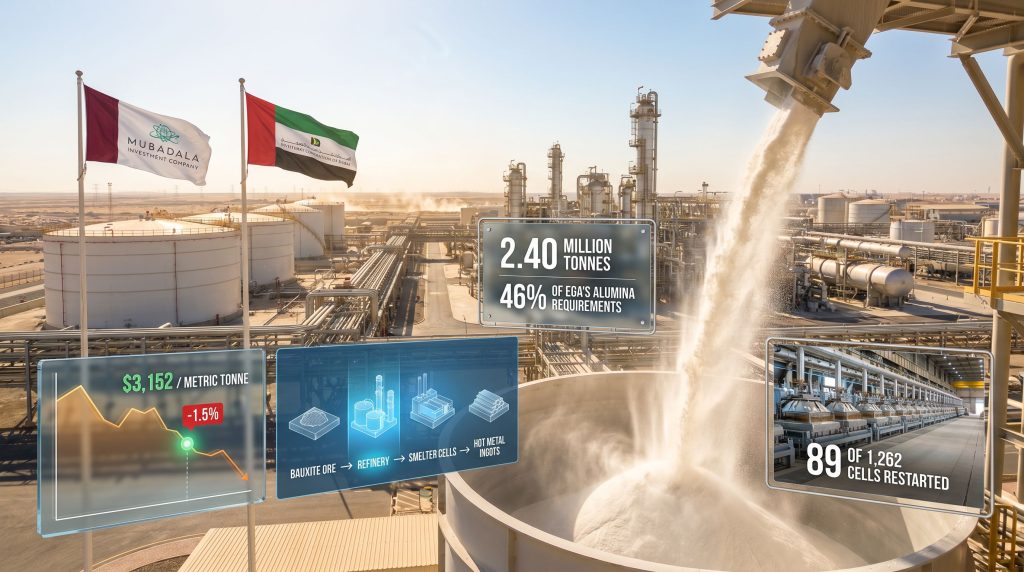
In 2025, the Al Taweelah refinery produced 2.40 million tonnes of alumina, meeting approximately 46% of EGA's total alumina requirements. The remaining 54% was sourced externally, through long-term supply agreements and spot market procurement, primarily from Australian and other international producers contributing to global bauxite production.
The Alumina-to-Aluminum Production Chain Explained
For investors and market observers unfamiliar with the production mechanics, the supply chain works as follows:
-
Bauxite mining extracts the raw ore, typically from tropical laterite deposits in Australia, Guinea, Brazil, or Indonesia.
-
Alumina refining (the Bayer Process) chemically dissolves bauxite in caustic soda under high pressure and temperature, producing alumina (aluminum oxide).
-
Aluminum smelting (the Hall-Heroult Process) uses electrolysis to reduce alumina into primary aluminum metal, consuming enormous quantities of electricity in the process.
-
Hot metal output then flows to casting, rolling, or alloying operations for end-use manufacturing.
The critical bottleneck is step two. Alumina refineries are chemically intensive facilities requiring precise temperature management, caustic chemical handling, and continuous process flow. Unlike a warehouse or a logistics hub, they cannot simply be switched back on after a forced shutdown without careful, staged recommissioning.
This is precisely why the pace of the EGA Al Taweelah alumina refinery restart attracted such close market attention.
What the March 2026 Strike Actually Damaged and Why It Matters
On March 28, 2026, Iranian missile and drone strikes targeted the Khalifa Economic Zone in Abu Dhabi, causing direct infrastructure damage to the Al Taweelah complex. The emergency shutdown that followed affected both the alumina refinery and the aluminum smelter, though the nature and severity of damage differed significantly between the two facilities.
The smelter's damage was particularly complex to assess. Aluminum smelters operate through electrolytic reduction cells, where alumina dissolved in molten cryolite is reduced to liquid aluminum using high-current electricity. The Al Taweelah smelter contains 1,262 individual reduction cells. Each cell must be carefully managed, as an unplanned power interruption can cause the molten bath to solidify, a process known in the industry as a frozen pot, which requires labour-intensive and time-consuming rehabilitation.
A frozen reduction cell is not simply restarted. The solidified bath must be physically broken out, the cell relined in some cases, and the electrolyte chemistry carefully re-established before production can resume. This is why smelter recovery timelines are measured in months, not days.
As of early July 2026, only 89 of the 1,262 reduction cells had been successfully restarted, with full hot metal output recovery projected to take up to 12 months, though accelerated scenarios of 6 months remained plausible depending on the rehabilitation pace.
The alumina refinery, by contrast, sustained damage that was significant but more amenable to rapid remediation, allowing for a faster recommissioning sequence. Furthermore, LME Insight has reported strong progress on the restart trajectory, with a return to full production expected within that compressed timeframe under favourable conditions.
| Facility Component | Status (Early July 2026) | Recovery Timeline |
|---|---|---|
| Alumina Refinery | Restarted; ramping to 50% capacity | Full capacity by end of 2026 |
| Aluminum Smelter | 89 of 1,262 cells restarted | Up to 12 months for full hot metal recovery |
| Hot Metal Output | Partial; phased ramp-up underway | 6 to 12 months (scenario-dependent) |
How the EGA Al Taweelah Alumina Refinery Restart Was Executed
The restart followed a structured, phased approach designed to rebuild production stability without overextending a system still in the early stages of recovery:
-
Phase 1: Initial alumina production achieved in early Q3 2026, within the originally projected restart window, itself a notable achievement given the severity of the March strike.
-
Phase 2: Ramp-up to 50% of nameplate capacity projected within days of the formal restart announcement, reflecting rapid progress through the early commissioning stages.
-
Phase 3: Full production restoration targeting technical readiness by end of 2026, subject to supply chain conditions and strategic sourcing decisions.
EGA explicitly noted that the timing of further ramp-ups would depend on conditions across its broader alumina sourcing strategy. This is a subtle but important signal. Even as internal refinery output recovers, EGA must balance this against existing third-party alumina supply contracts, some of which may carry take-or-pay obligations or volume commitments that cannot be immediately wound back without financial penalty.
Operational nuance: Ramping an alumina refinery too quickly while simultaneously managing contracted external supply can create an alumina surplus within the company's own system, adding cost rather than reducing it. EGA's measured ramp-up language reflects awareness of this dynamic.
A further critical operational detail confirmed by EGA is that hot metal production recovery at the smelter does not depend on full alumina refinery restoration. The two recovery processes are operationally decoupled, allowing the smelter rehabilitation to proceed independently of refinery ramp-up pace. This decoupling accelerated the overall market recovery narrative, as the aluminium journal has also noted in its coverage of the resumed operations.
Market Reaction: Why LME Prices Fell and What It Signals
LME aluminum futures declined 1.5% to $3,152 per metric tonne following the restart announcement. To understand this reaction, it helps to understand how commodity markets price geopolitical risk.
When the March 2026 strike occurred, aluminum futures incorporated a scarcity premium, reflecting uncertainty about how long Gulf production would remain offline. This premium was not derived from actual physical shortages in the short term, given that global aluminum inventories and alternative supply sources provided a buffer, but from risk-adjusted expectations about future tightness.
The faster-than-expected refinery restart directly deflated that scarcity premium. Markets recalibrated by pricing out some of the forward supply risk, resulting in the observed price decline. However, broader shifts in industrial metals demand continue to shape the medium-term outlook for aluminum pricing beyond this immediate event.
Short-term implications (0 to 6 months):
- Alumina spot prices face downward pressure as Al Taweelah output re-enters the market
- EGA's reliance on third-party spot alumina procurement eases, reducing competition for spot tonnes
- Smelter-level hot metal output remains constrained, meaning the aluminum supply recovery lags the alumina recovery
Longer-term implications (6 to 24 months):
- Full refinery restoration by end of 2026 rebuilds EGA's alumina self-sufficiency toward pre-strike levels
- Smelter cell rehabilitation pace will determine when hot metal volumes normalise
- If smelter recovery tracks the optimistic 6-month scenario, Gulf aluminum supply could surprise markets on the upside in early 2027
Sovereign Ownership and Its Strategic Implications for Recovery
EGA is jointly owned by Mubadala Investment Company, Abu Dhabi's sovereign wealth fund, and the Investment Corporation of Dubai, a state-owned entity. This ownership structure has direct implications for how recovery decisions are made.
Unlike a publicly listed aluminum producer facing shareholder pressure to minimise losses and restore margins quickly, EGA operates within a framework where long-term industrial policy objectives carry significant weight alongside commercial considerations. Sovereign-backed entities have demonstrated repeatedly in the metals sector that they can absorb extended recovery periods without the financial distress triggers that would force asset sales or production compromises in privately held or listed peers.
This financial resilience means EGA can afford to optimise its alumina sourcing strategy carefully during the restart period, rather than rushing to full internal production in ways that might create cost inefficiencies or contract complications.
The next major ASX story will hit our subscribers first
Geopolitical Risk Repricing: A New Calculus for Gulf Industrial Assets
The March 2026 strike introduced a risk variable that Gulf industrial operators, insurers, and investors had long modelled theoretically but had not confronted at this scale in practice. The Khalifa Economic Zone hosts not only EGA's operations but a constellation of energy, petrochemical, and industrial assets, meaning the insurance and risk premium implications extend well beyond aluminum.
For the alumina and aluminum markets specifically, the episode has accelerated strategic conversations around supply chain diversification. In addition, aluminium tariff impacts in key consuming regions are compounding the pressure on producers to reassess their sourcing and pricing strategies. Australia remains the world's largest bauxite and alumina exporter, and its established trade relationships with Gulf buyers position it as a natural beneficiary of any structural shift toward diversified sourcing.
The disruption has also reinforced the case for alumina inventory buffers, a practice that had become less common as just-in-time supply chains gained dominance across industrial metals. Furthermore, the accelerating push toward decarbonised metals production adds another layer of strategic complexity for operators weighing long-term capital allocation against near-term recovery priorities.
The broader lesson for metals investors is that geopolitical risk in commodity supply chains is non-linear. Facilities that appear geographically remote from active conflict zones can be affected by missile strikes with ranges measured in hundreds of kilometres, and the recovery timelines for complex chemical processing facilities can extend well beyond the duration of the triggering event itself.
Frequently Asked Questions: EGA Al Taweelah Alumina Refinery Restart
What triggered the shutdown of the Al Taweelah alumina refinery?
An emergency shutdown was initiated on March 28, 2026, following Iranian missile and drone strikes on the Khalifa Economic Zone in Abu Dhabi, which caused direct damage to the Al Taweelah complex.
How much alumina does the Al Taweelah refinery produce annually?
The refinery produced 2.40 million tonnes of alumina in 2025, supplying roughly 46% of EGA's total alumina requirements.
When will the refinery reach full production capacity?
EGA has indicated it expects technical capability to restore full production by end of 2026, with the pace of ramp-up subject to supply chain conditions and alumina sourcing strategy optimisation.
Is the aluminum smelter also recovering?
Yes, but on a separate and longer timeline. As of early July 2026, 89 of 1,262 reduction cells had been restarted, with full hot metal output recovery expected to take up to 12 months.
How did markets respond to the restart announcement?
LME aluminum futures fell approximately 1.5% to $3,152 per metric tonne, as traders priced out some of the scarcity premium that had built up following the March disruption.
Does refinery recovery depend on smelter recovery?
No. EGA confirmed the two facilities are recovering on independent timelines, and hot metal production ramp-up is not contingent on full alumina refinery restoration.
Key Metrics at a Glance
| Metric | Detail |
|---|---|
| Refinery Annual Output (2025) | 2.40 million tonnes of alumina |
| Share of EGA's Alumina Needs | 46% |
| Emergency Shutdown Date | March 28, 2026 |
| Restart Achieved | Early Q3 2026 |
| Near-Term Capacity Target | 50% within days of restart |
| Full Capacity Target | End of 2026 |
| Smelter Cells Restarted | 89 of 1,262 (early July 2026) |
| Smelter Full Recovery Timeline | Up to 12 months |
| LME Aluminum Price Reaction | -1.5% to $3,152 per metric tonne |
| EGA Ownership | Mubadala (Abu Dhabi) + ICD (Dubai) |
This article is intended for informational purposes only and does not constitute financial or investment advice. Commodity price forecasts and recovery timelines referenced herein reflect publicly available information and involve inherent uncertainty. Readers should conduct their own due diligence before making any investment decisions.
Want to Stay Ahead of the Next Major Commodity Supply Disruption?
Discovery Alert's proprietary Discovery IQ model delivers real-time alerts on significant ASX mineral discoveries, instantly transforming complex commodity data into actionable investment insights — explore historic examples of exceptional returns on Discovery Alert's discoveries page to see why timing matters, then begin your 14-day free trial at Discovery Alert to position yourself ahead of the market.