July 24, 2026
The Hidden Cost Architecture Driving Foundry Margin Collapse in 2026
Most manufacturing inputs fluctuate around a single, globally referenced price. Copper trades against the LME. Steel has benchmark hot-rolled coil indices. Even plastics trace back to crude oil derivatives with reasonably consistent global pricing. Aluminium, in 2026, no longer works this way. The metal has fractured into at least two distinct price realities, separated by geography, trade policy, and the compounding weight of regional delivery surcharges. For foundries, this fracture is not an abstraction. It shows up directly on the cost sheet, every single tonne, every single month.
Understanding aluminium casting prices, tariffs, premiums and energy as interconnected forces, rather than separate line items, is now the foundational requirement for any operator, buyer, or investor engaging with this market.
When big ASX news breaks, our subscribers know first
The Three-Layer Cost Problem Redefining Foundry Competitiveness
Why Aluminium Casting Pricing Can No Longer Be Read From a Single Benchmark
For most of the past two decades, a foundry could look at the London Metal Exchange aluminium price, apply a modest regional adjustment, and arrive at a serviceable estimate of input costs. That framework has broken down. In 2026, the actual price a US foundry pays for aluminium is assembled from three compounding layers, each with its own drivers, each pushing in the same direction.
The first layer is the LME benchmark, which reflects global supply and demand dynamics. The second layer is the US Midwest Premium, a physical delivery surcharge that captures the cost of tariff-induced scarcity inside the American market. The third layer is energy, the structural cost floor beneath the entire stack. None of these layers can be read in isolation, and their combined effect determines whether a casting operation generates a margin or destroys one.
In 2026, there is no longer a single aluminium price. There is a global price, a materially higher US price, and the distance between them is determined entirely by trade policy.
The Structural Decoupling Between Global and Domestic Aluminium Markets
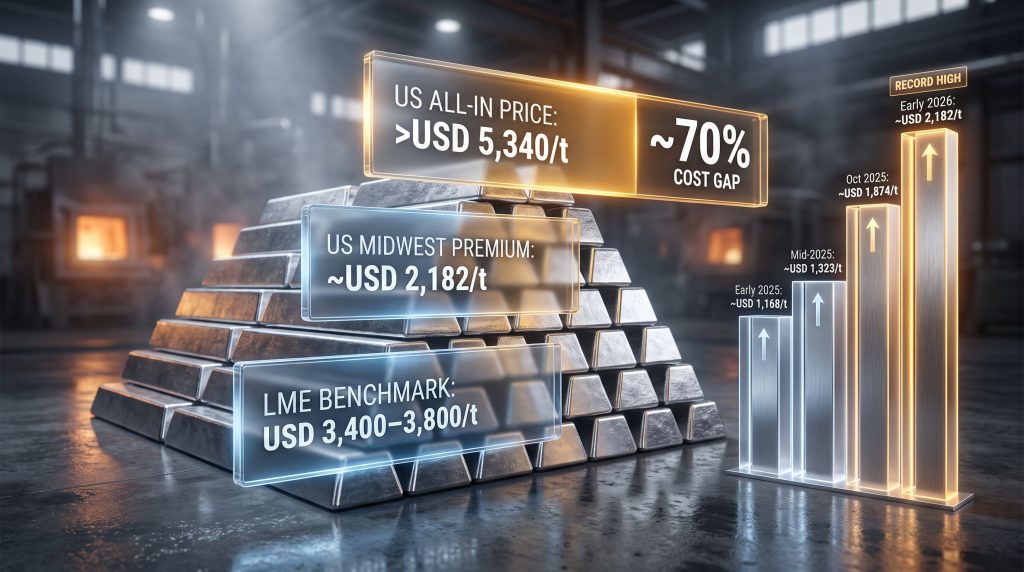
The decoupling between LME-referenced global pricing and the US all-in price is the defining feature of the current market. International foundries in Asia-Pacific and Europe source aluminium against the LME benchmark with modest regional adjustments. Their US counterparts pay that same benchmark plus a Midwest Premium that reached a record ~USD 2,182 per tonne in early 2026, the first time in history it has crossed the symbolic USD 1.00 per pound threshold.
The result is a structural competitive gap of approximately 70% between what a US foundry pays and what an international competitor pays for identical metal. This gap is not a temporary pricing anomaly. It is the arithmetic consequence of a sustained tariff regime, and it will persist for as long as that regime remains in place. Furthermore, the US aluminium tariffs driving this dislocation show no sign of reversal in the near term.
What Does Aluminium Actually Cost a Foundry in 2026? A Full Input Cost Breakdown
Layer 1: The LME Benchmark
The LME aluminium price serves as the global reference point from which all physical transactions are anchored. Major institutional forecasts for 2026 place the benchmark in the USD 3,400 to USD 3,800 per tonne range, equivalent to roughly USD 1.54 to USD 1.72 per pound. Several institutions have adopted a more constructive stance extending into 2027, citing supply tightness and durable demand growth from lightweighting applications across automotive, aerospace, and packaging sectors.
This benchmark price is what foundries outside tariff-affected markets pay, after modest freight and handling adjustments. It is the global floor from which every other cost in the system is built upward. According to recent price analysis, the divergence between US domestic and international benchmark pricing has become one of the most significant structural developments in aluminium markets in recent memory.
Layer 2: The US Midwest Premium
The Midwest Premium is the surcharge applied on top of the LME price for physical aluminium delivery inside the United States. It is not a fee or a tax in the conventional sense. It is the market's real-time measurement of domestic supply scarcity, and in 2026, that scarcity is severe. The premium trajectory over the past 18 months illustrates the pace and scale of escalation:
| Period | Approximate Midwest Premium |
|---|---|
| Early 2025 | |
| Mid-2025 | |
| October 2025 | |
| Early 2026 (record) |
This escalation is not incidental. It is mechanically connected to Section 232 tariff escalations, which progressively restricted the supply of competitively priced imported metal. As import volumes contracted, domestic buyers competed more aggressively for available supply, bidding the premium higher in a self-reinforcing cycle. Every tonne a US-based foundry purchases carries this surcharge as an unavoidable, plant-gate cost. The broader context of aluminium premiums across North America reflects just how far this dynamic has reached beyond the US border.
Layer 3: Energy
Aluminium melting is among the most electricity-intensive operations in all of manufacturing. Unlike the tariff-driven premium, which could theoretically reverse with a policy change, energy cost pressures are structural and persistent across all geographies. In high-cost electricity markets, energy can represent approximately 25% of primary metal production costs. Optimised furnace operations can push energy costs as low as USD 0.03 per pound of aluminium output, but achieving this requires meaningful capital investment and rigorous process discipline.
Energy does not dominate the headlines the way tariffs do, but it operates as a permanent floor beneath the entire cost structure. Foundries in regions where electricity is cheap hold a durable advantage that no trade policy can easily replicate or offset. In addition, greening aluminium through tariffs and energy costs is increasingly shaping how producers approach long-term capital allocation decisions.
What Is the All-In Aluminium Price for US Foundries in 2026?
Breaking Down the USD 5,340+ Per Tonne Reality
When the three cost layers are assembled, the full picture becomes stark:
| Cost Component | Approximate Level (Early 2026) | Notes |
|---|---|---|
| LME Benchmark | USD 3,400–3,800/t | Global reference price |
| US Midwest Premium | ~USD 2,182/t | Physical delivery surcharge (record high) |
| US All-In Price (LME + Premium) | >USD 5,340/t | What American foundries actually pay |
| International Competitor Cost | ~USD 3,400–3,800/t | LME-referenced, minimal premium |
| US vs. International Cost Gap | ~70% | Structural competitive disadvantage |
The all-in aluminium price for US foundries in 2026 exceeds USD 5,340 per tonne, approximately 70% above what international competitors pay sourcing metal against the LME benchmark alone.
This gap is not theoretical. It translates directly into reduced export competitiveness, compressed domestic margins, and an accelerating incentive to shift casting supply chains toward lower-cost geographies. For procurement teams and investors evaluating foundry economics, this number is the single most important data point in the market.
How Did US Section 232 Tariffs Create a Two-Tier Global Aluminium Market?
The Policy Escalation Timeline That Restructured Import Economics
The current market structure was not created overnight. It is the product of a deliberate and sequential policy escalation. The broader impacts of steel and aluminium tariffs have reverberated well beyond the United States, reshaping global trade flows and forcing downstream manufacturers to reassess supply chain strategies:
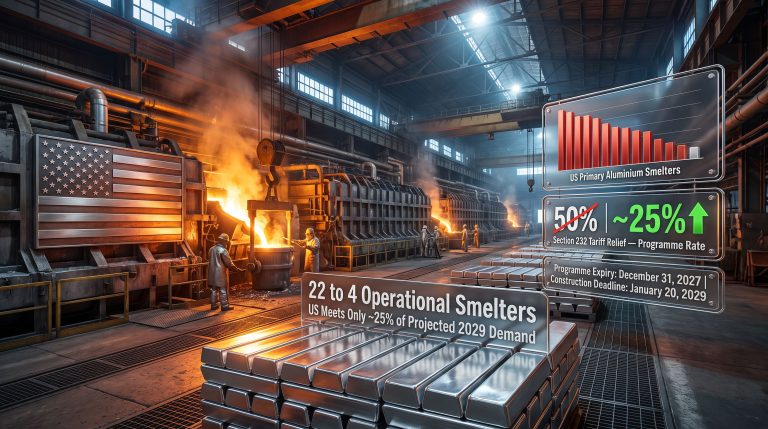
- Section 232 aluminium tariffs were raised from 10% to 25% in early 2025
- A further escalation to 50% ad valorem was implemented in mid-2025
- Certain aluminium derivative articles carry a 25% tariff rate
- Qualifying US-content products may access a 10% rate under specific conditions
A 50% import duty applied to a country that remains structurally dependent on aluminium imports produces a predictable and measurable outcome. Domestic metal becomes scarce. Buyers compete on price to secure physical supply. The Midwest Premium rises until it reflects the full cost of that scarcity. The premium is therefore not a separate market phenomenon but the visible price signal of tariff mechanics working exactly as designed, with costs distributed across the entire downstream manufacturing sector.
The Three-Tier Market Structure That Has Emerged
| Foundry Category | Cost Position | Strategic Implication |
|---|---|---|
| US-based standalone casters | Highest input costs globally | Margin compression; limited export competitiveness |
| Asia-Pacific and European casters | LME-referenced; structural cost advantage | Competitive in neutral export markets |
| Vertically integrated producers | Own upstream metal supply | Best positioned to absorb premium volatility |
The pattern that emerges from this structure is consistent with historical observations across tariff-affected commodity markets: whoever controls cost, not just capacity, holds the durable competitive advantage. Consequently, the leading aluminium supply leaders with vertically integrated operations are best positioned to weather sustained premium volatility.
How Do High Aluminium Input Costs Cascade Through Foundry Operations?
The Margin Compression Sequence Every Casting Buyer and Seller Should Understand
Casting operates on characteristically thin margins, making it disproportionately vulnerable to rapid input cost movements. When metal prices surge, the operational impact follows a predictable three-step sequence:
- Margin erosion occurs first. Metal is procured before finished castings are invoiced. Any mid-cycle price movement directly compresses the spread between input cost and selling price, with no mechanism to recover it from existing contracts.
- Contract tenors shorten. Volatility makes both buyers and sellers reluctant to commit to long-dated fixed-price agreements. Deal structures become shorter in duration, smaller in volume, or stall entirely pending price clarity.
- Demand behaviour shifts. As all-in part costs rise, procurement teams delay orders, re-evaluate alternative sourcing regions, or revisit the internal make-versus-buy decision with fresh urgency.
What This Means for Casting Prices Across Different Processes and Regions
Casting prices vary significantly by process, alloy grade, and geography. To illustrate the range of market pricing, indicative levels in 2026 include:
- Indian market listings: approximately INR 200 to INR 650 per kg depending on alloy and casting process
- Standard Al-Si 12 sand casting (CIF Los Angeles): approximately USD 3.20 to USD 4.10 per kg
- Die-cast components: quoted across a broad range from USD 0.20 to USD 5.00 per piece depending on complexity, volume, and finishing requirements
It is important to note that a foundry quote bundles alloy input, labour, energy, tooling, machining, finishing, inspection, packaging, logistics, and overhead into a single delivered price. Raw metal cost, despite being the single largest individual input, is only one component of the final casting cost equation. Furthermore, alumina market pressures upstream are adding another layer of cost complexity that foundries cannot afford to ignore.
The next major ASX story will hit our subscribers first
What Investors and Procurement Teams Need to Know About Alloy Selection
One dimension of foundry cost management that receives insufficient attention outside the industry is alloy selection strategy. The choice between common casting alloys, including A356, A360, and A380, carries meaningful implications for scrap generation, energy consumption per unit, fluidity in the casting process, and downstream machining requirements.
A356, for example, is widely used in structural automotive components where high elongation and strength are required after heat treatment. A380 is the dominant die casting alloy due to its excellent fluidity and resistance to hot cracking, but it carries different recycled content constraints. A360 offers superior corrosion resistance at some cost to castability.
Each of these alloys responds differently to changes in the primary-versus-secondary metal mix, which is why alloy strategy and scrap utilisation strategy cannot be treated as independent decisions in a high-cost metal environment.
Foundries that align their alloy selection, process routing, and secondary metal utilisation strategy as a single integrated decision are capturing cost advantages that competitors managing these as separate functions are not.
What Is the Aluminium Casting Price Outlook for the Remainder of 2026?
Institutional Forecasts and the Policy Variable That Overrides Them
Major institutional forecasts maintain consensus in the USD 3,400 to USD 3,800 per tonne range for the 2026 LME annual average. Several banks have moved to a more constructive position through 2027, underpinned by supply constraints in primary production and sustained demand growth from lightweighting applications in electric vehicles, commercial aerospace, and consumer electronics.
However, for US foundries, the LME forecast is a secondary consideration. The primary variable is the Midwest Premium, and the primary driver of the premium is tariff policy. The policy scenarios carry materially different outcomes:
| Policy Scenario | Likely Midwest Premium Trajectory | Impact on US Foundry Costs |
|---|---|---|
| Section 232 maintained at 50% | Remains elevated; two-tier market persists | High and volatile; no structural relief |
| Section 232 narrowed to finished derivatives only | Premium could moderate as primary metal flows ease | Partial cost relief for standalone foundries |
| Full tariff removal (low probability) | Premium normalises toward historical levels | Significant competitive rebalancing |
For foundry operators and procurement teams building 2026 cost models, the prudent planning assumption is a market that is high, geographically divided, and subject to swing risk in both directions depending on policy developments in Washington.
Can Foundries Actively Manage Their Exposure to Aluminium Price Volatility?
Three Operational Levers That Deliver Measurable Cost Control
While benchmark pricing and tariff regimes sit entirely outside any individual foundry's control, cost management within the operation remains fully actionable. Three levers are delivering measurable results across the industry in 2026:
1. Expanding Secondary Aluminium Utilisation
Remelting recycled aluminium scrap consumes a fraction of the energy required to process primary metal. This reduces both direct energy expenditure and carbon intensity simultaneously. Under frameworks such as the EU Carbon Border Adjustment Mechanism (CBAM), a higher recycled content share carries financial value beyond operational cost savings, creating a compliance dividend for operations managing exports into regulated markets.
2. Alloy and Process Optimisation
Selecting the appropriate alloy grade and casting route for each application reduces scrap generation, energy consumption per unit, and downstream machining requirements. These are costs the foundry directly controls, fully independent of external market conditions. The decision is particularly impactful when optimised at the quoting stage rather than during production.
3. Disciplined Price Tracking and Hedging
Monitoring LME price series and Midwest Premium movements systematically allows premium assumptions to be embedded into every customer quotation. The financial difference between a margin that absorbs a price swing and one that is destroyed by it often comes down to whether the premium cost was explicitly priced in at the quoting stage, rather than discovered after the fact.
Frequently Asked Questions: Aluminium Casting Prices, Tariffs and Premiums in 2026
Why are aluminium casting prices significantly higher in 2026 than in prior years?
The primary driver is the compounding effect of US Section 232 tariffs at 50%, a record US Midwest Premium of approximately USD 2,182 per tonne, and elevated energy costs. Together, these forces have pushed the all-in aluminium cost for US foundries above USD 5,340 per tonne.
What is the LME aluminium price forecast for 2026?
Major institutional forecasts cluster in the USD 3,400 to USD 3,800 per tonne range for the 2026 annual average, with a more constructive outlook developing for 2027 based on supply constraints and structural demand growth from lightweighting applications.
What is the US Midwest Premium and why does it matter for casting economics?
The Midwest Premium is the physical delivery surcharge US buyers pay above the LME benchmark. It reached a record of approximately USD 2,182 per tonne in early 2026. Because it is applied to every tonne a US foundry purchases, it directly and materially widens the cost gap between American and international casting operations. This is why understanding aluminium casting prices, tariffs, premiums and energy as a unified cost framework is essential for sound procurement planning.
How large is the cost gap between US and international foundries in 2026?
Approximately 70%. US foundries pay an all-in price exceeding USD 5,340 per tonne, while international competitors sourcing against the LME benchmark pay USD 3,400 to USD 3,800 per tonne.
What tariff rates apply to aluminium imports into the US in 2026?
- Primary aluminium: 50% ad valorem under Section 232
- Certain aluminium derivative articles: 25%
- Qualifying US-content products: 10%
Will aluminium casting prices fall before the end of 2026?
Any meaningful reduction depends primarily on tariff policy. If Section 232 is narrowed or modified, the Midwest Premium could ease and US costs could partially converge with international levels. If the current regime holds, the two-tier, high-cost market structure is likely to persist through year-end.
How can casting operations reduce their exposure to high aluminium prices?
The most effective levers are increasing the share of recycled secondary aluminium in the melt mix, optimising alloy selection and casting process to reduce scrap and energy per unit, and embedding Midwest Premium assumptions into every customer quotation through systematic price tracking and hedging discipline.
Key Takeaways: What Aluminium Casting Buyers, Sellers and Investors Need to Know in 2026
- There is no single global aluminium price in 2026, there is an LME benchmark and a materially higher US all-in price separated by approximately 70%
- The Midwest Premium at ~USD 2,182 per tonne is the most direct market signal of tariff-induced domestic scarcity and the primary driver of the US cost disadvantage
- Energy remains a permanent, geography-dependent cost floor that operates independently of trade policy cycles
- The three-tier market structure (US-only casters, international casters, vertically integrated producers) creates a durable ranking of cost competitiveness that will persist as long as the current tariff regime holds
- Alloy selection strategy, secondary metal utilisation, and hedging discipline are the internal levers through which foundries can partially offset external cost pressures
- The policy variable, not the demand variable, is the primary swing factor for US casting costs through the remainder of 2026 and into 2027
This article is based on publicly available market data, institutional pricing forecasts, and industry analysis current as of mid-2026. The figures and forecasts referenced, including LME benchmark ranges and Midwest Premium levels, are drawn from reported market data and major bank consensus estimates. Readers should note that aluminium prices, tariff regimes, and regional premiums are subject to rapid change. Nothing in this article constitutes financial or investment advice. Readers seeking additional context on aluminium market dynamics and downstream pricing trends can explore industry coverage and data resources available through AL Circle, which publishes ongoing reporting on aluminium casting markets, LME price histories, and regional premium movements.
Want to Identify the Next Major ASX Mineral Discovery Before the Broader Market?
Discovery Alert's proprietary Discovery IQ model delivers real-time alerts the moment significant mineral discoveries are announced on the ASX, translating complex data across more than 30 commodities into clear, actionable insights for investors at every experience level — begin your 14-day free trial today and see why historic discoveries have generated extraordinary returns for those positioned early.