July 24, 2026
The Architecture of African Economic Integration: Why Bilateral Frameworks Are Becoming the Engine of Continental Trade
Intra-African trade has long underperformed relative to the continent's economic potential. Despite decades of regional integration rhetoric, Africa's internal commerce accounts for roughly 15 to 17 percent of total African exports, a figure that stands in stark contrast to the more than 60 percent recorded within Europe and approximately 58 percent across Asia. The structural reasons for this gap are well understood: fragmented customs regimes, divergent product standards, poor physical connectivity, and weak institutional continuity across political cycles. Ghana and Morocco sign 11 agreements to advance intra-African trade represents exactly the kind of precision bilateral instrument designed to dismantle these barriers layer by layer.
The decision by Ghana and Morocco to construct an integrated institutional architecture targets trade friction across multiple dimensions simultaneously. Rather than pursuing a single sweeping liberalisation measure, the two countries have taken a more nuanced approach. Understanding why this matters requires looking beyond the headline agreement count and examining the strategic logic embedded within each instrument.
When big ASX news breaks, our subscribers know first
Understanding the Scope of the 11 Agreements
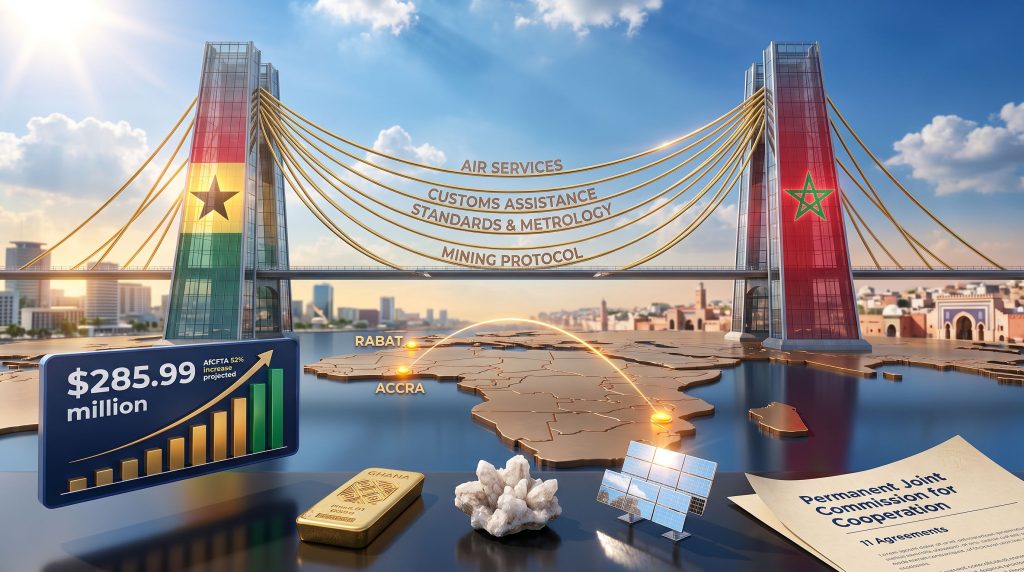
The bilateral framework formalised during the second session of the Permanent Joint Commission for Cooperation covers a deliberately broad range of domains. This breadth is not accidental. It reflects a sophisticated understanding that trade volumes between two economies are determined not only by tariff schedules, but by the cumulative friction generated across customs procedures, logistics networks, product certification regimes, institutional capacity, and human capital pipelines.
The 11 agreements can be grouped into three functional clusters:
Hard trade infrastructure instruments:
- Air Services Agreement, improving both passenger and cargo connectivity
- Mutual Administrative Assistance in Customs Matters, directly targeting procedural trade barriers
- Standardisation, Conformity Assessment and Metrology agreement, addressing non-tariff barriers arising from divergent product certification requirements
Sectoral and scientific cooperation instruments:
- Meteorology and Climatology cooperation, enabling agricultural and infrastructure planning through shared climate data
- Scientific and Technical Cooperation Protocol between Morocco's National Office of Hydrocarbons and Mines, Ghana's Minerals Commission, and the Ghana Geological Authority
- Higher Education, Science and Technology memorandum of understanding
Institutional and soft diplomacy instruments:
- Diplomatic and Vocational Training agreement
- Scholarships and Internships programme
- Knowledge Sharing framework
- Sports Cooperation protocol
- Archives Cooperation agreement
| Agreement Category | Primary Trade Function | Time Horizon for Impact |
|---|---|---|
| Air Services | Physical connectivity for goods and people | Near to medium term |
| Customs Mutual Assistance | Procedural barrier reduction | Near term |
| Standards Harmonisation | Non-tariff barrier elimination | Medium to long term |
| Mining Scientific Protocol | Value chain development in extractives | Long term |
| Higher Education and Science | Human capital pipeline | Long term |
| Meteorology Cooperation | Agricultural and infrastructure planning | Medium term |
| Diplomatic Training | Governance and trade administration quality | Long term |
| Scholarships and Internships | Professional network development | Long term |
| Knowledge Sharing | Policy and innovation diffusion | Medium term |
| Sports Cooperation | Soft diplomacy and people-to-people ties | Ongoing |
| Archives Cooperation | Legal and administrative continuity | Foundational |
The simultaneous coverage of hard trade infrastructure alongside soft institutional pillars signals a long-term integration strategy rather than a transactional arrangement designed to generate a diplomatic photo opportunity.
How the AfCFTA Framework Amplifies the Ghana-Morocco Dynamic
The timing of the Ghana and Morocco sign 11 agreements moment is inseparable from the broader African Continental Free Trade Area architecture. Ghana's position as the permanent host of the AfCFTA Secretariat in Accra is not merely symbolic. It confers on Ghana a disproportionate role in shaping continental trade governance norms, dispute resolution procedures, and implementation priorities.
When a country occupying that institutional position signs a bilateral cooperation framework with a major African economy, the agreement carries demonstrative weight beyond its direct economic impact. It signals how bilateral deals can be constructed to complement, rather than circumvent, the continental trade architecture. Furthermore, tracking African mining finance trends reveals how capital deployment patterns across the continent increasingly follow these bilateral integration signals.
Three of the 11 agreements align most directly with AfCFTA's implementation challenges:
- Customs mutual assistance reinforces AfCFTA's trade facilitation protocols by reducing the procedural delays that currently impose disproportionate costs on smaller traders and manufacturers
- Standards harmonisation directly addresses what AfCFTA implementation research consistently identifies as the most persistent obstacle to intra-African trade growth: non-tariff barriers arising from incompatible product certification systems
- Air services connectivity supports the physical movement of goods across a continent where logistics costs remain among the highest globally, a structural constraint that tariff reductions alone cannot resolve
According to World Bank projections, full AfCFTA implementation could increase intra-African exports by up to 52 percent over the long term. Bilateral frameworks that embed the same reform priorities at the country-to-country level create compounding effects by advancing implementation ahead of the continental timeline.
The Strategic Complementarity Between Morocco and Ghana
Morocco's Dual-Facing Economic Position
Morocco occupies a rare geographic and commercial position on the continent. It faces simultaneously toward Europe through its established EU trade corridors and toward sub-Saharan Africa through a decade-long strategy of expanding banking, infrastructure, and agricultural investments across the region. This dual orientation makes Morocco a genuine commercial bridge across multiple regional blocs, a characteristic few African economies can claim.
Morocco's strategic assets most relevant to the Ghana partnership include:
- Established trade corridors with the European Union, offering Ghanaian exporters a potential gateway into European value chains
- One of Africa's most advanced renewable energy solutions programmes, targeting 52 percent of electricity generation from renewables by 2030, including the landmark Noor Ouarzazate solar complex
- Status as one of the world's largest phosphate producers, bringing agro-industrial and fertiliser expertise directly relevant to Ghana's agricultural development priorities
- A banking sector that has expanded significantly across West Africa, creating institutional familiarity and trust within the region
Ghana's Institutional and Resource Leverage
Ghana contributes a distinct and complementary set of strategic assets:
- AfCFTA Secretariat hosting in Accra, conferring institutional influence over continental trade rule-setting and implementation governance
- A critical minerals profile encompassing gold, bauxite, manganese, and emerging lithium exploration activity, which aligns directly with the broader critical minerals energy transition agenda reshaping global supply chains
- ECOWAS market access, providing Morocco with a gateway to a regional consumer bloc of approximately 400 million people
- Ambitions in vaccine and pharmaceutical manufacturing, consistent with the African Union's Agenda 2063 target of producing 60 percent of Africa's vaccine requirements on the continent by 2040
Baseline Trade Figures and the Untapped Potential Gap
According to data from the Observatory of Economic Complexity, bilateral trade between Ghana and Morocco currently stands at approximately $285.99 million. Measured against the combined economic weight of both nations and the structural complementarities identified above, this figure represents a significant underperformance.
| Trade Indicator | Current Position |
|---|---|
| Ghana-Morocco bilateral trade volume | $285.99 million (OEC) |
| Intra-African trade share of total African exports | ~15-17% |
| AfCFTA projected long-term trade increase | Up to 52% (World Bank) |
| ECOWAS consumer market | ~400 million people |
| AU Agenda 2063 vaccine production target | 60% on-continent by 2040 |
The gap between the current $285.99 million baseline and what structural complementarity would suggest is theoretically achievable is precisely the kind of inefficiency that layered bilateral reform frameworks are designed to address. Historical evidence from other bilateral trade agreements that have combined customs facilitation with standards harmonisation and connectivity improvements suggests that these reforms tend to deliver compounding trade growth effects, with customs efficiency gains typically captured first, followed by standards-driven market access expansion, and then investment flow increases over a longer horizon.
High-Value Sectors Within the Cooperation Framework
Renewable Energy Technology Transfer
Ghana's explicit interest in drawing on Morocco's renewable energy expertise represents one of the most commercially significant elements of the partnership. Morocco's energy transition programme is among the most advanced on the continent, backed by substantial infrastructure investment and operational experience in grid-scale solar and wind deployment.
Potential cooperation pathways within this sector include joint feasibility work for solar and wind deployment in Ghana's northern regions, technology transfer arrangements for grid-scale storage and energy management systems, and the development of shared regulatory frameworks designed to attract renewable energy investment at scale.
Mining and Critical Minerals Knowledge Exchange
The scientific and technical cooperation protocol signed between Morocco's National Office of Hydrocarbons and Mines, Ghana's Minerals Commission, and the Ghana Geological Authority creates a formal trilateral institutional channel for knowledge exchange in the extractive sector. This is particularly significant given the accelerating critical minerals demand surge globally and both countries' strategic interest in moving further up the extractive value chain beyond raw commodity export models.
This protocol opens pathways for:
- Geological data sharing and alignment of survey methodologies
- Best-practice exchange on environmental and social governance standards in mining operations
- Potential joint investment frameworks for mineral processing and downstream value addition
A shift toward knowledge-based partnerships in extractive industries, rather than simple commodity export relationships, represents one of the more structurally significant trends emerging across African bilateral cooperation frameworks in the current decade.
Pharmaceutical and Health Sovereignty
Ghana's stated intention to collaborate with Morocco on vaccine and pharmaceutical manufacturing reflects a continent-wide imperative that gained urgency in the post-pandemic period. Morocco already operates an established pharmaceutical manufacturing base that exports to multiple African markets. Furthermore, Ghana's ambition to become a West African pharmaceutical hub aligns with the AfCFTA pharmaceutical annex and the broader AU Agenda 2063 health sovereignty framework.
The next major ASX story will hit our subscribers first
Implementation Risks That Could Constrain Delivery
Well-structured bilateral agreements are not self-executing. The history of African regional cooperation frameworks includes numerous examples of commitments that remained aspirational for extended periods due to predictable execution gaps. The Ghana-Morocco framework faces several of these risks:
1. Institutional capacity constraints
Effective customs mutual assistance requires compatible information technology systems, trained personnel, and aligned legal frameworks. These prerequisites require sustained budgetary investment that extends well beyond any signing ceremony.
2. The technical complexity of standards harmonisation
Aligning conformity assessment procedures between two countries with different regulatory traditions is a technically demanding, multi-year undertaking. It requires dedicated working groups and consistent political commitment to sustain momentum through the inevitable periods of slow progress.
3. Air connectivity commercial viability
An air services agreement establishes the legal framework enabling new routes, but commercial viability ultimately depends on airline decisions driven by passenger demand and cargo volumes. These economic variables may lag institutional reform by years.
4. Political continuity risk
Permanent Joint Commissions depend on sustained political will across electoral cycles. Leadership transitions in either country can slow implementation momentum or shift priorities in ways that existing agreements cannot prevent.
5. Financing implementation activity
Technical cooperation protocols without dedicated joint funding mechanisms risk remaining declarations of intent rather than operational programmes.
Mapping the Framework Against AU Agenda 2063
AU Agenda 2063 provides the long-term developmental context within which the Ghana-Morocco agreements acquire their full significance. Several of the framework's aspirational pillars are directly served by elements of the 11 agreements:
- Aspiration 1 (Prosperous Africa): Customs cooperation and standards harmonisation reduce trade costs, supporting inclusive economic growth across both economies
- Aspiration 2 (Integrated Africa): Air services and institutional cooperation agreements strengthen physical and administrative continental connectivity
- Aspiration 3 (Good Governance): Diplomatic training and institutional capacity-building instruments reinforce governance quality and administrative effectiveness
- Aspiration 6 (People-Driven Development): Scholarship programmes, vocational training, and sports cooperation advance human capital development and cultural exchange at the individual level
The preparatory process that preceded the formal signing is also worth noting. A meeting of technical experts held in Rabat between June 9 and 11, 2026 reviewed the state of bilateral cooperation and prepared the agreements for ministerial approval. This sequencing — with substantive technical review preceding political formalisation — reduces the risk that the commitments reflect diplomatic ambition rather than operational feasibility.
What the Ghana-Morocco Framework Signals for Intra-African Trade Strategy
Several broader lessons emerge from the structure and content of this bilateral framework that are relevant to policymakers, investors, and analysts tracking African economic integration. Consequently, these signals carry weight for how the continent approaches the metals and mining geopolitics that increasingly intersect with trade architecture.
- Multi-sector bilateral frameworks are becoming the preferred implementation instrument for advancing intra-African trade within the AfCFTA era, complementing the continental agreement with sector-specific mechanisms that can move faster than continental-level negotiations
- The $285.99 million trade baseline significantly understates structural potential, given the complementarity between Ghana's West African institutional position and Morocco's European gateway and renewable energy capabilities
- Standards harmonisation and customs cooperation represent the highest-leverage instruments in the package for near-term trade volume growth, based on historical evidence from comparable bilateral frameworks globally
- The mining cooperation protocol reflects a continent-wide strategic shift toward extractive industry partnerships built around knowledge transfer and value chain development rather than raw material flows
- Human capital agreements are the long-duration infrastructure of sustainable bilateral economic integration, with impacts on trade and investment flows that typically materialise over decades rather than years
Disclaimer: This article contains forward-looking analysis based on publicly available economic data, World Bank projections, and AfCFTA implementation research. Projections regarding trade growth and bilateral economic outcomes involve inherent uncertainty and should not be interpreted as financial advice or investment guidance.
Want to Track the Mining Opportunities Emerging From Africa's Shifting Trade Landscape?
As bilateral frameworks like the Ghana-Morocco agreement accelerate critical minerals cooperation and extractive value chain development across Africa, Discovery Alert's proprietary Discovery IQ model instantly identifies significant ASX mineral discoveries the moment they are announced — transforming complex geological data into actionable investment insights. Explore how major mineral discoveries have historically generated substantial returns on Discovery Alert's discoveries page, and begin your 14-day free trial today to position yourself ahead of the market.