July 24, 2026
The $100 Oil Threshold: Why Emerging Economies Feel It First
In global commodity markets, certain price levels carry weight far beyond their numerical significance. Brent crude near $100 and India's inflation concerns have moved firmly into the spotlight as the $100 per barrel mark looms. For oil-importing economies, particularly large and structurally dependent ones, this threshold does not merely represent a data point on a price chart. It functions as a policy stress trigger, a fiscal pressure valve, and an inflation accelerant, all simultaneously.
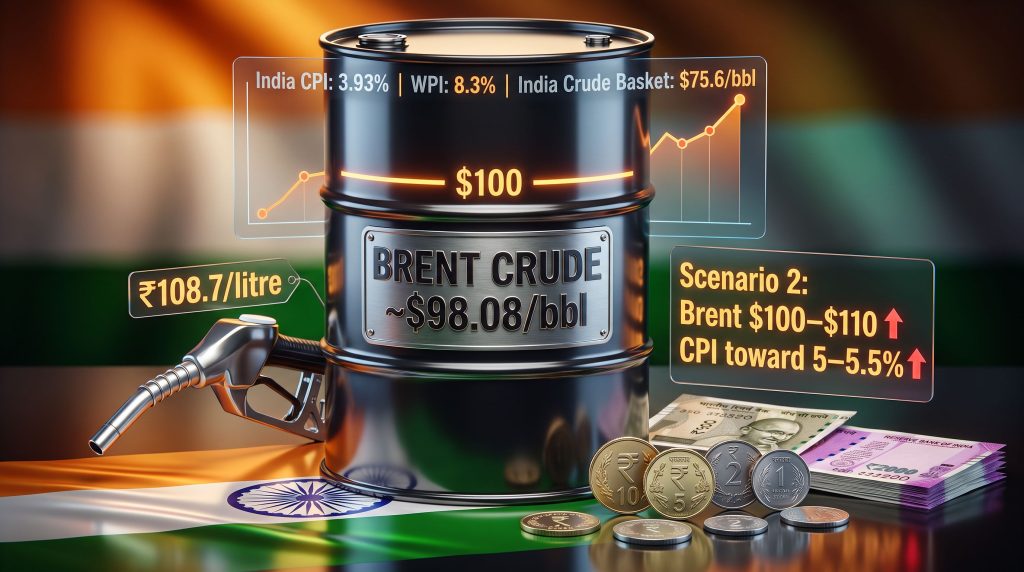
For India specifically, the mechanics of oil price transmission are unusually direct. The country imports approximately 85% of its total crude oil requirement, meaning that fluctuations in international benchmark prices ripple almost immediately through the nation's import bill, currency dynamics, and ultimately its consumer prices. With Brent crude recently trading near $98.08 per barrel and WTI at approximately $89.63 per barrel, the question of whether prices breach and sustain the $100 level is no longer abstract.
Understanding the broader crude oil price trends helps contextualise these developments. It carries concrete consequences for inflation trajectories, monetary policy, and fiscal management heading into the second half of 2026.
When big ASX news breaks, our subscribers know first
What Is Actually Pushing Brent Crude Toward $100?
Geopolitical Fear Premium vs. Structural Supply Reality
A critical distinction often overlooked in headline coverage is the difference between geopolitically driven price spikes and those rooted in genuine supply deficits. These two forces may produce similar price outcomes in the short term, but they have dramatically different implications for duration and policy response.
The current elevated Brent pricing environment reflects the former rather than the latter. Ongoing tensions across the Middle East have injected a sustained risk premium into crude markets, with traders pricing in potential supply disruption scenarios that have not yet materialised at scale. Furthermore, geopolitical tensions reshaping trade patterns globally are adding another layer of complexity to price formation. This type of fear-based pricing tends to be volatile and self-correcting once geopolitical anxiety subsides or fails to produce an actual supply shock.
Market analysis indicates that the prevailing crude price environment is being driven by geopolitical risk appetite rather than a fundamental breakdown in global supply. Consequently, a prolonged Brent rally well above $100 per barrel is considered unlikely given that no structural supply deficit has emerged.
The Role of OPEC and Trade Pressures
OPEC's market influence remains a critical variable in determining whether current price levels prove temporary or entrenched. Production decisions made in Vienna reverberate directly through India's import bill and fiscal calculations.
In addition, the trade war oil impacts on global supply chains have introduced further uncertainty into energy markets. However, oil prices and trade tensions between major economies could, paradoxically, dampen demand growth enough to offset some of the upward price pressure from geopolitical risk premiums.
The Discount Crude Dynamic: India's Procurement Advantage
What makes India's exposure particularly nuanced is that the country does not simply pay the Brent spot price for its crude. Over recent years, India has aggressively diversified its supplier base, securing crude volumes at meaningful discounts to the Brent benchmark from multiple international sources.
According to the Reserve Bank of India's latest bulletin, India's crude oil basket price stood at $75.6 per barrel in July 2026. This represents a significant discount to spot Brent near $98 per barrel and a dramatic easing from the April 2026 peak of $114.5 per barrel. That roughly $22-per-barrel effective discount reflects deliberate procurement diversification that partially insulates India's actual energy costs from headline benchmark movements.
However, this buffer is not a firewall. If Brent rallies sharply, discounted crude prices rise in absolute terms regardless, and India's import bill expands accordingly.
India's Inflation Architecture: Mapping the Transmission Channels
Direct Fuel Cost Exposure
India's domestic retail fuel prices remained frozen through July 2026, with petrol held at ₹108.7 per litre and diesel at ₹98.1 per litre, unchanged from June levels. Domestic LPG prices also held steady across the same period. This price stability is the product of active government management rather than market equilibrium.
The government's capacity to maintain retail price stability rests on a combination of fiscal buffers, excise duty flexibility, and oil marketing company (OMC) margin compression. These tools are effective in absorbing short-term crude price spikes but carry cumulative fiscal costs that become unsustainable if elevated prices persist.
Key structural risk: If Brent remains above $100 per barrel for a prolonged period, the arithmetic of fiscal absorption eventually breaks down, making retail fuel price adjustments fiscally unavoidable. When that pass-through occurs, it triggers a cascade of inflationary effects through transportation, food supply chains, and manufacturing input costs.
Indirect Inflation Channels: Diesel, Food, and Manufacturing
Diesel is the backbone of India's agricultural logistics and freight transport networks. When diesel costs rise, that pressure transmits through the entire food supply chain, from farm gate to retail shelf. As reported by India Today, with crude near $110, both India and global markets face compounding inflation and fuel risks that extend well beyond headline energy costs.
This indirect transmission channel is arguably more consequential for household inflation than direct fuel costs, because food carries a higher weight in India's Consumer Price Index than it does in developed economies. The leading indicator data is already showing stress. Wholesale Price Index (WPI) inflation reached 8.3% in April 2026, a level that typically precedes broader consumer price acceleration by several months.
The Currency Depreciation Amplifier
Higher oil prices create a compounding loop that is often underappreciated in simplistic inflation analyses. The mechanism works as follows:
- Rising crude prices increase India's dollar-denominated import bill.
- Greater dollar outflows place downward pressure on the Indian rupee.
- A weaker rupee raises the cost of all imported goods, not just crude.
- Broader import cost inflation feeds into consumer prices across multiple categories.
- The RBI faces pressure to respond, constraining monetary policy flexibility.
This loop means that the inflationary impact of an oil price shock is always larger than the direct fuel cost effect alone would suggest.
India's 2026 Macroeconomic Snapshot: Key Data in Context
| Indicator | Figure | Period |
|---|---|---|
| Brent Crude (spot) | ~$98.08 per barrel | July 2026 |
| WTI Crude (spot) | ~$89.63 per barrel | July 2026 |
| India Crude Oil Basket Price | $75.6 per barrel | July 2026 |
| India Crude Oil Basket Price (Peak) | $114.5 per barrel | April 2026 |
| Retail Petrol Price | ₹108.7 per litre | July 2026 |
| Retail Diesel Price | ₹98.1 per litre | July 2026 |
| CPI Inflation | 3.93% | May 2026 |
| CPI Inflation | 3.48% | April 2026 |
| WPI Inflation | 8.3% | April 2026 |
The divergence between WPI and CPI inflation is itself a warning signal. Wholesale price pressure at 8.3% while consumer prices sit at 3.93% suggests a significant pipeline of cost pressure that has not yet fully reached households. Sustained high oil prices would accelerate that transmission.
Current Account Deficit and Forex Reserve Vulnerabilities
The Import Bill Arithmetic
Every sustained $10 per barrel increase in India's effective crude cost materially widens the current account deficit. Given India's import volumes, this is not a marginal adjustment. Historical episodes of oil price spikes, including the 2011–2014 period when Brent averaged above $100 per barrel for an extended stretch, produced significant CAD widening that constrained both monetary easing and fiscal flexibility simultaneously.
Concerns over India's inflation and forex reserves have been well documented by financial analysts, who note that Brent near $100 places concurrent pressure across multiple macroeconomic indicators. Notably, the European Central Bank's decision to hold interest rates despite rising oil and gas-driven inflation expectations reflects the fact that energy price anxiety is not uniquely an Indian problem. It is a global central banking challenge in mid-2026.
Foreign Exchange Reserve Pressure Under Stress Scenarios
Elevated and sustained oil prices accelerate the pace at which foreign exchange reserves are drawn down, as a larger volume of dollars exits the economy to cover the import bill. The RBI's reserve buffer provides a critical stabilisation mechanism during oil price shocks, but it is not unlimited. If crude prices remain elevated for an extended period, the pace of reserve consumption becomes a live policy concern.
Three Scenarios: What Sustained High Oil Prices Would Mean for India
Scenario 1: Brief Spike Above $100, Rapid Retreat (Base Case)
- Geopolitical tensions ease without producing an actual supply disruption.
- Brent retreats below $95 per barrel within weeks of breaching $100.
- India's crude basket price remains well below $90 per barrel.
- No retail fuel price adjustment required; CAD widens modestly and stabilises.
- RBI maintains its existing policy stance; rate trajectory unaffected.
This remains the most probable outcome given the absence of a structural supply deficit and the reality of aggressive producer competition for market share in current markets.
Scenario 2: Sustained $100–$110 Brent for 2–3 Months (Adverse Case)
- Prolonged geopolitical disruption sustains the risk premium.
- India's crude basket price rises toward the $90–$95 per barrel range.
- Retail fuel price adjustments become fiscally necessary.
- CPI inflation accelerates toward 5–5.5%, eroding the current comfortable buffer below the RBI's 6% upper tolerance band.
- CAD widens by an estimated 0.3–0.5% of GDP.
- Any prospective RBI rate-cutting cycle is delayed or cancelled.
Scenario 3: Brent Above $110 for an Extended Period (Tail Risk)
- A structural supply shock drives prices to multi-year highs.
- India's crude basket price tracks toward levels last seen at the April 2026 peak or beyond.
- CPI inflation risks breaching the 6% RBI upper tolerance band.
- Significant forex reserve drawdown; sustained rupee weakness.
- Government forced into a combination of excise duty cuts, OMC support packages, and targeted subsidies, each carrying direct fiscal cost.
Structural ceiling on the upside: Global producer competition for market share, combined with the availability of discounted crude from multiple suppliers, creates a natural price ceiling that limits how far and how long Brent can sustain above $100 in the absence of a genuine supply breakdown.
The next major ASX story will hit our subscribers first
The RBI's Policy Dilemma: When Monetary Tools Meet Supply Shocks
The Dual-Shock Scenario India's Policymakers Fear Most
The Reserve Bank of India has explicitly identified two primary upside risks to India's inflation trajectory: Middle East geopolitical tensions and monsoon variability. Individually, either shock is manageable. Together, they create what policymakers regard as the most challenging macroeconomic environment to navigate.
A below-average monsoon raises food prices from the supply side. Elevated oil prices raise energy and transport costs simultaneously. Both forces feed into CPI through different channels, and crucially, neither can be addressed through monetary tightening without imposing significant growth costs.
The RBI's inflation surveys already show household inflation expectations rising in response to energy price concerns, and that expectation-setting dynamic can become self-fulfilling if not managed carefully. The fundamental policy constraint is that oil-driven, supply-side inflation does not respond well to interest rate increases. Raising rates dampens demand but does not reduce the cost of imported crude.
India's Strategic Crude Diversification: Structural Hedge With Limits
India's procurement diversification strategy deserves recognition as a genuine structural improvement in the country's energy resilience. The fact that India's crude basket price of $75.6 per barrel in July 2026 sits approximately $22 below spot Brent is a direct consequence of deliberate supplier diversification, not market luck.
However, investors and policymakers should understand the limits of this hedge:
- Discounted crude prices still rise in absolute terms when the Brent benchmark rises sharply.
- The discount to Brent is not guaranteed and reflects competitive market dynamics that can shift.
- Geopolitical risks associated with certain supplier relationships introduce non-price vulnerabilities that are harder to quantify.
- Logistical and refinery configuration constraints limit how rapidly India can shift its sourcing mix in response to sudden market changes.
The diversification strategy reduces but does not eliminate India's structural exposure to global oil price dynamics. With Brent crude near $100 already generating material concern across India's macroeconomic indicators, the resilience of that procurement advantage under a sustained high-price scenario remains one of the most consequential variables to monitor through the remainder of 2026.
Frequently Asked Questions
Why does Brent crude near $100 matter specifically for India's economy?
India sources roughly 85% of its crude oil from international markets, meaning global price increases flow almost directly into the country's energy import costs. Higher prices widen the current account deficit, pressure the rupee through increased dollar outflows, and eventually feed into consumer inflation through fuel, transportation, and food supply chain costs.
Will retail petrol and diesel prices increase if Brent holds above $100?
As of July 2026, retail petrol prices are held at ₹108.7 per litre and diesel at ₹98.1 per litre, unchanged from June. The government can absorb elevated crude costs through fiscal tools in the near term, but a prolonged period of high prices would likely make retail price adjustments unavoidable, which would then accelerate broader consumer price inflation.
What is the RBI watching most closely regarding oil and inflation?
The RBI has flagged Middle East geopolitical tensions and monsoon performance as the two primary upside risks to India's inflation path. Internal surveys suggest household inflation expectations have already shifted upward in response to energy market uncertainty, which adds urgency to the central bank's monitoring of crude price developments.
How does India's crude oil basket price differ from spot Brent?
India's crude oil basket represents a weighted average of the specific crude grades India actually imports, including discounted volumes from multiple suppliers. In July 2026, this basket price was approximately $75.6 per barrel, compared to spot Brent near $98 per barrel. This roughly $22 discount reflects the benefit of India's diversified, discount-focused procurement strategy, though this buffer narrows in absolute terms when benchmark prices rise sharply.
Is a prolonged Brent rally above $100 per barrel the most likely outcome?
Based on current market dynamics, a prolonged rally above $100 is not the base case. The primary driver of elevated pricing is geopolitical risk premium rather than a structural supply deficit, and aggressive producer competition for market share acts as a meaningful ceiling on sustained upside. A brief breach of $100 is possible, but the structural conditions for a multi-month rally above that level are not strongly present in the current environment.
Disclaimer: This article contains forward-looking analysis, scenario modelling, and macroeconomic projections based on data available as of July 2026. These represent analytical frameworks rather than investment advice or guaranteed outcomes. Readers should conduct independent research and consult qualified financial advisors before making investment or financial decisions based on energy market or macroeconomic forecasts.
Want to Capitalise on the Next Major Commodity Discovery Before the Market Moves?
Whilst macroeconomic forces like crude oil price surges reshape global commodity markets, Discovery Alert's proprietary Discovery IQ model scans ASX announcements in real time, delivering instant alerts on significant mineral discoveries across more than 30 commodities — from energy to base metals — so subscribers can act on actionable opportunities ahead of the broader market. To understand the scale of returns that major discoveries have historically generated, explore Discovery Alert's dedicated discoveries page and begin your 14-day free trial today.