July 24, 2026
America's Smelting Deficit and the Defence Supply Chain Crisis Driving Policy Change
The history of industrial decline rarely announces itself with a single dramatic event. It accumulates quietly, one facility closure at a time, until the gap between domestic capacity and national need becomes too wide to ignore through conventional policy channels. That is precisely the situation confronting the United States in primary aluminium production, and US aluminium tariffs for smelter investment, announced in July 2026, represent the clearest signal yet that policymakers are treating this not as an industrial competitiveness question, but as a defence readiness emergency.
Understanding why this matters requires stepping back from trade policy mechanics and looking at what aluminium actually does inside the defence industrial base, and how badly the structural supply gap has widened over the past two decades.
When big ASX news breaks, our subscribers know first
The Collapse of US Primary Aluminium Capacity: A Two-Decade Contraction
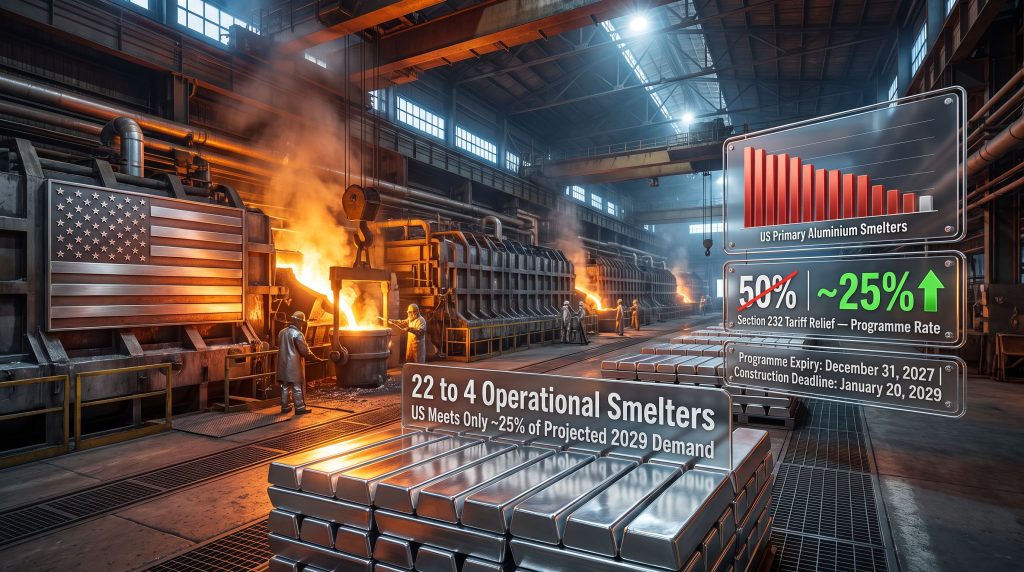
The scale of capacity loss in American primary aluminium smelting is striking when presented in concrete terms. According to research published by the think-tank SAFE (Securing America's Future Energy), the number of US smelters capable of producing feedstock for high-performance alloys has contracted from 22 operational facilities to just four over roughly twenty years. That is not a gradual fade — it is a structural collapse.
The consequence of that collapse is measurable: the United States can currently satisfy only approximately 25% of its projected primary aluminium demand by 2029 from domestic sources. The remaining three-quarters must be sourced from international markets, with all the geopolitical exposure that entails.
What makes this particularly acute from a national security perspective is that aluminium is not a peripheral input. It is foundational to:
- Armoured fighting vehicles and troop carriers
- Naval vessel superstructures and hulls
- Aerospace platforms including military aircraft and spacecraft
- Precision munitions systems and guidance housings
At a moment when the Pentagon is actively pressuring defence contractors to accelerate output, the supply chain beneath those contractors is structurally inadequate. This dynamic, more than any trade economics argument, is what converted the aluminium smelting question from an industrial policy issue into a defence procurement crisis.
Not All Aluminium Is Equal: The Alloy Feedstock Distinction
A critical and often overlooked detail in this discussion is the difference between commodity aluminium and defence-grade alloy feedstock. Not every tonne of primary aluminium can be used interchangeably in defence applications. High-performance aerospace and armour applications require specific alloy series, most notably the 2000 and 7000 series aluminium alloys, which demand tightly controlled feedstock chemistry and production processes that not all smelters are equipped to provide.
This distinction means the effective pool of strategically relevant smelting capacity is even narrower than the headline figure of four operational facilities suggests. Furthermore, rebuilding domestic capacity is not simply a matter of increasing raw metal output — it requires rebuilding specific technical capability within the production chain.
This framing positions aluminium alongside rare earth elements and advanced permanent magnets in the US critical minerals tariff landscape policy conversation, as a material where the quality and specification of supply matters as much as the volume.
What the US Aluminium Tariffs for Smelter Investment Programme Actually Does
The programme announced in July 2026 operates through a targeted tariff relief mechanism linked directly to domestic capital investment commitments. The underlying logic is straightforward: if a company is prepared to rebuild or expand American smelting capacity, the government will reduce the cost of importing primary aluminium feedstock in the interim, making the investment more financially viable.
Policy Snapshot: The baseline Section 232 tariff on aluminium imports was elevated to 50% in June 2025. Approved programme participants can access a reduced effective rate of approximately 25% on qualifying primary aluminium imports, representing a halving of the standard levy. For broader context on how US aluminium tariffs have reshaped market dynamics heading into this period, the trajectory of policy escalation is important to understand.
Eligibility and Programme Parameters
| Requirement | Detail |
|---|---|
| Application body | US Department of Commerce |
| Eligible investment types | Build, expand, or refurbish a US primary aluminium facility |
| Construction commencement deadline | January 20, 2029 |
| Programme expiry | December 31, 2027 |
| Eligible material | Primary aluminium only |
| Refurbishment relief basis | Calibrated to the value of capital investment committed |
A critical exclusion is worth emphasising: the relief applies only to primary aluminium. Derivative articles, semi-fabricated products, and unrelated capital equipment fall outside the programme's scope. This is not a broad tariff reduction — it is a precisely targeted incentive instrument.
Step-by-Step: How a Company Accesses the Relief
- Identify a qualifying investment, whether new smelter construction, capacity expansion at an existing site, or facility refurbishment.
- Prepare a formal onshoring plan documenting the scope, capital commitment, and construction timeline.
- Submit the application to the US Department of Commerce for review and approval.
- Upon approval, receive authorisation to import a commensurate volume of primary aluminium at the reduced approximately 25% tariff rate.
- Commence construction no later than January 20, 2029 to maintain programme eligibility.
The hard construction commencement deadline is a deliberate design feature. It converts a financial incentive into an operational imperative, preventing companies from banking approval without actually breaking ground. According to analysis from Global Trade Alert, the programme represents one of the more structurally coherent industrial incentive mechanisms introduced under recent US trade policy frameworks.
A Real-World Example: Century Aluminium and the Oklahoma Smelter
Century Aluminium's leadership indicated to the Financial Times that the tariff relief programme would provide direct support for the company's planned investment in a new Oklahoma smelter developed in partnership with Emirates Global Aluminium. This joint venture structure is instructive, as it combines domestic eligibility with international operational expertise and access to established upstream supply chains — precisely the model most likely to prove viable under the programme's parameters.
Can Tariff Relief Alone Rebuild US Smelting Economics?
Here is where honest analysis diverges from policy optimism. Tariff relief on imported feedstock improves one dimension of smelter economics, but it does not address the single largest operational cost variable in primary aluminium production: electricity.
Electricity accounts for roughly 30 to 40% of total primary aluminium smelting costs globally. The reason US smelters closed over the past two decades was not primarily tariff policy — it was the structural energy cost disadvantage relative to competing production hubs:
- The Middle East, where Gulf producers access cheap associated gas from hydrocarbon production
- Canada and Iceland, where abundant low-cost hydroelectric power creates a persistent competitive advantage
- Russia, where subsidised industrial power tariffs historically supported large-scale smelting
US industrial power costs have risen substantially in recent years, and the programme does nothing to directly address that gap. This is the central tension in the policy design. Indeed, reporting from Reuters has highlighted how electricity costs have continued to drive smelter closures even as tariff levels have escalated, underscoring the limits of trade policy acting alone.
Tariff policy can meaningfully alter the investment calculus at the margin, particularly for refurbishment projects where capital requirements are lower. However, without complementary solutions to the energy cost problem — whether through dedicated power purchase agreements, co-location with low-cost renewable generation, or other mechanisms — the long-term operational viability of new US smelting capacity remains genuinely uncertain.
Greenfield vs. Refurbishment: Comparing the Investment Profiles
| Investment Type | Tariff Benefit | Energy Cost Exposure | Construction Timeline Risk | Overall Viability Assessment |
|---|---|---|---|---|
| Greenfield smelter (new build) | High, full programme access | High, no existing power contracts | High, tight 2029 deadline | Moderate |
| Capacity expansion at existing site | High, commensurate volume relief | Lower, existing power arrangements | Lower, infrastructure in place | High |
| Facility refurbishment | Proportional to investment value | Variable | Lower | Moderate to High |
The economics most clearly favour companies with existing infrastructure, where the combination of lower capital expenditure and improved feedstock cost economics creates the most compelling near-term return profile.
The Dual-Track Strategy: Tariff Relief and Tightened Defence Waivers
The aluminium smelter incentive programme did not emerge in isolation. It was announced concurrent with a separate tightening of the waiver rules governing defence industry procurement — specifically the rules that previously permitted contractors to source sensitive materials, including rare-earth magnets, from geopolitically adversarial nations including China and Russia.
The simultaneous nature of these two policy moves reflects a coherent strategic framework: reduce the financial attractiveness of importing from rivals while simultaneously improving the economics of domestic production. Carrot and stick, applied together. This approach mirrors the logic underpinning the broader steel and aluminium tariffs framework, which similarly sought to pair import penalties with domestic production incentives.
However, the Aerospace Industries Association's public response introduced an important complication. While welcoming the policy direction of reducing adversarial supply chain dependence, the AIA cautioned that tighter waiver conditions could prove counterproductive in the near term. For several critical minerals, domestic supply infrastructure simply does not yet exist at commercial scale, meaning defence contractors could face a situation where they are simultaneously prohibited from sourcing internationally and unable to source domestically.
This tension is the defining policy challenge, and it applies to aluminium as much as to rare earths.
The Rare Earth Precedent: What Aluminium Policymakers Appear to Have Learned
The US rare earth sector offers a cautionary precedent that appears to have directly informed the aluminium programme's design. When tariff measures and export controls were applied to rare earth supply chains, they successfully accelerated investment interest and project announcements, but did not automatically translate into operational processing capacity within the timeframes policymakers needed. America's rare earth supply chain challenges illustrate precisely how difficult it is to rebuild strategic material capacity once it has been allowed to atrophy.
The aluminium programme's hard construction commencement deadline of January 2029 appears to reflect an awareness of this failure mode. Rather than relying on investment pledges and approval processes alone, the programme creates a concrete operational trigger that must be satisfied to maintain eligibility. In addition, the Defense Production Act has been invoked in parallel to accelerate permitting and procurement timelines for critical material facilities, further reinforcing the government's commitment to meaningful delivery over symbolic policy gestures.
Second-Order Effects on Global Aluminium Trade
The programme's implications extend beyond US domestic markets. Countries that currently supply primary aluminium to the United States face a structural demand shift if domestic capacity additions materialise, though the timeline for meaningful new capacity extends well beyond the programme's December 2027 expiry date.
Gulf-based producers, particularly those in the UAE and Saudi Arabia who have historically supplied significant volumes of primary aluminium to North American markets, face the most direct long-term competitive exposure. These producers benefit from low-cost gas-based power and have invested heavily in smelting capacity over the past decade, but their position in the US market could erode progressively as domestic alternatives emerge.
Importantly, the programme does not restrict foreign-partnered entities from qualifying, provided the smelting investment is located within the United States. This creates a logical pathway for international aluminium producers to participate as joint venture partners, contributing operational expertise and established supply chain relationships while satisfying the domestic investment requirement. The Century Aluminium and Emirates Global Aluminium Oklahoma project exemplifies this structure.
The next major ASX story will hit our subscribers first
Frequently Asked Questions: US Aluminium Tariffs for Smelter Investment
What Is the Current US Tariff Rate on Aluminium Imports?
The baseline Section 232 tariff on aluminium imports was raised to 50% in June 2025. Companies participating in the approved smelter investment programme can access a reduced effective rate of approximately 25% on qualifying primary aluminium volumes.
Who Administers the Tariff Relief Programme?
Applications are reviewed and approved by the US Department of Commerce, which assesses submitted onshoring plans and determines eligibility and authorised import volumes.
Does the Tariff Relief Apply to All Aluminium Products?
No. The relief is restricted to primary aluminium — the raw metal produced directly from smelting operations. Derivative articles, semi-fabricated products, and unrelated capital equipment are excluded from the programme.
When Does the Programme Expire?
The current programme runs through December 31, 2027. Companies must have approved applications and must commit to commencing construction by January 20, 2029 to qualify.
Can Foreign-Owned Companies Participate?
The programme requires investment in US-based smelting capacity. Joint ventures and foreign-partnered entities appear eligible, provided the qualifying facility is located within the United States and meets all Commerce Department requirements.
Is a 25% Effective Tariff Rate Competitive Enough to Make US Smelting Economically Viable Long-Term?
Tariff relief improves the feedstock cost equation, but industry analysts consistently identify electricity costs as the more significant structural barrier. Consequently, US aluminium tariffs for smelter investment alone are unlikely to be sufficient without complementary energy solutions to resolve the underlying power cost disadvantage.
Key Takeaways for Industry Stakeholders
- The structural deficit is severe: A contraction from 22 to just 4 operational high-performance alloy smelters over two decades has left the US able to meet only approximately 25% of projected 2029 primary aluminium demand from domestic sources.
- The incentive is meaningful but time-limited: Halving the applicable tariff rate from 50% to approximately 25% on qualifying primary aluminium imports provides real cost relief, but only through December 2027.
- Construction deadlines create genuine urgency: The January 2029 commencement requirement gives companies roughly 2.5 years from the programme announcement to move from planning to groundbreaking.
- Energy costs remain the unresolved structural variable: Tariff policy addresses feedstock import costs but does not resolve the power cost disadvantage that drove the original wave of US smelter closures.
- Joint ventures with international producers may be the most viable pathway: Combining domestic investment eligibility with international operational expertise and established upstream supply chains represents the most commercially credible route to qualifying projects.
- The defence imperative is the policy engine: This programme is fundamentally a defence supply chain resilience measure, and that framing is likely to sustain political support regardless of broader shifts in US trade policy direction.
Disclaimer: This article contains forward-looking statements, forecasts, and scenario analysis. These represent analytical assessments based on publicly available information and should not be construed as financial or investment advice. Readers should conduct their own due diligence before making any investment decisions related to companies or sectors discussed in this article.
Want to Track ASX Mineral Discoveries Linked to Critical Defence Supply Chains?
Discovery Alert's proprietary Discovery IQ model delivers real-time alerts the moment significant ASX mineral discoveries are announced — including aluminium, rare earths, and other strategic commodities reshaping global defence supply chains — turning complex data into clear, actionable investment insights. Explore how historic mineral discoveries have generated substantial returns and begin your 14-day free trial at Discovery Alert to position yourself ahead of the broader market.