
June 8, 2026
The Carbon Reckoning Arriving at the Factory Gate: What 2028 Really Changes for Aluminium Trade
For decades, the architecture of global industrial trade has been shaped by an implicit advantage: manufacturers in energy-intensive economies could externalise carbon costs that their European counterparts were increasingly forced to internalise. The European Union's emissions trading system created a domestic carbon price, but it operated like a one-sided tariff wall, protecting the atmosphere inside European factories while leaving the import gate wide open to goods produced under no equivalent constraint. The Carbon Border Adjustment Mechanism was designed to correct this asymmetry at the raw materials level. What happens in January 2028, however, represents something far more consequential than a policy refinement.
The aluminium CBAM downstream expansion in Europe is not merely a procedural update. It is a structural reorientation of how carbon liability is assigned across global manufacturing value chains, and for exporters in Asia, the Middle East, and North Africa, the window to adapt is closing faster than most supply chain managers currently appreciate.
When big ASX news breaks, our subscribers know first
What the 2028 CBAM Downstream Expansion Actually Means for Aluminium Trade
From Primary Metals to Finished Goods: Understanding the Scope Shift
When the EU launched the CBAM transitional phase in October 2023, the regulatory perimeter was deliberately narrow. Unwrought aluminium, iron, steel, cement, fertilisers, and electricity formed the initial coverage universe. The rationale was straightforward: start where carbon intensity is most measurable, build the verification infrastructure, and then expand.
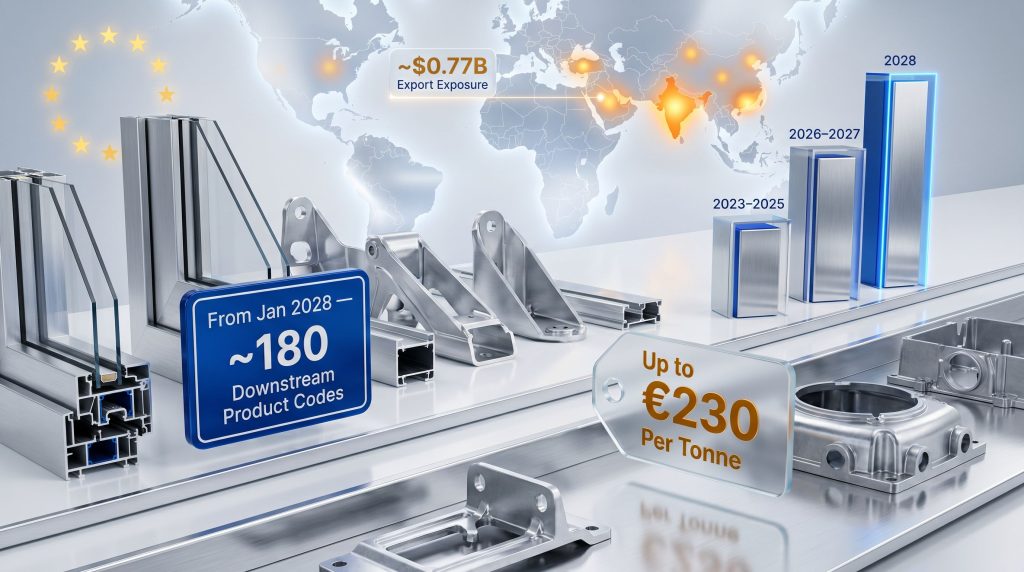
That expansion arrives in 2028 with approximately 180 new downstream product codes entering the CBAM framework. The shift moves the mechanism from taxing raw tonnage to assessing the embedded carbon within complex manufactured goods, including automobile structural components, household appliances, architectural assemblies, and precision-fabricated aluminium parts.
This distinction matters enormously. A kilogram of unwrought aluminium has a relatively traceable carbon footprint rooted in smelting energy sources. A finished automotive casting, by contrast, carries embedded emissions from multiple upstream processes: the original smelting, the alloying, the die-casting energy consumption, the surface treatment, and the logistics chain. Verifying this layered carbon data across thousands of product lines is an order of magnitude more complex than what the current transitional regime requires.
Why the European Commission Designed a Built-In Expansion Trigger
The downstream expansion was never an afterthought. Article 30 of the original CBAM regulation explicitly mandated a review and expansion process, recognising from the outset that restricting coverage to primary materials would create a structural arbitrage opportunity.
If only raw aluminium carries a European carbon cost, the commercially rational response for any importer is to shift purchasing downstream: buy finished components rather than raw material, import the carbon liability in embodied form rather than in declared form. The Commission's expansion trigger was engineered to foreclose this substitution before it could calcify into permanent trade patterns.
The Carbon Leakage Logic: Why Taxing Only Raw Metal Was Never Enough
Carbon leakage, the phenomenon whereby tightening domestic emissions rules causes carbon-intensive production to relocate offshore rather than actually reduce emissions, sits at the conceptual core of CBAM's entire design. For aluminium specifically, the leakage risk is acute because the metal is globally fungible, energy-intensive to produce, and deeply integrated into high-value finished goods that flow freely into European markets.
Without downstream inclusion, manufacturers in Guangdong, Gujarat, or Greater Istanbul could theoretically absorb primary aluminium at prevailing global prices, add significant value through fabrication, and export finished goods into the EU with zero carbon cost obligation. The European producer making the same window frame or automotive bracket would carry an embedded carbon cost in their raw material input that their foreign competitor simply does not face. The downstream expansion closes this competitive gap.
The Scale of Change: What 180 New Product Codes Mean for Global Exporters
Which Downstream Aluminium Categories Fall Under the 2028 Net
The expanded CBAM coverage is expected to capture a broad range of fabricated and assembled aluminium products that currently cross EU borders without carbon cost obligations. Based on current policy modelling and Commission consultation materials, the affected categories include:
- Aluminium extrusions used in window, door, and curtain wall construction
- Die-cast and gravity-cast automotive structural components
- Heat exchangers, radiators, and thermal management assemblies
- Consumer appliance housings and structural frames
- Fabricated aluminium parts for aerospace and industrial machinery
- Structural assemblies used in civil construction and infrastructure
The common thread running through all these categories is that they represent the stage at which raw aluminium's carbon footprint becomes embedded in a product the EU consumer or manufacturer ultimately purchases. Taxing only the raw input while leaving the fabricated form untaxed created exactly the kind of leakage channel the mechanism was designed to prevent.
How Approximately 7,500 New Importers Will Be Drawn Into CBAM Compliance Obligations
Current policy modelling indicates that the 2028 downstream expansion will bring approximately 7,500 new importers into active CBAM compliance and reporting obligations. This figure dwarfs the importer population currently navigating the transitional phase, which focused on a relatively concentrated group of primary materials traders.
The new entrant profile is fundamentally different. These are not commodity traders accustomed to bulk emissions reporting. Many are mid-sized manufacturers, specialist component suppliers, or regional distributors who have never engaged with carbon accounting infrastructure. The compliance burden, including verified embedded emissions data, CBAM certificate purchases, and EU customs declarations, will require genuine operational investment rather than incremental administrative adjustment.
Furthermore, European aluminium industry bodies have noted that the downstream scope extension is essential for protecting European producers from carbon-cost arbitrage embedded in finished goods imports.
"The downstream expansion is structurally designed to close the most exploitable loophole in the original CBAM framework. Importing finished goods to bypass carbon costs applied only to raw material inputs was an entirely foreseeable outcome of a primary-only mechanism. Without downstream inclusion, the system would have accelerated a shift toward carbon-intensive manufacturing outside EU borders while leaving European downstream producers commercially exposed."
Who Bears the Highest Carbon Cost Risk? A Geopolitical and Trade Exposure Analysis
Export Vulnerability by Region: Asia, the Middle East, and North Africa in the Crosshairs
The geographic distribution of CBAM exposure is highly uneven. Exporters whose grids rely heavily on coal-fired electricity, and whose aluminium sectors have not undertaken systematic decarbonisation investment, face the steepest adjustment costs. The following table summarises modelled exposure by region:
| Exporting Region | Primary Exposure Level | Estimated Financial Impact | Key Product Categories at Risk |
|---|---|---|---|
| India | High | ~$0.77B in steel and aluminium exports | Extrusions, castings, fabricated parts |
| China | Very High | Under active modelling review | Window frames, auto components, profiles |
| Turkey | Moderate to High | Partial EU alignment advantage from customs union proximity | Semi-finished profiles, structural sections |
| GCC / Middle East | Moderate | Energy-intensive grid dependency creates exposure | Primary-linked downstream goods |
| Southeast Asia | Moderate and growing | Increasing exposure as FDI shifts production there | Consumer goods, appliance components |
India's Aluminium Sector: Modelling an Estimated $0.77 Billion Export Loss
India's exposure is quantifiable and significant. Economic modelling estimates that India's steel and aluminium export sectors combined face losses of approximately $0.77 billion as CBAM obligations intensify. Within the aluminium component of this figure, extrusion producers and casting operations supplying European automotive and construction chains carry the highest individual vulnerability.
India's electricity grid remains heavily coal-dependent, meaning the carbon intensity embedded in Indian aluminium fabrication is structurally elevated relative to producers operating in markets with higher renewable energy penetration. Without credible grid decarbonisation or facility-level renewable energy procurement, Indian exporters face a cost disadvantage that grows proportionally with the EU carbon price trajectory. These China industrial export pressures mirror similar dynamics playing out across other carbon-intensive industrial sectors globally.
China's Guangdong Extrusion Belt and South Asia's Die-Casting Hubs: Structural Exposure
China's Guangdong province represents one of the world's most concentrated aluminium extrusion and fabrication geographies. Export volumes directed toward European construction, automotive, and industrial sectors from this region are substantial. The 2028 downstream expansion will apply embedded carbon verification requirements directly to these product flows, with certificate costs tied to the carbon intensity of Chinese grid electricity, which remains dominated by coal generation in many industrial provinces.
South Asian die-casting clusters, particularly those serving European automotive original equipment manufacturers through Tier 2 and Tier 3 supply chains, face analogous structural exposure. Many of these operations lack the carbon monitoring infrastructure that CBAM compliance will ultimately demand.
The 0.37% Paradox: Marginal Global Emissions Impact vs. Concentrated Trade Disruption
One of the less-discussed features of CBAM is the striking disproportion between its projected trade coverage and its actual climate impact. Current analysis suggests the mechanism covers approximately 0.37% of global trade flows, while its projected contribution to global emissions reduction sits in a range of roughly 0.4 to 0.5 per cent of worldwide greenhouse gas output.
On a planetary scale, these are marginal numbers. Yet the economic disruption concentrated in specific export sectors of developing economies is anything but marginal. This asymmetry has generated significant criticism from trade economists and developing nation representatives who argue that CBAM functions primarily as a competitive protection mechanism for European industry rather than a genuine climate instrument. Indeed, the global industrial trade outlook suggests that carbon border mechanisms are reshaping industrial cost structures well beyond aluminium alone.
Structural Inequality in CBAM Design: Developed vs. Developing Economy Asymmetry
The structural inequality embedded in CBAM's design reflects a broader tension in climate policy architecture. Developed economies with established renewable energy grids, mature carbon markets, and deep capital pools can adapt to carbon pricing mechanisms with relative efficiency. Developing economies, which are often reliant on coal-dominated grids for industrial energy and lack equivalent public or private capital for rapid decarbonisation, face compliance costs that are disproportionate to their historical contribution to cumulative global emissions.
This is not merely an academic critique. It has material implications for how the WTO compatibility of CBAM is assessed, and for the geopolitical negotiations surrounding the mechanism's implementation that are currently ongoing between Brussels and multiple affected trading partners.
What Are the Unresolved Policy Controversies Surrounding the Downstream Expansion?
The Scrap Loophole: Why Post-Consumer Recycled Aluminium Remains a Contested Variable
Among the technical controversies embedded in the current CBAM methodology, the treatment of recycled aluminium stands out as particularly consequential. Aluminium manufactured from post-consumer scrap carries a dramatically lower carbon footprint than primary smelted aluminium, typically requiring only around 5% of the energy needed for primary production.
However, the current CBAM framework does not yet provide a fully standardised methodology for assigning verified carbon credit to scrap-based aluminium across complex product supply chains. This creates a potential distortion: a fabricator using genuinely low-carbon recycled aluminium may not receive proportionate competitive recognition under CBAM certificate calculations, while a producer using high-emission primary aluminium may face costs that do not fully reflect their actual embedded footprint if data verification is inconsistent.
The scrap loophole is an active subject of industry lobbying and technical consultation, with recycling industry associations pressing for robust differentiated treatment of secondary aluminium in the embedded emissions methodology.
Indirect Electricity Emissions: The Missing Calculation Layer in Current CBAM Methodology
Another technically significant gap involves the treatment of indirect emissions, specifically the carbon embedded in the electricity consumed during fabrication processes. The current CBAM framework prioritises direct process emissions while the methodology for attributing indirect electricity emissions across complex downstream value chains remains under development.
For aluminium fabrication, where electricity consumption during extrusion, casting, and surface treatment represents a major portion of total production-stage emissions, the absence of a robust indirect emissions accounting layer creates real uncertainty around the accuracy of declared embedded carbon figures.
"European industry associations are actively lobbying for a wider downstream product net. Their core argument is that if upstream aluminium carries a verified carbon cost while competing finished imports do not, the anti-leakage mechanism remains structurally incomplete. The Commission's response to this pressure will ultimately define the scope and credibility of the 2028 regime."
How Does the 2028 Expansion Compare to the Current CBAM Transitional Phase?
Understanding where the 2028 downstream expansion sits within the broader CBAM timeline is essential for calibrating compliance urgency. The mechanism has unfolded in distinct phases:
| CBAM Phase | Timeline | Products Covered | Obligations | Financial Liability |
|---|---|---|---|---|
| Transitional Phase | October 2023 to December 2025 | Cement, steel, iron, unwrought aluminium, fertilisers, electricity | Reporting only | None, data collection only |
| Definitive Regime | January 2026 to December 2027 | Same primary categories, full implementation | Certificate purchase required | Yes, linked to EU carbon price |
| Downstream Expansion | From January 2028 | Plus approximately 180 downstream product codes | Full reporting plus certificate purchase | Yes, verified embedded emissions |
What Embedded Emissions Means for Complex Manufactured Goods
The concept of embedded emissions is straightforward in theory but operationally demanding in practice. For a simple aluminium ingot, embedded emissions refer primarily to the energy consumed during electrolytic smelting. For a finished automotive casting, embedded emissions span every energy-consuming step from bauxite mining through alumina refining, primary smelting, alloying, casting, machining, finishing, and logistics.
Each transition point in this chain adds carbon liability, and each requires documented verification. The exporter's obligation under the expanded CBAM framework is not merely to declare a number but to provide the evidential trail that supports it, including energy source data, production volume records, and third-party verification where required.
How Verification and Certification Requirements Escalate Across the Value Chain
The verification burden increases non-linearly as product complexity rises. A flat-rolled aluminium sheet has a relatively compact verification chain. A multi-component automotive subassembly incorporating aluminium castings, extrusions, and fasteners from multiple suppliers requires coordinated carbon data collection across an entire supplier ecosystem.
For many exporters in developing markets, this verification infrastructure simply does not currently exist. Building it requires investment in measurement systems, data management platforms, third-party auditor relationships, and staff training. These are not trivial costs, and they fall disproportionately on smaller manufacturers for whom compliance overhead represents a higher share of total operating cost.
The next major ASX story will hit our subscribers first
What Carbon Risk Strategies Should Exporters Implement Before 2028?
The practical preparation pathway for exporters facing aluminium CBAM downstream expansion in Europe involves five sequential actions:
-
Conduct a full embedded carbon audit across your product portfolio. Map every production-stage energy input from raw material sourcing through final fabrication. Identify which product lines carry the highest embedded carbon intensity and therefore face the largest CBAM certificate cost exposure.
-
Map your energy sources and quantify grid emission intensity. Understand the carbon content of your electricity supply at facility level. Where grid emission factors are high, model the cost differential between continuing on grid power versus procuring renewable energy through power purchase agreements or on-site generation.
-
Identify which of your SKUs fall within the approximately 180 affected product codes. Conduct a systematic HS code mapping exercise against the published and draft downstream expansion product lists. Prioritise compliance planning for high-volume, high-value product lines with the greatest EU market revenue exposure.
-
Establish a verified carbon data infrastructure for EU customs compliance. Implement production-stage energy monitoring, integrate carbon accounting into your ERP or manufacturing execution systems, and establish relationships with accredited third-party verifiers capable of producing CBAM-compliant documentation.
-
Evaluate renewable energy transition economics against CBAM certificate costs. In many coal-grid markets, the projected cost of CBAM certificates over a five-to-ten year horizon will exceed the capital cost of transitioning to renewable energy sources. This calculation should be made explicitly and transparently rather than deferred until compliance obligations become financially acute.
"By 2028, exporters will not simply be selling aluminium components into Europe. They will be selling a verified carbon data package alongside the physical product. Exporters whose emissions data is absent, inaccurate, or tied to high-emission energy grids face the real prospect of being commercially priced out of the European market entirely."
How Will the Downstream Expansion Reshape European Manufacturing Competitiveness?
The Protective Logic: Shielding EU Downstream Producers from Carbon-Cost Arbitrage
From a European industrial policy perspective, the downstream expansion performs a protective function that the primary-only regime could never deliver. European aluminium fabricators, extruders, and component manufacturers operate under EU ETS obligations that embed a carbon cost into their production economics. If their finished goods competitors in third countries face no equivalent cost, the carbon pricing system functions as an inadvertent competitive penalty on European producers rather than a genuine emissions incentive.
The downstream expansion restores cost symmetry, at least in theory. Whether the verified embedded emissions methodology is sufficiently robust to achieve genuine parity in practice remains a subject of active technical debate. Top aluminium producers are already factoring these regulatory shifts into their long-term investment strategies across global operations.
Will CBAM Downstream Expansion Accelerate Nearshoring and EU Supply Chain Restructuring?
There is a credible argument that the 2028 expansion will accelerate nearshoring trends already visible in European manufacturing. If sourcing finished aluminium components from high-carbon third-country producers becomes structurally more expensive, the economic calculus for locating fabrication capacity closer to European consumption centres improves.
Turkey, with its proximity to European markets and partial EU regulatory alignment, may benefit disproportionately from this dynamic. North African producers with access to renewable energy sources, particularly solar, could also attract investment in aluminium fabrication capacity oriented toward EU export markets. Consequently, renewable aluminium operations and similar low-carbon projects are likely to gain increasing strategic relevance as CBAM certificate costs rise.
In addition, low-carbon aluminium ventures are already signalling that clean production credentials will become commercially decisive in European procurement well before the 2028 deadline.
What Does This Mean for Aluminium Pricing and Cost Structures in Europe?
Modelling the Up to €230 Per Tonne Additional Cost on Extrusion Imports
Analysis suggests that aluminium extrusion imports into Europe could face up to €230 per tonne in additional costs once the downstream expansion takes full effect, depending on the carbon intensity of the exporter's energy supply and production process. This figure is not a ceiling; at higher EU carbon prices or for exceptionally carbon-intensive production operations, the incremental cost could exceed this estimate.
For context, the LME aluminium price has historically traded in ranges where €230 per tonne represents a meaningful cost premium. For lower-margin extrusion products competing on price, this differential could be commercially decisive.
How CBAM Certificate Costs Will Transmit Through European Downstream Supply Chains
The certificate cost does not terminate at the European border. It transmits through supply chains to the ultimate buyers of aluminium-containing goods, including automotive OEMs, construction firms, and appliance manufacturers. These downstream customers will face input cost increases that they must either absorb, pass through to their own customers, or address through supply chain restructuring.
Implications for OEM Procurement Strategies in Automotive and Construction Sectors
Automotive OEMs with established supplier relationships in high-carbon third-country manufacturing regions will need to incorporate CBAM certificate costs into their total cost of ownership calculations for aluminium components. This will likely accelerate the qualification of lower-carbon alternative suppliers and create new competitive dynamics among Tier 1 and Tier 2 component manufacturers across different geographies.
Frequently Asked Questions: Aluminium CBAM Downstream Expansion
What is the aluminium CBAM downstream expansion?
The downstream expansion refers to the EU's planned extension of its Carbon Border Adjustment Mechanism to approximately 180 categories of finished and complex aluminium-containing goods, effective from 1 January 2028, significantly broadening coverage beyond the current primary and semi-finished aluminium scope.
Which aluminium products will be affected from 2028?
The expansion is expected to capture automobile components, household appliances, structural assemblies, architectural profiles, and a broad range of fabricated aluminium goods that currently enter EU borders without carbon cost obligations.
How many new importers will CBAM affect after the downstream expansion?
Policy modelling indicates approximately 7,500 new importers will enter CBAM compliance and reporting obligations under the expanded framework, dramatically broadening the regulated importer population beyond the current primary materials focus.
What is the scrap loophole in CBAM aluminium rules?
The scrap loophole refers to a structural gap in current CBAM methodology whereby aluminium manufactured from recycled or post-consumer scrap may not receive sufficient carbon cost differentiation, creating a potential competitive distortion that industry stakeholders are actively debating in EU technical consultations.
What additional costs could aluminium exporters face under the 2028 expansion?
Modelling suggests extrusion imports into Europe could face up to €230 per tonne in additional costs under the downstream expansion, depending on the carbon intensity of the exporter's energy grid and production processes.
Why does CBAM cover such a small share of global trade?
The mechanism is projected to cover approximately 0.37% of global trade flows, reflecting its targeted focus on high-leakage industrial sectors rather than broad coverage of all trade categories. Despite this narrow coverage, its economic impact on specific exporting regions is highly concentrated.
The Strategic Outlook: Is the 2028 Deadline a Threat or a Competitive Realignment Opportunity?
Exporters Who Move Early on Decarbonisation Will Gain a Durable Price Advantage
The 2028 deadline functions simultaneously as a compliance obligation and a competitive signal. Exporters who treat it purely as a cost to be managed will face ongoing exposure to rising EU carbon prices for the foreseeable future. Exporters who treat it as a catalyst for genuine decarbonisation investment will progressively reduce their CBAM certificate liability and build a structural cost advantage over less proactive competitors.
The economics of renewable energy deployment have improved dramatically across most of the high-exposure export geographies. Solar power purchase agreements in India, the Middle East, and Southeast Asia now offer grid parity or better in many industrial contexts. The capital case for transitioning fabrication energy supply is increasingly compelling even before CBAM costs are factored in.
Green Aluminium Certification as a Market Differentiation Tool in European Procurement
Beyond compliance, there is a growing commercial premium associated with verifiably low-carbon aluminium in European procurement. Major automotive OEMs, construction developers, and consumer electronics manufacturers have published scope 3 emissions reduction commitments that create genuine purchasing preferences for low-carbon material inputs.
Green aluminium certification frameworks, including those developed by the Aluminium Stewardship Initiative, provide a verification pathway that can translate decarbonisation investment into documented market differentiation. Exporters who build certification capability before 2028 will be positioned not merely to comply with CBAM but to command premium pricing in European procurement processes where carbon credentials are a genuine differentiator.
Long-Term Scenario: How CBAM Could Permanently Restructure Global Aluminium Value Chains
The most significant long-term implication of the aluminium CBAM downstream expansion in Europe may not be the certificate costs themselves but the structural investment decisions they catalyse. If carbon pricing progressively raises the cost of high-emission production relative to clean production across a growing share of the world's largest import market, capital allocation in global aluminium manufacturing will progressively shift toward lower-carbon geographies, technologies, and energy sources.
This shift, if sustained, represents a genuine restructuring of global aluminium value chains over the next decade. The exporters, regions, and technologies that position for this transition proactively will capture disproportionate value from a market realignment that is, by design, intended to be permanent.
This article incorporates publicly available regulatory information and policy modelling data. Financial and cost projections referenced herein are based on current modelling estimates and are subject to change as the CBAM legislative process, EU carbon pricing, and exporter compliance responses evolve. Nothing in this article constitutes financial, legal, or compliance advice. Readers are encouraged to consult qualified regulatory advisors for guidance specific to their trading circumstances. For additional context on CBAM scope and the 2028 downstream expansion, the European Commission's publicly available CBAM Q&A documentation and ongoing legislative consultation materials provide authoritative reference.
Want to Track the ASX Mining Companies Best Positioned for the Green Aluminium Transition?
As carbon border costs reshape global aluminium value chains, the ASX companies developing low-carbon mineral supply chains and critical materials projects stand to benefit significantly — and Discovery Alert's proprietary Discovery IQ model delivers real-time alerts the moment significant mineral discoveries hit the ASX, ensuring subscribers can act on emerging opportunities before the broader market. Explore the historic returns major discoveries have generated on Discovery Alert's dedicated discoveries page, and begin a 14-day free trial to position yourself ahead of the next transformative find.