
June 8, 2026
The Value Chain Imperative: Why Aluminium Smelting Is Becoming a National Priority
Across the global metals industry, a fundamental economic principle is reshaping how resource-rich regions think about their industrial futures. The difference between exporting a raw or semi-processed material and converting it into a higher-order product within your own borders is not simply a matter of price per tonne. It is the difference between participating in a commodity cycle and owning a manufacturing ecosystem. Aluminium, one of the most structurally important industrial metals of the 21st century, illustrates this principle with unusual clarity.
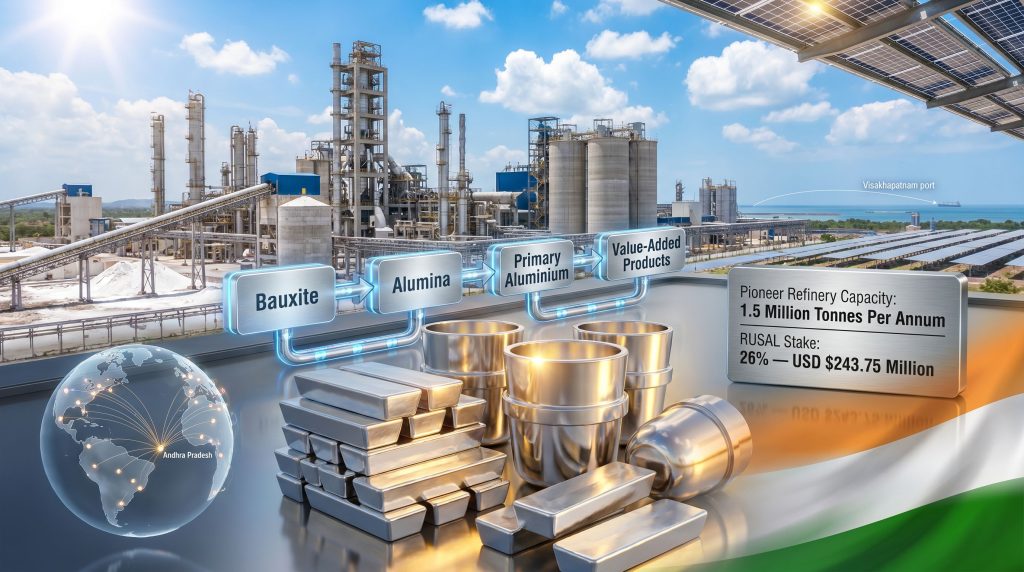
The aluminium value chain moves through four distinct stages: bauxite ore extraction, alumina refining, primary aluminium smelting, and value-added downstream fabrication. Each step multiplies the economic return per unit of input material, but the largest single leap in captured value occurs at the smelting stage, where alumina is electrochemically reduced into primary aluminium metal through the Hall-Heroult process. A region that refines alumina but exports it before smelting surrenders that value to whoever operates the smelter, wherever in the world that facility happens to be located.
This is precisely the industrial logic driving Andhra Pradesh's engagement with one of the world's most significant global aluminium producers, and why the Andhra Pradesh RUSAL aluminium smelter investment conversation carries implications well beyond a single bilateral meeting.
When big ASX news breaks, our subscribers know first
Understanding the Economics: What Stays on the Table When Alumina Leaves the State
The Revenue Gap Between Alumina and Primary Aluminium
The financial case for domestic smelting is straightforward when the numbers are laid out. Metallurgical-grade alumina typically trades on international markets at a fraction of the price of primary aluminium ingot. The smelting conversion process, which requires approximately 1.9 to 2.0 tonnes of alumina to produce one tonne of primary aluminium, transforms a bulk commodity into a traded industrial metal commanding a substantially higher per-tonne price.
When a region exports alumina rather than primary aluminium, it forfeits not only the margin difference between the two products but also the employment multiplier, the energy value-add, the logistics revenue, and the downstream fabrication opportunities that flow from having a smelter operating locally. For a state like Andhra Pradesh, which already hosts a 1.5 million tonne per annum alumina refinery through Pioneer Aluminium Industries, the arithmetic of co-located smelting capacity becomes a compelling industrial policy argument.
India's Aluminium Supply-Demand Structure in 2026
India's aluminium sector is experiencing a structural tension between strong domestic demand growth and an uneven distribution of processing capacity along the value chain. Demand is being pulled upward by several converging forces:
- Rapid expansion in passenger vehicle production and the accelerating shift toward aluminium-intensive electric vehicle architectures
- Growth in power transmission infrastructure, where aluminium conductors are preferred over copper for long-distance overhead lines due to their weight-to-conductivity ratio
- Construction sector activity driven by urbanisation, where aluminium curtain wall systems, window frames, and roofing products are increasing in adoption
- Defence and aerospace procurement programmes that specify aerospace-grade aluminium alloys
- Advanced manufacturing sectors requiring precision aluminium components
India's domestic smelting capacity has not expanded at the same pace as its refining output or its downstream consumption. This creates a structural import dependency for primary aluminium that represents both an economic cost and a strategic vulnerability. Consequently, states that can attract smelting investment address this gap at the regional level while contributing to national supply security.
The RUSAL Presence in Andhra Pradesh: A Foundation Already Laid
Pioneer Aluminium Industries and the March 2025 Stake Acquisition
The foundation of the current smelter discussion was established in March 2025, when RUSAL acquired a 26% equity stake in Pioneer Aluminium Industries for USD $243.75 million. This transaction gave one of the world's largest aluminium producers a direct ownership position in a major Indian alumina refinery, with a contractual pathway to increase that holding to 50% in stages.
Pioneer Aluminium Industries operates a metallurgical-grade alumina refinery in Anakapalli district, Andhra Pradesh, with an annual production capacity of 1.5 million tonnes. The facility supplies both domestic Indian customers and export markets, positioned approximately 75 kilometres from the deep-water port facilities at Visakhapatnam, which provides direct maritime access for international shipments.
For RUSAL, the Pioneer stake serves a clear strategic function: securing a reliable, cost-competitive upstream alumina supply outside its existing operational footprint. RUSAL's global model is built around vertical integration, controlling the full chain from bauxite mining through to aluminium production and downstream supply. Adding a significant alumina source in South Asia reduces the company's dependency on third-party alumina procurement and strengthens its supply chain resilience. This type of aluminium industry investment reflects a broader trend among major producers seeking to lock in upstream supply security.
| Metric | Detail |
|---|---|
| Pioneer refinery location | Anakapalli district, Andhra Pradesh |
| Alumina production capacity | 1.5 million tonnes per annum |
| RUSAL stake acquired | 26% (March 2025) |
| Acquisition cost | USD $243.75 million |
| Option to increase stake | Up to 50% in stages |
| Distance to Visakhapatnam port | Approximately 75 km |
| RUSAL global employees | 90,000+ |
| RUSAL countries of operation | 20+ |
The SPIEF 2026 Meeting and What Was Actually Proposed
In June 2026, on the sidelines of the St. Petersburg International Economic Forum, Andhra Pradesh's Minister for Education, IT and Electronics, Nara Lokesh, met with senior RUSAL officials to discuss the next phase of the company's engagement with the state. The forum, which functions as a platform for high-level bilateral industrial and economic discussions, provided the context for Andhra Pradesh to table a formal proposal.
The proposal centred on establishing aluminium smelting capacity adjacent to the existing Pioneer alumina refinery, creating an operationally integrated facility where alumina produced on-site would be converted directly into primary aluminium rather than being exported in semi-processed form. The state government's position was that such an arrangement would generate measurable economic returns through value addition, employment creation, and expanded export revenue.
Critical Distinction: As of June 2026, no confirmed smelter investment has been announced. RUSAL's stated position was that it would evaluate the proposals discussed at the meeting and explore opportunities to expand its presence in the state. The company's only confirmed operational commitment in Andhra Pradesh remains the 26% refinery stake in Pioneer Aluminium Industries.
RUSAL officials also provided updates on the company's broader Indian operations and its long-term interest in India's metals and manufacturing growth trajectory, but this falls short of a binding investment commitment on the smelter question.
Why Co-Location Creates a Structural Advantage Over Standalone Smelters
Operational and Logistical Benefits of Integrated Refinery-Smelter Facilities
The industrial logic of placing a smelter adjacent to an alumina refinery is well-established in global aluminium production. When both facilities share a site or are connected by short-distance conveyor or pipe infrastructure, the operational and financial benefits are significant:
- Elimination of bulk alumina transport costs, which for sea freight can represent a meaningful proportion of the final product cost
- Reduction in material handling losses and contamination risks that arise during loading, shipping, and unloading of bulk alumina
- Thermal integration opportunities where waste heat from one process can be recovered and utilised in adjacent operations
- Shared infrastructure costs for power supply, water treatment, road access, and worker facilities
- Supply chain simplification that reduces the number of contractual counterparties and logistical variables in the production system
The Pioneer refinery's proximity to Visakhapatnam's deep-water port infrastructure adds a further layer of advantage. Primary aluminium produced at a co-located smelter could be exported directly through existing port facilities, reaching international markets without the need for costly inland transport to separate shipping terminals.
Energy: The Critical Variable in Smelter Economics
Aluminium smelting is one of the most energy-intensive industrial processes in the global manufacturing economy. The electrolytic reduction of alumina through the Hall-Heroult process consumes approximately 13 to 15 kilowatt-hours of electricity per kilogram of aluminium produced, making the cost and carbon intensity of the power source the single most important variable in smelter economics and competitiveness.
This is where Andhra Pradesh's renewable energy ambitions become directly relevant to the smelter discussion. The state has been actively developing solar and wind capacity, and renewable-powered mining and smelting operations are increasingly central to competitive industrial strategy. A smelter powered substantially by renewable electricity would produce what the global aluminium industry increasingly classifies as low-carbon or green metals production, carrying a meaningful market premium in automotive, aerospace, and packaging supply chains where original equipment manufacturers face growing pressure to reduce embodied carbon.
RUSAL itself has built a global competitive position partly around its hydropower-based smelting operations in Siberia, which produce aluminium with a relatively low carbon footprint compared to coal-fired competitors. Replicating that low-carbon positioning in India using Andhra Pradesh's renewable energy resources would align with both RUSAL's commercial brand and the state's industrial development objectives.
RUSAL's Global Strategy and the India Opportunity
Comparing the Andhra Pradesh Approach to RUSAL's Broader Expansion Model
| Strategic Element | Andhra Pradesh Approach | RUSAL's Broader Global Model |
|---|---|---|
| Entry mechanism | Minority stake acquisition at refinery level | Greenfield, joint ventures, and acquisitions |
| Integration goal | Alumina supply security plus potential smelter | Full value chain from bauxite to aluminium |
| Host engagement | State-level ministerial diplomacy | Multi-government and multilateral frameworks |
| Low-carbon angle | Renewable energy potential in AP | Hydropower-driven smelting in Siberia |
| Current commitment | Exploratory (smelter); confirmed (refinery stake) | Operational across 20+ countries |
India represents a strategically significant long-term growth market for RUSAL for reasons that extend beyond the Pioneer investment. As one of the fastest-growing major economies globally, India's aluminium consumption per capita remains well below levels seen in comparable industrial economies, meaning the demand runway is substantial. A deeper operational presence in India, anchored by smelting capacity, would give RUSAL a foothold in one of the most important growth markets of the coming decade while simultaneously supplying its global customer base from a geographically diversified production base. Furthermore, this strategy aligns closely with broader energy transition metals demand trends that are reshaping global industrial investment priorities.
Risks and Challenges That Will Shape the Investment Decision
Geopolitical, Regulatory, and Sanctions Considerations
The Andhra Pradesh RUSAL aluminium smelter investment relationship operates within a complex geopolitical environment. RUSAL's ownership structure and its connection to Russian industrial interests have been a source of international attention in the context of Western sanctions regimes introduced since 2022. India has maintained an independent foreign policy stance and has not adopted these sanctions, which creates the legal basis for continued bilateral commercial engagement.
However, Indian state governments and private sector partners operating in internationally exposed industries must navigate the reputational and banking relationship dimensions of working with RUSAL-affiliated entities. India's foreign investment regulatory framework for strategic industrial assets, including aluminium smelting infrastructure, also introduces a central government dimension to what has thus far been a state-level discussion.
Feasibility Hurdles That Cannot Be Overlooked
Beyond the geopolitical dimension, several practical feasibility considerations will determine whether the smelter proposal advances:
- Power supply at scale: A mid-scale smelter of 500,000 tonnes per annum capacity would require several gigawatts of dedicated power supply. Securing competitive, reliable renewable power purchase agreements at this scale in Andhra Pradesh is achievable in principle but requires significant grid infrastructure and regulatory alignment.
- Water availability: Aluminium smelting requires substantial water for cooling and other process functions. Environmental compliance obligations around water use and waste management are increasingly stringent.
- Timeline realism: From feasibility study completion through environmental approvals, engineering, procurement, construction, and commissioning, greenfield smelter projects of this scale typically require five to eight years and capital expenditure measured in billions of dollars.
- Global aluminium price dynamics: Smelter project economics are sensitive to the LME aluminium price. Periods of price weakness can render marginal smelting projects economically unviable during their planning and construction phases.
Competitive Landscape for Indian Primary Aluminium
A new smelter in Andhra Pradesh would also enter a domestic market where established producers, notably Hindalco Industries and Vedanta's BALCO operations, have existing capacity and customer relationships. The competitive response from incumbent producers, pricing dynamics in the domestic market, and the evolving structure of India's aluminium import tariff framework would all factor into the investment calculus.
Speculative Note: Some industry observers have suggested that if RUSAL exercises its option to increase its Pioneer stake toward 50%, this would signal a materially deeper commitment to the Indian market and could be interpreted as a precursor to a more formal smelter feasibility announcement. The stake option exercise would be a meaningful leading indicator to monitor.
The next major ASX story will hit our subscribers first
What a Hypothetical Smelter Would Mean in Practical Terms
Illustrative Scale and Economic Impact
To understand the potential magnitude of the smelter proposal, consider a hypothetical mid-scale facility with an annual production capacity of approximately 500,000 tonnes of primary aluminium. Such a facility would:
- Consume roughly 950,000 to 1,000,000 tonnes of alumina annually, representing a substantial portion of Pioneer's 1.5 million tonne refinery output
- Require a dedicated workforce of several thousand direct employees for smelting operations, maintenance, and management functions
- Generate downstream employment in fabrication, logistics, port operations, and supporting services that typically multiplies the direct employment figure
- Produce primary aluminium that could supply domestic Indian manufacturers directly or be exported as ingot, billet, or further processed into rolled or extruded products
This scenario is illustrative only and does not reflect any announced project specifications, confirmed timelines, or committed investment figures.
Key Signals to Monitor as This Story Develops
Indicators That Would Signal Progression
For those tracking the Andhra Pradesh RUSAL aluminium smelter investment discussion, several specific developments would indicate meaningful forward movement:
- Announcement of a formal feasibility study by RUSAL, Pioneer Aluminium Industries, or a jointly constituted study team
- RUSAL's exercise of its option to increase its Pioneer stake beyond 26% toward the 50% ceiling
- Power purchase agreement discussions or renewable energy procurement announcements linked to potential smelting load requirements
- Any central government policy signal regarding foreign direct investment in aluminium smelting infrastructure
- Environmental pre-assessment or site selection announcements for smelting infrastructure in Anakapalli district
The Broader Industrial Policy Signal
Even in its current exploratory form, the Andhra Pradesh-RUSAL smelter discussion is significant as a signal of how Indian states are reorienting their industrial development strategies. The shift from raw material and semi-processed commodity export toward integrated manufacturing ecosystems that capture maximum domestic value from natural resources reflects a maturing approach to industrial policy.
If the smelter ultimately proceeds, Andhra Pradesh would establish a replicable model for aluminium value chain integration that other resource-holding Indian states could seek to emulate. The state's combination of an existing world-scale alumina refinery, deep-water port access, renewable energy capacity, and proactive investment attraction posture creates a genuinely competitive environment for this type of capital-intensive project.
The conversation between Andhra Pradesh and RUSAL is, at its core, about whether India is ready to stop selling the ingredient and start selling the product. The economic case for doing so has never been stronger, and the infrastructure foundations in Andhra Pradesh are already partially in place.
This article contains forward-looking analysis and illustrative scenarios. It does not constitute financial or investment advice. Readers should conduct independent research before making any investment decisions. All figures and facts are sourced from publicly available information as of June 2026.
Want to Track the Next Major Mineral Discovery Before the Market Does?
Discovery Alert's proprietary Discovery IQ model delivers real-time alerts on significant ASX mineral discoveries, transforming complex data across 30-plus commodities into clear, actionable insights for both short-term traders and long-term investors — explore the historic returns major discoveries have generated and begin your 14-day free trial at Discovery Alert to position yourself ahead of the broader market.