June 8, 2026
The Hidden Architecture Behind OPEC+ Supply Decisions: Why 188,000 BPD Tells Only Half the Story
Global oil markets have spent decades adjusting to the rhythms of coordinated producer behaviour, yet the mechanics driving those rhythms remain poorly understood outside specialist circles. Most coverage focuses on the headline number announced after each OPEC+ meeting, treating it as a simple dial that gets turned up or down in response to price conditions. The reality is considerably more layered.
What the alliance actually manages is a multi-tiered system of overlapping commitments, reversibility clauses, compliance obligations, and geopolitical constraints that interact in ways that can make the announced figure genuinely misleading as a guide to real-world supply additions.
The OPEC+ July oil output increase of 188,000 barrels per day, agreed upon by seven member nations during a virtual meeting in early June 2026, is best understood not as a simple production decision but as one data point inside a far more complex strategic architecture. To understand what it actually means for crude prices, energy importers, and global market equilibrium, it is necessary to examine the system producing it.
When big ASX news breaks, our subscribers know first
Understanding Voluntary Production Adjustments: The Two-Layer Framework
A voluntary production adjustment is a self-imposed output reduction agreed to by individual OPEC+ members beyond the group's standard quota obligations. These mechanisms can be returned to the market gradually, paused, or reversed entirely depending on demand conditions and compliance performance across the membership.
What makes the current cycle structurally distinct from previous OPEC+ unwind episodes is the existence of two separate layers of voluntary adjustments operating simultaneously:
-
The April 2023 layer: A set of additional voluntary reductions announced by several key members, forming the primary tranche now being unwound through the phased monthly quota increases running from April through at least July 2026.
-
The November 2023 layer: A secondary set of voluntary adjustments announced later in 2023, which remain in place as a separate commitment. The July 2026 decision explicitly reaffirms that the reversibility option extends to this layer as well, meaning OPEC+ retains the right to unwind, pause, or reinstate these cuts independently of the April 2023 unwinding timeline.
Conflating these two layers is one of the most common analytical errors in market commentary. The April 2023 layer is currently being systematically returned to the market through the monthly hike sequence. The November 2023 layer is not being unwound at this stage and represents a separate reservoir of potential future supply that OPEC+ can deploy or withhold depending on conditions.
Furthermore, understanding the OPEC influence on oil markets helps contextualise why the alliance structures its decisions in this deliberately layered fashion.
Key distinction: The July 2026 decision applies specifically to the April 2023 voluntary adjustments. The November 2023 adjustments remain separately managed and have not entered the unwinding cycle, giving the alliance a significant additional supply lever that is not reflected in current monthly quota announcements.
Breaking Down the July 2026 Production Decision
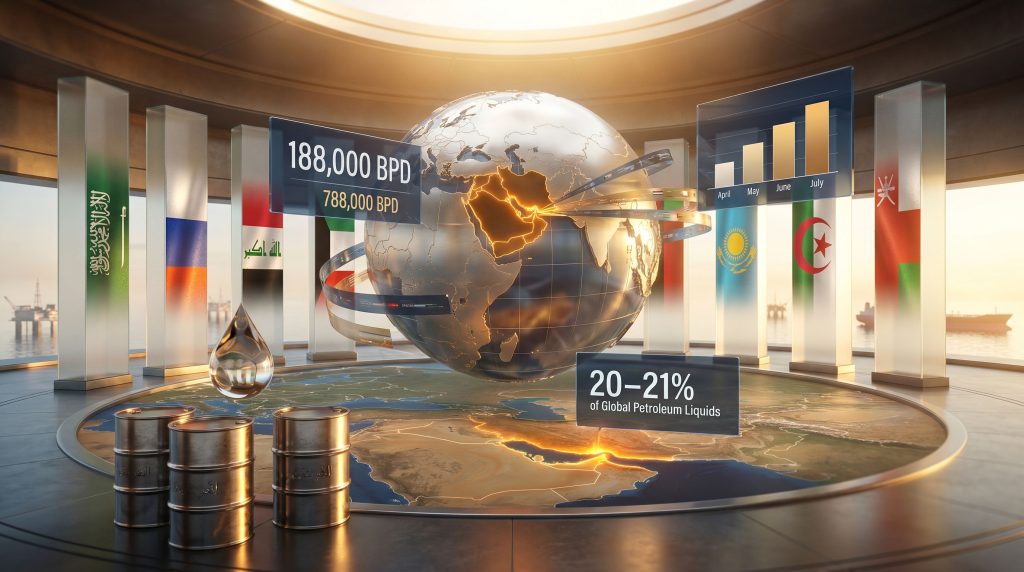
The seven nations involved in the OPEC+ July oil output increase are Saudi Arabia, Russia, Iraq, Kuwait, Kazakhstan, Algeria, and Oman. Their combined quota target rises by 188,000 bpd beginning in July 2026, matching the pace set in June and marking the fourth consecutive monthly increase under the current unwinding program.
Monthly Hike Trajectory: April Through July 2026
| Month | Agreed Increase (bpd) | Notable Context |
|---|---|---|
| April 2026 | 206,000 | Initial unwinding pace established |
| May 2026 | 206,000 | Rate maintained from April |
| June 2026 | 188,000 | Adjusted following UAE framework exit |
| July 2026 | 188,000 | Fourth consecutive hike; mirrors June |
The step-down from 206,000 bpd to 188,000 bpd in June was not a response to weakening demand signals or price concerns. It reflected a structural change in the participating membership, specifically the UAE's exit from this particular voluntary adjustment framework. The consistency between June and July suggests a deliberate and pre-planned unwinding cadence rather than reactive month-to-month recalibration.
Across the four-month period from April through July 2026, the cumulative quota restoration from these seven members reaches approximately 788,000 bpd. That figure represents a substantial portion of the voluntary reductions originally implemented under the April 2023 announcements, though the precise total involves complex calculations across different baseline periods and individual member adjustments.
The 188,000 BPD vs. 411,000 BPD Gap: What It Signals About Internal Dynamics
Reports circulating around the June 2026 meeting referenced an alternative scenario involving an increase of approximately 411,000 bpd, with speculation about an even larger so-called super-hike figure beyond that level. According to CNBC, OPEC+ members had seriously considered hiking July output by the full 411,000 barrels per day before settling on the more measured figure. The existence of this gap is not a data discrepancy. It reflects genuine internal OPEC+ tension between the measured, consensus-driven approach preferred by core Gulf producers and the more aggressive volume-restoration pressure driven by compliance politics.
| Scenario | Volume | Primary Driver | Market Implication |
|---|---|---|---|
| Confirmed Base Decision | 188,000 bpd | Consensus among seven members | Moderate bearish drift on crude benchmarks |
| Alternative Scenario | 411,000 bpd | Broader membership, compliance pressure | More significant downward price pressure |
| Super-Hike Territory | >411,000 bpd | Punitive response to compliance failures | Near-term price shock potential |
| Pause or Full Reversal | 0 bpd | Demand deterioration or geopolitical shock | Bullish price recovery |
Three Forces Driving the Phased Unwinding Timeline
1. The Compliance Deficit Problem
Perhaps the most underappreciated dimension of the current OPEC+ cycle is the role of compensation obligations in shaping the production landscape. Members that have produced above their agreed quota ceilings since January 2024 are formally required to submit compensation plans and execute offsetting production reductions to make up for past overproduction.
Kazakhstan is the most prominent example of a persistent compliance challenge. The country's overproduction is not primarily a political choice but a contractual and technical reality. Production at major fields, including Tengiz, is governed by long-term agreements with international oil companies whose operational obligations cannot be easily adjusted in response to OPEC+ quota decisions made in Riyadh or Vienna. This creates a structural compliance gap that political pressure alone cannot close.
The compensation window has been formally extended to December 2026, establishing a clear accountability deadline. Critically, because compensation cuts by overproducing members offset a portion of the headline quota increases, the net supply addition reaching global markets from the July decision may be materially smaller than the 188,000 bpd figure implies. Analysts who treat the announced hike as a direct proxy for incremental market supply are consequently likely overstating the bearish impact.
2. Alliance Credibility Management
The Joint Ministerial Monitoring Committee (JMMC) framework serves as both a compliance enforcement mechanism and a market signalling platform. The reaffirmation of the Declaration of Cooperation embedded in each monthly decision is not merely ceremonial. It communicates to markets that OPEC+ views the current unwinding as a structured, conditional process rather than a capitulation to volume-over-price pressure.
The incremental approach, releasing supply in measured monthly tranches rather than through a single large adjustment, is specifically designed to prevent the kind of market disruption that occurred during the 2020 price war. By keeping each increment small relative to total global liquids supply of approximately 100 million bpd, the alliance attempts to ensure absorption without triggering momentum-driven selling. The OPEC meeting production impact on global benchmarks has historically been most acute when this incremental discipline breaks down.
3. Gulf Producer Fiscal Dynamics
Saudi Arabia and other GCC members face an uncomfortable arithmetic. Their fiscal breakeven oil price requirements, broadly estimated in the $70 to $90 per barrel range depending on individual national budgets and government spending commitments, create competing incentives between defending prices through restraint and recovering market share through volume growth.
Vision 2030-era economic diversification programs in Saudi Arabia have reduced but not eliminated the kingdom's dependence on oil revenue. This means Riyadh still carries a strong incentive to prevent crude from falling sharply below fiscal breakeven levels, which in turn sets a practical floor on how aggressively the full unwind can be accelerated.
The Strait of Hormuz Variable: Why Paper Quotas and Physical Supply Have Diverged
One of the most consequential and least discussed aspects of the current cycle is the disconnect between announced quota increases and actual physical oil delivery to global markets. The Strait of Hormuz, through which approximately 20 to 21% of global petroleum liquids flow under normal operating conditions, has been subject to a blockade that constrains the physical realisation of barrel additions regardless of what quota decisions are announced on paper.
This creates a paradox: OPEC+ is technically expanding production allowances while real-world supply additions remain limited by transit disruption. For market participants focused on physical balances rather than paper quota arithmetic, this distinction is critical. In addition, the broader trade war oil impact has further complicated demand forecasting, making it harder for producers to calibrate the pace of their supply releases.
Tail risk scenario: If Strait of Hormuz transit normalises while OPEC+ quota increases remain in place, global markets could face a compressed supply surge in which multiple months of withheld quota volumes materialise simultaneously. This non-linear release dynamic is not well captured by standard monthly supply forecasting models and represents a meaningful downside price risk largely absent from current consensus estimates.
The three divergent pathways are:
-
Gradual reopening: Barrels re-enter markets incrementally and are absorbed by concurrent demand growth without triggering significant price disruption.
-
Rapid normalisation: Months of accumulated paper barrel allowances flood the physical market simultaneously, producing a sharp downward correction in Brent and WTI benchmarks.
-
Extended blockade: Physical supply remains restricted while OPEC+ quotas continue expanding on paper, creating an artificial tightness premium in spot prices that masks the underlying trajectory of production growth.
Simultaneously, Iranian oil exports have fallen to their lowest level in six years, according to shipping data reported by Zawya. This reduction in effective Iranian supply partially offsets the quota additions being announced by the seven-member group, complicating the net market supply picture considerably. The geopolitical oil price analysis surrounding these transit risks remains one of the most closely watched variables among energy traders.
Stakeholder Exposure: Who Gains, Who Bears Risk
| Stakeholder Group | Impact of 188,000 bpd Confirmed Increase | Impact of 411,000 bpd Alternative Scenario |
|---|---|---|
| Oil-importing emerging markets | Moderate price relief, improved trade balances | Stronger relief, reduced import cost burden |
| GCC producer economies | Marginal revenue impact; volume gain partially offsets price softness | Elevated fiscal risk if prices fall sharply |
| Non-OPEC producers (US shale, Canada) | Competitive pressure on marginal-cost barrels | Increased strain on higher-cost production |
| Global aviation and shipping | Modest fuel cost reduction | More substantial operating cost improvement |
| Energy transition investors | Reduced oil price spike narrative | Accelerated cost-competitiveness of renewable alternatives |
The next major ASX story will hit our subscribers first
Is Internal Discipline Eroding? Reading the Compliance Signals
OPEC+ cohesion stress indicators have become more visible in the 2025 to 2026 cycle than at any point since the 2020 price war. The persistence of Kazakh overproduction, the UAE's exit from the specific voluntary adjustment framework, and the emergence of a 411,000 bpd alternative scenario in pre-meeting discussions all point to growing centrifugal pressure within the alliance.
However, the retention of full reversibility rights represents what might be described as the alliance's built-in strategic escape valve. OPEC+ has formally reserved the authority to increase, pause, or completely reverse the unwinding of voluntary adjustments at any point. This is not rhetorical flexibility — the mechanism has been exercised repeatedly since 2020, including the surprise cuts announced in April 2023 that created the very layered structure now being unwound.
Markets have increasingly begun pricing in the probability of future reversal rather than treating each announced monthly hike as a firm and irreversible supply commitment. This shift in market psychology, where the optionality embedded in OPEC+ decisions is priced alongside the decision itself, is a relatively recent development in how traders and analysts approach the group's monthly outputs. WTI and Brent futures markets have begun reflecting this optionality more explicitly in their pricing structures.
Forward Scenarios: Three Pathways Through End-2026
| Scenario | Key Trigger | Oil Price Implication |
|---|---|---|
| Continued gradual unwind (~188,000 bpd/month) | Stable demand, improving compliance | Moderate bearish drift supported by geopolitical risk premium |
| Accelerated unwind (411,000+ bpd) | Compliance breakdown or market share contest | Sharper price correction; pressure on high-cost producers |
| Pause or reversal | Demand shock or Strait normalisation surge | Bullish price recovery; alliance credibility reinforced |
The December 2026 compensation deadline is the most important near-term inflection point to monitor. If overproducing members, particularly Kazakhstan, fail to demonstrate credible compensation execution by mid-Q4 2026, the probability of an accelerated or punitive hike scenario increases materially. Conversely, demonstrated compliance improvement would support the gradual unwinding pathway and reduce the risk of a disorderly supply release.
The broader geopolitical overlay, including the trajectory of US-Iran diplomatic engagement and its potential to alter both Iranian export capacity and Gulf producer strategic calculations, adds further uncertainty to any end-2026 supply forecast. According to the official OPEC communiqué, the alliance has consistently reaffirmed its commitment to market stability throughout this unwinding cycle. What is clear is that the OPEC+ July oil output increase of 188,000 bpd is far less a definitive supply statement than it is a carefully calibrated signal within a system designed to preserve maximum flexibility for the months ahead.
This article is intended for informational purposes only and does not constitute financial or investment advice. Oil market forecasts involve significant uncertainty, and actual supply and price outcomes may differ materially from the scenarios described. Readers should conduct independent research before making investment decisions.
Want to Track the Investment Opportunities Emerging From Global Energy Market Shifts?
Discovery Alert's proprietary Discovery IQ model delivers real-time alerts on significant ASX mineral discoveries, instantly translating complex market data into actionable investment opportunities — whether you're a short-term trader or a long-term investor. Explore historic discoveries and their remarkable returns to understand the potential, and begin your 14-day free trial today to position yourself ahead of the market.