June 8, 2026
The Hidden Fragility of Gulf Export Infrastructure Beyond Hormuz
Most conversations about oil supply risk in the Middle East default to a single geographic chokepoint: the Strait of Hormuz. Roughly one-fifth of global oil supply transits through this narrow waterway, and its vulnerability has been extensively documented across decades of geopolitical analysis. Yet this framing creates a blind spot. It conditions markets, procurement teams, and risk analysts to treat infrastructure sitting outside the Strait as structurally safer, when in reality, the threat landscape has shifted in ways that challenge that assumption entirely.
The events of early June 2026 at Oman's primary crude export gateway offered a sharp illustration of how quickly that assumption can unravel. The Oman Mina al Fahal oil loading suspension, triggered by an explosion near the terminal's offshore mooring infrastructure, sent ripples through Asian trading sessions and forced a rapid reassessment of what counts as a protected asset in today's Gulf energy environment.
When big ASX news breaks, our subscribers know first
Why Mina al Fahal Carries Outsized Strategic Weight
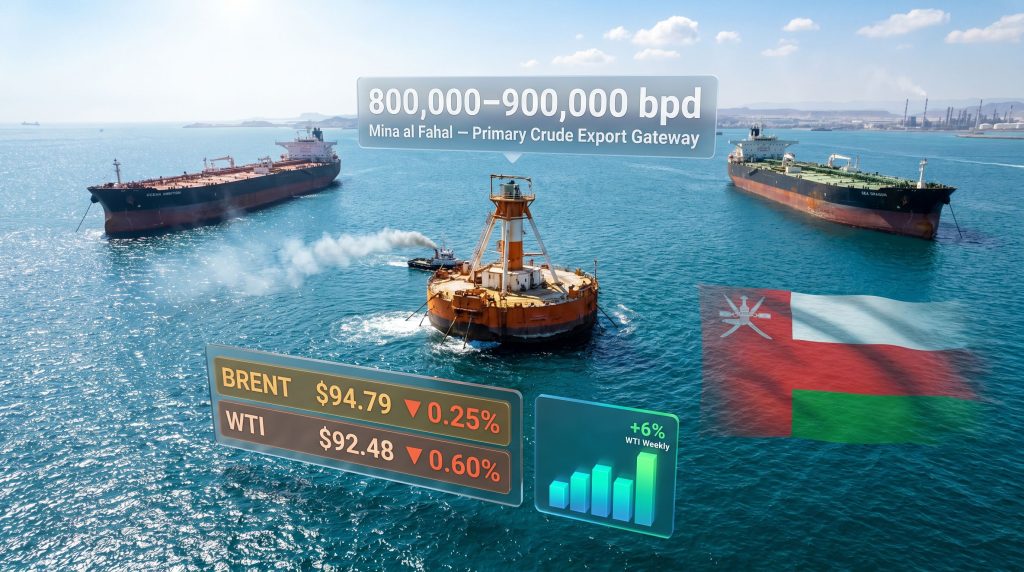
Mina al Fahal is not simply one terminal among many. Operated by Petroleum Development Oman (PDO), it functions as the primary gateway through which Oman delivers between 800,000 and 900,000 barrels per day (bpd) of crude oil to international markets. That volume alone places it among the most significant crude export facilities in the broader Gulf region, even as it operates with considerably less geopolitical coverage than Saudi Aramco's Ras Tanura or Abu Dhabi's export infrastructure.
Its position outside the Strait of Hormuz has historically been treated as a strategic advantage. During periods when Hormuz traffic has been constrained, buyers who are exposed to rerouting risks naturally seek supply from terminals with clear, unimpeded sea lanes. Mina al Fahal has filled that role, funnelling Omani crude predominantly toward Asian refiners in China, India, Japan, and South Korea. Furthermore, geopolitical oil price risks in the region have increasingly challenged the assumption that distance from Hormuz confers meaningful protection.
How Single-Buoy Mooring Systems Create a Security Paradox
The terminal relies on single-buoy mooring (SBM) infrastructure, an offshore floating buoy system that enables very large crude carriers (VLCCs) and supertankers to load crude without entering a conventional port berth. This architecture is essential for handling the scale of vessels that dominate Asian crude trade routes, but it introduces a security paradox that is rarely discussed in mainstream energy coverage.
Unlike onshore tank farms, pipeline corridors, or hardened port facilities, SBM systems sit exposed in open water. They cannot be fortified in the same manner as land-based infrastructure, and continuous maritime surveillance of offshore buoy systems requires significant naval resources. A disruption to even a single SBM berth has the capacity to halt loading operations across multiple vessels simultaneously, creating a paralysis effect disproportionate to the physical size of the damaged component.
The efficiency that makes SBM systems operationally attractive for large-vessel loading is precisely the characteristic that makes them structurally difficult to defend against standoff threats such as drone strikes or waterborne explosive devices.
Following the explosion near the mooring berths in early June 2026, multiple supertankers were observed anchored offshore, unable to complete loading. This pattern of vessel congregation is itself a market signal, as tanker AIS (Automatic Identification System) tracking data can reveal terminal disruptions before any official statement is issued. Informed traders and procurement desks with access to real-time vessel movement data would have registered the anomaly before public reporting confirmed it.
A Chronology of the Disruption and Immediate Price Response
The sequence of events illustrates how quickly official communications can shift market direction, but also how incomplete that reassurance can be.
| Date / Time | Event |
|---|---|
| June 4-5, 2026 | Explosion reported near Mina al Fahal's SBM berths; crude loading suspended |
| June 5, 2026 (early) | Multiple sources confirm loading suspension to Reuters |
| June 5, 2026 (morning) | PDO issues statement confirming operations proceeding normally |
| June 5, 2026 (0704 GMT) | Brent crude at $94.79/barrel, down 0.25% following PDO clarification |
| June 5, 2026 | WTI at $92.48/barrel, down 0.6% on the day |
Despite the PDO statement, prices did not fully reverse course. Both benchmarks remained under modest downward pressure throughout the session, reflecting what can be described as residual uncertainty pricing rather than restored confidence. Critically, both Brent and WTI were still on track for their first weekly gain in three weeks, with WTI up more than 6% on the week. These oil price movements had little to do with Mina al Fahal specifically. They were the product of a broader Middle East risk premium that had been accumulating as US-Iran peace negotiations stalled and Hormuz traffic remained constrained.
Several key facts remained officially unconfirmed in the aftermath:
- The precise cause of the explosion and whether it was deliberate
- The extent of any structural damage to SBM berths
- The full duration of the loading suspension before normal operations resumed
- Whether any specific vessel cargo schedules were materially impacted
The absence of these confirmations is itself analytically significant. In normal operating environments, terminal operators provide granular incident reports. The information vacuum following the Mina al Fahal explosion suggests the situation was more complex than a routine mechanical failure.
The Compounding Risk Stack Surrounding the Incident
Analysing the Oman Mina al Fahal oil loading suspension in isolation would produce a distorted picture. The incident occurred within a layered risk environment that had been building pressure across multiple fronts simultaneously.
Iranian Export Collapse and Hormuz Constraints
Iranian crude exports had fallen to their lowest level in six years by the time of the Mina al Fahal incident, driven primarily by a US naval blockade. Weak demand from Chinese buyers had further depressed pricing for Iranian grades, removing a volume buffer that had historically allowed markets to absorb Gulf supply disruptions with more flexibility.
Hormuz traffic itself remained limited, meaning the one-fifth of global oil supply that transits the strait was already operating under constrained conditions. Mina al Fahal's outside-the-Strait positioning, which should have made it a relief valve in this scenario, instead placed it under greater strategic importance and, consequently, greater scrutiny as a potential target.
The Lebanon Ceasefire Deadlock
Simultaneously, Hezbollah's rejection of a US-brokered ceasefire agreement added a diplomatic deadlock layer to the conflict picture. Iran had explicitly made a Lebanon ceasefire a condition for any broader peace arrangement with Washington, creating a diplomatic interdependency that prevented resolution on any single front. US President Donald Trump expressed a belief that progress was being made between Israel and Lebanon, but that assessment remained contested by events on the ground.
IG market analyst Tony Sycamore characterised the trading environment as heavily clouded by a tangled web of competing headlines, and noted that from a technical standpoint, WTI crude's risk profile remained skewed to the upside as long as prices held above trendline support in the low $80s range. That framing captures an important dynamic: markets were not simply pricing specific events, but rather building a structural premium into crude prices to reflect the unpredictability of the information environment itself. In addition, the trade war impact on oil markets had already introduced significant volatility into pricing dynamics ahead of this incident.
OPEC's Demand Confidence Versus Supply Uncertainty
OPEC's market influence remained a stabilising force, with Secretary General Haitham Al Ghais reaffirming the organisation's oil demand growth forecast of 1.2 million bpd for 2026 despite the regional conflict environment and Hormuz closure. This position signals that OPEC views current disruptions as temporary and does not expect demand-destructive outcomes. However, analysts had separately flagged declining global oil inventories as a structural vulnerability that could amplify any supply interruption into a sharper price spike, particularly in Q3 2026.
Furthermore, OPEC demand forecasts suggest the organisation maintains confidence in long-term consumption growth, even as near-term supply risks mount.
When inventory buffers are thin, even a 24 to 48-hour suspension of 800,000 to 900,000 bpd of export capacity can create a material near-term supply gap for Asian refiners with high Omani crude dependency. The price response would not be proportional to the duration of the disruption; it would be proportional to how full storage tanks are at the moment it occurs.
Scenario Analysis: Three Outcome Pathways and Price Implications
| Scenario | Description | Estimated Brent Impact |
|---|---|---|
| Contained Incident | Minimal SBM damage; operations fully restored within 24-48 hours | Neutral to -$1 to -$2/barrel (relief selling) |
| Sustained Disruption | SBM berths require repair; loading suspended 1-2 weeks | +$3 to +$6/barrel premium on Omani crude grades |
| Escalation Signal | Incident confirmed as deliberate attack; further Gulf infrastructure targeted | +$8 to +$15/barrel broad market risk premium |
Market pricing in the hours following the PDO statement appeared to sit between the Contained and Sustained scenarios, with residual uncertainty preventing a full return to pre-incident levels.
What This Means for Asian Crude Procurement Strategy
For Asian refiners, the Mina al Fahal disruption raises questions that extend well beyond a single operational incident. Oman's crude grades, particularly Oman Blend, serve as a benchmark for Gulf crude pricing in Asian markets and are directly referenced in pricing formulas used by numerous regional buyers. A sustained disruption to Mina al Fahal loading would not just reduce volumes; it would introduce basis risk into pricing arrangements structured around Omani grades.
Procurement and risk teams monitoring Gulf supply should track the following indicators:
- PDO operational bulletins for SBM berth status and loading schedule updates
- Tanker AIS data around Mina al Fahal, specifically vessel anchoring patterns that precede official disclosure of terminal disruptions
- Brent-Oman crude spread movements as a proxy for the market's assessment of Omani supply risk premium
- US-Iran diplomatic developments, particularly any progress on Lebanon ceasefire negotiations, which carry downstream effects on Hormuz traffic normalisation
- Global inventory reports from the IEA and EIA, which determine how much amplification a supply interruption translates into price movement
It is also worth noting that the March 2026 smoke incident at the Mina Petroleum facility at Salalah Port, a separate Omani terminal, demonstrated that stress on Oman's broader export infrastructure was not a new phenomenon in 2026. The June Mina al Fahal explosion occurred against a backdrop of pre-existing infrastructure vulnerability across multiple Omani export points. Consequently, oil prices edged higher across both benchmark grades as market participants priced in the possibility of further infrastructure incidents.
The next major ASX story will hit our subscribers first
Reclassifying Risk Across Gulf Export Infrastructure
The deeper strategic implication of the Oman Mina al Fahal oil loading suspension is not about the specific incident. It is about the mental models that energy market participants use to categorise infrastructure risk. For years, a quiet consensus held that terminals outside the Strait of Hormuz, and particularly Omani infrastructure given the country's diplomatic neutrality, operated in a lower-risk category than Saudi, Emirati, or Iranian export facilities.
That consensus deserves reassessment. The proliferation of drone technology and waterborne attack capabilities has extended the effective threat radius well beyond the political fault lines that previously defined high-risk zones. Standoff attack vectors do not respect diplomatic neutrality. They respond to strategic value, and Mina al Fahal, handling nearly one million barrels per day of crude destined for some of the world's largest refining economies, represents precisely the kind of strategic value that attracts targeting consideration.
For energy market participants, the practical takeaway is that no Gulf terminal should carry an implicit safety discount in risk modelling frameworks. Every major export facility in the region now requires explicit security assumptions rather than inherited ones.
Disclaimer: This article contains forward-looking scenario analysis and market commentary intended for informational purposes only. It does not constitute financial or investment advice. Price projections and scenario outcomes are speculative and subject to significant uncertainty. Readers should conduct independent analysis before making any investment or procurement decisions.
Want To Stay Ahead of the Next Major Mineral Discovery on the ASX?
While geopolitical disruptions reshape global commodity markets, Discovery Alert's proprietary Discovery IQ model delivers real-time alerts on significant ASX mineral discoveries, turning complex mineral data into actionable investment insights — explore historic discoveries and their extraordinary returns or start your 14-day free trial today to position yourself ahead of the broader market.