July 14, 2026
The Digital Infrastructure Wave Quietly Transforming Aluminium Markets
Every major industrial transition in the past century has created a corresponding shift in materials demand. Steel fed the railway age. Concrete shaped urbanisation. Silicon underpinned the semiconductor revolution. Today, a quieter but structurally significant transition is playing out in the aluminium market, driven not by a single policy or product cycle, but by the relentless physical requirements of digital infrastructure at scale.
The expansion of hyperscale computing, artificial intelligence workloads, and cloud services is generating an enormous and largely underappreciated demand signal for aluminium. This is not a speculative thesis built on policy incentives or consumer trends. It is grounded in the fundamental physics of heat, electricity, and weight that govern how modern data centres are designed, built, and operated. Understanding the full scope of aluminium demand in data centres requires moving well beyond facility-level estimates to capture the broader infrastructure systems that these facilities pull into existence.
When big ASX news breaks, our subscribers know first
Why Data Centres Are Becoming a Defining Force in Global Aluminium Consumption
The Evolution of Aluminium's Demand Landscape
Aluminium's demand history reads as a series of successive adoption waves, each rooted in the metal's unique physical properties. Its early dominance in packaging and transportation reflected advantages in corrosion resistance, formability, and weight reduction. The electrical and electronics sectors followed, capitalising on aluminium's conductivity-to-weight ratio. Then came renewable energy infrastructure and electric vehicles, both of which created fresh, large-scale structural demand that the industry is still absorbing.
The current wave, driven by digital infrastructure, differs in one critical respect: it is not consumer-led. Demand is being generated by the capital expenditure decisions of a relatively small number of hyperscaler companies, cloud service providers, and colocation operators. These entities operate on multi-year investment horizons, deploy capital at extraordinary scale, and have made public commitments to data centre expansion that are largely insulated from short-term economic sentiment.
This makes the resulting aluminium demand more predictable, more durable, and in some respects more structurally significant than demand tied to consumer product cycles. Top aluminium miners are already positioning to capture this structural shift as the demand signal becomes more legible.
The Hidden Multiplier Most Analyses Miss
A persistent methodological gap in how analysts approach this topic is the tendency to measure only the aluminium consumed inside the physical data centre building. This captures cooling systems, server racks, enclosures, power distribution hardware, and structural framing, but it misses a substantial portion of the total aluminium footprint that data centre expansion creates.
The more complete picture includes the external infrastructure that data centre growth requires: grid upgrades, high-voltage transmission lines, substation equipment, and the on-site independent power systems that operators are increasingly building in response to grid connection delays and local electricity capacity constraints. When this external infrastructure is incorporated into the analysis, total attributable aluminium demand is estimated to be three to four times higher than in-facility figures alone suggest.
This distinction is not merely academic. For supply forecasting, investment planning, and product mix decisions across the aluminium value chain, the difference between a one-million-tonne and a three-to-four-million-tonne demand signal has material consequences. Furthermore, Wood Mackenzie analysts have noted that data centre metals demand is fundamentally a grid story rather than an asset story, reinforcing why this external multiplier cannot be ignored.
Internal facility aluminium demand is projected to reach 0.6 to 0.9 million tonnes annually by the early 2030s, with cumulative demand between 2025 and 2030 approaching 1.1 million tonnes. Including grid and power infrastructure, total attributable demand across the same period is estimated to be several times larger, fundamentally repositioning data centres as a top-tier structural demand driver for the aluminium industry.
What Is Driving Aluminium Demand Inside Data Centre Facilities?
Cooling Infrastructure: The Physics Behind the Numbers
The single most aluminium-intensive application within a data centre is thermal management. This is not accidental. Modern server hardware, particularly the graphics processing units (GPUs) and application-specific integrated circuits (ASICs) used for AI inference and training workloads, generates heat densities that would have been considered extreme by data centre standards just a decade ago. Managing this thermal output is the dominant engineering challenge in contemporary facility design.
Aluminium is exceptionally well-suited to this challenge. Its thermal conductivity, typically around 160 to 205 W/m·K depending on alloy composition, allows it to transfer heat rapidly away from heat-generating components. More practically, aluminium can be extruded into complex fin geometries that dramatically increase the effective surface area available for heat dissipation.
A well-designed aluminium heat sink with closely spaced fins can achieve surface areas many times greater than the base component, enabling efficient heat transfer across passive convection, forced-air, and liquid-cooled configurations. As weatheritegroup.com explains, aluminium's properties make it integral to smarter and more sustainable data centre construction across all cooling configurations.
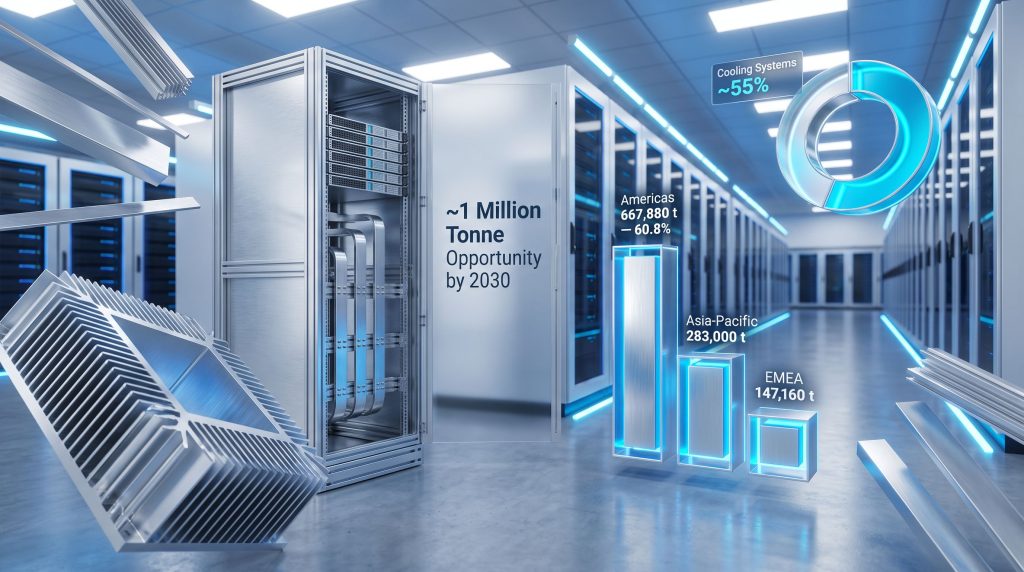
Cooling systems account for approximately 55% of total internal aluminium demand within data centre facilities, consuming roughly 6,700 kg of aluminium per MW of installed IT capacity across Computer Room Air Handler units, coolant distribution units, chillers, and cooling towers. The dominant alloys in this application are 6061 and 6063, chosen for their extrudability, surface quality, and thermal performance.
Server Racks, Structural Systems, and Modular Design
Racking and structural framing represents approximately 25% of internal aluminium demand. Data centres are not static structures. As compute hardware evolves rapidly, particularly under AI-driven upgrade cycles, operators require facility layouts that can be reconfigured quickly and cost-effectively. Aluminium's combination of high strength-to-weight ratio, corrosion resistance, and compatibility with modular T-slot framing systems makes it the material of choice for rack support structures, aisle containment systems, vertical partitions, and ceiling grid components.
The primary alloys used in structural data centre applications are 6063, 6060, 6061, and 6082, each selected based on specific strength, surface finish, and machinability requirements. The reconfigurability factor is particularly important in hyperscale facilities, where hardware refresh cycles are measured in months rather than years.
Power Distribution and Electrical Systems
Aluminium busbars serve as high-current conductors in busway and upstream power distribution systems within data centres. While copper's electrical conductivity is approximately 60% higher than aluminium's on a volume basis, this gap can be offset by designing aluminium busbars with larger cross-sections, which remain practical given aluminium's substantially lower density. The weight and cost savings at scale are significant, particularly in large hyperscale facilities where hundreds of metres of busway are installed.
Electrical systems and backup power infrastructure, including generators and uninterruptible power supply (UPS) systems, account for approximately 1,200 kg of aluminium per MW. The alloy series most commonly specified in electrical applications are 1050, 1070, and 3003, chosen for their high electrical conductivity and formability.
Servers, Chips, and Hardware Components
At the component level, aluminium plays a critical role in CPU and GPU thermal management, memory housing, and local storage enclosures. Server and chip-level aluminium consumption is estimated at approximately 2,700 kg per MW, while networking and storage hardware accounts for a further 260 kg per MW.
Aluminium Consumption by Data Centre Application
| Application Category | Aluminium per MW (kg) | Share of Internal Demand |
|---|---|---|
| Cooling Systems (CRAH/C, CDUs, chillers) | ~6,700 | ~55% |
| Servers and Chip-Level Components | ~2,700 | ~20% |
| Racking, Enclosures, Structural Framing | Included in combined estimate | ~25% |
| Electrical Systems and Backup Power | ~1,200 | ~10% |
| Networking and Storage Hardware | ~260 | Included above |
| Industry Average (All Systems) | ~60,000–75,000 kg per MW | 100% |
Industry benchmarks indicate that each megawatt of data centre capacity embeds approximately 60 to 75 tonnes of minerals in total, with the majority concentrated in power and cooling systems rather than in server hardware itself.
How Large Is the Aluminium Demand Opportunity from Data Centres?
Translating Megawatts Into Tonnes: The Demand Projection Methodology
Converting data centre capacity expansion into aluminium demand forecasts requires several analytical steps that are worth making explicit. First, forward capacity estimates from publicly announced projects and planning applications are aggregated by region. Second, the per-megawatt aluminium intensity benchmarks for each application category are applied. Third, adjustments are made for improving material efficiency over time. Fourth, external infrastructure demand from grid and power systems is estimated separately and layered on top.
On this basis, internal facility demand is growing at an 8 to 10% CAGR through the early 2030s, with peak annual internal demand of 0.6 to 0.9 million tonnes and cumulative internal demand of approximately 1.1 million tonnes between 2025 and 2030.
The External Infrastructure Multiplier
The external demand component is being amplified by a structural shift in how data centre operators approach power supply. Grid connection timelines in many high-demand markets now extend to several years, and available local grid capacity is increasingly constrained. In response, hyperscalers and large colocation providers are investing in independent on-site power systems that include:
- Solar and wind generation with integrated battery storage
- Natural gas turbines and reciprocating gas engines
- Solid oxide fuel cells
- Early-stage small modular reactor (SMR) concepts under evaluation for future deployments
Each of these power system types generates additional aluminium demand in structural systems, cable management, power distribution, and thermal management. Annual power capacity additions for data centres are projected to rise from a current range of 15 to 20 GW toward a peak of approximately 30 to 33 GW in the early 2030s.
The Peak Demand Window and Efficiency Trajectory
Demand is not expected to grow indefinitely. AI-driven design optimisation, improved cooling efficiency, and the progressive reduction of material intensity per unit of compute output are expected to cause internal demand growth to plateau and then contract at approximately 2 to 3% per annum from the early 2030s onward. This is an important nuance for investors and supply chain planners: the window of maximum demand intensity is estimated to span 2025 to 2033, with the steepest growth curve concentrated in the first half of that period.
Global Data Centre Sector Investment Context
| Metric | Figure |
|---|---|
| Global data centre sector CAGR through 2030 | ~14% |
| Total investment required through 2030 | Up to USD 3 trillion |
| Global data centre capacity by 2030 | >100 GW (approx. double current installed base) |
| Global electricity consumption (data centres, 2024) | ~415 TWh (IEA) |
| Projected global electricity demand from data centres by 2030 | ~950 TWh |
Which Regions Will Drive the Most Aluminium Demand from Data Centres?
The Americas: An Outsized and Accelerating Position
The Americas are projected to account for 667,880 tonnes of cumulative data centre aluminium demand through 2030, representing 60.8% of the global total. North America alone is expected to contribute more than 40% of worldwide demand. The United States leads all countries globally in data centre count with 4,423 facilities, a figure that reflects decades of investment in digital infrastructure and the concentration of hyperscaler headquarters and operations in specific geographic clusters.
Americas data centre capacity is projected to grow at a 17% CAGR between 2020 and 2030, with approximately 59 GW of new planned capacity being added across the region. As of 2025, installed capacity stood at 49 GW.
An important near-term shift is already observable at the manufacturing level. US Midwest aluminium producers report that data centre construction is generating a meaningful change in their customer demand mix. Following changes to federal electric vehicle purchase incentive programmes, some of the EV-related demand growth that manufacturers had anticipated has not materialised on the expected timeline. Data centre and AI infrastructure demand is being cited as a partial offset.
However, it is worth noting that US aluminium tariffs are introducing additional complexity for domestic producers attempting to capitalise on this demand shift. One North American aluminium extrusion manufacturer has indicated that demand from data centre customers is projected to grow by several percentage points in 2026, against a broader US aluminium extrusion market growth forecast of just 0 to 1.5%. This divergence highlights how the data centre channel is already providing a counter-cyclical buffer for certain producers.
Asia-Pacific: High Growth, Large Absolute Numbers
Asia-Pacific is projected to account for 283,000 tonnes of cumulative demand, representing 25.8% of the global total. Regional capacity growth is projected at a 12% CAGR, with 25 GW of new planned capacity and an installed base of 32 GW as of 2025. Key markets by data centre count include China with 369 facilities, India with 296, Australia with 284, and Japan with 257.
In Australia, for instance, Gladstone aluminium operations are undergoing significant reinvestment as producers position themselves for the growing domestic and regional demand from digital infrastructure expansion.
EMEA: Smaller Share, Rising Strategic Importance
Europe, Africa, and the Middle East are projected to account for 147,160 tonnes, representing 13.4% of cumulative global demand. EMEA capacity growth is projected at a 10% CAGR, with 13 GW of new planned capacity and an installed base of 21 GW as of 2025.
The United Kingdom leads the region with 555 data centre facilities, followed by Germany with 523 and France with 394. European data centre electricity demand is projected to nearly double to 36 GW by the end of the decade, a trajectory that carries significant implications for both grid infrastructure and aluminium demand in cable and transmission systems.
Emerging Digital Hubs: Turkey as a Case Study
Turkey offers an instructive example of how rapidly digitalising economies are generating fresh aluminium demand signals. The country's data centre market is projected to expand from 66 MW of installed IT capacity in 2025 to approximately 140 MW by 2030, representing a 16.2% CAGR driven by cloud services investment, AI adoption, and national digital transformation programmes.
Yiğit Kasapoğlu, Director of RUSAL's Representative Office in Turkey, has noted that AI infrastructure is gradually emerging as a new driver of aluminium demand globally, and that the expansion of data centres requires substantial investment in energy, engineering, and construction infrastructure where aluminium's unique combination of properties makes it an increasingly valuable material. Kasapoğlu has specifically highlighted that this trend is becoming particularly visible in rapidly digitalising economies such as Turkey.
Regional Demand and Capacity Comparison
| Region | Projected Aluminium Demand (Cumulative) | Global Share | New Capacity Planned | CAGR (2020–2030) |
|---|---|---|---|---|
| Americas | 667,880 tonnes | 60.8% | ~59 GW | 17% |
| Asia-Pacific | 283,000 tonnes | 25.8% | ~25 GW | 12% |
| EMEA | 147,160 tonnes | 13.4% | ~13 GW | 10% |
| Global Total | ~1.1 million tonnes | 100% | ~97 GW | — |
What Aluminium Grades and Alloys Are Specified for Data Centre Applications?
Why Alloy Specification Matters for Producers and Extruders
The data centre opportunity is not uniformly distributed across the aluminium value chain. It is concentrated in specific alloy and product categories, with extruded products in the 6xxx series dominating the thermal and structural applications that account for the largest share of demand. Understanding which alloys are specified is essential for producers and fabricators evaluating whether their current product mix is positioned to capture this demand.
The primary alloy and application breakdown is as follows:
- Thermal management extrusions: 6061 and 6063 billets, used for heat sink profiles and cooling fin geometries where complex cross-sections are critical to surface area maximisation
- Structural framing and modular systems: 6063, 6060, 6061, and 6082, used in T-slot modular framing, rack support structures, aisle containment, and ceiling panels where reconfigurability is a key design requirement
- Electrical and enclosure applications: 1050, 1070, and 3003 series, used in cable management systems, equipment enclosures, and busbar conductors where high electrical conductivity and formability are prioritised
One dimension of alloy specification that is less commonly discussed is the tolerance sensitivity of data centre cooling extrusions. As server heat densities increase, the dimensional precision and surface consistency of extruded cooling profiles become more critical. This creates an implicit quality premium in the data centre segment that favours producers with precise extrusion capabilities over commodity extruders.
The next major ASX story will hit our subscribers first
Is the Data Centre Boom a Net Positive or Net Negative for the Aluminium Industry?
The Strategic Opportunity: Capital-Intensity as a Demand Anchor
The defining characteristic of aluminium demand in data centres, relative to other end-use categories, is its anchoring in committed capital expenditure rather than in consumer behaviour. Hyperscaler companies including major US cloud providers have collectively announced hundreds of billions of dollars in data centre investment across multi-year programmes. This capital is substantially pre-committed and is being deployed regardless of short-term economic conditions.
For aluminium producers and extruders, this creates a demand channel with unusually high visibility and duration. Unlike automotive demand, which fluctuates with consumer confidence and credit availability, or packaging demand, which tracks disposable income patterns, data centre demand is driven by the structural economics of AI deployment, cloud adoption, and digital service consumption, all of which are on long-term secular growth trajectories. Consequently, aluminium sector investment is increasingly being structured around these emerging demand profiles.
The Strategic Tension: Competing for the Same Critical Resource
The dual paradox embedded in this opportunity cannot be ignored. Aluminium smelting is among the most electricity-intensive industrial processes in the world, typically consuming 13 to 15 MWh per tonne of primary aluminium produced. Data centres are equally voracious electricity consumers. And unlike aluminium producers, whose margins are compressed by high energy costs, hyperscaler data centre operators can absorb premium electricity prices because their core business economics are far less sensitive to energy costs as a percentage of total operational expenditure.
The consequences of this competitive dynamic are already visible:
- Global data centre electricity consumption reached approximately 415 TWh in 2024, equivalent to Italy's entire annual electricity consumption, according to the International Energy Agency
- This figure is projected to rise to approximately 950 TWh by 2030 as AI workloads and cloud capacity expand
- US industrial electricity prices rose by 24.9% between 2015 and 2025, a trend that is expected to continue as data centre capacity expands
- Bank of America projects that US electricity demand will grow five to ten times faster over the next decade compared to the previous ten years
The Nordic Energy Paradox
Perhaps the most telling illustration of this structural tension is unfolding in the Nordic countries, which have historically been considered among the most attractive global locations for energy-intensive aluminium smelting due to their abundant, low-cost, and predominantly hydroelectric power supply. Grid operators in the region have now flagged that data centre expansion will consume available electricity capacity faster than previously modelled, creating tightening conditions that threaten the cost advantage that has anchored aluminium production in those markets for decades.
This is a scenario that has profound implications for long-term primary aluminium supply economics. The regions most favourable for low-carbon production are increasingly contested by digital infrastructure capital, which can offer long-term power purchase agreements at rates that industrial manufacturers struggle to match. In addition, the green metals transition being pursued by major producers adds further complexity to how the industry manages competing energy demands.
The dual paradox is this: at the very moment that hyperscale investment is creating a new structural demand channel for aluminium that could absorb well over a million tonnes of production through 2030, the same sector's electricity consumption is progressively eroding the production economics of the facilities that must supply that demand. Managing this tension is one of the defining strategic challenges for the aluminium industry over the next decade.
Frequently Asked Questions: Aluminium Demand in Data Centres
How much aluminium does a data centre use per megawatt of capacity?
On average, a data centre embeds approximately 60 to 75 tonnes of minerals per megawatt of installed IT capacity across all systems. Cooling systems alone account for approximately 6,700 kg of aluminium per MW, while server and chip-level components add roughly 2,700 kg per MW and electrical systems and backup power contribute approximately 1,200 kg per MW.
What is the projected aluminium demand from data centres by 2030?
Cumulative internal facility demand is projected to approach 1.1 million tonnes between 2025 and 2030. When external grid and power infrastructure aluminium is incorporated, total attributable demand is estimated at three to four times that figure. The Americas are expected to account for approximately 60.8% of cumulative internal demand.
Why is aluminium preferred over other materials in data centre cooling?
Aluminium offers a combination of high thermal conductivity, light weight, corrosion resistance, and design formability that allows it to be extruded into complex fin geometries that maximise heat dissipation surface area. This combination of properties cannot be replicated at equivalent cost by competing materials across the full range of data centre cooling configurations.
Which aluminium alloys are most commonly used in data centres?
- 6061 and 6063 for thermal management extrusions
- 6063, 6060, 6061, and 6082 for structural framing and modular systems
- 1050, 1070, and 3003 for electrical enclosures and cable management
Will data centre aluminium demand continue to grow indefinitely?
No. Internal demand is projected to plateau and then decline at approximately 2 to 3% per annum from the early 2030s onward as AI-driven design efficiency reduces material intensity per unit of compute output. The peak demand intensity window is estimated to span 2025 to 2033.
How does data centre expansion affect aluminium production costs?
Data centres compete directly with aluminium smelters for electricity supply. Their willingness to pay premium energy prices contributes to rising industrial electricity costs and, in some regions, to constraints on available grid capacity. US industrial electricity prices rose 24.9% between 2015 and 2025, and this pressure is expected to intensify as data centre capacity continues to expand through the remainder of the decade.
Key Takeaways: The Structural Case for Aluminium in the Digital Infrastructure Era
- Data centres are transitioning from a niche aluminium end-use into a top-tier structural demand driver, with characteristics that differentiate it from consumer-led demand categories
- An 8 to 10% CAGR in internal aluminium demand, combined with the external infrastructure multiplier, positions this sector as a critical growth channel for producers, extruders, and downstream fabricators through 2030
- The Americas will dominate demand with a 60.8% share, but Asia-Pacific at 25.8% and EMEA at 13.4% represent significant and fast-growing secondary markets
- The alloy and product mix required, particularly 6xxx series extrusions for thermal and structural applications, creates targeted opportunities for extruders with precise manufacturing capabilities
- The energy competition dynamic is a structural risk to aluminium production economics that must be incorporated into any credible long-term supply and pricing analysis
- The peak demand window is finite: the 2025 to 2033 period represents the primary opportunity horizon before efficiency gains begin compressing material intensity per megawatt
Disclaimer: Demand projections, capacity forecasts, and aluminium intensity figures referenced in this article are drawn from industry analysis and published estimates. All forward-looking figures involve inherent uncertainty and should not be relied upon as financial advice. Readers seeking to make investment or operational decisions should consult primary sources and qualified advisers. Readers interested in further aluminium industry data and end-use analysis can visit AL Circle, which publishes ongoing coverage of aluminium demand developments across emerging sectors.
Want to Capitalise on the Structural Shift Reshaping Aluminium Markets?
Discovery Alert's proprietary Discovery IQ model scans ASX announcements in real time, instantly identifying significant mineral discoveries — including those positioned to benefit from surging aluminium demand driven by digital infrastructure expansion — and delivers actionable alerts directly to subscribers ahead of the broader market. Explore historic discoveries and their returns to understand the scale of opportunity, then begin your 14-day free trial to position yourself at the forefront of this structural demand wave.