July 14, 2026
Why China's Carbon Architecture Is Unlike Any Other Climate Framework on Earth
Most climate policy discussions focus on what countries promise to do. Far fewer examine the mechanical infrastructure built to enforce those promises at scale. China's approach to decarbonisation operates differently from virtually every other major economy: it functions through a cascading series of planning mandates, sectoral benchmarks, and administrative controls that translate headline targets into enforceable industrial obligations across thousands of facilities and dozens of provinces.
Understanding this machinery matters not just for climate analysts, but for commodity traders, infrastructure investors, and any industry whose supply chain touches Chinese heavy industry. Furthermore, the China steel market dynamics and broader mining decarbonisation trends are directly shaped by how effectively this framework is implemented.
The China energy conservation and carbon reduction roadmap currently taking shape across the 2026-2030 planning window represents the most structurally ambitious phase of Beijing's long-term decarbonisation effort. It moves beyond the incremental efficiency improvements of previous Five-Year Plans into territory that involves absolute emissions constraints, provincial carbon budgets, and the coordinated restructuring of nine of the world's most carbon-intensive industrial sectors simultaneously.
When big ASX news breaks, our subscribers know first
The Structural Logic Behind China's Three-Phase Approach
China's climate governance operates through successive implementation layers, each designed to build on the previous one. Rather than treating decarbonisation as a single policy event, Beijing has constructed a phased architecture where near-term operational plans inform medium-term industrial programs, which in turn feed into the broader Five-Year Plan framework.
Phase One: Operational Foundations (2024-2025)
The first layer was established through a State Council action plan released in May 2024, which set the immediate regulatory conditions for the current transition period. This plan focused on several specific quantitative benchmarks:
- Non-fossil fuel power generation reaching 39% of the total generation mix by the end of 2025
- Total energy consumption intensity falling 13.5% below 2020 levels
- Non-fossil energy accounting for approximately 20% of total energy consumption
- Annual energy savings of roughly 50 million tonnes of standard coal through targeted industrial transformation programs
These targets served a dual purpose: establishing measurable short-term accountability while creating the statistical baseline systems needed to support the more ambitious phases that follow.
Phase Two: Nine-Industry Efficiency Drive (2026-2028)
The National Development and Reform Commission launched a three-year industrial upgrade program beginning in 2026, targeting nine sectors identified as carrying the highest combined energy intensity and emissions burden. The program mandates specific efficiency benchmark uplift targets across each sector, with sub-benchmark capacity to be essentially eliminated by 2028.
| Industry Sector | Efficiency Benchmark Uplift Target (by 2028) |
|---|---|
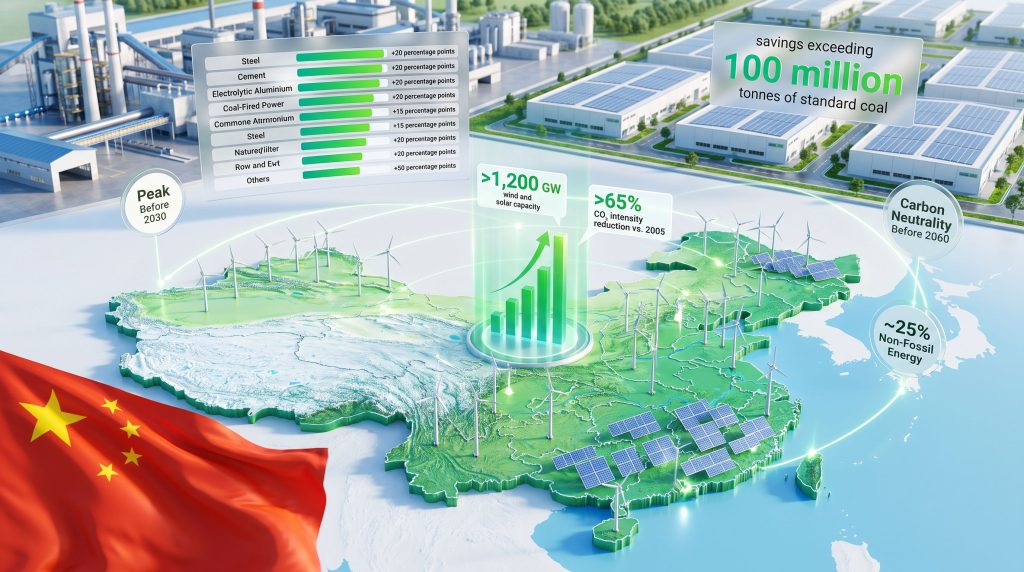
| Steel | +20 percentage points of capacity meeting benchmarks |
| Electrolytic Aluminium | +20 percentage points |
| Cement | +20 percentage points |
| Flat Glass | +20 percentage points |
| Oil Refining | +20 percentage points |
| Ethylene | +20 percentage points |
| Synthetic Ammonia | +20 percentage points |
| Methanol | +20 percentage points |
| Coal-Fired Power | +15 percentage points |
The projected cumulative impact of this program extends to savings exceeding 100 million tonnes of standard coal and emissions reductions surpassing 200 million tonnes of CO₂ across the three-year window. For context, 200 million tonnes of CO₂ represents roughly half the annual emissions of the United Kingdom.
Phase Three: The 15th Five-Year Plan (2026-2030)
The current Five-Year Plan cycle represents the systemic transformation layer. Key structural features include:
- Introduction of provincial carbon budgets, with pilot testing frameworks established before end-2025
- Construction of approximately 100 national-level zero-carbon industrial parks
- Explicit targeting of a coal consumption peak within the planning window
- Renewable energy displacing roughly 30 million tonnes of coal annually
The 15th Five-Year Plan's carbon intensity reduction target is set at 17% against 2025 baseline levels, marginally below the 14th FYP's 18% goal, which was not fully achieved. This recalibration reflects the practical difficulty of sustaining intensity reductions whilst maintaining GDP growth above 4-5% annually. Notably, the simultaneous introduction of absolute emissions controls through the dual-control mechanism partially compensates for the reduced intensity ambition.
Core 2030 Targets: What China Has Committed To
By 2030, China's binding climate commitments measured against 2005 baseline levels include a greater than 65% reduction in carbon dioxide emissions per unit of GDP, non-fossil energy reaching approximately 25% of total energy consumption, and installed wind and solar capacity exceeding 1,200 GW.
The table below consolidates the key metrics across the near-term and 2030 horizon:
| Metric | 2025 Interim Target | 2030 Target |
|---|---|---|
| Non-fossil share of total energy consumption | ~20% | ~25% |
| Non-fossil share of power generation | 39% | Not specified |
| Wind + Solar installed capacity | Not specified | >1,200 GW |
| CO₂ intensity reduction vs. 2005 | Not specified | >65% |
| CO₂ intensity reduction vs. 2025 | Not applicable | 17% (15th FYP) |
Achieving the 1,200 GW wind and solar target requires sustained installation rates across onshore wind, offshore wind, utility-scale solar, and distributed solar over the five-year period. Nuclear and large-scale hydropower serve as baseload complements to these intermittent sources, providing grid stability during periods of low renewable output.
The Dual-Control Mechanism: Why This Is a Policy Turning Point
Perhaps the most consequential regulatory development within China's energy conservation and carbon reduction roadmap is the formalisation of dual-control. Under previous frameworks, carbon management operated primarily through GDP-intensity ratios, a metric that allowed absolute emissions to continue rising as long as the economy expanded at a sufficient pace. The denominator effect meant that rapid economic growth could statistically dilute emissions performance without any physical reduction in greenhouse gas output.
The dual-control mechanism closes this loophole by adding absolute emissions ceilings alongside intensity benchmarks. Industries can no longer rely on growth-rate arithmetic to demonstrate compliance. They must reduce the total volume of greenhouse gases emitted within defined caps. In addition, renewable energy solutions are increasingly central to meeting these absolute constraints across industrial sectors.
Provincial Carbon Budgets: The Enforcement Architecture
The operationalisation of dual-control flows directly into the provincial carbon budget system. Each province and municipality will operate under a formalised carbon budget, creating accountability at the sub-national level that was largely absent from previous frameworks. This matters for several reasons:
- Provinces with carbon-intensive industrial bases face structural economic adjustment pressure, not merely efficiency improvement targets
- Fixed-asset investment projects must now undergo carbon emissions assessments as a prerequisite for approval
- Improved statistical accounting in electricity, steel, and petrochemical sectors is required by 2025 to support credible enforcement
The provincial budget system also intersects with China's national emissions trading scheme (ETS), creating a two-layer carbon pricing architecture where ETS-covered sectors face market-price carbon costs whilst industries outside the scheme face administrative intensity controls.
How China's Framework Compares Globally
| Framework | Primary Metric | Absolute Cap? | Key 2030 Goal |
|---|---|---|---|
| China NDC (updated) | CO₂/GDP intensity | Emerging via dual-control | >65% intensity reduction vs. 2005 |
| EU Climate Law | Absolute net emissions | Yes | 55% net reduction vs. 1990 |
| US IRA Framework | Sectoral incentives | No binding cap | ~50-52% reduction vs. 2005 |
| India NDC | Emissions intensity of GDP | No | 45% intensity reduction vs. 2005 |
China's framework sits between the EU's hard absolute cap approach and the incentive-based US model. The dual-control evolution is moving China's architecture meaningfully toward the EU model, though full convergence remains a long-term proposition. According to Climate Action Tracker, China accounts for roughly 30% of global CO₂ emissions, meaning even moderate deviations from stated targets carry measurable consequences for global temperature trajectories.
Sector-by-Sector Transformation: What Changes and for Whom
Heavy Industry
Steel, cement, aluminium, and chemicals face the most immediate compliance burden. The elimination of sub-benchmark capacity across nine designated sectors will generate consolidation pressure, particularly in fragmented markets where smaller, less efficient producers have historically survived on thin margins. The embedded circular economy principles within industrial planning mandates will reduce raw material throughput requirements, affecting upstream commodity demand dynamics. Furthermore, Australia's green metals leadership position is closely linked to how these Chinese industrial reforms reshape global supply chains.
Energy Sector
The phrase used within Beijing's policy framing around coal is deliberately calibrated: strictly and reasonably controlling coal consumption signals a managed phase-down rather than an abrupt exit. Coal continues to provide baseload stability during the renewable buildout, and any policy that destabilises grid reliability would carry significant political costs. The tension between renewable intermittency and grid stability requirements makes energy storage policy a critical adjacent framework within the overall roadmap.
Buildings and Transport
Public building energy consumption per unit of floor area is targeted to fall by 5% over the planning period, with new construction increasingly required to meet near-zero energy performance criteria. On the transport side, road electrification remains the primary decarbonisation lever, whilst aviation and maritime transport face longer timelines given the absence of commercially viable zero-carbon fuel alternatives at scale.
The next major ASX story will hit our subscribers first
Key Risks and Implementation Challenges
No analytical framework for China's carbon roadmap is complete without an honest assessment of the factors that could impede delivery:
GDP growth volatility represents a structural tension. Intensity targets become mathematically harder to achieve if GDP growth slows, because the denominator effect that previously helped dilute emissions also helps dilute intensity improvements when economic output contracts.
Provincial compliance variation has been a persistent weakness across previous planning cycles. Provinces with heavy industrial employment bases have historically delayed or underreported compliance with national energy targets, and there is limited evidence that the institutional incentives driving this behaviour have fundamentally changed.
Monitoring, reporting, and verification gaps remain a credibility constraint. The reliability of China's carbon accounting has been questioned in peer-reviewed research, particularly within the power sector. Satellite-based emissions monitoring by independent research groups increasingly provides cross-validation data, and the 2025 deadline for improved statistical accounting in electricity, steel, and petrochemicals is therefore a critical milestone for international credibility.
Carbon leakage risk applies particularly to steel and aluminium, where production displaced by domestic capacity elimination could shift to less-regulated jurisdictions, neutralising part of the domestic emissions reduction. This risk is especially relevant in the context of the EU's Carbon Border Adjustment Mechanism, which will apply carbon costs to imported steel, aluminium, and cement, creating an external price signal that may partially discipline leakage dynamics.
Strategic Implications for Global Commodity and Clean Technology Markets
China's renewable capacity buildout targeting over 1,200 GW of wind and solar by 2030 generates sustained structural demand for the critical minerals demand underpinning energy storage and generation equipment: lithium, cobalt, nickel, copper, and rare earth elements used in permanent magnets for wind turbines. The nine-industry efficiency drive simultaneously creates demand for advanced process technology, industrial automation, and green hydrogen as an industrial feedstock substitute for carbon-intensive processes in chemicals and steel production.
For globally traded commodities, the mandatory capacity elimination program creates a nuanced supply picture. In the short term, consolidation pressure in steel and aluminium may reduce Chinese export volumes in certain product categories. Over the medium term, the combination of domestic capacity rationalisation and rising carbon costs within China's ETS could reshape competitive positioning in global commodity markets in ways that are difficult to model with precision.
Investors and industry participants monitoring China's energy conservation and carbon reduction roadmap should treat the formalisation of provincial carbon budgets before end-2025 as the single most important near-term policy development. The pace of sub-benchmark capacity elimination in the nine targeted industrial sectors will serve as the most reliable leading indicator of whether implementation ambition matches policy design.
Frequently Asked Questions
What is China's carbon neutrality target year?
China has committed to achieving carbon neutrality before 2060, with carbon dioxide emissions peaking before 2030 as the required intermediate milestone.
What does the dual-control mechanism mean for Chinese industry?
The dual-control system manages both the intensity of carbon emissions per unit of GDP and the absolute volume of emissions produced. This means industries can no longer rely on economic growth to dilute their intensity performance. They must reduce the total output of greenhouse gases within defined caps, fundamentally changing the regulatory exposure for heavy industry sectors.
Which industries are targeted in China's 2026-2028 efficiency drive?
Nine sectors are designated: steel, electrolytic aluminium, cement, flat glass, oil refining, ethylene, synthetic ammonia, methanol, and coal-fired power. Each faces mandatory efficiency benchmark uplift targets, with sub-baseline capacity scheduled for elimination by 2028.
What are zero-carbon industrial parks?
Approximately 100 national-level zero-carbon industrial parks are planned under the 15th Five-Year Plan as demonstration zones where industrial production operates on near-zero-emissions energy systems. These parks function as scalable models intended to inform broader industrial decarbonisation pathways across the economy.
How does China plan to peak coal consumption?
The 15th Five-Year Plan explicitly targets a coal consumption peak within the 2026-2030 window, supported by displacing approximately 30 million tonnes of coal annually with renewable energy sources and accelerating the retirement of inefficient coal-fired generation capacity.
Disclaimer: This article contains forward-looking statements, regulatory projections, and analytical interpretations based on publicly available policy documents and research. Targets and timelines referenced reflect stated government commitments and should not be construed as guaranteed outcomes. Readers making investment or business decisions based on this content should conduct independent due diligence and consult qualified advisors.
Want to Capitalise on the Commodity Shifts Driven by China's Decarbonisation Push?
China's nine-industry efficiency drive and renewable buildout are reshaping global demand for critical minerals including lithium, copper, nickel, and rare earth elements — and Discovery Alert's proprietary Discovery IQ model delivers real-time ASX alerts the moment significant mineral discoveries are announced, turning complex market signals into actionable investment opportunities. Begin your 14-day free trial today and position yourself ahead of the market before the next major discovery moves.