July 13, 2026
The Structural Fault Line Beneath India's Industrial Ambitions
When an economy grows fast enough, certain industrial materials stop behaving like commodities and start behaving like infrastructure. Concrete. Steel. Copper. And increasingly, aluminium. What separates aluminium from these other materials is the extraordinary complexity of producing it at scale: bauxite must be mined, refined into alumina, then smelted using enormous quantities of electricity before a single ingot reaches a fabricator. That multi-stage dependency creates long lead times, capital-intensive bottlenecks, and compounding vulnerabilities that demand forecasts alone cannot capture.
India's aluminium sector is approaching precisely this kind of inflection point. Domestic demand is accelerating across too many sectors simultaneously for any single capacity addition to absorb the impact. The question facing the industry is not whether India will face an aluminium demand-supply gap but how wide that gap will grow before new capacity can close it. The India aluminium capacity expansion demand supply gap is therefore not a niche industrial concern — it is a strategic national challenge.
When big ASX news breaks, our subscribers know first
Why India's Aluminium Demand Is Outpacing Its Own Production Ambitions
The Structural Mismatch Reshaping India's Industrial Supply Chain
India's aluminium consumption is no longer growing in a straight line. It is compounding. The convergence of national infrastructure programmes, electric vehicle manufacturing targets, renewable energy buildouts, and defence indigenisation policies has created simultaneous demand acceleration across sectors that were previously not all growing at once. This synchronised demand surge is what makes the current cycle structurally different from previous periods of rising consumption.
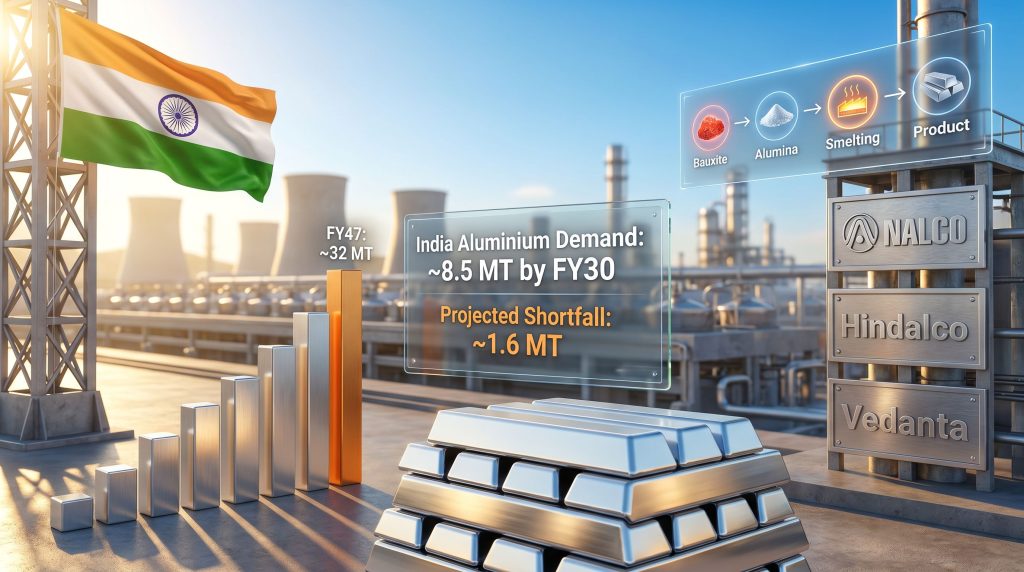
According to Ministry of Mines projections, domestic aluminium demand could reach 8.5 million tonnes by FY30, compared to a combined primary and secondary production capacity of approximately 6.2 million tonnes today. That gap of roughly 2.3 million tonnes represents more than a supply planning challenge. It represents a strategic industrial vulnerability for an economy betting its development trajectory on materials-intensive green and defence infrastructure.
The drivers locking in this demand acceleration include:
- Rising aluminium intensity across electric vehicles, where each unit can contain up to 30% more aluminium than an equivalent internal combustion vehicle
- Solar mounting systems consuming approximately 500 to 700 kilograms of aluminium per megawatt of installed capacity, creating structural demand tied to India's 500 GW renewable energy target
- Government-mandated localisation in defence and aerospace manufacturing, requiring aerospace-grade aluminium alloys previously sourced as finished imports
- Urban construction driving demand for aluminium cladding, curtain wall systems, and structural components across metro rail, airport, and housing projects
- Packaging sector transition from steel and plastic to lightweight aluminium formats accelerating ahead of most baseline forecasts
Furthermore, India's industrial metals demand is being shaped by policy commitments that make these vectors non-discretionary. They are embedded in multi-year procurement commitments, national policy targets, and private sector supply chain investments that cannot be easily unwound.
How Aluminium Became a Bottleneck, Not Just a Commodity
The shift from commodity to strategic bottleneck does not happen gradually. It happens when demand growth rates across multiple end-use sectors all exceed supply growth rates simultaneously. India's aluminium production has expanded at an average annual rate of approximately 4% over the past decade. Consumption, by contrast, has grown at roughly double that pace.
The cumulative effect of that divergence is a consumption-to-production ratio that has been steadily deteriorating, placing increasing pressure on imports to bridge the gap. According to research on emerging structural tightness in aluminium supply, China's production cap and rising electrification demand are compounding global supply pressures, further reducing the buffer available to import-dependent economies such as India.
Complicating matters further, the current global energy environment adds cost pressure to new smelting investment. West Texas Intermediate crude oil has risen to US$94.20 per barrel amid the ongoing Middle Eastern crisis, with major oil-producing nations having reduced output by approximately 11 million barrels per day. This energy market disruption elevates operating costs for energy-intensive aluminium smelters and can delay final investment decisions on new capacity.
What Does India's Current Aluminium Production Capacity Actually Look Like?
Breaking Down Primary Versus Secondary Production
India's total aluminium production capacity of approximately 6.2 million tonnes annually is not a unified system. It is two structurally distinct sectors with very different input dependencies, cost profiles, and vulnerability characteristics.
| Capacity Type | Estimated Capacity (MT) | Key Input Dependency | Vulnerability Profile |
|---|---|---|---|
| Primary Aluminium (Smelting) | ~4.2 MT | Domestic bauxite, imported alumina | Power costs, upstream sequencing |
| Secondary Aluminium (Recycling) | ~2.0 MT | Imported aluminium scrap | Trade policy, global scrap prices |
| Total Combined Capacity | ~6.2 MT | Mixed domestic and import inputs | Structural import dependence |
| FY30 Demand Projection | ~8.5 MT | Demand-driven | Shortfall ~1.6 MT under expansion plans |
The primary sector, producing approximately 4.2 million tonnes annually, benefits from domestic bauxite access but faces structural constraints around alumina refining capacity and power economics. Indian primary smelters average approximately 14,500 kilowatt-hours of electricity per tonne of aluminium produced, making power cost the single largest variable in production economics.
Smelters supplied by captive coal or renewable power enjoy significant cost advantages over those reliant on grid electricity, where tariff structures remain commercially challenging. The global bauxite supply chain adds a further layer of complexity, as India's upstream refining economics are partly contingent on how international bauxite markets evolve alongside domestic reserve development.
The Secondary Sector's Hidden Structural Weakness
India's secondary aluminium sector contributes approximately 2.0 million tonnes to annual output but should not be treated as a reliable buffer against primary production shortfalls. Approximately 75% of its raw material inputs consist of imported aluminium scrap, creating dependency on global scrap availability, international shipping economics, and import duty policy.
Any tightening of global scrap markets, adjustment of import tariff structures, or disruption to trade corridors could compress secondary output with minimal lead time for substitution. This dependency is particularly significant because secondary aluminium is frequently positioned in policy discussions as a demand-gap solution. In practice, it functions as a parallel system with its own vulnerabilities rather than as a controllable domestic buffer.
The secondary sector's scrap dependency means India's effective aluminium production capacity is partly a function of global trade flows, not purely domestic industrial capability.
Bauxite mining capacity stands at approximately 38 million tonnes annually, though current utilisation sits at around 65%, reflecting infrastructure gaps and environmental clearance delays rather than reserve exhaustion. Alumina refining capacity of approximately 10.5 million tonnes annually is running at close to 92% utilisation, already approaching ceiling operating rates. This near-maximum refinery utilisation is arguably the most immediate upstream constraint, creating a sequencing risk where smelter expansions could outpace refinery capacity additions. The alumina market pressures being observed globally reinforce how vulnerable integrated producers are when refinery throughput fails to keep pace with smelting ambitions.
How Large Is the India Aluminium Demand-Supply Gap, and When Does It Peak?
A Three-Horizon Framework for Understanding India's Deficit
The India aluminium capacity expansion demand supply gap is not a single-point problem with a single-point solution. It is a compounding structural deficit that intensifies across successive planning horizons, with each horizon presenting qualitatively different challenges.
| Planning Horizon | Projected Demand (MT) | Required Production Capacity (MT) | Estimated Shortfall (MT) |
|---|---|---|---|
| FY30 | ~8.5 MT | ~8.5 MT | ~1.6 MT deficit |
| FY40 | ~18 MT | ~25 MT | Significant upstream gap |
| FY47 | ~32 MT | ~37 MT | Raw material shortfall ~7+ MT |
The FY30 shortfall of approximately 1.6 million tonnes is the most immediately actionable. Yet even this near-term deficit persists despite the largest wave of announced capacity investment in India's aluminium history. The fact that INR 640 billion in committed capital across three major producers does not fully close a 1.6 million tonne gap by FY30 speaks directly to the magnitude of the demand growth and the unavoidable time lag between investment approval and production ramp-up.
What the FY47 Raw Material Shortfall Actually Signals
The Ministry of Mines projection of a raw material shortfall exceeding 7 million tonnes by FY47 deserves careful interpretation. This figure is not a smelting capacity number. It is an upstream materials number, encompassing bauxite and alumina availability. Its significance lies in what it reveals about the structural architecture of India's aluminium challenge.
Smelters can be built in 4 to 7 years. Bauxite reserves take decades to discover, permit, develop, and integrate into refinery supply chains. The FY47 raw material shortfall is therefore not a future problem. It is a present-day policy problem requiring immediate action on bauxite exploration programmes, mining lease allocation timelines, and international resource partnership frameworks.
Three critical implications follow from this projection:
- Domestic bauxite reserves, while substantial in Odisha, Jharkhand, and Andhra Pradesh, are insufficient to support long-range production targets without new discoveries or supplemental import arrangements
- Alumina refining capacity must scale in parallel with smelting investments, not sequentially. The current near-capacity utilisation rate at refineries signals that this parallel scaling is already behind schedule
- India's aluminium self-sufficiency ambitions require upstream resource policy reform as a prerequisite, not as a downstream consequence of smelter investment
Which Companies Are Driving India's Aluminium Capacity Expansion?
The Three Producers Shaping the Next Decade of Supply
India's primary aluminium industry is effectively a triopoly. NALCO, Hindalco, and Vedanta collectively account for the overwhelming majority of domestic primary production. The major aluminium producers operating in India have announced capacity expansion programmes representing the most significant capital deployment cycle in the sector's history.
Combined announced expansion overview:
- Alumina refinery capacity additions: approximately 7 million tonnes across the three producers
- Primary aluminium smelter capacity additions: approximately 3 million tonnes over the next 5 to 6 years
- Total capital investment commitment: exceeding INR 640 billion across announced programmes
NALCO (National Aluminium Company Limited)
As the state-owned integrated producer, NALCO holds a structural advantage through captive bauxite access in Odisha, which eliminates the upstream cost exposure that constrains other producers. Its expansion plans focus on scaling both refinery throughput and smelter nameplate capacity. NALCO's government ownership also means its investment timeline may be less sensitive to short-term market conditions than private sector competitors.
Hindalco Industries
Hindalco's expansion strategy combines primary capacity growth with accelerated investment in value-added product manufacturing and downstream processing. Its ownership of Novelis, the world's largest aluminium recycling company, provides a unique structural advantage: access to high-quality recycled aluminium feedstock from global markets that most Indian producers lack. This global integration partially insulates Hindalco against domestic raw material constraints.
Vedanta Aluminium
As India's largest primary aluminium producer by volume, Vedanta carries the heaviest expansion obligation and faces the most acute power cost challenges. Its smelter expansion pipeline in Odisha and Jharkhand is substantial, but the economics of new smelting capacity depend heavily on securing competitively priced captive power. Vedanta has been active in pursuing captive renewable energy arrangements, a strategy that also improves the carbon intensity profile of its aluminium — increasingly relevant for export-oriented sales to environmentally demanding customers.
INR 640 billion in committed capital across India's three major aluminium producers represents a generational industrial bet. The critical risk is not whether this capital will be deployed, but whether the upstream raw material chain can scale fast enough to support it.
Will Planned Expansions Be Enough? Stress-Testing the Capacity Gap
Why 3 Million Tonnes of New Smelting Capacity Does Not Automatically Close a 1.6 Million Tonne Gap
On paper, 3 million tonnes of announced primary smelter additions against a 1.6 million tonne projected shortfall suggests a comfortable surplus. In practice, the apparent buffer dissolves under realistic assumptions about construction timelines, commissioning curves, and demand growth variability.
Several structural factors compress this apparent surplus:
- Construction and commissioning timelines: Large-scale smelter projects typically require 4 to 7 years from investment approval to full production ramp. Projects approved in 2024 or 2025 may not reach nameplate capacity until FY30 or beyond
- Utilisation rate variability: New capacity rarely operates at nameplate efficiency in its first 2 to 3 years, with ramp-up periods typically averaging 70 to 80% of design capacity
- Demand growth rate uncertainty: If India's GDP growth and green infrastructure spending outperform base-case projections, demand could exceed 8.5 million tonnes before FY30, eliminating the apparent buffer entirely
- Refinery sequencing risk: Alumina refinery expansions must precede smelter additions. With existing refineries already operating at approximately 92% utilisation, any delay creates a hard ceiling on smelter output
However, the aluminium tariff impacts introduced in global markets add another dimension of uncertainty. Trade policy shifts can alter the relative cost-competitiveness of domestic production versus imports, consequently affecting the urgency and economics of new domestic capacity investment.
Mapping the Upstream Value Chain Pressure Points
Understanding India's aluminium challenge requires mapping each stage of the production chain against its specific constraint profile. Furthermore, the aggregate capacity numbers obscure qualitatively different risk levels at each stage.
| Value Chain Stage | Current Constraint | Risk Level |
|---|---|---|
| Bauxite Mining | Insufficient long-range reserve development, environmental clearance delays | High |
| Alumina Refining | Near-capacity utilisation, sequencing risk against smelter additions | Medium-High |
| Primary Smelting | Significant investment announced, commissioning timeline risk | Medium |
| Secondary Aluminium | Imported scrap dependency, trade policy exposure | Medium |
| Power Supply | High grid electricity costs compress smelter economics significantly | High |
The bauxite mining and power supply stages both carry high risk ratings for qualitatively different reasons. Bauxite constraints are geological and regulatory in nature, requiring long lead times to resolve. Power cost constraints are economic and policy in nature, potentially resolvable through captive renewable energy frameworks but dependent on supportive regulatory environments at the state level.
It is worth noting that while the global energy market disruptions stemming from the Middle Eastern crisis have elevated oil prices to multi-year highs, India's aluminium smelters are primarily electricity consumers rather than direct oil consumers. The indirect transmission mechanism operates through elevated diesel costs for mining and logistics operations, as well as through broader inflationary pressures on construction materials required for new smelter development.
The next major ASX story will hit our subscribers first
What Are the Structural Demand Drivers Locking In India's Aluminium Consumption Growth?
Sector-by-Sector Demand Acceleration: Why Each Driver Is Non-Discretionary
What distinguishes India's current aluminium demand cycle from previous growth phases is the simultaneous activation of multiple end-use sectors, each with commitments that make demand reduction economically or politically infeasible. According to IEA projections for the aluminium sector, global aluminium demand linked to clean energy transitions is expected to increase substantially through 2030 and beyond, with emerging economies like India at the centre of that growth trajectory.
Electric Vehicles and Automotive Lightweighting
India's EV manufacturing ambitions, targeting millions of annual units by decade's end, embed aluminium demand into vehicle production economics in ways that cannot be easily substituted. Battery enclosures require aluminium for thermal management properties. Each electric vehicle built with aluminium-intensive architecture locks in approximately 200 to 250 kilograms of consumption per unit, significantly above conventional vehicle averages.
Renewable Energy Infrastructure
The 500 GW renewable energy target by 2030 is perhaps the most powerful single source of non-discretionary aluminium demand in India. Solar mounting systems, high-voltage transmission conductors, wind turbine components, and substation infrastructure all rely heavily on aluminium. The demand this target creates is not contingent on consumer preferences or market cycles. It is driven by government procurement contracts and long-term power purchase agreements, making it structurally insulated from economic slowdowns.
Construction and Urban Infrastructure
India's ongoing infrastructure investment across metro rail networks, airport expansions, affordable housing programmes, and commercial real estate development creates sustained demand for aluminium in facade systems, structural glazing, and roofing. Modern curtain wall systems consume approximately 15 to 20 kilograms of aluminium per square metre of facade area. As India's commercial building stock expands at accelerating rates, this per-square-metre figure aggregates into substantial annual demand.
Defence and Aerospace Indigenisation
India's defence modernisation programme represents a qualitatively different demand vector because it requires aerospace-grade aluminium alloys with specifications that most domestic producers have historically not supplied. The shift toward domestic manufacturing of military aircraft, unmanned aerial vehicles, and satellite launch systems creates demand for high-performance aluminium-lithium alloys and precision-rolled sheet products. Building domestic capacity to serve this segment requires upstream metallurgical capability development beyond simple smelter expansion.
How Does India's Aluminium Position Compare Regionally and Globally?
India's Structural Anomaly in the Global Aluminium Landscape
India's status as a net aluminium importer despite possessing significant domestic bauxite reserves is a structural anomaly that has persisted for decades. Understanding why this anomaly exists provides important context for evaluating whether expansion plans can genuinely transform India's position.
| Country/Region | Primary Production Capacity | Demand Trajectory | Import/Export Status |
|---|---|---|---|
| China | ~40+ MT | Mature and stable | Net exporter |
| India | ~4.2 MT primary | Rapidly and structurally growing | Net importer, gap widening |
| Middle East (GCC) | ~5+ MT | Stable | Net exporter |
| Russia | ~3.7 MT | Constrained by sanctions environment | Selective exporter |
The comparison with China is instructive. China built its aluminium dominance through sustained state investment in integrated production infrastructure over multiple decades, combining abundant coal-fired power with domestic bauxite processing and smelting at scales that generated global cost competitiveness. India's historical underinvestment in refining and smelting infrastructure, compounded by grid power cost disadvantages, explains the persistent gap between reserve endowment and production capacity.
One underappreciated dimension of India's global positioning is the quality of its bauxite reserves. Indian bauxite deposits in Odisha are predominantly gibbsitic in mineralogy, characterised by high available alumina content and relatively low silica reactive index. This mineralogical profile is commercially advantageous because gibbsitic bauxite can be processed using low-temperature Bayer refining conditions, reducing both energy consumption and caustic soda requirements. This inherent quality advantage represents a genuine competitive asset for India's refining economics that is not fully reflected in current investment valuations.
What Policy and Regulatory Levers Could Accelerate India's Aluminium Self-Sufficiency?
Strategic Interventions That Could Reshape the Expansion Timeline
The structural case for policy intervention in India's aluminium sector rests on a straightforward logic: market forces alone will not resolve the upstream bottlenecks that constrain capacity expansion, because those bottlenecks arise from regulatory, geological, and infrastructure dimensions that individual producers cannot solve independently.
Several policy frameworks are under consideration or active development:
Production-Linked Incentive Scheme Expansion
Extending PLI incentives to primary aluminium production and upstream bauxite processing could materially accelerate private sector investment decisions. The PLI mechanism has demonstrated effectiveness in other capital-intensive sectors by de-risking the initial production ramp period when unit economics are weakest. Applying this framework to aluminium would need to be calibrated carefully to avoid creating perverse incentives toward capacity additions without corresponding upstream raw material development.
Bauxite Mining Policy Reform
Streamlining environmental clearances and mining lease allocations for bauxite in Odisha, Jharkhand, and Andhra Pradesh is arguably the highest-leverage policy action available. The current 65% utilisation rate of India's bauxite mining capacity reflects bureaucratic and regulatory delays rather than resource constraints. Addressing clearance timelines would immediately expand effective upstream capacity without requiring new capital investment.
Captive Renewable Energy Integration
The single most structurally important cost intervention for Indian smelting economics is enabling competitive captive renewable energy at scale. Policy frameworks that allow aluminium producers to develop or procure large-scale solar and wind power at guaranteed preferential terms would structurally alter the investment calculus for new smelter development. Renewable captive arrangements cannot fully replicate the advantage of hydro-powered smelters in Norway, but they can meaningfully narrow the gap.
Strategic Import Scrap Management
During the interim period before domestic capacity closes the demand gap, a calibrated policy approach to aluminium scrap imports will be essential. Balancing the secondary sector's feedstock requirements against primary producer protection represents a genuine policy tension. An excessively restrictive scrap import environment would reduce secondary output at precisely the time when every available tonne of production capacity is needed.
Key Takeaways: Five Structural Realities Defining India's Aluminium Future
Understanding the full complexity of the India aluminium capacity expansion demand supply gap requires holding five structural realities simultaneously:
- The demand curve is policy-embedded and non-reversible. India's green energy, EV, construction, and defence commitments have locked in aluminium consumption growth that cannot be moderated without abandoning national development targets.
- INR 640 billion in investment is historically significant but structurally insufficient for FY30. The capital commitment from India's three major producers narrows the projected deficit to approximately 1.6 million tonnes by FY30 rather than eliminating it.
- Upstream is the critical path, not smelter construction. Bauxite availability and alumina refining capacity represent the binding constraints on India's aluminium expansion. Smelters without secured upstream raw material supply are expensive infrastructure waiting to be utilised below capacity.
- Import dependence will structurally persist through the 2030s. Both primary aluminium and scrap imports will remain essential supply components until domestic capacity across the full value chain reaches operational scale.
- The FY47 raw material shortfall demands present-day action. The projected raw material deficit exceeding 7 million tonnes by FY47 is a geological and regulatory challenge that cannot be deferred.
This article is intended for informational and educational purposes only and does not constitute financial or investment advice. Demand and supply projections referenced are drawn from Ministry of Mines analyses and industry research and are subject to revision as economic and policy conditions evolve. Readers seeking comprehensive ongoing data and market analysis on India's aluminium sector can explore related coverage through AL Circle, which tracks primary aluminium, alumina, and downstream market developments across the Indian and global aluminium ecosystem.
Want to Track the ASX Companies Positioned to Benefit From India's Aluminium Supply Crisis?
Discovery Alert's proprietary Discovery IQ model delivers real-time alerts the moment significant mineral discoveries — including bauxite and aluminium-related opportunities — are announced on the ASX, transforming complex geological data into actionable investment insights before the broader market reacts. Explore how historic discoveries have generated extraordinary returns and begin your 14-day free trial today to position yourself ahead of the next major find.