
June 21, 2026
The Post-Smelter Era: Why Aluminium's Real Growth Story Begins After Primary Production
For most of aluminium's industrial history, competitive advantage was measured at the smelter gate. Cheap energy, access to bauxite, and refining scale defined who won and who lost. That calculus is shifting in ways that many market observers are only beginning to fully appreciate. The critical question in 2026 is no longer how much primary aluminium the world can produce. It is about which fabricated forms that metal takes, which end-use sectors absorb it, and which nations and corporations control the processing infrastructure that converts ingot into high-margin finished products.
Understanding aluminium downstream and end-user demand today requires a fundamentally different analytical lens than the one applied to upstream production capacity. The growth frontier has moved, and following it means tracking everything from electric vehicle platform specifications to beverage industry contract law.
When big ASX news breaks, our subscribers know first
The Compositional Shift: Volume Is No Longer the Right Metric
Aggregate production figures still dominate headlines, but they increasingly obscure the more important structural story unfolding within aluminium markets. Global aluminium demand is being reshaped not by raw tonnage growth alone, but by an accelerating shift toward value-added downstream products that command premium pricing, longer supply contracts, and greater technical complexity. Furthermore, top aluminium producers are increasingly investing in fabrication capacity rather than simply expanding smelter output.
The segments driving this transition include:
- Automotive flat rolled sheet for body panels, battery enclosures, and structural components
- Precision extrusions for aerospace and commercial vehicle frames
- Aluminium foil for pharmaceutical, food, and industrial packaging applications
- Die castings for powertrain and EV drivetrain components
- Architectural extrusions for high-specification building envelope systems
Each of these product categories carries distinct quality requirements, alloy specifications, and customer relationships that differ fundamentally from commodity ingot markets. Producers operating at this level are not simply selling metal. They are selling engineered performance, and that distinction matters enormously for pricing power and long-term demand visibility.
Which Sectors Are Generating the Strongest End-User Demand?
Transportation: The Dominant Engine Across Every Major Market
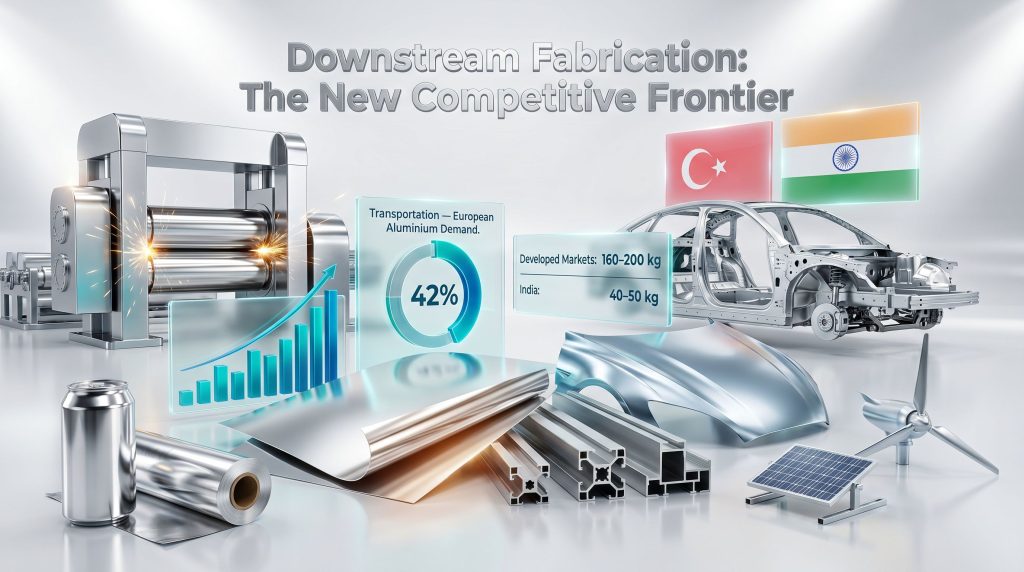
Transportation remains the single largest end-use category for aluminium globally, and its influence is intensifying as electrification mandates tighten across North America, Europe, and increasingly Asia. In Europe, transportation accounts for approximately 42% of regional aluminium end-use consumption, with construction representing around 23% and packaging contributing approximately 17%, according to downstream aluminium end-use trends.
The structural case for aluminium in transportation rests on three converging pressures:
- Regulatory emissions targets that reward vehicle mass reduction
- Battery electric vehicle platform design, where lightweighting directly extends driving range
- Commercial vehicle fuel efficiency economics, where payload optimisation translates into measurable operating cost advantages
One of the more technically significant developments in this space has been the demonstration of aluminium alloy formulations capable of reducing commercial truck engine weight by approximately 15%. This is not a marginal refinement. Moving aluminium from structural and body applications into performance-critical powertrain components represents a genuine expansion of the metal's addressable market within transportation. The electric vehicle transformation is, consequently, reshaping specification requirements across virtually every segment of the automotive supply chain. Each kilogram eliminated from an engine block translates into compounding efficiency benefits across a vehicle's operational lifetime.
The India Demand Gap: The Industry's Most Significant Untapped Opportunity
Perhaps no single data comparison better illustrates the potential scale of future aluminium demand growth than the per-vehicle aluminium content differential between emerging and developed automotive markets. India's transportation sector has expanded aluminium consumption by 14% over the past five years, yet the average Indian vehicle currently incorporates only 40 to 50 kilograms of aluminium. Vehicles in the United States, Europe, and Japan regularly contain 160 to 200 kilograms.
| Market | Average Aluminium Content Per Vehicle | 5-Year Transport Demand Growth |
|---|---|---|
| Developed Markets (U.S., Europe, Japan) | 160-200 kg | Moderate, maturing |
| India (Current Average) | 40-50 kg | +14% |
| Southeast Asia (Emerging) | 50-80 kg (estimated) | Accelerating |
As Indian automakers align manufacturing specifications with global efficiency and safety standards, the incremental aluminium demand generated by closing even a fraction of this content gap would represent a substantial addition to global consumption volumes. This is not speculative. It is a function of regulatory convergence that is already underway.
Packaging: Recyclability as a Commercial and Legal Asset
Beverage and food packaging continues to represent one of aluminium's most structurally stable demand categories. The metal's closed-loop recyclability credentials have shifted from being a marketing talking point to a genuine procurement criterion among major consumer goods manufacturers operating under sustainability commitments and emerging extended producer responsibility regulations.
The strategic weight of downstream packaging assets was illustrated in an unusual way by a legal dispute in which Boston Beer agreed to pay USD 191 million to aluminium can manufacturer Ardagh. While the circumstances of the settlement relate to specific contractual obligations, the scale of the financial consequence reflects how consequential downstream supply agreements have become in packaging markets. Long-term contracts for aluminium can supply are no longer peripheral commercial arrangements. They carry substantial financial exposure.
Renewable Energy and Electrical Infrastructure: The Emerging Volume Driver
Grid modernisation programs, solar mounting infrastructure, wind turbine nacelles and housings, and battery enclosure systems are collectively creating new high-volume demand channels for aluminium. The metal's combination of low weight, corrosion resistance, and electrical conductivity makes it difficult to displace across many of these applications.
In addition, the push toward green metals production is reinforcing the case for aluminium in renewable energy infrastructure, given its favourable lifecycle sustainability profile. Electrification investment cycles are expected to sustain elevated aluminium consumption in electrical engineering applications well into the late 2020s, with transmission infrastructure expansion representing a particularly large and consistent demand source in both developed and emerging markets.
Consumer Electronics: Where Perception Drives Industrial Strategy
Premium consumer electronics occupy a disproportionate position in aluminium's demand narrative relative to the actual tonnage they consume. Reports surrounding the alleged aluminium frames planned for Apple's upcoming iPhone 18 Pro Max generated significant industry attention in mid-2026, reinforcing the metal's enduring position as the preferred structural material in high-end portable electronics.
This matters beyond the units sold. Consumer products shape material perception, and material perception influences specification decisions in adjacent industries. The engineer designing an automotive interior component or a medical device casing operates within a broader cultural context about which materials signal quality and precision. Aluminium's consistent presence in premium consumer electronics reinforces its positioning across a much wider range of industrial applications than smartphone production alone would suggest.
Similarly, Royal Enfield's Classic 650 motorcycle launch demonstrated how aluminium remains central to the design philosophy of modern mobility products, integrated across frames, engine casings, and component systems to meet performance and weight targets while maintaining aesthetic integrity.
The Selective Reality: Not All Downstream Segments Are Growing
The downstream aluminium narrative requires careful segmentation. The growth story is real, but it is not uniform, and conflating expanding segments with contracting ones produces a misleading picture of industry health.
Novelis restarting its Oswego facility, the largest aluminium rolling mill in the United States, signals sustained and confident demand from automotive customers for high-specification flat rolled products. At the same time, Hydro announced the closure of two U.S. aluminium extrusion plants scheduled for 2027, reflecting overcapacity conditions and margin compression in segments where demand growth has not kept pace with installed capacity.
Downstream aluminium must be assessed at the product-segment level. Transportation-linked rolled products and renewable energy components are in structural growth phases, while certain extrusion and general construction-adjacent segments face near-term consolidation pressures.
| Downstream Segment | Growth Classification | Key Demand Driver |
|---|---|---|
| Automotive flat rolled products | High structural growth | EV lightweighting, OEM supply chains |
| Aluminium foil (packaging) | Stable high-volume | Recyclability mandates, sustainability procurement |
| Renewable energy components | Accelerating | Grid modernisation, solar, wind |
| General extrusions | Consolidating | Overcapacity in select markets |
| Consumer electronics | Niche, perception-influencing | Premium aesthetics, material performance |
| Transmission and electrical | Emerging high-growth | Electrification infrastructure investment |
Trade Policy and the New Competitive Frontier
One of the more underappreciated dimensions of the downstream aluminium story is the degree to which governments have repositioned their industrial policy focus from upstream raw material security to downstream fabrication capability. However, this shift is not occurring in isolation. US aluminium tariffs have accelerated this strategic reorientation by prompting nations to reconsider where along the value chain they wish to compete.
Turkey extended anti-dumping duties on Chinese aluminium foil imports for a further five-year period, signalling a long-term institutional commitment to protecting domestic foil conversion manufacturing rather than simply regulating trade flows. India maintained anti-dumping protections on selected Asian aluminium foil imports through 2026, reflecting a parallel strategic priority to retain value-added manufacturing domestically.
| Policy Action | Country | Segment Protected | Duration |
|---|---|---|---|
| Anti-dumping duty extension on aluminium foil | Turkey | Foil conversion manufacturing | 5 years |
| Anti-dumping protection on foil imports | India | Foil fabrication | Through 2026 |
| Rolling mill capacity restart | United States | Automotive flat rolled products | Ongoing |
| Extrusion plant closure announcements | United States | General extrusion capacity | By 2027 |
These are not isolated trade disputes. They represent a fundamental reorientation of industrial strategy in which the competitive battleground has shifted from smelters to fabricators. For decades, controlling bauxite deposits and smelting capacity was sufficient to secure strategic advantage in aluminium markets. Increasingly, the entities that control high-specification rolling mills, foil converters, and precision extrusion facilities hold the most defensible and highest-margin positions across the value chain.
The next major ASX story will hit our subscribers first
What the Flat Rolled Products Sector Reveals About Downstream Health
The aluminium flat rolled products sector functions as a reliable leading indicator of broader downstream demand conditions. FRP facilities supply automotive, packaging, construction, and industrial markets simultaneously, meaning that investment and capacity decisions made within this segment reflect aggregated demand signals from multiple end-use industries at once.
A concentrated group of global FRP producers effectively determines where capital flows within downstream aluminium, which alloy technologies gain commercial traction, and which end-use sectors receive supply priority and investment. Their capacity decisions, as demonstrated by the Novelis Oswego restart, carry outsized significance for understanding where genuine structural demand is located within the broader market. Furthermore, the battery materials demand cycle is increasingly influencing FRP investment decisions, as battery enclosure specifications drive new alloy development programmes.
Key demand drivers supporting flat rolled products through 2032 include:
- Automotive lightweighting and EV platform design requirements
- Beverage and food can manufacturing sustained by recyclability preferences
- Building envelope and architectural panel applications
- Industrial and electrical engineering component fabrication
FAQ: Aluminium Downstream and End-User Demand
What does aluminium downstream demand actually measure?
Downstream aluminium demand refers to consumption of aluminium in fabricated and processed forms, including rolled sheet, extrusions, castings, foil, and finished components, rather than primary ingot. It covers all sectors that convert aluminium into intermediate or final products.
Which sector consumes the most aluminium globally?
Transportation is consistently the largest global end-use sector, driven by automotive lightweighting requirements, commercial vehicle efficiency economics, and the growing aluminium intensity of electric vehicle transformation platforms across all major markets.
Why does the India vehicle content gap matter to global aluminium markets?
With Indian vehicles averaging only 40 to 50 kilograms of aluminium versus 160 to 200 kilograms in developed markets, the incremental demand created by regulatory convergence and manufacturing modernisation represents one of the industry's most significant identified growth opportunities over the next decade.
How are anti-dumping trade policies affecting downstream aluminium?
Turkey and India have both implemented or extended anti-dumping protections specifically targeting downstream aluminium products such as foil. This reflects a strategic shift toward defending domestic fabrication capacity, not just upstream raw material access. The aluminium market price drivers associated with these policy shifts are increasingly consequential for producers and buyers operating in protected segments.
Is downstream aluminium demand growing uniformly?
No. Automotive-linked flat rolled products and renewable energy components are in strong structural growth phases, while certain extrusion segments face consolidation due to overcapacity. Aggregate demand figures can obscure these important intra-sector differences.
What is driving aluminium demand in renewable energy?
Transmission grid upgrades, solar mounting systems, wind turbine components, and battery enclosures all require aluminium's combination of low weight, corrosion resistance, and electrical conductivity, positioning the metal as a structural beneficiary of global electrification investment cycles.
The Strategic Conclusion: Downstream Is Where Value Is Being Created
The defining characteristic of aluminium downstream and end-user demand in 2026 is not aggregate volume growth. It is the accelerating migration of strategic and commercial value toward higher-specification, application-specific downstream products. The evidence is visible across multiple fronts simultaneously: automotive rolling mill restarts, packaging contract disputes worth hundreds of millions of dollars, alloy research targeting powertrain weight reduction, and trade policy increasingly focused on protecting fabrication capacity rather than primary production.
Producers, investors, and policymakers who understand this compositional transition are better positioned to identify where genuine value creation is occurring within the aluminium supply chain. The post-smelter era is not approaching. Based on the signals emerging from 2026's downstream landscape, it is already here.
Disclaimer: This article contains forward-looking statements and market projections based on currently available data and industry reporting. Actual demand outcomes may differ materially from projections due to macroeconomic changes, technology shifts, policy developments, or other unforeseen factors. This content is for informational purposes only and does not constitute investment advice.
Want to Identify the Next Major ASX Mineral Discovery Before the Broader Market?
Discovery Alert's proprietary Discovery IQ model delivers real-time alerts on significant ASX mineral discoveries — instantly turning complex resource data into actionable investment insights for both short-term traders and long-term investors. Explore historic examples of exceptional discovery returns and start your 14-day free trial today to position yourself ahead of the market.