
June 30, 2026
The Electricity Paradox Reshaping North American Aluminium Supply
Few industrial supply chains reveal the complexity of modern trade policy quite like primary aluminium. Unlike commodities that can be stored indefinitely or substituted with relative ease, aluminium production is anchored to geography, energy infrastructure, and decades-old smelting investments. When tariff regimes shift abruptly, the ripple effects move through pricing, logistics, customer relationships, and capital allocation decisions simultaneously. Understanding how producers navigate these shocks offers a window into the structural forces that govern one of the world's most strategically important metals.
When big ASX news breaks, our subscribers know first
Rio Tinto Aluminium Exports to US Recover Pre-Tariff Levels: The Numbers Behind the Recovery
The recovery of Rio Tinto aluminium exports to US pre-tariff levels is not simply a logistics story. It represents a full-cycle stress test of how a major integrated producer responds to sudden trade disruption, and what the return to normalcy actually looks like in commercial terms.
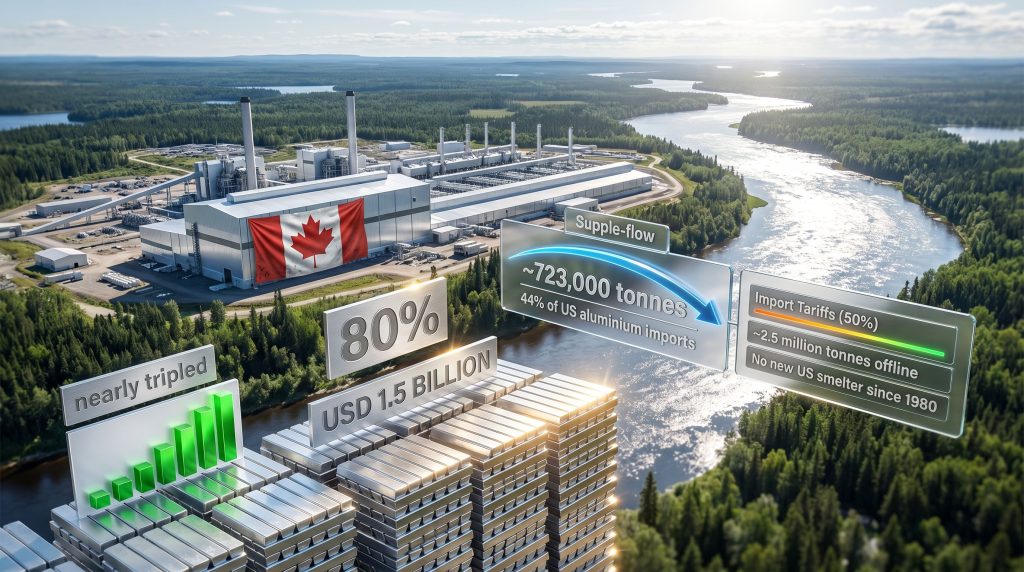
Before the imposition of steep import duties, approximately 80% of Rio Tinto's North American aluminium output was directed toward US customers. Canada's structural role as the dominant US aluminium supplier underpinned this arrangement, with the country accounting for roughly 44% of total US aluminium imports. Rio Tinto's Canadian operations shipped approximately 723,000 tonnes to the US in the first half of the reference period, reflecting a deeply entrenched cross-border commercial relationship built over decades.
When the US imposed 50% import duties on aluminium, the economics of that relationship changed overnight. The US-bound share of Rio Tinto's North American output contracted sharply to the mid-60% range, a deviation that forced rapid commercial restructuring. The company responded on two fronts simultaneously: redirecting Canadian volumes toward European buyers who could absorb the metal at competitive prices, and purchasing at least 50,000 tonnes from the US domestic spot market to maintain supply continuity for American customers without triggering full tariff exposure.
Today, the allocation has recovered to approximately 80% of North American output directed toward the US, closely matching historical norms. That recovery reflects restored customer relationships, re-established logistics contracts, and margin improvement driven by elevated US premiums. According to Bloomberg's coverage of the rebound, this recovery marks a significant milestone for cross-border aluminium trade flows.
The mid-60% to 80% swing in US-directed shipment share is more than a logistics adjustment. It reflects a complete recalibration of commercial strategy under acute tariff pressure, and the pathway back reveals which structural advantages actually hold under stress.
The European Diversion Strategy: What It Reveals About Canadian Aluminium's Competitive Position
The temporary redirection of Canadian aluminium volumes toward European buyers during peak tariff disruption was not simply an emergency measure. It was commercially viable precisely because Canadian aluminium carries attributes that European buyers actively value.
Quebec-produced aluminium, powered by abundant hydroelectric energy, carries a significantly lower carbon footprint than coal-fired alternatives from other producing regions. As European industrial buyers face tightening sustainability procurement requirements, lower-carbon metal commands a pricing premium that offsets longer logistics chains. This dynamic made European diversion economically rational rather than merely reactive.
The ability to pivot toward Europe and then pivot back to the US also demonstrates the optionality embedded in Canadian production geography. Producers with access to multiple deep buyer pools across different trade blocs hold a structural advantage over captive suppliers whose economics depend entirely on a single regional market.
The spot market procurement strategy during the disruption period illustrated a different kind of trade-off calculation. Purchasing pre-tariff US inventory meant paying spot market premiums, but those premiums were mathematically preferable to absorbing a 50% import tariff on direct Canadian shipments at full volume. This kind of granular arbitrage analysis, running in real time across thousands of tonnes of metal, reflects the operational sophistication required to manage supply chains at scale during trade policy disruption. Furthermore, the impact of US aluminium tariffs continues to reshape strategic decision-making across the entire sector.
Three Forces Driving the US Midwest Premium Higher
The US Midwest premium, the above-benchmark surcharge paid for aluminium delivered into the region, has nearly tripled since mid-last year. Understanding why requires examining three independent forces that converged simultaneously.
| Driver | Mechanism | Market Impact |
|---|---|---|
| 50% import tariffs | Raises landed cost of all non-exempt foreign aluminium | Significant upward pressure on domestic pricing |
| Middle East capacity disruption | ~2.5 million tonnes of smelting offline | Tightens global supply availability |
| Structural US production deficit | No new primary smelter built since 1980 | No domestic buffer to absorb supply shocks |
Import tariffs created an immediate pricing floor by raising the cost of bringing foreign metal into the US market. Even tariff-exempt suppliers benefit from this floor because their competitive position improves relative to tariff-exposed alternatives. In addition, the broader consequences of trade wars and tariffs in 2025 have amplified supply chain vulnerabilities across multiple commodity sectors.
Middle East supply disruption added a global dimension to what might otherwise have been a purely bilateral US-Canada trade story. Conflict in the Gulf region has taken an estimated 2.5 million tonnes of annual aluminium smelting capacity offline, with infrastructure damage and logistics constraints through the Strait of Hormuz affecting both production and material movement. The knock-on effect redirected European and Asian buyers toward Canadian, Australian, and New Zealand producers, indirectly tightening the supply available for US consumption.
Structural domestic production limitations represent the third force, and arguably the most durable. The US has not built a new primary aluminium smelter since 1980. Decades of closures, driven by high energy costs and import competition, have left the country with minimal primary production capacity. When import barriers rise and global supply tightens simultaneously, there is no domestic buffer to moderate the price response.
The convergence of tariff-driven import barriers, geopolitical supply destruction, and a four-decade domestic capacity deficit has produced an unusually tight North American aluminium market, one that structurally advantages established Canadian producers with existing US customer relationships.
Why the Electricity Market Has Become the Defining Variable for Aluminium Economics
The question of whether to build new US primary aluminium smelting capacity illuminates a structural shift in energy economics that extends far beyond the aluminium industry.
Aluminium smelting ranks among the most electricity-intensive industrial processes in existence. Power costs typically represent 30 to 40% of total production costs in a primary smelter, making the price and reliability of electricity the single most important variable in determining whether a facility is economically viable. Historically, US smelters competed by locating near hydroelectric or low-cost coal power sources. That calculus has fundamentally changed.
The rapid expansion of data centre infrastructure, driven by artificial intelligence compute demand, has created a new class of industrial electricity buyer. Data centre operators can sustain electricity prices two to three times higher than the threshold required for competitive aluminium smelting economics. This creates a structural electricity price floor in US grid markets that aluminium smelting cannot profitably exceed.
The practical consequence is that even if a company wanted to build a new US primary smelter, it would face the challenge of securing long-term power purchase agreements at rates that make the economics work, in a market where competing bidders can pay multiples more for the same electrons. Quebec's hydroelectric infrastructure does not face this competition to the same degree, providing a cost base that US grid electricity increasingly cannot replicate.
This dynamic explains why Rio Tinto's investment thesis remains anchored in Canada rather than the US, even as tariff conditions have improved the economics of serving the American market. Consequently, Rio Tinto's repowering of Gladstone aluminium operations underscores how the company continues to prioritise energy-advantaged facilities across its global portfolio.
The AP60 Expansion: What a USD 1.5 Billion Investment Actually Achieves
Rio Tinto recently commenced operations at the expanded AP60 smelter complex in Quebec's Saguenay-Lac-Saint-Jean region, representing the company's largest recent capital commitment in primary aluminium at USD 1.5 billion.
Saguenay-Lac-Saint-Jean is one of North America's most significant aluminium production clusters. The region's combination of abundant hydroelectric power, established smelting infrastructure, skilled workforce, and proximity to US markets makes it a natural anchor for North American aluminium strategy. The low-carbon credentials of hydroelectric-powered production are increasingly valued by US industrial buyers navigating their own supply chain decarbonisation requirements.
A critical technical nuance worth understanding is what the AP60 expansion actually accomplishes in production terms. The new capacity is primarily designed to offset output losses from ageing potline retirements at existing facilities, rather than representing a pure net capacity addition. Aluminium smelters operate through a series of electrolytic reduction cells, or potlines, that degrade over decades of continuous operation. Replacing ageing potline capacity with more efficient AP60 technology serves multiple purposes simultaneously:
- Production continuity: Prevents net output decline as older infrastructure reaches end-of-life
- Efficiency improvement: AP60 technology operates at higher energy efficiency than legacy potlines, reducing per-tonne power consumption
- Carbon footprint reduction: More efficient electrolysis with lower-carbon power further improves the environmental profile of the metal produced
- Customer relationship preservation: Maintaining output levels protects supply commitments to long-standing US and European customers
The net effect stabilises Rio Tinto's North American production base rather than dramatically expanding it in isolation. Investors should interpret this investment as a strategic maintenance and modernisation decision rather than an aggressive capacity growth play. Furthermore, the economic benefits of decarbonisation in mining are becoming an increasingly compelling driver behind capital allocation decisions of this kind.
The next major ASX story will hit our subscribers first
The Oklahoma Smelter: A Different Strategic Calculation
While Rio Tinto has determined that new US primary smelting capacity does not fit its investment framework, other industry participants have reached a different conclusion. Emirates Global Aluminium has confirmed plans to build the first new US primary aluminium smelter since 1980, with Century Aluminum joining as a project partner for the proposed Oklahoma facility.
| Company | US Smelter Plans | Strategic Rationale |
|---|---|---|
| Rio Tinto | No new US smelter planned | Prioritising Canadian hydroelectric-cost advantage |
| Emirates Global Aluminium | Oklahoma facility confirmed | Domestic supply positioning, tariff insulation |
| Century Aluminum | Partner in Oklahoma project | Expanding domestic production footprint |
The Oklahoma project's viability will depend critically on securing competitively priced long-term power. Oklahoma has historically offered relatively lower industrial electricity costs compared to coastal US markets, which may provide sufficient margin above the data centre price floor. Whether the economics work over a multi-decade smelter lifespan, across varying tariff regimes and energy market conditions, remains one of the more significant capital allocation questions in the North American metals sector.
Construction is expected to commence before year-end, making this project's progress a meaningful indicator of whether the current tariff and premium environment is durable enough to justify the long-dated capital commitment that primary smelter construction requires.
Canada's Irreplaceable Role in US Aluminium Supply Security
The tariff shock and subsequent recovery episode has reinforced rather than undermined Canada's structural importance to US aluminium supply. At 44% of US aluminium imports, Canada's contribution cannot be substituted at scale over any commercially realistic timeframe. Geographic proximity, established logistics infrastructure, trade exemption status under relevant agreements, and the lower-carbon profile of hydroelectric-powered production collectively create a competitive position that no alternative supplier currently matches.
An underappreciated dimension of this relationship is the carbon premium trajectory. As US industrial buyers face increasing pressure from customers, regulators, and investor frameworks to decarbonise their supply chains, the embodied carbon content of input materials becomes a pricing variable rather than simply an environmental metric. Canadian aluminium produced with hydroelectric power carries substantially lower lifecycle emissions than coal-powered alternatives from other major producing regions. This differential is likely to become more commercially significant over time, adding a layer of pricing power to Canadian producers that extends beyond pure cost competition.
The combination of geographic advantage, energy cost structure, carbon credentials, and established customer relationships creates what amounts to a durable competitive moat for Canadian aluminium production, one that a 50% tariff tested severely but ultimately could not dismantle. However, understanding how the top aluminium mining companies are positioning themselves globally provides essential context for assessing where long-term competitive advantage truly lies. As illustrated by mining.com's analysis of tariff-driven purchasing shifts, even major producers must adapt their procurement strategies when trade dynamics shift dramatically.
Frequently Asked Questions
What percentage of Rio Tinto's North American aluminium now goes to the US?
Approximately 80% of Rio Tinto's North American aluminium output is currently directed to the US market, closely matching historical pre-tariff trading patterns. At peak tariff disruption, this share had fallen to the mid-60% range.
How much aluminium capacity has been lost in the Middle East?
An estimated 2.5 million tonnes of annual aluminium smelting capacity in the Middle East is currently offline due to infrastructure damage and logistics disruption, contributing to tighter global supply conditions and elevated premiums in North American and European markets.
Why won't Rio Tinto build a new aluminium smelter in the United States?
The primary barrier is electricity cost competition. Data centre operators competing for US grid power can sustain electricity prices two to three times higher than what aluminium smelting economics require, making new US smelter construction commercially unviable compared to Quebec's low-cost hydroelectric alternative.
How much has the US Midwest aluminium premium increased?
The US Midwest premium has nearly tripled since mid-last year, driven by import tariffs, geopolitical supply disruption in the Middle East, and the structural absence of new domestic primary production capacity.
How did Rio Tinto manage US customer supply during peak tariff disruption?
Rio Tinto purchased at least 50,000 tonnes of aluminium from the US domestic spot market to maintain supply to American customers while direct cross-border shipments were commercially constrained by the 50% import tariff. This approach exemplifies how Rio Tinto aluminium exports to US pre-tariff levels were ultimately restored through a combination of strategic flexibility and commercial discipline.
This article contains forward-looking statements and market analysis based on publicly available information. It does not constitute financial advice. Readers should conduct their own due diligence before making any investment decisions. Commodity market conditions, trade policy settings, and company strategies are subject to change.
Want To Capitalise on the Next Major ASX Mineral Discovery Before the Broader Market?
Discovery Alert's proprietary Discovery IQ model delivers real-time alerts on significant ASX mineral discoveries, transforming complex mineral data into actionable insights for both short-term traders and long-term investors — start your 14-day free trial today and gain a market-leading edge, or explore Discovery Alert's dedicated discoveries page to understand how historic mineral discoveries have generated substantial returns.