August 13, 2026
The Structural Forces Reshaping Aluminium Extrusion Through 2035
Few industrial materials illustrate the tension between cyclical pricing and structural demand as clearly as aluminium extrusions. While headline market valuations shift with every swing in London Metal Exchange primary aluminium spot prices, the underlying consumption trajectory has been remarkably consistent for over two decades. What is changing now is the composition of that growth. Electric mobility, decarbonisation investment, and digitally optimised manufacturing are layering new, durable demand vectors onto an already substantial base, creating a market that looks fundamentally different in 2035 than it did in 2015.
Understanding the aluminium extrusion market outlook requires more than tracking a single headline figure. It demands an appreciation of how billet economics, alloy selection, die engineering, surface finishing, and end-use application interact to determine where value is created and captured across a global supply chain spanning more than 1,600 producers.
When big ASX news breaks, our subscribers know first
How Big Is the Global Aluminium Extrusion Market in 2025?
Arriving at a single, definitive market size figure is more complicated than it might appear, because the traded value of extrusions is directly tied to billet pricing, which itself moves with primary aluminium spot prices and regional delivery premiums. This creates natural variance between research providers depending on their base-year definitions, application scope, and whether downstream fabrication value is included in the headline number.
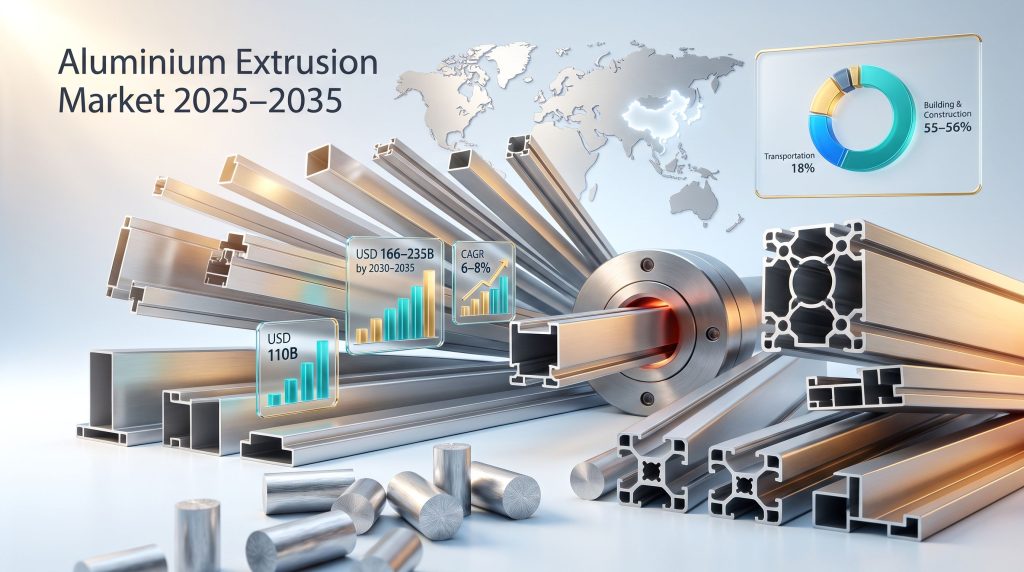
Across the range of available forecasts, the global aluminium extrusion market is estimated at approximately USD 110 billion in 2025, sitting within a broader research range of USD 95 billion to USD 139 billion depending on methodology. The directional consensus, however, is unambiguous: the market is on a sustained upward trajectory regardless of which valuation framework is applied.
| Forecast Scenario | 2025 Estimate | 2030-2035 Target | CAGR |
|---|---|---|---|
| Conservative | ~USD 95-100B | ~USD 141-147B | ~6.0-6.5% |
| Consensus Mid-Range | ~USD 110B | ~USD 166-170B | ~7.0-7.2% |
| High-Growth | ~USD 130-139B | ~USD 192-245B | ~7.5-8.4% |
| Extended Horizon (to 2035) | ~USD 110B | ~USD 195-235B | ~6-8% |
The 2024 base-year figure sat at approximately USD 100-105 billion, rising to the current 2025 estimate of around USD 110 billion, with projections suggesting a near-term milestone of approximately USD 118 billion by 2026 and a longer-run target of USD 195-235 billion by 2035. According to Grand View Research's aluminium extrusion analysis, these growth projections are underpinned by consistent demand expansion across both developed and emerging markets.
A critical nuance that many analysts overlook: because market valuation is billet-led, any significant move in primary aluminium prices will shift the headline number without any change in underlying consumption volumes. Volume-based tracking is therefore a more reliable indicator of structural demand than dollar-denominated valuations alone.
Breaking Down Global Extrusion Demand by End-Use Sector
Construction: The Indispensable Foundation
Building and construction has held the dominant position in global extrusion consumption for decades, currently accounting for approximately 55-56% of total global demand. The breadth of construction applications helps explain this resilience: fenestration systems, curtain walls, structural glazing, internal partitioning, concrete formwork, scaffolding systems, and increasingly, solar panel mounting frames all rely on extruded aluminium profiles.
Green building certification frameworks and tightening energy efficiency mandates across major construction markets are reinforcing aluminium's structural role rather than threatening it. The material's combination of thermal performance, particularly in thermal-break profile configurations, corrosion resistance, and design flexibility makes it difficult to substitute in high-performance building envelopes. Sustained urbanisation across Asia-Pacific and the Middle East underpins the long-run demand base.
Electric Vehicles: The Most Consequential Growth Vector
Transportation represents approximately 18% of global extrusion consumption and is among the fastest-expanding segments in the market. What makes this segment particularly compelling from a structural demand perspective is the shift from internal combustion vehicles to battery electric vehicles, which are systematically more aluminium-intensive.
Average aluminium extrusion content per battery electric vehicle is projected to increase from approximately 65 kg to 80 kg by 2030, driven by the proliferation of dedicated EV architectures that specify extruded aluminium for:
- Battery enclosure structures and underbody protection systems
- Thermal management trays and cooling channel assemblies
- Crash management systems and front/rear energy absorbers
- Body-in-white structural members and door sill reinforcements
- Space-frame components in premium and performance applications
The physics underlying this trend are straightforward. Every 100 kg reduction in vehicle mass can improve driving range by an estimated 10-15%, creating a durable, specification-driven incentive for original equipment manufacturers to maximise extrusion content wherever weight savings can be realised. This is not a trend dependent on policy preferences; it is anchored in the fundamental relationship between mass and battery range efficiency.
Renewable Energy and Electrical Infrastructure
Solar panel framing and ground-mount racking systems represent a growing and relatively underappreciated incremental demand source for the extrusion industry. As global solar installation rates accelerate under decarbonisation investment programmes, the cumulative aluminium extrusion demand from the energy sector is becoming a structurally meaningful contributor to the overall market. Furthermore, the broader push toward green metals production is reinforcing the case for low-carbon aluminium profiles across renewable infrastructure projects.
The electrical and electronics segment, encompassing busbars, conductor profiles, heat sinks, and EV thermal management hardware, is also expanding. The 1xxx alloy series is gaining market share within this segment due to its superior electrical conductivity characteristics relative to the structural 6xxx alloys that dominate overall production volumes.
Alloy Selection, Profile Geometry, and Surface Finishing: The Technical Architecture of the Market
Alloy Series and Their Applications
The 6xxx alloy series dominates global extrusion production in volume terms. Within this group, alloy 6063 is the workhorse of architectural applications, offering excellent surface finish capability and moderate strength. For structural and automotive requirements demanding higher mechanical performance, alloys 6061, 6082, and 6005A are the standard specifications.
| Alloy Series | Primary Applications | Growth Trajectory |
|---|---|---|
| 6xxx (6063, 6061, 6082) | Architecture, structure, automotive | Dominant; stable growth |
| 1xxx | Busbars, conductors, EV electronics | Growing with electrification |
| 5xxx | Marine, transport, industrial | Niche; steady |
| 7xxx | Aerospace, high-performance structural | Low volume; premium pricing |
Profile Geometry: Solid, Hollow, and Semi-Hollow
Profile geometry is a technically important dimension of market segmentation that receives less attention in broad market analyses. Solid profiles lead by tonnage and serve the majority of general construction and industrial applications. Hollow and semi-hollow profiles, produced using porthole dies and bridge dies respectively, are gaining importance in EV battery enclosures, structural tubing, and thermal management assemblies.
The die engineering complexity required to produce hollow and semi-hollow profiles with tight dimensional tolerances is meaningfully higher than solid profiles. Consequently, producers capable of precision hollow extrusion command pricing premiums and are better positioned to serve the most demanding automotive and aerospace applications.
Surface Finishing and Value Addition
Surface treatment is where commodity extrusion transitions into higher-margin product. Mill finish profiles lead by volume across general industrial and construction applications, but:
- Anodised finishes command premium pricing in architectural, decorative, and transport applications due to their hardness and corrosion resistance
- Powder-coated profiles serve high-value construction, façade, and transport markets with a broad colour palette and durable finish
- Thermal-break profiles combine extruded aluminium sections with thermally insulating polyamide barriers, and are increasingly specified in energy-efficient fenestration systems to meet building performance standards
The shift toward higher-specification surface treatments is one of the clearest indicators that the industry's growth trajectory is moving from volume-led to value-led competition.
Regional Dynamics: Where the Market Is Won and Lost
Asia-Pacific: Scale, Concentration, and Emerging Competition
Asia-Pacific's dominance of the global aluminium extrusion market is difficult to overstate. The region accounts for approximately 74% of global extrusion demand, with China alone representing 66% of global usage in 2023. China's installed extrusion capacity stands at approximately 64% of the global total, distributed across more than 500 extrusion companies with combined capacity exceeding 30 million tonnes.
China Zhongwang stands out as the largest single-site producer, with annual capacity of approximately 850,000 tonnes, a scale that illustrates both the concentration of Chinese production and the structural overcapacity that has kept global extrusion pricing under pressure.
India is emerging as the most significant secondary growth engine within the region, driven by sustained infrastructure investment, domestic manufacturing expansion, and a construction sector operating at a substantially earlier stage of development than China's. For a deeper perspective on the Australia aluminum extrusion market, regional dynamics highlight how smaller developed markets are carving out specialised, high-value niches within the broader Asia-Pacific growth story.
North America: Trade Policy Reshaping Domestic Investment
North America represents one of the more dynamically changing markets in the global extrusion landscape. Demand is expanding across green building construction, EV production ramp-ups, and reshoring of manufacturing capacity. However, the most structurally significant development in recent years has been the introduction of preliminary US countervailing duties on extrusion imports from China, Indonesia, Mexico, and Turkey.
These US aluminium tariffs are incentivising domestic capacity investment, particularly in automated press lines with higher throughput and tighter dimensional tolerances. Domestic producers including Arconic, Kaiser Aluminium, Universal Alloy, and Bonnell Aluminium are the principal beneficiaries of this supply chain reconfiguration. In addition, tariff-driven supply chains are prompting downstream buyers to reassess their sourcing strategies more broadly.
Europe: Sustainability Pressure and Energy Cost Headwinds
European extrusion demand is comparatively mature, with growth constrained by elevated energy costs and the uneven economic performance of core manufacturing economies. The EU Carbon Border Adjustment Mechanism is accelerating the transition toward low-carbon billet sourcing and higher post-consumer scrap integration among European producers. Key players including Hydro, Constellium, Otto Fuchs, ST Extruded Products, Alumil, and Grupa Kety are navigating this combination of regulatory pressure and cost challenge simultaneously.
Middle East: Low-Cost Energy as a Structural Advantage
The Middle East is scaling both primary billet production and finished extrusion capacity, underpinned by access to competitively priced energy that provides a structural cost advantage relative to European producers in particular. Gulf Extrusions, ALUPCO, and BALEXCO are the principal regional producers expanding capacity to serve both export and domestic construction markets.
The Economics of Extrusion: Cost Drivers That Determine Competitiveness
Billet: Where Extrusion Economics Begin
Billet is the foundational cost input in extrusion production, and its quality directly determines the quality of the finished profile. Global billet consumption for extrusion reached 42.84 million tonnes in 2024, a figure that underscores the scale of this critical input market.
The extrusion process itself involves heating billets to temperatures between 375°C and 500°C before forcing the softened metal through precision-engineered steel dies using hydraulic presses. Press capacity spans an enormous range, from 100 tonnes for small-section precision profiles to 15,000 tonnes for large structural sections used in aerospace and heavy transport applications.
A less commonly understood dynamic: billet pricing does not simply track LME aluminium prices. Regional delivery premiums, alloy composition surcharges, and the growing differential between primary and recycled billet add layers of complexity to extrusion cost modelling that can significantly affect producer margins even when LME prices are stable.
Energy, Automation, and Process Efficiency
Energy is the second-largest cost component in extrusion after billet, and its significance varies dramatically by geography. European producers face the most acute energy cost pressure, accelerating investment in energy efficiency measures, renewable sourcing, and process digitalisation. Globally, producers are responding to margin pressure through:
- Installation of larger-capacity press lines that reduce energy consumption per tonne of output
- Robotics and automated handling systems that reduce labour costs and improve throughput consistency
- AI-assisted process controls that optimise billet temperature profiles, extrusion speed, and die cooling
- Digital twin technology for real-time die condition monitoring and predictive maintenance scheduling
Trade Policy and Geopolitical Risk as Cost Variables
The imposition of countervailing duties on extrusion imports from China, Indonesia, Mexico, and Turkey has introduced a structural cost variable into North American supply chain planning that did not exist at the same scale five years ago. For downstream buyers, this translates into the need to reassess supplier geography, contract duration, and inventory strategy. For producers, it creates both protective margin opportunities and investment incentives. Notably, aluminium sector investment is responding accordingly, with new joint ventures and capacity partnerships emerging across the value chain.
The next major ASX story will hit our subscribers first
The Competitive Landscape: Scale, Technology, and Sustainability
The global extrusion industry encompasses more than 1,600 companies operating across approximately 49 million tonnes of installed capacity. China's dominance at 64% of global capacity creates a structural overhang that persistently pressures global pricing, particularly in commodity-grade solid profiles.
| Metric | 2023 Data Point |
|---|---|
| Total global extrusion companies | 1,600+ |
| Global installed capacity | ~49 million tonnes |
| China's capacity share | ~64% |
| China's extrusion companies | 500+ |
| China's installed capacity | 30+ million tonnes |
| Largest single producer (Zhongwang) | ~850,000 tonnes/year |
Competitive dynamics are shifting in response. The next phase of industry competition will be won not on volume and price alone, but on:
- Technical capability to produce complex hollow and semi-hollow profiles with tight tolerances
- Sustainability credentials through post-consumer scrap integration and low-carbon billet sourcing
- Application-specific engineering capability for EV, aerospace, and precision industrial customers
- Digital process control that delivers consistent quality at scale
Producers with integrated recycling capability and access to post-consumer scrap hold a structural advantage that will compound through 2035 as both the carbon cost of primary billet and the regulatory pressure to demonstrate embedded emissions reduction intensify. The top aluminium companies are already investing heavily in this direction to secure their long-term competitive positioning.
Five Structural Trends Defining the Aluminium Extrusion Market to 2035
1. BEV Extrusion Content Growth
Average extrusion content per battery electric vehicle is rising from approximately 65 kg toward 80 kg by 2030, driven by dedicated EV platform architectures and OEM lightweighting mandates. This single trend could add millions of tonnes of incremental demand to the global extrusion market over the next decade.
2. Renewable Energy as a Recurring Demand Source
Solar framing, wind energy components, and grid transmission profiles are not one-cycle demand events. As global decarbonisation investment continues through 2035, the energy sector will provide a reliably recurring incremental demand base for the extrusion industry.
3. Low-Carbon Billet and Post-Consumer Scrap Integration
Global aluminium consumption is forecast to grow from 101.4 million tonnes in 2024 to 121 million tonnes by 2030, expanding the raw material base available to extruders. Within that growing base, the shift toward post-consumer scrap will reduce both embedded carbon intensity and production cost, particularly for producers operating in CBAM-affected markets.
4. Press Technology, Automation, and Digitalisation
The productivity gap between leading and lagging producers will widen as AI-assisted process controls, robotics, and digital twin monitoring become standard practice among top-tier extruders. Producers that delay this investment face an accelerating cost and quality disadvantage.
5. Product Differentiation Over Commodity Volume
Margin compression in commodity-grade solid profiles will intensify as Chinese overcapacity continues to exert downward pressure on global pricing. However, producers capable of delivering complex profiles, application-specific engineering, and premium surface finishes will capture disproportionate value from the industry's structural growth.
Frequently Asked Questions: Aluminium Extrusion Market Outlook
What is the projected market size by 2030?
Most forecasts place the global aluminium extrusion market between USD 141 billion and USD 170 billion by 2030, with a consensus mid-range of approximately USD 166-170 billion at a compound annual growth rate of 7.0-7.2%.
Which sector generates the most extrusion demand?
Building and construction accounts for approximately 55-56% of global extrusion consumption, making it the largest end-use sector by a considerable margin.
Which region dominates production and consumption?
Asia-Pacific accounts for approximately 74% of global demand, with China alone representing around 66% of global usage and holding 64% of global installed capacity.
What is the most widely used alloy in extrusion production?
The 6xxx alloy series is dominant, led by alloy 6063 for architectural applications and alloys 6061 and 6082 for structural and automotive specifications.
How are electric vehicles changing demand dynamics?
EVs are driving a structural increase in aluminium extrusion content per vehicle, with battery enclosures, crash management systems, and thermal management components pushing average content from approximately 65 kg toward 80 kg per vehicle by 2030. The broader aluminium extrusion market outlook for the next decade is closely tied to the pace and scale of this EV-driven transition.
What are the primary risks to the market outlook?
Key risks include energy price volatility affecting production economics, Chinese overcapacity placing downward pressure on global extrusion pricing, geopolitical trade disruptions affecting supply chain planning, and variation in the pace of EV adoption across major automotive markets.
Disclaimer: All market size figures, CAGRs, and forecasts referenced in this article are drawn from third-party industry research and represent estimates subject to revision. They should not be interpreted as investment advice. Readers should conduct independent due diligence before making any investment or business decisions based on market projections.
Want to Identify ASX Mineral Discoveries Before the Broader Market Does?
Discovery Alert's proprietary Discovery IQ model delivers real-time alerts on significant ASX mineral discoveries — instantly converting complex data across more than 30 commodities into clear, actionable insights for investors at every experience level. Explore Discovery Alert's discoveries page to understand why major mineral discoveries can generate exceptional market returns, and begin your 14-day free trial at Discovery Alert to position yourself ahead of the market.