
August 13, 2026
When a Single Smelter Shakes the World: Understanding the Al Taweelah Disruption
Global commodity markets have a unique sensitivity to concentration risk. When a disproportionate share of any critical material flows through a single facility, a single node in the supply network, the vulnerability is invisible until the moment it becomes catastrophic. That is precisely what the aluminum and alumina markets discovered on March 28, 2026, when one of the planet's largest single-site smelting operations was forced into an unplanned shutdown, sending benchmark prices surging across seven consecutive trading sessions and prompting a fundamental reassessment of Gulf aluminium supply security.
The EGA Al Taweelah smelter recovery has since become one of the most closely watched industrial rehabilitation programmes in the global metals sector, not simply because of its scale, but because of what it reveals about the structural vulnerabilities embedded in primary aluminium supply chains.
When big ASX news breaks, our subscribers know first
The Scale of What Was Lost: Al Taweelah in a Global Context
To appreciate the significance of the Al Taweelah disruption, it is necessary to understand just how large this facility is within the context of global aluminium production. The smelter houses 1,262 electrolytic reduction cells, each of which performs the core process of converting alumina into primary aluminium metal through electrolysis. At full operation, Al Taweelah represents a cornerstone of Emirates Global Aluminium's (EGA) production footprint and a critical source of primary metal for Asian and European buyers alike, served efficiently through Gulf shipping lanes.
The Khalifa Economic Zone, where Al Taweelah is located, sits in Abu Dhabi and is designed to function as an integrated industrial hub. The strikes on March 28, 2026, disrupted essential utility supply to the facility, forcing an emergency shutdown that immediately suspended hot metal output and halted outbound aluminium shipments from UAE ports.
For context, the disruption to a smelter of this scale is not equivalent to an ordinary plant maintenance shutdown. The entire electrolytic reduction process in aluminium smelting is continuous by design. Cells operate at temperatures exceeding 960 degrees Celsius, and when power or critical utilities are lost suddenly, molten aluminium and the cryolite bath within each cell begin to freeze. This phenomenon, known in the industry as a frozen pot, dramatically increases the complexity and cost of any restart.
The EGA Al Taweelah Smelter Recovery: A Technical Deep Dive
Why Restarting Is Far Harder Than Starting
One of the least understood aspects of the EGA Al Taweelah smelter recovery is precisely how technically demanding the restart process is. Unlike most industrial facilities where production can resume relatively quickly after a shutdown, aluminium smelters operate within extraordinarily narrow electrochemical parameters. Restarting requires not just restoring power, but rebuilding the thermal and chemical environment inside each cell from scratch.
The six-stage restart sequence progressing at Al Taweelah illustrates this complexity:
- Anode removal from each damaged or solidified cell, clearing the path for inspection and cleaning.
- Bath cleaning to remove the frozen cryolite electrolyte that solidifies when cells lose heat, a process now approximately 90% complete across all 1,262 cells.
- Frozen metal extraction, clearing solidified aluminium from more than 20% of cells, an ongoing phase as of mid-2026.
- Utility restoration, involving the phased ramp-up of natural gas and electricity availability in line with the restart programme's sequential demands.
- Sequential cell energisation, bringing cells back online in controlled batches to avoid grid instability and thermal shock that could damage refractory cell linings.
- Hot metal flow resumption, the final stage, targeted at pre-incident levels by Q1 2027.
This sequence cannot be compressed without risking thermal shock to the carbon lining of cells, which if cracked, requires full relining at significant cost and time. Industry precedent from comparable smelter restart events globally confirms that rushing the restart process routinely extends, rather than shortens, overall recovery timelines.
Recovery Milestone Tracker
The phased restart has been progressing since late May 2026, with the following confirmed milestones:
| Milestone | Status / Date |
|---|---|
| First reduction cell restarted | May 26, 2026 |
| Cells restarted by July 2, 2026 | 89 cells |
| Cells restarted by H1 2026 results | 227 cells |
| Anode removal across all cells | Complete |
| Bath cleaning progress | ~90% of all cells |
| Frozen metal clearance | >20% of cells |
| Current operating capacity | 18% of full capacity |
| Alumina refinery restart | Early July 2026, reaching 50% of pre-incident levels |
| Recycling plant current capacity | ~10% |
| Recycling plant full production target | Q4 2026 |
| Full hot metal output restoration target | Q1 2027 |
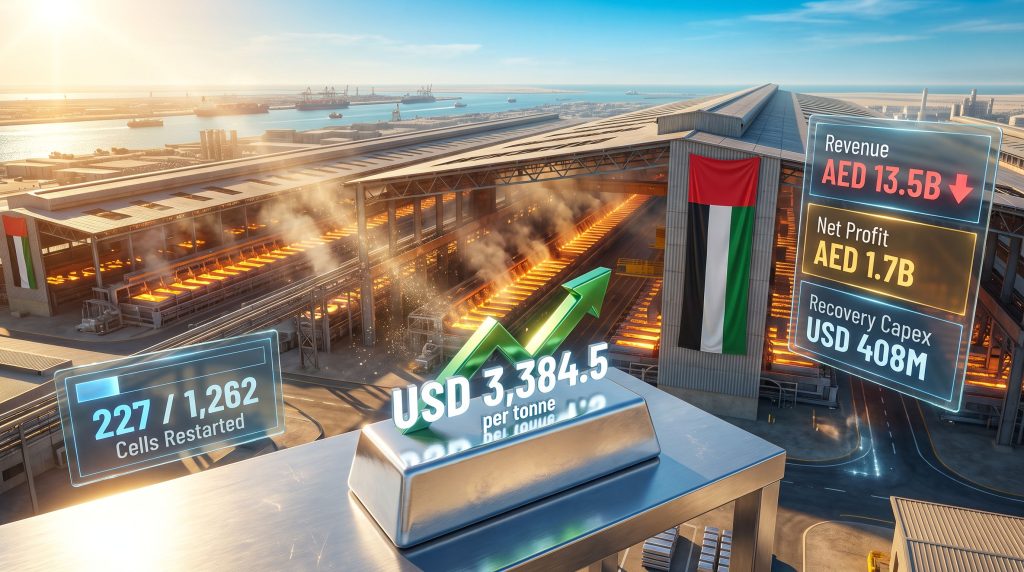
With 227 of 1,262 cells back online as of the half-year results, the programme is tracking along a timeline that will see the recovery span roughly twelve months from the initial shutdown. This is consistent with major smelter restart precedents in the industry, where full recovery from a cold freeze event at scale has historically taken between nine and fifteen months depending on the depth of damage.
According to EGA's official operations update, the facility remains a cornerstone of the UAE's industrial output, further underscoring why this recovery timeline is of national as well as commercial significance.
A lesser-known technical reality in smelter restarts is that the carbon cathode lining of each reduction cell has a finite lifespan even under normal operation, typically five to eight years. An uncontrolled freeze can cause the lining to crack due to thermal stress contraction, meaning some cells may require full relining rather than simple restart, adding both cost and time to the recovery programme.
How the Disruption Moved Global Aluminium Prices
The Seven-Session Rally and the Certainty Premium
Benchmark three-month aluminium on the London Metal Exchange rallied across seven consecutive trading sessions following the Al Taweelah shutdown, reaching a seven-week high of USD 3,384.5 per tonne. A concurrent feedstock disruption at Norsk Hydro's alumina operations in Brazil amplified the upward pressure by introducing doubt about alumina supply availability, which is the critical feedstock for primary aluminium production.
What followed is a textbook example of what traders refer to as the certainty premium. Once EGA confirmed that recovery was progressing on schedule toward a Q1 2027 restoration of full capacity, LME prices retreated 1.7% to USD 3,308 per tonne. The market had priced in a worst-case supply scenario and, upon receiving credible evidence that the disruption was bounded in both time and volume, partially unwound that premium.
This dynamic reveals an important nuance about how commodity markets process disruption news. It is not always the disruption itself that drives the maximum price impact. Often, it is the uncertainty about duration that sustains elevated prices. A confirmed recovery timeline, even one that extends twelve months, provides the market with the visibility it needs to begin rebalancing expectations.
Structural Deficit Conditions: The Price Floor Beneath the Volatility
Beyond the incident-specific price dynamics, the aluminium market entered 2026 already operating under structural deficit conditions. EGA's Chief Financial Officer confirmed this during the H1 2026 results presentation, noting that deficit conditions have provided meaningful support to margins even as production volumes declined sharply. Furthermore, these broader industrial metal pricing trends have reinforced the case for a sustained price floor throughout the recovery period.
The demand drivers sustaining this deficit are well established:
- Energy transition applications, particularly in electric vehicle battery housings, charging infrastructure, and grid-scale energy storage components that rely on aluminium's conductivity and weight characteristics.
- Automotive lightweighting, where aluminium continues to displace steel in body-in-white and structural applications across both combustion and electric vehicle platforms.
- Infrastructure investment cycles across Asia, the Middle East, and North America, all of which are aluminium-intensive in construction.
The deficit context means that even a partial recovery at Al Taweelah still leaves the global market in a tighter position than pre-incident projections anticipated.
Comparative Disruption Analysis
| Event | Location | Capacity Affected | LME Price Impact | Recovery Duration |
|---|---|---|---|---|
| Al Taweelah shutdown (2026) | UAE | ~18% operating (est. full capacity) | +7 sessions, peak USD 3,384.5/t | ~12 months (est.) |
| Hydro Alunorte curtailment (2018) | Brazil | ~50% of alumina output | Significant short-term spike | Several months |
| Rusal sanctions shock (2018) | Russia | ~6% of global primary supply | LME spike exceeding 30% | Months of uncertainty |
This table is provided for illustrative comparative purposes based on publicly available industry reporting. Past disruption events do not guarantee equivalent future market responses.
Financial Impact: Resilience Under Extraordinary Pressure
H1 2026 Results: Profit Despite the Damage
The financial results EGA reported for the first half of 2026 are notable for demonstrating the company's underlying earnings resilience despite an event its chief executive described as the most challenging period in the company's long history.
| Metric | H1 2026 | H1 2025 | Change |
|---|---|---|---|
| Net profit | AED 1.7B (USD 473M) | Not separately disclosed | Includes AED 725M incident impact |
| Revenue | AED 13.5B (USD 3.7B) | AED 15.1B (USD 4.1B) | Approximately -10.6% |
| Aluminium sales volume | Significantly reduced | Baseline | -32% year-on-year |
| Net incident financial impact | AED 725M (USD 197M) | N/A | Incident-specific |
| Total debt | AED 18B (USD 5B) | Lower | Elevated |
| Interim dividend approved | AED 1.7B (USD 463M) | N/A | Maintained |
The 32% year-on-year decline in aluminium sales volumes reflects the full impact of the March shutdown and the temporary suspension of new outbound shipments from UAE ports. Higher realised aluminium prices during the period partially cushioned the revenue impact, a direct consequence of the market dynamics described above.
Where the USD 408 Million Restoration Budget Is Going
Total restoration expenditure is estimated at approximately AED 1.5 billion (USD 408 million), with the majority concentrated in 2026. The spend is allocated across several priority areas:
- Cell relining for units where cathode damage was confirmed during the freeze event.
- Utility infrastructure restoration and capacity expansion to support the sequential restart programme.
- Anode system repair and replacement across affected cells.
- Logistics reconfiguration to support alternative export routing.
Alongside this capital commitment, EGA has reduced discretionary expenditure to protect cash flow during the recovery phase, a prudent capital allocation decision given the simultaneous pressure on debt levels.
The Power Asset Sale: A Strategic Balance Sheet Move
Perhaps the most strategically significant financial decision embedded in EGA's recovery plan is the planned sale of its Al Taweelah power assets, expected to generate USD 1.7 billion in proceeds. This transaction serves a dual purpose: providing liquidity to fund the restoration programme while simultaneously reducing leverage from the current total debt position of AED 18 billion (USD 5 billion).
The board's decision to maintain an interim dividend of AED 1.7 billion (USD 463 million) despite the incident underscores management's confidence in the recovery trajectory and signals to debt markets that the company's creditworthiness remains intact.
Supply Chain Restructuring: Rerouting Around the Strait of Hormuz
Alternative Export Corridors: A Lasting Infrastructure Change
The immediate suspension of outbound shipments from UAE ports in March 2026 forced EGA to undertake a rapid supply chain pivot with few modern precedents in the aluminium industry. The company has established alternative export routes through ports situated outside the Strait of Hormuz, a geographic workaround that carries both higher logistical cost and longer transit times to key Asian markets.
This routing change has material implications beyond the immediate crisis period. Buyers who relied on Al Taweelah metal through established UAE port channels have had to source alternative supply, in some cases from top aluminium producers whose own order books were already constrained by the global supply deficit.
A supply chain reality often overlooked in commodity disruption analysis is that long-term supply contract disruptions rarely resolve cleanly once production recovers. Buyers who secured alternative supply sources during the outage period frequently maintain dual sourcing arrangements post-recovery, meaning the EGA Al Taweelah smelter recovery may not immediately restore pre-incident market share even once full production capacity is regained.
The next major ASX story will hit our subscribers first
Broader Implications: Concentration Risk and the Future of Gulf Aluminium
What This Incident Reveals About Supply Chain Vulnerability
The events of 2026 have forced a reconsideration of how the aluminium industry assesses geopolitical risk embedded in its supply geography. The Gulf region has emerged as a dominant force in primary aluminium production over the past two decades, driven by access to low-cost energy, proximity to shipping lanes, and large-scale integrated smelting infrastructure. Al Taweelah is the clearest expression of this model.
However, the very scale that makes these facilities efficient also makes them singular points of failure. A disruption at a smaller, more distributed production base would have generated a fraction of the LME price response observed following the Al Taweelah shutdown. The concentration of capacity in a geopolitically sensitive region has now been quantified in market terms, and that risk premium is unlikely to disappear from aluminium pricing models in the near term.
Consequently, questions around the aluminium tariffs impact on trade flows and supply chain resilience have taken on renewed urgency for policymakers and industry participants alike. In addition, shifts in global bauxite supply from key producing nations could further reshape how primary aluminium supply chains are configured over the medium term.
Key Price Risk Scenarios Through 2026 and Into 2027
Upside price risks:
- Recovery delays beyond the Q1 2027 target caused by unforeseen technical complications in the later stages of cell restart.
- Further geopolitical disruption to Gulf energy or industrial infrastructure.
- Continued feedstock constraints at Norsk Hydro's Brazilian alumina operations extending into H2 2026.
Downside price risks:
- Demand softening in key consuming regions, particularly China and Europe, reducing the depth of the structural deficit.
- Accelerated Chinese primary aluminium exports providing swing supply to deficit markets.
- EGA recovery progressing ahead of the Q1 2027 schedule, restoring volumes earlier than the market has priced.
The above scenarios are speculative projections based on current market conditions and publicly available data. They do not constitute financial advice. Aluminium prices are subject to a wide range of macroeconomic, geopolitical, and supply-side variables that can shift rapidly.
Frequently Asked Questions: EGA Al Taweelah Smelter Recovery
What caused the Al Taweelah smelter shutdown?
The facility entered emergency shutdown on March 28, 2026, after strikes on the Khalifa Economic Zone in Abu Dhabi disrupted the essential utility supply that the smelter requires for continuous operation. As reported by Aluminium Today, EGA moved swiftly to assess the damage and establish a phased recovery programme.
How many reduction cells have been restarted?
As of EGA's H1 2026 results, 227 of the 1,262 reduction cells had been restarted, placing the facility at approximately 18% of full operating capacity.
When will full production be restored?
EGA has confirmed a target of Q1 2027 for the return of hot metal output to pre-incident levels. The recycling plant is expected to reach full capacity by the end of Q4 2026.
How much will the restoration cost?
Total restoration expenditure is estimated at approximately AED 1.5 billion (USD 408 million), with most spending concentrated in 2026.
Is EGA still generating profit during the recovery?
Yes. EGA reported a net profit of AED 1.7 billion (USD 473 million) for H1 2026, incorporating a net incident impact of AED 725 million. Revenue declined approximately 10.6% year-on-year, driven by a 32% fall in aluminium sales volumes.
How did the shutdown affect LME aluminium prices?
Benchmark three-month aluminium rallied across seven consecutive LME trading sessions, reaching a seven-week high of USD 3,384.5 per tonne, before retreating 1.7% to USD 3,308 per tonne once EGA confirmed its Q1 2027 recovery timeline.
Want to Capitalise on Real-Time Commodity Supply Disruptions Like the Al Taweelah Event?
Discovery Alert's proprietary Discovery IQ model instantly identifies significant ASX mineral discoveries and high-impact commodity announcements, transforming complex market data into actionable investment insights for both short-term traders and long-term investors — explore Discovery Alert's discoveries page to see how major resource events have historically generated substantial returns, and begin your 14-day free trial today to ensure you're positioned ahead of the market.