August 13, 2026
When Geography Becomes Destiny: The Strait of Hormuz and the Fragility of Global Aluminium Supply
Few supply chain vulnerabilities reveal themselves gradually. Most announce their presence suddenly, through the kind of disruption that exposes years of accumulated structural dependency in a matter of weeks. The Strait of Hormuz aluminium supply disruption unfolding through 2026 fits this pattern precisely. It is not simply a shipping problem. It is a stress test for a global industrial system that has quietly concentrated enormous production capacity around one of the most geopolitically volatile maritime corridors on earth.
Understanding what is actually at stake requires moving beyond the familiar framing of oil markets and examining aluminium specifically, a metal whose importance to modern manufacturing, infrastructure, and defence systems is frequently underestimated until supply becomes scarce.
When big ASX news breaks, our subscribers know first
The Architecture of Vulnerability: Why Hormuz Controls So Much Aluminium
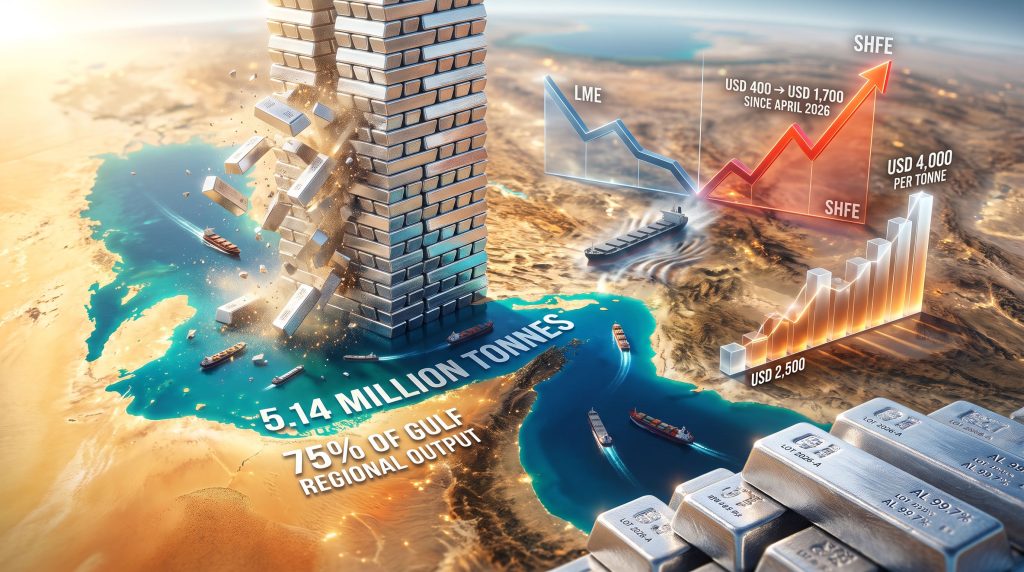
The Strait of Hormuz is roughly 33 kilometres wide at its narrowest navigable point. Through that gap, approximately 5.14 million metric tonnes of primary aluminium pass annually, according to AL Circle's market reporting. This figure represents around 75% of total Gulf regional aluminium production, which itself accounts for an estimated 9 to 10% of total global primary aluminium output.
The Middle East's combined primary aluminium smelting capacity stands at approximately 6.92 million tonnes per year, spanning operations across the UAE, Bahrain, Oman, Saudi Arabia, Qatar, and Iran. Regional alumina refining capacity adds a further 4.95 million tonnes annually to the picture.
What makes the Hormuz chokepoint uniquely dangerous for aluminium, as distinct from other commodity exposures, is its bidirectional nature. Unlike crude oil, which flows primarily outward from the Gulf, aluminium supply chains depend on two-way movement through the same narrow corridor:
- Outbound: finished primary aluminium shipped to buyers in Europe, the United States, and Asia
- Inbound: alumina, the refined feedstock produced from bauxite ore, which must reach Gulf smelters to sustain production
- Secondary: energy and logistics inputs that underpin operational continuity
Wood Mackenzie has estimated that Hormuz disruptions could sever up to 60% of alumina supply reaching Middle Eastern smelters. When inbound alumina is cut, smelter curtailments become physically inevitable, regardless of how intact the export shipping routes remain. This two-way squeeze is the mechanism that transforms a geopolitical event into a structural supply crisis. Fastmarkets has documented how European and US buyers have already begun experiencing the consequences of this bidirectional vulnerability.
Comparing Global Maritime Chokepoints for Aluminium Risk
| Shipping Chokepoint | Primary Commodity Risk | Annual Aluminium Volume at Risk | Strategic Significance |
|---|---|---|---|
| Strait of Hormuz | Aluminium, crude oil, LNG | ~5.14Mt primary aluminium | Highest Gulf export dependency |
| Bab al-Mandab | Red Sea trade, aluminium re-routing | Significant European supply exposure | Secondary disruption amplifier |
| Malacca Strait | Asian commodity flows | Major Asian trade corridor | Lower aluminium-specific risk |
| Black Sea (Ukraine) | Grain, steel, industrial metals | Ukrainian export corridor | Emerging secondary disruption |
What Is Happening Inside Gulf Smelters in 2026
The production data emerging from the Gulf's largest facilities tells a story that raw price charts alone cannot convey. The disruption is not theoretical. Output has already collapsed in measurable, quantifiable terms.
Emirates Global Aluminium (EGA) at Al Taweelah, Abu Dhabi represents the most acute case. Its alumina refinery suffered severe structural damage and an uncontrolled power loss that forced potline shutdowns beginning 28 March 2026. Alumina output for the first half of 2026 came in at 602,000 tonnes, compared with 1.14 million tonnes during the same period in 2025. That represents a year-on-year decline of approximately 47%, according to EGA's own reported figures as covered by AL Circle. EGA has since set a target of full recovery by Q1 2027, though that timeline depends on conditions remaining stable enough for reconstruction and recommissioning work to proceed.
Beyond EGA, the damage extends across the region's major producers. Furthermore, alumina market pressures have been intensifying well before this crisis fully materialised, making the current situation structurally more difficult to absorb:
- Aluminium Bahrain (Alba): Sustained structural impact at its large single-site facility, affecting output continuity
- Sohar Aluminium (Oman): Reduced export shipments across multiple trade lanes, reflecting both logistical and operational constraints
- Iranian producers including Salco, Hormozal Aluminium, and Ahmadhi Aluminium have reported declining aluminium sales volumes as shipping access deteriorates
Wood Mackenzie's aggregate projection is stark. The conflict could remove between 3.0 and 3.5 million tonnes of aluminium output across the full year 2026, placing this disruption among the largest single-year supply losses in the metal's modern industrial history.
Across the supply chain, multiple producers have issued force majeure notices or implemented formal delivery disruption protocols, signalling that this is no longer a short-term logistical inconvenience but a contractual and operational crisis.
Price Signals and Market Psychology: What the Futures Markets Are Revealing
Commodity markets often price in risk before the physical consequences fully materialise. In aluminium's case during 2026, the price movement has been both dramatic and instructive about the nature of the disruption.
Primary aluminium prices have moved from approximately USD 2,500 per tonne to nearly USD 4,000 per tonne over the past year, a rise directly correlated with the tightening of physical supply from Gulf production losses. For context, that represents a price increase of roughly 60%, a move that compresses margins across every downstream sector from automotive manufacturing to construction. Investing.com has noted that aluminium has reached a four-year high as the Hormuz disruption fundamentally reprices the supply chain.
Yet the more analytically revealing signal comes from the divergence between Western and Asian futures markets:
| Exchange | Recent Direction | Primary Driver |
|---|---|---|
| London Metal Exchange (LME) | Declining futures | Western demand uncertainty, rerouting costs |
| Shanghai Futures Exchange (SHFE) | Rising sharply | Chinese domestic demand, import substitution |
SHFE aluminium futures have reportedly climbed from approximately USD 400 to USD 1,700 since April 2026. This divergence is not noise. It reflects a structural fragmentation of global aluminium pricing, with Western and Asian markets beginning to decouple in ways that could persist long after the immediate physical disruption resolves. In addition, China industrial demand dynamics are playing a significant role in driving SHFE's divergent trajectory.
The divergence between LME and SHFE aluminium futures in 2026 signals more than temporary disruption. It points toward a long-term geographic bifurcation of pricing, where Western buyers and Asian buyers increasingly operate within separate supply ecosystems.
Regional physical premiums have escalated sharply across the Rotterdam benchmark, the U.S. Midwest premium, and Japanese quarterly contract premiums, according to analysis from Reuters, Fastmarkets, and Wood Mackenzie. For downstream buyers, the concern is no longer purely one of cost. It has become a question of whether sufficient physical metal will reach their facilities at all, regardless of price.
A Lesser-Known Dimension: The Aluminium Smelting Energy Paradox
One aspect of this crisis that receives insufficient attention is the role of energy infrastructure in determining which smelters can survive disruption and which cannot. Gulf smelters have historically benefited from access to subsidised or competitively priced natural gas, which provides both electricity generation and process heat for smelting operations. When infrastructure is damaged and power supply becomes unreliable, the energy cost advantage that underpins Gulf competitiveness disappears overnight.
This is why uncontrolled power loss at Al Taweelah was so consequential. Aluminium smelting requires continuous, uninterrupted electrical current through potlines. Even brief interruptions can cause the molten bath to freeze, requiring expensive and time-consuming potline restarts that can take months to complete. The 47% output decline at Al Taweelah is partly a direct destruction effect and partly a consequence of the technical complexity of restarting damaged smelting infrastructure.
The United States Exposure: Structural Dependency Without Domestic Alternatives
The Gulf disruption's implications for the US market deserve particular attention, because they expose a structural gap in American industrial capability that has been building for over two decades.
US aluminium demand stands at approximately 12 million tonnes per year according to S&P Global estimates, growing at an average of around 1% annually. Against that demand picture, domestic production capacity has been systematically dismantled. However, US aluminium tariffs have further complicated the country's ability to source affordable replacement supply from traditional trading partners:
- The Intalco facility in Washington State, once one of the country's most significant smelters, was physically demolished in a controlled demolition earlier in 2026
- The Hawesville plant in Kentucky had already ceased primary aluminium production
- Rising electricity costs have been the consistent driver of these closures, with US industrial power prices making aluminium smelting economically unviable
US Aluminium Supply and Demand: The Numbers That Define the Gap
| Metric | Estimated Value |
|---|---|
| Total US aluminium demand | ~12 million tonnes per year |
| Average annual demand growth | ~1% per year |
| Canadian supply to US annually | ~4-6 million tonnes |
| Gulf aluminium supply to US | ~2 million tonnes annually |
| Chinese aluminium imports to US | Below 700,000 tonnes |
The Gulf's approximately 2 million tonnes of annual aluminium supply to the US represents a material share of the import mix that cannot be quickly substituted. Canada, the largest single supplier at 4 to 6 million tonnes annually, is not infinitely scalable. Expanding Canadian smelter output to absorb Gulf supply losses would require new long-term contracts, infrastructure investment, and lead times measured in years rather than months.
The Trump administration's attempt to address this vulnerability through a partnership between Emirates Global Aluminium and Century Aluminium aimed at reviving domestic alumina refining capacity has reportedly stalled, for precisely the same reason that domestic smelters have closed: the domestic energy cost environment in the United States makes primary aluminium production economically unviable without significant structural reform of energy markets.
There is a fundamental paradox at the centre of US aluminium policy. The federal government has classified aluminium as a critical national security material, yet the domestic conditions that would enable competitive domestic production have not been addressed. Identifying a problem and solving it are two very different things.
Aluminium's Defence Dimension: Why This Is Not Just an Industrial Story
The strategic significance of aluminium extends well beyond construction, packaging, and automotive manufacturing. Its role in defence systems makes supply disruption a national security concern in the most literal sense. Consequently, the broader surge in critical minerals demand has further intensified competition for secure, stable supply sources across allied nations.
Aluminium is a core material in:
- Radar systems and electronic warfare platforms
- Night vision and advanced optical devices
- Warship hull construction and naval architecture
- Military aircraft, helicopters, and unmanned aerial systems
- Missile fuel formulations and propellant chemistry
- Tracer munitions, illumination rounds, and explosive formulations
The US national security resolution covering 12 critical metals, including aluminium, enacted six months ago reflects Washington's recognition of this dependency. However, policy recognition without the industrial and energy conditions to enable domestic production creates a gap between stated strategic intent and operational reality.
The next major ASX story will hit our subscribers first
The Black Sea Compounding Effect: A Secondary Risk Layer
The Strait of Hormuz aluminium supply disruption does not exist in isolation. Simultaneous pressure on Ukraine's Black Sea maritime access is adding a secondary layer of complexity to global commodity trade flows.
Attacks on Odesa's port infrastructure and surrounding transport links, including bridges connecting to Romania, have disrupted Ukrainian maritime exports. Reports indicate Ukrainian port operations were suspended for approximately three weeks, blocking the majority of the country's seaborne exports across commodity categories.
For aluminium specifically, the Black Sea disruption compounds investor confidence problems and creates additional uncertainty for European buyers who might otherwise seek alternative supply routes. The reconstruction financing challenge is particularly acute: capital is unlikely to flow into port rebuilding when the risk of renewed destruction remains unresolved.
Three Scenarios for Global Aluminium Supply Chains Through 2027
Scenario 1: Short-Term Disruption, Rapid Resolution (6-12 months)
If Gulf stability is restored quickly and EGA's Q1 2027 recovery timeline holds, prices could normalise toward a USD 2,800 to 3,200 per tonne range. Regional premiums would moderate and supply chains would adapt through rerouting and inventory drawdowns.
Scenario 2: Prolonged Disruption (12-24 months)
Should Wood Mackenzie's 3.0 to 3.5 million tonne output loss scenario fully materialise across 2026, structural premium elevation becomes the baseline for European and US buyers. Downstream manufacturers would accelerate supply chain diversification, and investment in secondary aluminium recycling would intensify as a near-term supply response.
Scenario 3: Structural Realignment of Global Aluminium Trade
In the most consequential scenario, Gulf producers permanently lose market share to Australian, Canadian, and Norwegian supply sources. The top aluminium producers outside the Gulf region would find themselves repositioned with significant strategic advantage. China consolidates its dominant position in global aluminium production, the SHFE-LME price divergence becomes a permanent structural feature, and Western governments are compelled to make the energy policy changes necessary to enable competitive domestic smelting.
Key Indicators to Track
- EGA's Al Taweelah recovery timeline and Q1 2027 recommissioning progress
- U.S. Midwest and Rotterdam aluminium physical premium movements
- SHFE-LME spread trajectory and whether divergence widens or narrows
- Wood Mackenzie quarterly revisions to 2026 regional output loss estimates
- US energy policy developments with implications for domestic smelter viability
- Alumina shipping insurance premiums through Hormuz as a forward-looking risk indicator
Frequently Asked Questions
How much aluminium passes through the Strait of Hormuz each year?
Approximately 5.14 million metric tonnes of primary aluminium transits the Strait of Hormuz annually, representing around 75% of total Gulf regional production and roughly 9 to 10% of global primary aluminium output.
Why does the disruption affect inbound supply as well as outbound exports?
Gulf smelters depend on imported alumina, the refined bauxite feedstock required to produce aluminium. This material also moves through the Strait. Restricting inbound alumina flows forces production curtailments even before outbound export disruptions take full effect, creating a simultaneous squeeze on both sides of the supply chain.
How much has Gulf aluminium production fallen in 2026?
EGA's Al Taweelah refinery produced 602,000 tonnes of alumina in H1 2026, compared with 1.14 million tonnes in H1 2025, a decline of approximately 47% year-on-year. Wood Mackenzie estimates total regional output losses could reach 3.0 to 3.5 million tonnes across 2026.
Why can't the US simply source more aluminium from Canada to replace Gulf supply?
Canadian supply of approximately 4 to 6 million tonnes annually is already the largest single US import source. Canadian smelter capacity is not infinitely scalable in the near term, and absorbing additional Gulf-equivalent volumes would require new supply agreements, infrastructure, and years of lead time.
What explains the divergence between LME and SHFE aluminium futures?
LME futures reflect Western demand uncertainty and the cost impacts of supply rerouting, while SHFE futures have risen sharply, climbing from approximately USD 400 to USD 1,700 since April 2026, driven by Chinese domestic demand and import substitution dynamics. This divergence signals a geographic fragmentation of aluminium pricing between Western and Asian markets.
This article incorporates market data and analysis from AL Circle, Wood Mackenzie, S&P Global, Fastmarkets, and Reuters Commodities. Scenario projections and market forecasts involve inherent uncertainty and should not be construed as investment advice. Readers are encouraged to consult independent financial and commodity market advisors before making decisions based on forward-looking assessments.
Want to Capitalise on the Next Major Commodity Supply Disruption Before the Broader Market Reacts?
Discovery Alert's proprietary Discovery IQ model delivers real-time alerts on significant ASX mineral discoveries — instantly transforming complex commodity data into actionable investment insights for both short-term traders and long-term investors. Explore Discovery Alert's discoveries page to see how historic mineral discoveries have generated substantial returns, and begin your 14-day free trial today to position yourself ahead of the market.