August 13, 2026
When Physical Scarcity Meets Market Structure: Reading the Aluminium Forward Curve
Few signals in commodity markets are as instructive as the shape of a forward curve under stress. When spot prices surge while long-dated contracts retreat simultaneously, the market is communicating something precise: supply is tight right now, but participants do not expect that tightness to persist indefinitely. This is exactly the dynamic unfolding in the London Metal Exchange aluminium market as of late April 2026, where the LME aluminium cash price near $3,700 and stocks fall together present a textbook case of near-term physical scarcity colliding with longer-run supply expectations.
Understanding what is driving this divergence, and what it means for industrial buyers, traders, and long-term investors, requires looking beyond the headline price movements and examining the structural mechanics underneath.
When big ASX news breaks, our subscribers know first
The Architecture of a Price Rally: What $3,683 Per Tonne Actually Signals
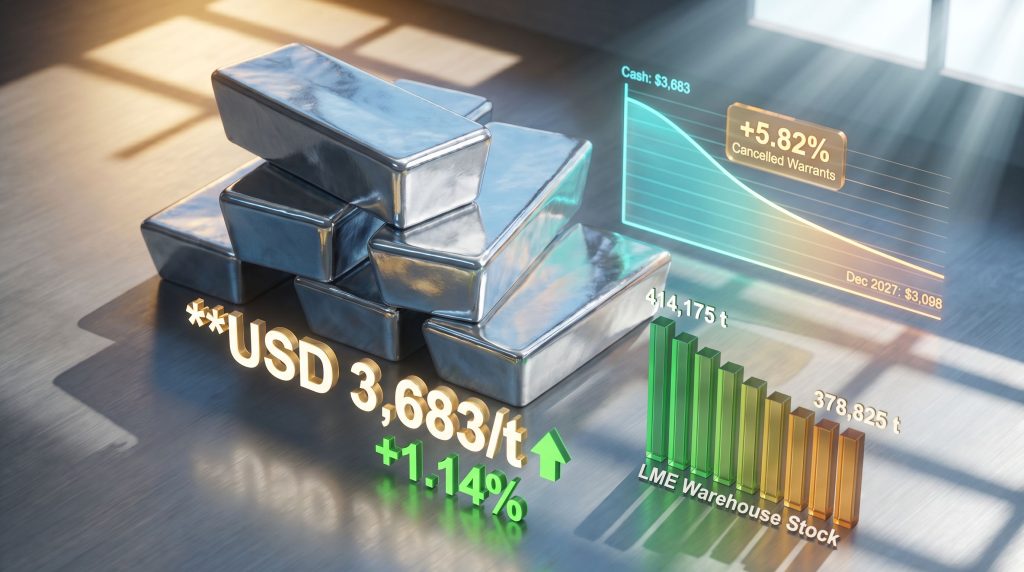
On April 24, 2026, the LME aluminium cash bid price reached USD 3,683 per tonne, representing a 1.14% gain in a single session. The cash offer price moved in parallel, climbing to USD 3,685 per tonne, up 1.18% day-on-day. These figures place the metal within striking distance of the psychologically significant USD 3,700 per tonne threshold, a level that functions as both a technical resistance point and a sentiment benchmark for the broader market.
Zooming out from the single-session move, the appreciation over the preceding month approached roughly 11%, while year-over-year gains reached approximately 47.82%. That kind of multi-timeframe momentum is not generated by speculative positioning alone. It reflects a fundamental repricing of aluminium's value relative to available physical supply.
The USD 3,700 level carries particular weight because it sits at the intersection of technical chart resistance and the upper boundary of cost-curve economics for higher-cost smelters. Furthermore, breaching and sustaining prices above this threshold would shift the incentive calculus for idle capacity restarts globally.
Decoding the Contract Curve: Near-Term Strength vs. Long-Dated Weakness
The most analytically rich feature of April 24's trading session was not the cash price itself, but the divergence across contract tenors.
| Contract Tenor | April 23 Bid (USD/t) | April 24 Bid (USD/t) | Change |
|---|---|---|---|
| Cash | 3,641.5 | 3,683.0 | +1.14% |
| 3-Month | 3,588.0 | 3,598.0 | +0.28% |
| December 2027 | 3,135.0 | 3,098.0 | -1.18% |
The 3-month contract recovered modestly, with the bid rising from USD 3,588 per tonne to USD 3,598 per tonne and the offer from USD 3,590 to USD 3,600 per tonne, each posting a 0.28% gain. The LME aluminium 3-month Asian Reference Price settled at USD 3,591 per tonne, a slight pullback from USD 3,620 per tonne the prior session, reflecting regional pricing nuances across different time zones and delivery locations.
Meanwhile, December 2027 contracts moved sharply in the opposite direction. Both the bid and offer fell 1.18%, with the bid dropping from USD 3,135 per tonne to USD 3,098 per tonne and the offer from USD 3,140 to USD 3,103 per tonne.
This divergence is the market's clearest communication: participants are willing to pay a premium for aluminium today, but they expect meaningful supply normalisation within a 12 to 18 month horizon. The December 2027 contract at USD 3,098 per tonne implies the market prices in a correction of roughly 16% from current cash levels over that period.
What Backwardation Looks Like Before It Fully Develops
The spread between the cash price and the 3-month contract, known in trading as the cash-to-three-month spread, is a critical structural indicator. In normal contango markets, forward prices exceed spot prices, compensating holders for storage costs and capital tied up in inventory. When spot prices begin to exceed forward prices, the market enters backwardation, a condition that discourages inventory accumulation and accelerates physical withdrawal.
While full backwardation has not been confirmed in this dataset, the directional signals — including a 1.14% cash gain against a 0.28% 3-month gain — indicate the curve is flattening and potentially tilting. For physical traders, this is a warning to reassess deferred purchase strategies.
Inventory Dynamics: The Critical Role of Cancelled Warrants
The inventory story unfolding across April 2026 is as important as the price trajectory. LME aluminium opening stocks have been in a sustained drawdown since the start of the month.
| Date | Cash Bid (USD/t) | Opening Stock (Tonnes) | Cancelled Warrants (Tonnes) |
|---|---|---|---|
| April 21 | ~3,545-3,580 | 383,275 | N/A |
| April 22 | ~3,622 | 381,050 | N/A |
| April 23 | 3,641.5 | 381,050 | 41,275 |
| April 24 | 3,683.0 | 378,825 | 43,825 |
From approximately 414,175 tonnes at the start of April to 378,825 tonnes on April 24, the month-to-date drawdown exceeds 35,000 tonnes. On April 24 alone, stocks fell 0.58% in a single session. Consequently, the bauxite supply fundamentals underpinning primary production are coming under renewed scrutiny as physical metal leaves exchange hands at pace.
Understanding Cancelled Warrants: A Leading Indicator Most Investors Overlook
A cancelled warrant is a formal instruction to withdraw physical metal from an LME-registered warehouse. Unlike a decline in headline stock figures, which could theoretically reflect accounting adjustments, rising cancelled warrants represent a deliberate decision by a market participant to take physical delivery of metal. This is genuine demand absorption.
On April 24, cancelled warrants rose from 41,275 tonnes to 43,825 tonnes, an increase of 5.82% in a single session. This is a substantial single-day jump. Live warrants remained stable at 335,000 tonnes, meaning the increase in cancellations was additive rather than redistributive.
- Rising cancelled warrants reduce the effective available pool of exchange inventory faster than headline numbers suggest.
- Metal with a cancelled warrant is no longer accessible to other market participants for purchase or borrowing against.
- Accelerating cancellations can create sudden tightness in the lending market, pushing the cash-3-month spread sharply.
- The 5.82% single-session rise in cancellations suggests at least one, possibly multiple, large industrial buyers or financing entities are pulling metal off the exchange with urgency.
Alumina Pricing and Its Underappreciated Role in Smelter Economics
While aluminium pricing captures most of the market's attention, the dynamics across aluminum and alumina markets — particularly alumina as an intermediate feedstock refined from bauxite before being smelted into primary aluminium — play a decisive role in smelter margin economics. Alumina typically accounts for 30 to 35% of the total cash cost of primary aluminium production.
On April 24, the LME alumina Platts price eased to USD 307.5 per tonne, down 0.39% from USD 308.69 per tonne the prior session. This softening, while modest in isolation, has compounding implications:
- When alumina prices fall while aluminium cash prices rise, smelter operating margins expand on both ends simultaneously.
- Expanded margins reduce the financial pressure on higher-cost smelters that have been operating near breakeven.
- Sustained margin improvement historically precedes capacity restart decisions, which typically require 6 to 18 months of lead time to translate into additional supply.
- This lag effect is likely one structural reason why December 2027 contracts are softening: the market is pricing in the probability that today's margin recovery eventually triggers new supply.
The counterintuitive insight here is that falling alumina prices, often interpreted as a negative signal for the aluminium supply chain, can actually be bearish for long-dated aluminium contracts by making capacity restarts economically viable sooner than the spot market expects.
Macro and Structural Demand Drivers Underpinning the Rally
The near-term tightness driving the LME aluminium cash price near $3,700 and stocks fall lower does not exist in a vacuum. However, several structural demand vectors are amplifying the physical market's sensitivity to inventory drawdowns. In addition, the aluminium tariffs impact introduced through recent US trade policy has further reshaped global procurement strategies, compressing available supply in certain regions:
- Electric vehicle manufacturing: Aluminium's role in battery enclosures, structural body panels, and lightweight chassis components is expanding as automakers target weight reduction targets. A single mid-size EV can contain between 150 and 250 kilograms of aluminium, significantly above the 120 to 160 kilogram range typical of conventional internal combustion vehicles.
- Renewable energy infrastructure: Solar mounting structures, wind turbine housings, and transmission line conductors all rely heavily on aluminium. Accelerating renewable energy deployment across Asia, Europe, and North America provides a durable demand floor that is largely insensitive to short-term economic cycles.
- Packaging and construction: These sectors provide baseline consumption continuity. While neither drives incremental demand growth, they absorb substantial tonnage annually and limit the downside for exchange prices during demand softening episodes.
- Supply chain geopolitics: Disruptions to trade routes and energy access affecting Middle Eastern smelting output have introduced supply-side uncertainty that physical buyers are hedging against through early procurement, which itself accelerates stock drawdowns.
The next major ASX story will hit our subscribers first
Interpreting the Forward Curve for Strategic Positioning
The term structure divergence visible on April 24 presents distinct implications depending on the type of market participant.
For Industrial Buyers
The flattening forward curve and rising cash premiums create a tactical dilemma. Locking in forward purchases at December 2027 levels around USD 3,098 to 3,103 per tonne offers meaningful cost certainty relative to current cash prices. However, if the market's supply normalisation thesis proves incorrect, those forward hedges may represent a missed opportunity relative to spot alternatives.
For Physical Traders and Merchants
Rising cancelled warrants and falling exchange stocks reduce the collateral pool available for financing trades. Metal financing arrangements, where aluminium is used as collateral for short-term borrowing, become less accessible as exchange stocks tighten. This can force some financing-driven demand out of the market, paradoxically creating temporary pressure on cash prices even as physical scarcity intensifies.
For Long-Term Investors
The year-over-year appreciation of approximately 47.82% reflects a fundamental re-rating of aluminium's strategic value. Institutional consensus forecasts place LME aluminium at approximately USD 3,643 per tonne by quarter-end, with some analysis pointing toward $3,800 per tonne in Q2 2026 contingent on supply conditions remaining constrained. These projections carry inherent uncertainty and should not be treated as guarantees of performance.
Furthermore, the global steel outlook provides useful context here, as structural shifts across base metals broadly influence how institutional capital rotates between aluminium and steel-adjacent positions. Similarly, understanding how top aluminium producers are responding to current margin conditions is essential for gauging how quickly new supply could materialise.
Disclaimer: All price forecasts and institutional targets referenced in this article are based on publicly available market analysis and consensus data as of late April 2026. Commodity markets are inherently volatile and subject to rapid changes in supply, demand, geopolitical conditions, and macroeconomic factors. Nothing in this article constitutes financial advice or a recommendation to buy or sell any financial instrument.
Key Market Metrics at a Glance: April 24, 2026
- Cash bid price: USD 3,683 per tonne (+1.14%)
- Cash offer price: USD 3,685 per tonne (+1.18%)
- 3-month bid: USD 3,598 per tonne (+0.28%)
- 3-month Asian Reference Price: USD 3,591 per tonne
- December 2027 bid: USD 3,098 per tonne (-1.18%)
- Opening stock: 378,825 tonnes (-0.58%)
- Cancelled warrants: 43,825 tonnes (+5.82%)
- LME alumina Platts price: USD 307.5 per tonne (-0.39%)
Frequently Asked Questions
Why Does the LME Aluminium Cash Price Nearing $3,700 Matter to Industrial Buyers?
The USD 3,700 level represents a threshold above which aluminium cost exposure becomes material for manufacturers in automotive, packaging, and construction sectors. Sustained pricing at this level accelerates hedging activity and can trigger contract renegotiations across supply chains. Recent trading data confirms the market is watching this level closely.
Can Falling LME Stocks Continue Even If Prices Rise Sharply?
Yes. Rising prices do not automatically attract new supply into exchange warehouses. Smelter capacity takes months to restart, and producers may prefer selling directly to consumers at spot premiums rather than depositing metal into LME warehouses. Falling stocks and rising prices can therefore reinforce each other until new supply physically enters the market. This is precisely the dynamic that makes the LME aluminium cash price near $3,700 and stocks fall scenario so significant for near-term procurement planning.
What Would Cause December 2027 Contracts to Recover?
A reversal in December 2027 contract prices would likely require evidence that smelter restart activity is accelerating, alumina costs are rising again constraining margins, or that demand growth in key sectors is moderating. Any combination of supply additions and demand softening over the next 12 to 18 months could close the current gap between spot strength and long-dated weakness.
Want to Track the Next Major ASX Mineral Discovery Before the Market Moves?
Discovery Alert's proprietary Discovery IQ model delivers real-time alerts on significant ASX mineral discoveries, transforming complex data across more than 30 commodities into clear, actionable investment insights — whether you're a short-term trader or a long-term investor. Explore Discovery Alert's discoveries page to see how historic finds have generated substantial returns, and begin your 14-day free trial today to position yourself ahead of the broader market.