
July 28, 2026
When Benchmark Numbers Lie: The Hidden Cost of Pricing Errors in Physical Metals Markets
Every physical commodity market runs on a shared assumption: that the published price data underpinning billions of dollars in contracts is accurate. When that assumption fractures, even temporarily, the consequences ripple outward through supply chains, procurement teams, and trading desks with surprising speed. Monthly average corrections in commodity benchmarking are not common, but when they occur in tightly traded markets like European aluminium foundry alloys, the financial stakes are anything but trivial.
The correction to May averages for aluminium primary foundry alloy premiums, specifically across two European benchmark assessments, offers a sharper lens through which to understand how pricing infrastructure actually functions, where it can fail, and why market participants cannot afford to treat published averages as immutable facts.
When big ASX news breaks, our subscribers know first
What Aluminium Primary Foundry Alloy Silicon 7 Premiums Actually Measure
Before unpacking the mechanics of the correction itself, it helps to understand exactly what these benchmarks are tracking and why they matter to a wide range of industrial buyers.
Aluminium primary foundry alloy silicon 7 ingot, commonly abbreviated as Si7, is a specific aluminium alloy formulation containing approximately 7% silicon by weight. This composition gives the material excellent castability, fluidity during the casting process, and resistance to hot tearing, making it a favoured input for pressure die casting and gravity casting operations. The end markets are broad and commercially significant:
- Automotive components, including engine blocks, transmission housings, and structural castings
- Industrial machinery and capital goods requiring complex near-net-shape geometries
- Aerospace sub-components where lightweight, high-integrity castings are required
- Construction hardware and architectural fittings
The premium component of these assessments reflects the delivered cost above the London Metal Exchange cash aluminium price. In physical metals trading, the LME price functions as a global reference floor, while regional premiums capture the localised costs of logistics, duty, warehousing, and supply-demand imbalance. A delivered duty paid, or ddp, premium means all costs up to the point of delivery at the buyer's door are embedded within the quoted figure.
Two separate regional benchmarks capture the European market for this material:
| Benchmark Code | Description | Delivery Basis | Currency |
|---|---|---|---|
| MB-AL-0339 | Aluminium primary foundry alloy Si7 ingot premium | ddp Germany | USD/tonne |
| MB-AL-0340 | Aluminium primary foundry alloy Si7 ingot premium | ddp Eastern Europe | USD/tonne |
Germany functions as the primary European pricing anchor because it hosts the continent's most concentrated cluster of automotive casting and fabrication activity. The Eastern Europe benchmark, while reflecting a structurally different cost base, has grown in relevance as manufacturing investment has expanded across Poland, the Czech Republic, Slovakia, and Romania over the past two decades. Furthermore, shifts in the broader aluminum and alumina markets have increasingly influenced how these regional benchmarks interact with global pricing signals.
The Mechanics of the Procedural Lapse
A monthly average in commodity price reporting is not simply a rough approximation. It is a calculated arithmetic mean drawn from every valid daily or periodic assessment session conducted within the calendar month. Price reporting agencies like Fastmarkets assess these benchmarks on defined publication days, aggregating data from verified market participants including producers, traders, consumers, and intermediaries.
When the final assessment session of a month is excluded from that calculation, the resulting average reflects an incomplete dataset. Depending on the direction prices moved during the omitted session, the published average will either overstate or understate the true market consensus for that month.
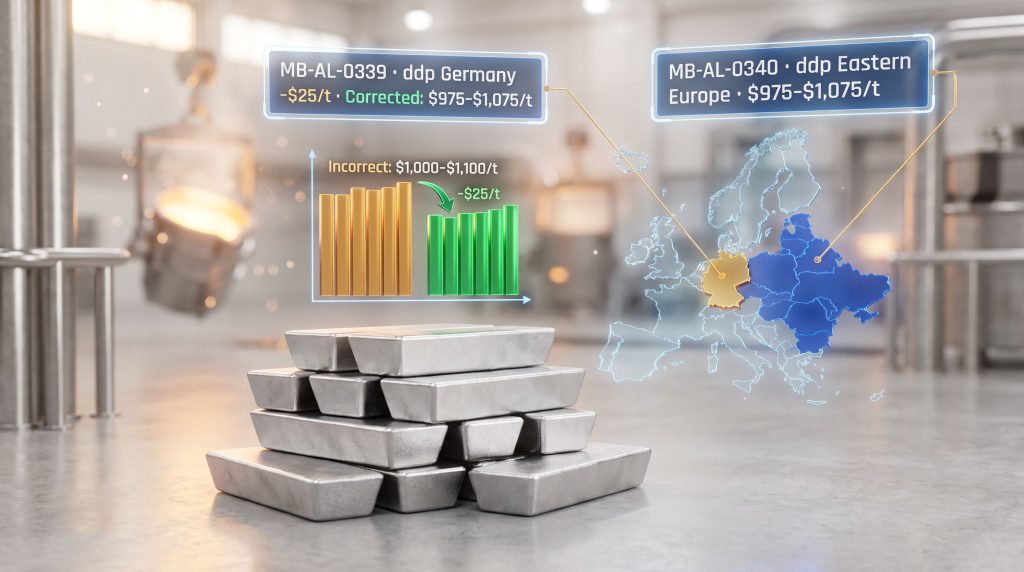
In the case of the May correction, the pricing session conducted on May 29 was not incorporated into the initial monthly average calculation for either MB-AL-0339 or MB-AL-0340. The effect was an upward distortion of $25 per tonne across both the low and high points of each benchmark's monthly average range.
A single omitted end-of-month session can introduce a directional bias into a monthly average that does not reflect genuine market movement. If late-month price softening occurs during the excluded session, the published average artificially preserves a higher mid-month consensus that no longer represents where the market actually settled.
The before-and-after figures tell the story precisely:
| Benchmark | Incorrect Low ($/t) | Incorrect High ($/t) | Corrected Low ($/t) | Corrected High ($/t) | Adjustment |
|---|---|---|---|---|---|
| MB-AL-0339 (Germany ddp) | 1,000 | 1,100 | 975 | 1,075 | -$25/t across range |
| MB-AL-0340 (Eastern Europe ddp) | 1,000 | 1,100 | 975 | 1,075 | -$25/t across range |
The uniform nature of the correction across both benchmarks is notable. Both assessments were affected identically, which is consistent with the explanation that a single procedural step, specifically the inclusion of the May 29 session, was missed during the average compilation process for both codes simultaneously. Issues of this nature are closely related to broader base metal price delays that can disrupt trading decisions across the wider metals complex.
Why a $25 Per Tonne Error Carries Real Commercial Weight
For observers outside physical metals markets, a $25 per tonne adjustment might appear minor. In practice, it is the kind of variance that procurement managers and commodity risk teams track with precision, and for good reason.
Consider the exposure profile across different participant types:
- Automotive OEMs and Tier 1 suppliers frequently operate index-linked supply agreements where monthly average premiums determine the final invoice price. A $25/tonne overpayment across a 10,000-tonne monthly volume represents $250,000 in financial misalignment that requires reconciliation.
- Foundry operators running thin margin businesses may have fixed price-in commitments to customers while their input costs float against monthly averages. A $25/tonne error in either direction distorts their margin calculations for the settlement period.
- Commodity trading desks using monthly average positions to hedge physical exposure against futures contracts need accurate settlement figures to assess basis risk correctly.
- Procurement benchmarking teams using published averages to evaluate supplier performance or negotiate future contract terms would be working from flawed reference data until the correction was applied.
The critical operational risk is the window between when the incorrect average was published and when the correction notice reached relevant stakeholders. Any contract that settled, or was priced, against the uncorrected $1,000 to $1,100 per tonne range rather than the correct $975 to $1,075 per tonne range would require bilateral reconciliation between buyer and seller.
Participants relying on published monthly averages for contract settlement should maintain active monitoring of correction notices from their price reporting agency. In high-volume index-linked contracts, a $25 per tonne variance can translate into six-figure financial adjustments that require documentation, verification, and counterparty agreement to resolve.
How Price Reporting Agencies Handle Corrections: Process and Governance
The correction process followed in this case reflects a broader governance architecture that price reporting agencies are required to maintain. Fastmarkets pricing delay incidents, in common with other PRA governance events, operate under methodology frameworks that define how assessments are conducted, how errors are classified, and how remediation is communicated.
The typical correction lifecycle moves through several defined stages:
- Error identification: An internal review process, or an alert from a data submitter, flags a discrepancy between the published average and the expected calculation.
- Classification: The error is assessed to determine whether it represents a data input error (incorrect price data was used) or a procedural lapse (the correct data existed but was not included in the calculation). The May correction falls into the second category.
- Internal validation: The corrected calculation is verified before any public communication is issued.
- Correction notice publication: A formal notice describing the nature of the error, the affected benchmarks, and the revised values is published transparently, with a date stamp.
- Database update: The pricing database is amended to reflect the corrected historical values, ensuring that downstream systems and data feeds pulling historical averages retrieve the accurate figure.
Fastmarkets confirmed that its pricing database was updated following the May correction, with both MB-AL-0339 and MB-AL-0340 revised accordingly. The correction notice itself invited market participants to submit feedback, with the option to designate comments as confidential. Non-confidential responses may be made available on request, a standard transparency provision aligned with recognised benchmark governance principles.
The governance standards guiding major PRAs increasingly align with the IOSCO Principles for Financial Benchmarks, which set expectations around transparency, methodology consistency, and stakeholder engagement. While aluminium physical premiums are not classified as financial benchmarks under most regulatory definitions, the PRA sector has voluntarily adopted comparable standards to maintain market confidence.
Reading the Corrected Premium Levels: What $975 to $1,075 Per Tonne Signals About European Aluminium Markets
Beyond the mechanics of the correction itself, the corrected premium range of $975 to $1,075 per tonne ddp Germany is worth contextualising against the broader European aluminium market landscape.
European aluminium premiums have historically been sensitive to several interlocking forces:
- Primary aluminium import availability: Europe is structurally reliant on imported primary metal, drawing supply from the Middle East (particularly Bahrain, UAE, and Saudi Arabia), Norway, Iceland, and increasingly from other regions. When import availability tightens, regional ddp premiums expand.
- Energy cost pressure on domestic smelting: European primary smelting capacity has contracted materially over the past decade as power costs have risen. Higher energy prices reduce competitive domestic output, increasing the market's dependence on imported metal and applying upward pressure on delivery premiums.
- Automotive production cycles: Germany's outsized role in European automotive manufacturing means foundry alloy demand follows vehicle production schedules closely. Seasonal shutdowns, model changeovers, and inventory destocking cycles all influence near-term demand for Si7 alloys. Indeed, the European aluminium foundry alloy market has faced notable headwinds from subdued domestic automobile production in recent periods.
- Scrap and secondary alloy competition: Primary foundry alloy competes with secondary aluminium alloys derived from scrap. When scrap availability is high and secondary alloy quality meets casting specifications, buyers may substitute away from primary Si7, applying downward pressure on primary premiums.
- Logistics and freight dynamics: The ddp delivery basis means freight, insurance, and inland haulage costs are all embedded in the premium. Disruptions to shipping routes or haulage capacity translate directly into premium movements.
The convergence of Germany and Eastern Europe premiums to the same corrected range of $975 to $1,075 per tonne is structurally interesting. Historically, these two benchmarks have traded at different levels, reflecting Germany's higher logistics costs, denser automotive demand, and more established supply infrastructure compared to Eastern European markets. Premium convergence can signal either supply normalisation across the two regions or a period of softer demand that reduces the premium buyers in Germany are willing to pay above the Eastern European reference point.
Regional Premium Spread Dynamics: A Structural Comparison
| Factor | Impact on Germany Premium | Impact on Eastern Europe Premium |
|---|---|---|
| Logistics and freight costs | Higher structural baseline | Lower baseline due to shorter import distances from East |
| Local smelting capacity | Very limited, heavily import-dependent | Emerging, some capacity in Russia-adjacent regions |
| Automotive demand density | Extremely high, globally significant | Moderate but growing as OEMs expand into CEE |
| Import tariff exposure | EU-wide standard | EU-wide standard |
| Scrap competition | Strong secondary sector | Growing but less developed |
| Currency sensitivity | EUR-dominated contracts | Mixed EUR and local currency exposure |
However, it is also worth noting that the aluminium tariffs impact on global trade flows has introduced additional complexity into how European regional premiums are priced, as import volumes and sourcing patterns shift in response to trade policy changes.
The next major ASX story will hit our subscribers first
Practical Steps for Market Participants Following a Correction Notice
Receiving a correction notice is only the beginning of the operational response required from affected market participants. A structured approach reduces financial and reputational exposure:
- Immediately retrieve the corrected values from the PRA's database rather than relying on cached or internally stored historical figures.
- Identify all contracts referencing the affected benchmark codes (MB-AL-0339 and MB-AL-0340) with May settlement periods.
- Recalculate invoice values using the corrected average of $975 (low) to $1,075 (high) per tonne rather than the incorrect $1,000 to $1,100 per tonne range.
- Engage counterparties to confirm the recalculation and agree on any required payment adjustments or credit notes.
- Update internal risk systems and pricing models to ensure the corrected historical average is used for any retrospective analysis, hedging assessment, or procurement performance review.
- Submit feedback to the PRA if the correction has created downstream complications that warrant further clarification or if the organisation wishes to participate in the quality feedback process.
Frequently Asked Questions: Aluminium Primary Foundry Alloy Premium Corrections
What caused the correction to May averages for aluminium primary foundry alloy premiums?
The May 29 final pricing session was not included in the initial monthly average calculation for MB-AL-0339 and MB-AL-0340. This omission resulted in published averages that were $25 per tonne higher than the accurate figures across both the low and high points of each range.
Which benchmarks were affected?
Both MB-AL-0339 (aluminium primary foundry alloy silicon 7 ingot premium, ddp Germany) and MB-AL-0340 (aluminium primary foundry alloy silicon 7 ingot premium, ddp Eastern Europe) were affected, both denominated in USD per tonne.
What are the corrected May average values?
The corrected May average for both benchmarks is $975 per tonne (low) to $1,075 per tonne (high), revised downward from the incorrectly published $1,000 to $1,100 per tonne range.
What package do these prices belong to?
Both benchmarks are components of the Fastmarkets Base Metals Physical Prices package.
How can market participants provide feedback on the correction?
Participants may submit comments through Fastmarkets' designated contact channels, indicating whether their submission is confidential. Non-confidential responses may be made available to other market participants upon request, consistent with the agency's transparency framework.
Where can methodology documentation be found?
Full pricing methodology and specification documents for base metals physical price assessments, including aluminium foundry alloy premiums, are available through Fastmarkets' publicly accessible methodology page at fastmarkets.com/methodology.
The Broader Lesson: Benchmark Integrity as a Market Infrastructure Issue
The correction to May averages for aluminium primary foundry alloy premiums is a reminder that commodity pricing infrastructure, however sophisticated, is not immune to procedural error. What distinguishes a well-governed benchmarking system from a poorly governed one is not the absence of errors, but the speed, transparency, and thoroughness with which errors are identified, disclosed, and corrected.
For aluminium buyers, sellers, and risk managers operating in European markets, this episode reinforces several enduring principles. Furthermore, top aluminium producers and downstream consumers alike benefit from robust correction protocols that preserve long-term trust in benchmark data:
- Monthly average publications should be treated as provisional until the correction window has passed and no amendment notice has been issued.
- Index-linked contracts benefit from explicit provisions addressing how retroactive corrections to reference benchmarks are handled between counterparties.
- Active monitoring of PRA correction notices is not a back-office administrative task. It is a front-line risk management function with direct financial implications.
- Participation as a data submitter to benchmark assessments gives market participants both a voice in the price formation process and earlier visibility into assessment dynamics.
Disclaimer: This article is intended for informational and educational purposes only. Nothing contained herein constitutes financial, investment, legal, or trading advice. Commodity price benchmarks are subject to revision and correction, and readers should always verify current values directly with the relevant price reporting agency. Past pricing levels and trends discussed in this article do not guarantee future market conditions.
Want to Catch the Next Major ASX Mineral Discovery Before the Market Does?
Discovery Alert's proprietary Discovery IQ model delivers real-time alerts on significant ASX mineral discoveries, transforming complex data across more than 30 commodities into clear, actionable insights — so both short-term traders and long-term investors can act with confidence the moment an opportunity emerges. Explore historic discoveries and their market returns, then begin your 14-day free trial to secure a genuine market-leading edge.