August 24, 2026
When Fear Leaves the Market: Understanding the Architecture of Oil Price Risk Premiums
Crude oil markets do not simply reflect today's supply and demand realities. They price tomorrow's fears. When geopolitical tension rises near the world's critical energy arteries, traders embed a layer of insurance into every barrel traded on futures exchanges. That insurance cost is known as the geopolitical risk premium, and understanding how it forms, inflates, and collapses is essential to interpreting why oil prices fall as Middle East and Black Sea supply concerns ease, sometimes with breathtaking speed.
The sharpest single-session price movements in crude oil history are rarely caused by actual supply disruptions. More often, they are caused by the repricing of probability around supply disruptions that never fully materialised. July 2026 delivered a textbook example of precisely this dynamic, and furthermore, it illustrated how oil price volatility trends can shift dramatically within a single trading session.
When big ASX news breaks, our subscribers know first
How Geopolitical Risk Gets Embedded Into Crude Oil Prices
The mechanism through which conflict anxiety enters oil pricing is both technical and deeply psychological. Institutional traders, hedge funds, and algorithmic systems monitor geopolitical developments and translate perceived threat levels into futures positions. When escalation risk rises near a major chokepoint, long positions accumulate rapidly, pushing prices above the level that pure supply-demand fundamentals would justify.
This gap between fundamental value and market price is the risk premium. It is not irrational; it reflects a rational repricing of supply certainty. The problem is that it creates a structurally unstable price level, one that is vulnerable to rapid collapse the moment the perceived threat begins to diminish.
Several instruments signal the presence and magnitude of a geopolitical risk premium:
- Options implied volatility rises sharply when conflict risk enters the market, signalling that traders are paying elevated prices for downside protection.
- Brent-WTI spread compression or expansion can reveal whether supply concerns are regionally concentrated or globally systemic.
- Tanker freight rates and war-risk insurance premiums, tracked through Lloyd's of London and specialist marine underwriters, provide a real-economy read on how seriously the shipping industry is pricing physical route risk.
- Speculative net long positioning in CFTC Commitment of Traders reports reveals how crowded the bullish trade has become, and therefore how violent the unwind might be.
Historical Benchmarks: How Fast Do These Premiums Unwind?
History shows that geopolitical risk premiums in crude oil markets can dissolve almost as fast as they form. The table below illustrates how past conflict cycles have translated into premium formation and subsequent unwinding:
| Geopolitical Event | Estimated Peak Risk Premium | Approximate Unwind Timeframe |
|---|---|---|
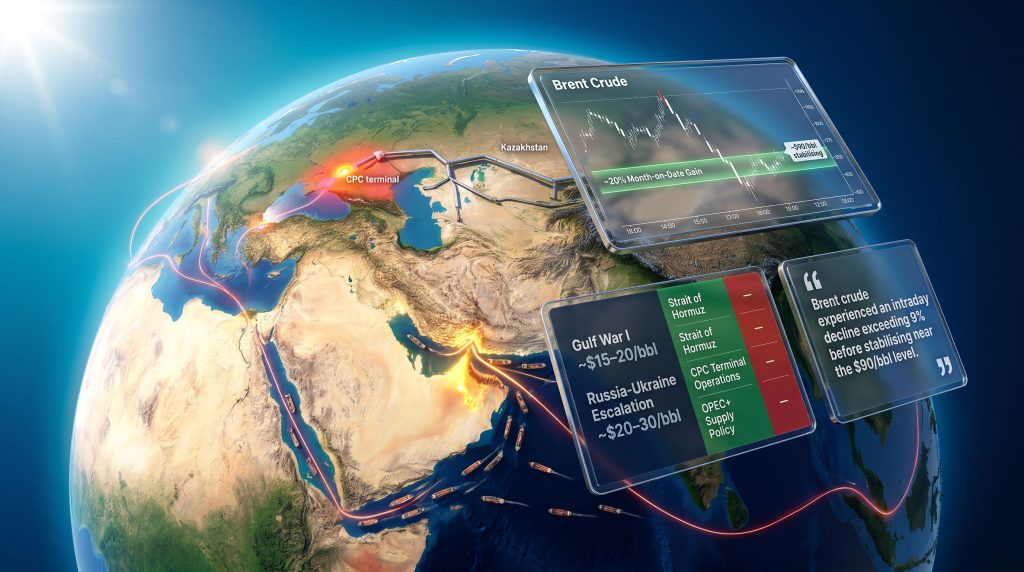
| Gulf War I (1990-91) | ~$15-20/bbl | 3-6 months |
| Libyan Civil War (2011) | ~$10-15/bbl | 4-8 weeks |
| Russia-Ukraine Escalation (2022) | ~$20-30/bbl | 6-12 weeks |
| Iran-U.S. Tension Cycle (2019-20) | ~$5-8/bbl | Days to weeks |
Note: Premium magnitudes and unwind timelines are estimates based on historical price analysis. Actual outcomes varied significantly based on the proximity of conflict to export infrastructure and the availability of alternative supply routes.
One pattern is consistent across these episodes: premiums collapse faster when the conflict does not translate into actual physical supply loss. Markets are, in essence, constantly recalibrating the probability of disruption rather than responding to disruption itself.
The Two Flashpoints That Drove July 2026 Crude Prices Higher
The Strait of Hormuz: The World's Most Critical Energy Chokepoint
No waterway on Earth carries more geopolitical weight in energy markets than the Strait of Hormuz. Approximately 20-21% of total global oil trade transits this narrow passage between the Persian Gulf and the Gulf of Oman on a daily basis, according to the U.S. Energy Information Administration. There is no viable large-scale alternative routing for the bulk of this volume without adding weeks to voyage times and billions in freight costs.
During nearly two weeks of active U.S. military strikes against Iran in July 2026, market participants priced in a meaningful probability that Iranian retaliatory action could disrupt tanker traffic through the Strait. This concern was not theoretical. Iran has previously threatened to close the Strait in response to military pressure, and its naval capabilities in the Gulf represent a credible asymmetric threat to very large crude carriers (VLCCs) and product tankers transiting the passage.
Compounding this anxiety, Iran-backed Houthi militant activity in the Red Sea simultaneously threatened Saudi export infrastructure and European-bound cargo routes. The convergence of two simultaneous maritime risk vectors created an unusually elevated and sustained risk premium across Brent crude futures. In addition, the trade war impact on oil added a further layer of complexity to an already strained pricing environment.
The CPC Terminal: Kazakhstan's Black Sea Gateway Under Threat
Less discussed but equally significant to European energy markets was the disruption at the Caspian Pipeline Consortium (CPC) terminal on Russia's Black Sea coast. The CPC pipeline system transports crude oil from Kazakhstan's major western fields, including the Tengizchevroil and Kashagan developments, across Russian territory to a marine terminal near Novorossiysk, from which tankers distribute volumes primarily to European refiners.
Ukrainian drone strikes on Black Sea maritime infrastructure caused shipowners to avoid the CPC terminal in the weeks leading into the July price peak, creating a regional supply anxiety loop. For European energy buyers who had been systematically diversifying away from Russian-origin crude following the 2022 invasion of Ukraine, Kazakh crude via CPC had become a strategically important alternative supply stream. Any threat to its continuity carried outsized psychological weight in market pricing.
Key Structural Insight: The CPC terminal handles a significant share of Kazakhstan's crude exports, and Kazakhstan produces approximately 1.9-2.0 million barrels per day of total crude oil. Even partial disruptions to CPC loadings tighten European crude import balances in ways that ripple across Brent futures pricing.
Market Mechanics: Dissecting the July 2026 Selloff
When the U.S. announced a pause in military strikes against Iran, and when crude loadings at the CPC terminal resumed, the market response was immediate and aggressive. Brent crude fell more than 9% intraday, stabilising near the $90 per barrel level in one of the sharpest geopolitical unwind sessions in recent memory. Consequently, oil prices fall as Middle East and Black Sea supply concerns ease, demonstrating how swiftly accumulated risk premiums can evaporate.
Understanding why the selloff was so sharp requires understanding the mechanics of a crowded long trade:
- During the escalation phase, institutional and speculative investors accumulated large net long positions in Brent and WTI futures, creating a heavily one-sided book.
- When de-escalation signals emerged, stop-loss orders triggered automatically below key technical price levels, creating cascading algorithmic selling pressure.
- Simultaneously, short sellers entered the market, repricing the probability that a broader regional conflict requiring actual supply curtailment would now be avoided.
- The combination of long liquidation and fresh short entry amplified the selloff well beyond what fundamental supply changes alone would have justified.
Despite this dramatic single-session decline, it is critical to maintain perspective. Brent crude futures remained approximately 20% higher on a month-to-date basis as of late July 2026. The risk premium had not fully evaporated; it had partially corrected. The underlying conflict architecture across the Middle East remained intact.
Three Analytical Lenses on the Price Drop
Market analysts approached the July selloff through meaningfully different frameworks, and understanding each perspective matters for assessing what comes next.
Interpretation 1: Temporary De-escalation, Not Structural Resolution
The geopolitical foundations that drove crude higher have not been dismantled by a military pause. Conflict pauses have historically been followed by resumptions. Risk premiums that unwind rapidly can rebuild just as rapidly, particularly if hostilities in the Hormuz region or Red Sea escalate further.
Interpretation 2: Speculative Overshoot Correction
Some analysts argue that the rally itself overshot what physical supply fundamentals justified. The pause in military action provided a catalyst for a correction that was arguably overdue on pure valuation grounds, with bearish repositioning reflecting rational mean-reversion rather than any genuine shift in the underlying supply picture.
Interpretation 3: Macro Demand Headwinds Amplifying the Decline
A third school of thought points to demand-side softness as a concurrent driver. Broader global economic concerns, including the oil prices and trade war dynamic and decelerating industrial activity in major consuming economies, may be limiting crude oil's ability to sustain elevated price levels even in a geopolitically complex environment.
Which Supply Routes Remain Structurally Vulnerable?
The resumption of CPC loadings and the U.S. military pause are positive signals, but neither represents a durable resolution to the underlying supply route vulnerabilities. Several structural risk factors persist:
- Strait of Hormuz throughput remains below pre-conflict baseline levels. VLCC operators continue to factor elevated war-risk insurance premiums into voyage economics, effectively raising the delivered cost of Gulf crude to Asian and European buyers even when physical passage is occurring.
- Red Sea corridor risks remain elevated given ongoing Houthi militant activity. War-risk insurance surcharges for vessels transiting the Red Sea have increased dramatically compared to pre-2024 norms, with some estimates placing the additional cost at tens of thousands of dollars per voyage for standard-sized tankers.
- CPC terminal resumption is fragile. The Black Sea remains an active theatre of asymmetric drone warfare, and the operational continuity of the Novorossiysk terminal depends on conditions that can deteriorate rapidly without warning.
The next major ASX story will hit our subscribers first
Key Variables That Will Determine Crude Oil's Next Directional Move
| Variable | Bullish Scenario | Bearish Scenario |
|---|---|---|
| Middle East Conflict | Hostilities resume; Hormuz disruption escalates | Ceasefire formalised; shipping normalises |
| CPC Terminal | Renewed drone strikes halt loadings | Sustained resumption of Kazakh crude flows |
| OPEC+ Policy | Production cuts maintained or deepened | Output increases capitalise on elevated prices |
| Speculative Positioning | Long positions rebuild on renewed risk | Bearish bets accumulate into crowded short |
| Global Demand | Strong Asian industrial demand | Macro slowdown suppresses consumption |
| U.S.-Iran Diplomacy | Talks collapse; sanctions tighten further | Agreement reduces Iranian supply risk |
Second-Order Effects: LNG, Refined Products, and the Insurance Market
Crude oil price volatility of this magnitude does not stay contained within the oil market. Its effects cascade across the broader energy complex in ways that matter to a wide range of businesses and consumers.
LNG spot pricing in European and Asian import markets responds to shipping route disruptions because many LNG carriers transit both the Strait of Hormuz and the Red Sea. Understanding LNG supply dynamics is therefore essential context here, as extended rerouting around the Cape of Good Hope adds approximately 10-14 days to voyage times from the Persian Gulf to European terminals, tightening effective supply availability and supporting spot LNG prices.
Refined products markets see diesel and jet fuel crack spreads widen during sustained crude supply disruption anxiety, as refinery operators adjust run rates and product inventories in response to margin uncertainty. Airlines and logistics companies are particularly exposed, given that fuel typically represents 20-30% of airline operating costs under normal conditions, a share that rises significantly when jet fuel surcharges are applied.
War-risk insurance markets, led by Lloyd's of London syndicates and specialist P&I clubs, function as a real-time pricing mechanism for route-specific conflict exposure. Elevated war-risk premiums are not just a cost burden; they act as a leading indicator of how the maritime industry genuinely assesses the probability of vessel damage or interdiction across specific corridors. Furthermore, OPEC market influence on production decisions continues to shape how effectively supply-side responses can offset route disruption impacts.
Frequently Asked Questions
Why did oil prices fall while the Middle East conflict was still ongoing?
Crude oil futures price expected future supply conditions, not current events in isolation. When the market's assessed probability of a worst-case disruption scenario decreases, even temporarily, the risk premium embedded in futures prices deflates rapidly. A military pause does not require a full conflict resolution to trigger significant price selling; a reduced escalation probability is sufficient.
What makes the Strait of Hormuz uniquely important to global oil prices?
The Strait of Hormuz is a roughly 33-kilometre-wide passage at its narrowest navigable point, through which approximately one-fifth of the world's daily oil supply transits. There is no cost-effective large-scale alternative routing for the majority of Persian Gulf crude exports. Any credible interdiction threat, whether through mining, naval action, or missile strikes on tanker traffic, immediately raises the probability of a large-volume supply shortfall with no short-term replacement capacity.
How does the CPC terminal fit into European energy security?
The Caspian Pipeline Consortium pipeline runs approximately 1,510 kilometres from western Kazakhstan's major oilfields to the Black Sea coast. It serves as a primary export channel for Kazakh crude into European refining markets, making it a strategically important diversification asset for European buyers seeking to reduce dependence on Russian-origin barrels following the 2022 geopolitical rupture.
How long do geopolitical risk premiums typically persist in oil markets?
Based on historical episodes, geopolitical risk premiums can last anywhere from days to several months, depending on three primary factors: the proximity of conflict to critical export infrastructure, the duration and intensity of the underlying military activity, and the availability of credible alternative supply sources to offset any actual production or export loss.
What This Episode Reveals About the Fragility of Global Energy Supply Architecture
The July 2026 crude oil price episode is a reminder that modern global energy supply remains structurally dependent on a small number of maritime chokepoints, pipeline corridors, and export terminals whose disruption can reshape price levels within hours. As analysts at OilPrice.com have noted, geopolitical calm in oil markets is rarely permanent, and the conditions that caused oil prices fall as Middle East and Black Sea supply concerns ease can reverse with little warning. Several durable conclusions emerge from this episode:
- Geopolitical risk premiums form and collapse with a speed that frequently overwhelms fundamental supply-demand analysis, creating both trading opportunities and significant valuation uncertainty for energy-exposed businesses.
- The simultaneous vulnerability of the Strait of Hormuz, the Red Sea corridor, and the CPC Black Sea terminal in a single market episode represents an unusual convergence of risk vectors that amplified price volatility in both directions.
- A military pause is categorically different from a resolution. Structural supply route vulnerabilities across the Middle East and Black Sea remain intact, preserving significant upside price sensitivity to any renewed escalation.
- The war-risk insurance market, tanker freight rates, and speculative positioning data are often more timely leading indicators of market direction than headline news flow alone.
- For long-term energy policy planners and investors, this episode reinforces the investment case for supply geography diversification, domestic energy production, and the broader transition toward energy sources that are less exposed to chokepoint-dependent logistics chains.
This article is intended for informational and analytical purposes only and does not constitute financial, investment, or trading advice. Crude oil price forecasts, geopolitical risk assessments, and scenario projections involve significant uncertainty and may not reflect actual future market outcomes. Readers should conduct independent research and consult qualified financial advisers before making investment decisions.
Want to Stay Ahead of the Next Major Resource Discovery?
While geopolitical risk premiums reshape energy markets with breathtaking speed, Discovery Alert's proprietary Discovery IQ model delivers real-time alerts on significant ASX mineral discoveries, instantly translating complex resource data into actionable investment opportunities — explore historic discoveries and their returns to understand why being first to act on a major find can be transformative, and begin your 14-day free trial today to secure your market-leading edge.