July 28, 2026
The Hidden Architecture of Brazil's Phosphate Dependency
Global fertilizer markets operate on cycles that most observers only notice when prices spike or shortages emerge. Yet beneath those headline moves lies a more nuanced structural reality: certain importing nations are so deeply embedded in international phosphate supply chains that any disruption, policy shift, or production adjustment anywhere in the world creates immediate ripple effects in their domestic markets. Few countries illustrate this dynamic more sharply than Brazil.
Understanding the Brazil phosphate market outlook requires looking beyond simple supply and demand curves. It demands an appreciation of soil chemistry, crop economics, currency mechanics, geopolitical exposure, and the behavioural patterns of some of the world's most commercially sophisticated farming operations. Together, these forces create a market that is simultaneously predictable in its seasonal rhythms and volatile in its price responses.
When big ASX news breaks, our subscribers know first
Why Brazil's Agricultural Dominance Creates Structural Phosphate Demand
Brazil's position as one of the world's top agricultural producers is not incidental to its phosphate consumption profile. It is the entire explanation. The country consistently ranks among the top three global producers of soybeans, corn, sugarcane, and cotton, with its agricultural sector accounting for a substantial share of national export revenues.
What makes this particularly relevant to phosphate markets is a geological reality that is often underappreciated: Brazilian soils, particularly across the Cerrado savanna region, are naturally deficient in phosphorus. This is not a correctable condition in any practical agronomic sense. It is a permanent characteristic of the underlying geology that makes phosphate fertiliser application an agronomic necessity rather than a discretionary input.
The consequence is a demand floor that cannot be engineered away. Brazilian farmers cannot choose to stop applying phosphate the way they might reduce irrigation or delay planting. Phosphorus deficiency in Cerrado soils means that crops simply do not achieve economic yields without consistent replenishment.
This soil chemistry reality is compounded by the scale of Brazil's farming operations. Large commercial soy producers in Mato Grosso, Paraná, and Goiás operate at a level of agronomic sophistication that includes precise soil testing, nutrient management plans, and forward procurement strategies. These are not subsistence farmers making ad hoc input decisions. They are industrial-scale operations managing complex input cost structures across millions of hectares.
Import Dependency: Brazil's Structural Vulnerability
Despite its agricultural scale, Brazil's domestic phosphate rock production covers only a fraction of national fertiliser requirements. The country imports the large majority of its phosphate needs from Morocco, Russia, China, and the Middle East, each source carrying distinct geopolitical and logistical risk profiles. Furthermore, the US fertiliser import reliance dynamic offers a useful comparison for understanding how import-dependent nations navigate supply chain exposure.
This import dependency creates a compounding vulnerability when the Brazilian Real weakens against the US dollar. Since phosphate fertilisers are priced internationally in USD, a depreciating Real effectively inflates the local-currency cost of every tonne imported, even when international benchmark prices remain unchanged. When currency weakness coincides with elevated global phosphate prices, the affordability squeeze on Brazilian buyers can be severe enough to trigger measurable demand contraction.
Price Trajectory and Demand Dynamics: What the Numbers Reveal
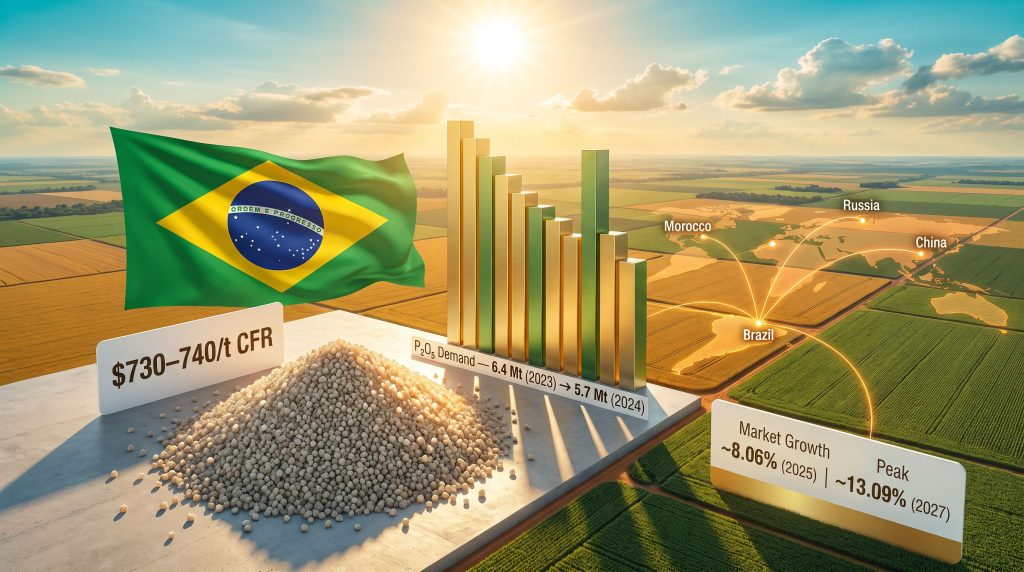
The price history of the Brazil phosphate market over recent years provides a clear illustration of how price elasticity operates in this market. Brazilian MAP (monoammonium phosphate) CFR prices were reported in the $630 to $635 per tonne range in late 2024, escalating to $730 to $740 per tonne CFR by early 2026. That represents a price increase of approximately 16 to 17 percent across roughly 14 to 15 months. According to SP Global's fertiliser analysis, phosphate fertiliser prices are not expected to fall anytime soon, a view consistent with the structural supply constraints visible across global markets.
The demand response to this pricing environment was visible and measurable. Brazil's P₂O₅ consumption declined from an estimated 6.4 million tonnes in 2023 to approximately 5.7 to 5.8 million tonnes in 2024, a contraction of roughly 10 to 11 percent. The primary mechanism was deteriorating soybean barter ratios: as the cost of phosphate inputs rose relative to the value of soybean output, farmer purchasing power eroded and procurement volumes fell.
| Product | Price Range (2024-2026) | Primary Use in Brazil | Price Sensitivity |
|---|---|---|---|
| MAP (CFR Brazil) | $630-$740/t | Soybean, corn pre-plant | High |
| DAP (CFR Brazil) | Correlated to MAP | Broad-acre crops | High |
| SSP / TSP | Lower cost alternative | Pasture, sugarcane | Moderate |
| Phosphate Rock | Domestic production base | Industrial/processing | Lower (captive supply) |
Key Market Insight: The critical distinction that separates Brazil's 2024 demand contraction from a structural market deterioration is the difference between demand destruction and demand deferral. Demand destruction involves permanent reductions in application rates. Demand deferral involves delayed purchasing that eventually resurfaces. The evidence from 2024, given Brazil's continuing agricultural expansion trajectory, points primarily toward deferral behaviour rather than any structural retreat from phosphate application.
The Barter Ratio as a Real-Time Demand Barometer
One of the least-discussed but most analytically powerful tools for understanding Brazilian phosphate purchasing behaviour is the soybean-to-fertiliser barter ratio. This metric expresses how many tonnes of soybeans a farmer must sell to purchase one tonne of MAP or DAP. When this ratio deteriorates, either because soybean prices fall or fertiliser prices rise, farmers delay procurement in anticipation of more favourable conditions.
This behavioural pattern creates a self-reinforcing dynamic. When large numbers of buyers simultaneously defer purchases, the market appears soft, which can temporarily moderate prices. But deferred demand does not disappear. It accumulates in the background and re-emerges as a concentrated buying surge when either soybean prices recover, fertiliser prices soften, or the planting window can no longer be delayed.
Global Supply Disruptions Reshaping Brazil's Import Landscape
The Moroccan Supply Equation and US Trade Policy
The United States' decision to suspend countervailing duties on Moroccan phosphate imports has introduced a new competitive variable into the global supply picture. When Moroccan product gains improved access to the North American market, the world's largest phosphate exporter, OCP (Office Chérifien des Phosphates), faces a commercial incentive to prioritise higher-value or higher-volume US trade flows.
The downstream consequence for Brazilian buyers is not straightforward. Increased US absorption of Moroccan product could reduce the volumes available for Brazilian import programmes, applying upward pressure on CFR Brazil benchmarks. However, if OCP expands output capacity in response to improved US market access, global supply could increase sufficiently to offset any redirection effects. The net impact for the Brazil phosphate market outlook depends on which dynamic dominates over the 12 to 24-month horizon.
In addition, tariffs affecting global commodity markets are reshaping trade flows in ways that create both risks and opportunities for Brazilian importers navigating an already complex procurement environment.
Middle East Conflict and the Sulphur Supply Chain
A dimension of the Brazil phosphate market outlook that receives less attention than it deserves is the critical role of sulphur in the phosphate fertiliser production process. Converting phosphate rock into usable fertiliser products requires sulphur as a processing input, and a significant portion of global sulphur supply originates from Middle Eastern petroleum refining operations.
Ongoing conflict in the Middle East has introduced meaningful uncertainty into both phosphate and sulphur supply chains simultaneously. For Brazilian buyers, the direct exposure to Middle East phosphate supply is relatively limited. The indirect exposure through sulphur costs is more significant. When sulphur supply tightens or prices rise due to regional disruption, the full phosphate processing value chain experiences margin compression, which ultimately flows through to finished fertiliser prices at the CFR Brazil level.
Mosaic's Production Curtailments: Reading the Signal
Mosaic, one of the largest phosphate producers operating within Brazil, announced production cuts that tightened domestic market availability and altered the expectations of Brazilian buyers. Production curtailments by major domestic players serve as a leading indicator of the market's cost-price dynamics. They typically signal that either input costs have risen to levels that compress processing margins, that demand has softened sufficiently to make full-capacity operation uneconomic, or both conditions exist simultaneously.
For Brazilian importers and farming operations, Mosaic's reduced domestic output has several practical consequences:
- It increases reliance on imported product to fill the supply gap
- It reduces the competitive pressure on CFR import prices from domestically produced alternatives
- It signals to the broader market that current price levels may be sustainable, discouraging aggressive buying anticipation of near-term corrections
Furthermore, commodity prices impacting mining performance remain a key consideration as producers globally recalibrate output decisions in response to evolving market conditions.
Brazil's Seasonal Demand Cycle: Why September Changes Everything
The September soybean planting season across Brazil's Centre-West agricultural belt represents the single most consequential demand event in the country's phosphate calendar. Virtually all other demand patterns in the market subordinate themselves to this one agricultural milestone.
Pre-planting fertiliser procurement typically begins 60 to 90 days ahead of the planting window. This means July and August represent the peak purchasing period for phosphate products associated with the soybean season. When buyers defer procurement beyond this window due to price expectations or affordability constraints, the result is a compressed buying period in August and September that creates both logistics stress and price volatility.
| Crop | Phosphate Intensity | Seasonal Demand Peak | Estimated Share of Total P₂O₅ Demand |
|---|---|---|---|
| Soybeans | High | July-September (pre-plant) | ~45-50% |
| Corn (1st & 2nd crop) | Moderate-High | October-January | ~20-25% |
| Sugarcane | Moderate | Year-round | ~10-15% |
| Cotton | High | December-February | ~5-8% |
| Pasture & Other | Low-Moderate | Variable | Remainder |
Port congestion, vessel availability constraints, and inland freight capacity limitations in Brazil's agricultural interior can amplify the pricing effects of a late-season buying surge. Brazil's logistics infrastructure, while improving, remains a genuine bottleneck during peak demand periods.
Demand Scenarios for the 2025-2026 Planting Cycle
Scenario 1: Deferred Procurement Triggers a Late Surge
If Brazilian buyers continue deferring July purchases in anticipation of price corrections that do not materialise, a concentrated August-September buying surge becomes the base-case outcome. Logistics constraints would amplify the pricing effect of this concentrated demand. This scenario is broadly consistent with the historical pattern of compressed buying windows observed across multiple Brazilian agricultural cycles.
Scenario 2: Sustained Elevation Drives Application Rate Reduction
If MAP CFR prices remain above $720 to $740 per tonne through the planting season, economically marginal phosphate applications may be reduced, particularly on lower-value crops such as pasture and secondary grains. Primary soybean production is less vulnerable to this dynamic given the agronomic necessity of phosphorus application on phosphorus-deficient Cerrado soils. The long-term consequence of this scenario is accelerated soil phosphorus depletion, which builds a larger latent demand rebound in subsequent seasons.
Scenario 3: Global Supply Normalisation Enables Recovery
A resolution of Middle East supply chain disruptions combined with increased Moroccan export availability could ease global phosphate market tightness, bringing MAP CFR prices back toward the $620 to $650 per tonne range. At this price level, suppressed Brazilian demand would likely recover rapidly, potentially supporting the more optimistic growth projections of 8 to 13 percent that some forecasters have assigned to 2025 to 2027. According to Grand View Research's fertiliser market outlook, Brazil's fertiliser sector is positioned for sustained structural growth underpinned by continued agricultural expansion.
The next major ASX story will hit our subscribers first
Brazil Phosphate Market Forecast: Growth Projections Through 2030
| Forecast Metric | Estimate | Time Horizon |
|---|---|---|
| Market revenue (2026) | USD 6-8 billion | Current year estimate |
| Annual consumption growth | 1.5-2.5% | Conservative scenario through 2035 |
| Market growth rate (2025) | ~8.06% | Near-term optimistic scenario |
| Peak growth rate | ~13.09% | High-demand 2027 scenario |
| P₂O₅ demand (2023) | ~6.4 Mt | Historical baseline |
| P₂O₅ demand (2024) | ~5.7-5.8 Mt | Recent contraction |
Analyst Caution: The wide variance between conservative and optimistic forecast ranges reflects the market's acute sensitivity to three interacting variables: soybean commodity prices, BRL/USD exchange rates, and global MAP CFR benchmarks. Investors and procurement planners should model scenario ranges rather than relying on point estimates. Past demand contraction events in Brazil have consistently proven to be cyclical rather than structural.
Medium-term structural growth remains anchored to the continued expansion of Brazil's MATOPIBA agricultural frontier (Maranhão, Tocantins, Piauí, and Bahia), which represents the country's fastest-growing farming region. Agricultural credit programmes such as Plano Safra provide partial insulation from international price spikes by subsidising input costs for qualifying producers, though the primary market pricing environment remains largely market-driven. Consequently, the Brazil phosphate market outlook is ultimately more exposed to global pricing cycles than subsidy-intensive markets such as India.
How Brazil Compares to Other Major Phosphate-Consuming Nations
| Country | Annual P₂O₅ Consumption | Primary Crops | Import Dependency | Key Suppliers |
|---|---|---|---|---|
| Brazil | 5.7-6.4 Mt | Soybeans, corn, sugarcane | High (~75-80%) | Morocco, Russia, China |
| India | ~6-7 Mt | Rice, wheat, pulses | Very High (~90%+) | Morocco, Saudi Arabia |
| China | ~12-14 Mt | Grains, vegetables | Net Exporter | Domestic |
| USA | ~4-5 Mt | Corn, soybeans | Moderate | Domestic + Morocco |
The structural difference between Brazil and India is particularly instructive for market analysts. India's government-administered fertiliser subsidy regime partially decouples domestic phosphate prices from global benchmarks, providing a buffer against international price cycles. Brazil's market-driven pricing environment means that Brazilian buyers absorb the full force of global price movements, amplifying both the upside demand surges during favourable crop economics and the downside contractions during periods of combined price elevation and currency weakness.
Brazil's large-scale commercial farming sector also enables procurement behaviour that is more strategically sophisticated than is common in smallholder-dominated markets. Forward contracting, origin diversification, and inventory management are standard practice among large soy producers. This means demand responses in Brazil are often more deliberate and strategy-driven than raw affordability metrics alone would suggest.
Strategic Considerations for Buyers, Producers, and Market Participants
For Agricultural Buyers and Procurement Teams
- Track the BRL/USD exchange rate alongside international MAP CFR benchmarks to identify windows where the currency-adjusted landed cost is most favourable
- Pre-season forward contracting for July-August delivery can reduce exposure to the late-season price premiums that compressed buying windows historically generate
- Diversifying import origin exposure across Moroccan, Russian, and Chinese supply chains reduces single-source geopolitical risk, particularly relevant given current Middle East supply chain uncertainties
For Producers and Exporters Targeting Brazil
- Brazil's import-dependent market structure creates consistent receptiveness to new supply relationships when traditional sources face disruption; for instance, the Ammaroo phosphate project represents the type of emerging supply source that import-reliant markets like Brazil may increasingly engage with
- Timing export campaigns to align with the July-August pre-planting procurement peak maximises market penetration for the soybean season
- CFR price competitiveness accounting for full freight and logistics costs is the primary determinant of market share in a commercially sophisticated buying environment
For Market Analysts and Investors
- Brazil's phosphate demand trajectory is most accurately modelled as a function of three interacting variables: soybean commodity prices, BRL/USD exchange rates, and global MAP CFR benchmarks
- The 2024 contraction from 6.4 Mt to 5.7-5.8 Mt P₂O₅ should be interpreted as cyclical deferral consistent with historical fertiliser demand patterns, not as evidence of structural demand destruction
- The projected peak growth rate of approximately 13 percent in 2027 reflects a potential rebound cycle following suppressed purchasing in 2024-2025, a pattern that has recurred across multiple prior fertiliser price cycles in price-sensitive import markets
This article is intended for informational purposes only and does not constitute financial, investment, or agricultural procurement advice. Forecasts, price projections, and market estimates involve significant uncertainty and should not be relied upon as predictive of future market outcomes. Readers should consult qualified advisors before making investment or procurement decisions based on the information presented here.
Want to Track the Next Major Mineral Discovery Before the Broader Market Does?
Discovery Alert's proprietary Discovery IQ model delivers real-time alerts on significant ASX mineral discoveries, instantly transforming complex mineral data into actionable investment insights — visit the Discovery Alert discoveries page to explore historic examples of exceptional returns, and begin your 14-day free trial to position yourself ahead of the market.