August 5, 2026
Understanding the Current Aluminium Market Correction
Global commodity markets operate in perpetual cycles of expansion and contraction, driven by the complex interplay between industrial demand, monetary policy, and structural supply dynamics. The aluminium sector currently finds itself navigating a particularly nuanced phase where traditional price-support mechanisms appear temporarily disconnected from immediate market pricing, creating what economists term a "paradoxical correction."
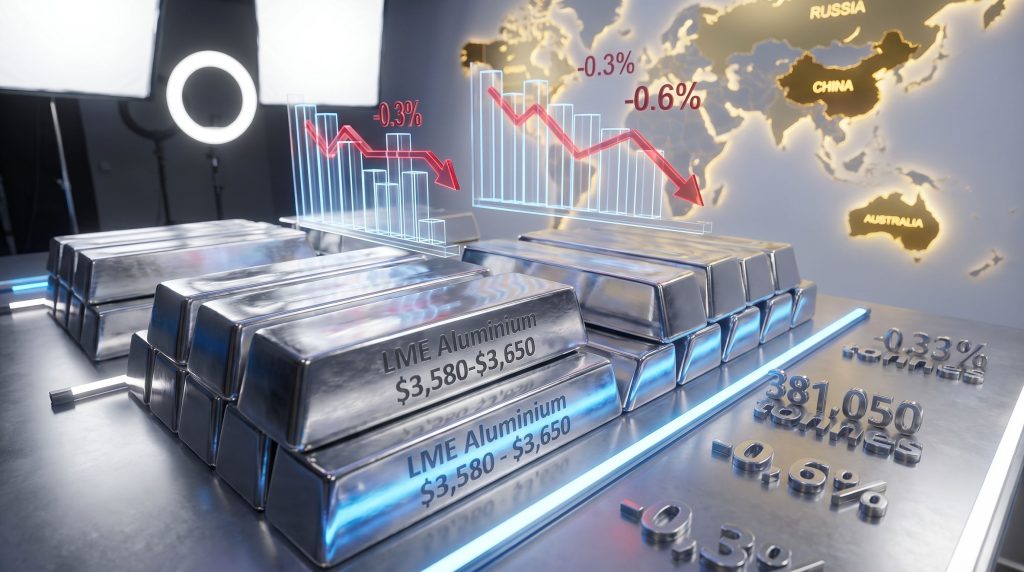
Recent sessions have witnessed the LME aluminium cash offer price declining to $3,642 per tonne, representing a 0.27% decrease from previous levels, while simultaneously exchange inventories contracted by 0.58% to 381,050 tonnes. This seemingly contradictory movement – declining prices amid tightening physical supply – illustrates the multifaceted nature of modern commodity price discovery mechanisms.
Market Context Behind Recent Price Volatility
The current LME aluminium price decline reflects broader commodity cycle dynamics where speculative positioning often precedes fundamental supply-demand rebalancing. Unlike equities markets where earnings visibility drives valuation metrics, aluminium pricing operates within a framework where physical inventory levels, forward curve structures, and regional premium differentials create multiple layers of price discovery complexity.
Historical analysis reveals that aluminium markets frequently experience correction phases following periods of sustained appreciation, particularly when inventory levels approach critical thresholds. The current inventory reading of 381,050 tonnes represents approximately 1.74 days of global consumption, assuming annual production levels near 80 million tonnes globally.
Furthermore, comprehensive tariff impact analysis demonstrates how trade policy adjustments contribute to short-term pricing volatility in industrial metals markets.
Key Metrics Driving Current Price Action
LME Aluminium Price Movement Analysis
| Contract Type | Current Level | Weekly Change | Monthly Trend |
|---|---|---|---|
| Cash Settlement | $3,642 | -0.27% | Softening momentum |
| 3-Month Forward | $3,588-$3,590 | -0.42% to -0.46% | Structural weakness |
| December 2027 | $3,135-$3,140 | -0.41% | Long-term bearishness |
The forward curve structure reveals critical insights into market sentiment, with longer-dated contracts showing more pronounced weakness than near-term positions. This contango pattern suggests market participants anticipate improved supply availability over extended timeframes, potentially through capacity additions or demand normalization.
The Asian Reference Price benchmark at $3,620 per tonne provides regional context, indicating that Asia-Pacific derivative markets are trading at modest discounts to LME aluminium cash levels, reflecting local supply-demand dynamics and currency considerations.
When big ASX news breaks, our subscribers know first
What Economic Forces Are Pressuring Aluminium Valuations?
Contemporary aluminium market dynamics operate within an increasingly complex macroeconomic environment where traditional demand drivers intersect with evolving trade policy frameworks and monetary policy transmission mechanisms. Understanding these forces requires examination of both cyclical and structural economic shifts affecting industrial metals consumption patterns.
Global Trade Policy Recalibrations
International trade policy adjustments continue reshaping aluminium flow patterns and pricing mechanisms across regional markets. Analysis of US economy tariffs reveals how tariff structure modifications and bilateral trade agreements influence not only direct aluminium trade but also derivative product movements, creating secondary effects on primary metal demand patterns.
Regional trade flow adaptations have become increasingly sophisticated, with market participants developing alternative supply chain configurations to optimize cost structures under evolving policy environments. These adaptations often involve complex triangular trading arrangements and processing location adjustments that can temporarily distort traditional pricing relationships.
Supply Chain Normalization Effects
The gradual restoration of normal supply chain operations across key producing and consuming regions represents a significant deflationary force on aluminium valuations. Inventory management strategies by major industrial consumers have shifted from crisis-mode stockpiling toward optimization-focused just-in-time procurement approaches.
Production capacity utilization rates across major producing regions show signs of stabilization, reducing the premium previously commanded by spot market transactions. This normalization process typically creates temporary oversupply conditions as pipeline inventories held during disrupted periods return to market circulation.
Additionally, sophisticated market volatility hedging strategies help market participants manage exposure to commodity price fluctuations during transitional periods.
Current LME inventory levels at 381,050 tonnes represent a 0.58% decline from previous sessions, indicating ongoing supply tightness despite price softening.
How Do Inventory Dynamics Influence Price Discovery?
Aluminium inventory dynamics operate through sophisticated warehouse financing mechanisms and regional distribution patterns that significantly influence price discovery processes. The distinction between different categories of LME-registered inventory creates multiple layers of supply availability that market participants must carefully analyze.
Exchange Stock Analysis and Market Signals
Current LME inventory composition reveals important structural insights about market liquidity and participant behavior. Live warrants totaling 335,000 tonnes represent 87.8% of total registered inventory, indicating that the vast majority of exchange stocks remain immediately available for physical withdrawal.
The sharper decline in cancelled warrants – falling 4.83% to 43,825 tonnes – suggests active warrant destruction or financing position unwinding. Cancelled warrants typically represent inventory held as collateral for financing arrangements, and their reduction can indicate either physical offtake or changes in warehouse financing economics.
Inventory Category Breakdown:
• Total Opening Stock: 381,050 tonnes (-0.58% session-over-session)
• Live Warrants: 335,000 tonnes (-0.18% decline)
• Cancelled Warrants: 43,825 tonnes (-4.83% decline)
• Implied Available Supply: ~335,000 tonnes functionally accessible
Physical Market Premiums and Basis Relationships
Regional premium structures continue reflecting local supply-demand imbalances, with Asia-Pacific markets showing modest discounts to LME benchmarks through the Asian Reference Price mechanism. These differentials indicate varying degrees of supply tightness across geographic regions.
Forward curve contango/backwardation implications affect storage economics significantly, as negative carry environments discourage inventory accumulation while positive carry structures incentivize stockpiling behavior. Current curve structures suggest modest carrying costs that neither strongly encourage nor discourage inventory holding.
What Role Does Alumina Pricing Play in the Value Chain?
Alumina represents the critical raw material input for primary aluminium production, with current pricing at $308.69 per tonne establishing fundamental cost structures for smelting operations worldwide. The alumina-to-aluminium conversion process typically requires 1.95 tonnes of alumina per tonne of primary metal output.
Upstream Cost Pressures and Margin Analysis
At current market levels, alumina input costs represent approximately $602.94 per tonne of aluminium output (308.69 × 1.95 conversion factor), accounting for roughly 16.5% of the aluminium price in raw material costs alone. This proportion provides important context for evaluating smelter margin sustainability under various price scenarios.
Energy costs constitute the largest variable input for aluminium production, typically representing 25-40% of total production costs depending on regional electricity pricing and facility efficiency levels. The combination of alumina costs and energy expenses determines the primary cost structure that influences producer output decisions.
Integrated Producer Strategies
Vertically integrated producers maintaining control over alumina supply chains possess significant advantages during volatile market periods. These operational structures provide natural hedging against input cost fluctuations and enable more sophisticated inventory management strategies.
However, broader energy transition challenges affect production costs and strategic planning across the aluminium value chain.
Production Cost Components:
• Alumina (Raw Material): ~16.5% of aluminium price
• Electricity/Energy: 25-40% depending on region
• Labor and Fixed Overhead: 10-15% typical range
• Transportation and Logistics: 3-8% based on location
• Carbon Anodes and Other Inputs: 5-10% combined
Which Macroeconomic Indicators Should Investors Monitor?
Aluminium demand patterns correlate strongly with specific macroeconomic indicators that provide leading signals about market direction. Understanding these relationships enables more informed investment decision-making and risk assessment frameworks.
Demand-Side Economic Drivers
Manufacturing activity indicators, particularly Purchasing Managers' Index (PMI) readings from major consuming regions, typically lead aluminium demand by 1-3 months. Construction sector health metrics including permit issuance, infrastructure spending announcements, and housing market activity provide additional demand visibility.
The automotive industry's ongoing transition toward electric vehicles creates evolving aluminium demand profiles that differ significantly from traditional internal combustion engine requirements. Electric vehicle production typically requires 20-30% more aluminium per unit than conventional vehicles, primarily due to battery housing and thermal management systems.
Currency and Financial Market Interactions
USD strength affects commodity pricing through multiple transmission mechanisms, including purchasing power changes for non-USD economies and alterations in speculative positioning by financial market participants. Interest rate environments impact storage costs and financing availability for inventory-holding strategies.
Understanding tariff economic implications provides crucial context for analysing how policy changes affect industrial metals pricing mechanisms.
Key Monitoring Framework:
• Manufacturing PMI: Leading indicator 1-3 months
• Construction Permits: Infrastructure demand proxy
• EV Production Data: Growth sector consumption
• USD Index (DXY): Currency impact assessment
• Real Interest Rates: Storage cost implications
LME aluminium prices are declining due to a combination of trade policy adjustments, supply chain normalization, and profit-taking after recent highs, despite underlying supply constraints that continue to support medium-term pricing fundamentals.
How Are Different Market Participants Responding?
Market participant behavior during correction phases reveals important insights about underlying sentiment and positioning strategies. The warrant activity patterns observed in recent sessions suggest active portfolio rebalancing across different participant categories.
Institutional Investment Flows
The 4.83% decline in cancelled warrants indicates potential institutional financing position adjustments, as these instruments frequently serve as collateral for structured commodity investments. This level of warrant destruction typically reflects either physical offtake acceleration or strategic repositioning by large-scale market participants.
Long-term contract negotiations between producers and industrial consumers often intensify during market correction phases, as purchasing managers seek to lock in favorable pricing for future delivery periods. These bilateral agreements can remove significant tonnage from spot market availability.
Producer Strategic Responses
Primary aluminium producers typically respond to margin pressure through production optimization rather than dramatic output curtailments, given the high fixed cost structure of smelting operations. Facility-level decisions focus on maximising operational efficiency and minimising variable costs.
Participant Response Patterns:
• Producers: Production optimization, cost reduction focus
• Consumers: Contract negotiation acceleration, inventory timing
• Financial Players: Position rebalancing, warrant management
• Traders: Arbitrage opportunity assessment, regional spreads
The next major ASX story will hit our subscribers first
What Does Technical Analysis Reveal About Price Trajectories?
Technical analysis of LME aluminium pricing reveals important structural patterns that complement fundamental analysis approaches. The current price action demonstrates classic correction characteristics within an established trading range framework.
Chart Pattern Recognition and Support Levels
The decline from $3,652 to $3,642 in cash pricing represents a modest technical retracement that remains well within normal volatility parameters for aluminium markets. Key support levels emerge around psychological round numbers and previous consolidation zones.
Forward curve analysis indicates systematic weakness across all contract maturities, with December 2027 contracts showing the most pronounced softness at $3,135-$3,140. This pattern suggests market participants anticipate supply-demand rebalancing over extended timeframes.
Detailed analysis from Trading Economics provides additional context on long-term price trends and economic indicators affecting commodity valuations.
Futures Curve Analysis
The current curve structure displays mild contango characteristics, where longer-dated contracts trade below near-term prices. This pattern typically reflects expectations of improved supply availability or demand moderation over time.
Technical Indicator Summary:
• Near-term Support: $3,580-$3,600 zone
• Resistance Levels: $3,680-$3,720 range
• Curve Structure: Mild contango suggesting supply expectations
• Volume Patterns: Moderate participation without panic selling
FAQ: Understanding Aluminium Market Dynamics
Why do aluminium prices fluctuate more than other base metals?
Aluminium markets exhibit higher volatility due to concentrated production capacity in specific regions and extreme energy intensity making prices sensitive to power cost fluctuations. The relatively small LME inventory base compared to global consumption amplifies price movements when supply-demand imbalances occur.
How do geopolitical events affect aluminium pricing?
Supply chain vulnerability analysis reveals that aluminium production clusters in regions with significant geopolitical risk factors. Strategic stockpiling by governments and trade policy transmission mechanisms create additional volatility layers beyond fundamental supply-demand dynamics.
What indicators predict future price movements?
Leading economic indicators with strong correlations include manufacturing PMI readings, construction activity metrics, and automotive production data. Supply-demand balance forecasting methodologies incorporating regional capacity utilisation provide additional predictive value.
Strategic Implications for Market Participants
The current LME aluminium price decline creates differentiated strategic implications across market participant categories, requiring tailored risk management approaches and positioning strategies.
Risk Management Considerations
Hedging strategies must account for basis risk between physical regional premiums and LME benchmark pricing, particularly given the evolving trade policy environment. Volatility management through derivative instruments becomes increasingly important as market uncertainty persists.
Portfolio diversification within commodity allocations should consider correlation relationships between aluminium and other industrial metals, as these relationships can shift during macroeconomic transition periods.
Long-term Outlook Assessment
Structural supply-demand balance projections indicate continued supply constraints over medium-term horizons, despite current price softening. Decarbonisation trends affecting aluminium demand create potential upside scenarios, while recycling rate improvements may moderate primary demand growth.
Risk Factors by Participant Type
| Participant | Primary Risks | Mitigation Strategies |
|---|---|---|
| Producers | Margin compression, energy costs | Production optimisation, power hedging |
| Consumers | Supply security, price volatility | Contract diversification, inventory timing |
| Investors | Market timing, correlation shifts | Position sizing, sector rotation |
| Traders | Basis risk, liquidity constraints | Spread analysis, multiple venue access |
The intersection of fundamental supply constraints with cyclical demand patterns continues supporting medium-term price stability above current correction levels. Market participants maintaining exposure to aluminium sector dynamics should focus on position sizing appropriate to volatility expectations rather than attempting precise market timing around short-term price fluctuations.
This analysis contains forward-looking statements and market projections that involve inherent uncertainties and risks. Past performance does not guarantee future results, and commodity investments can result in significant losses. Readers should consult qualified financial advisors and conduct independent research before making investment decisions.
Looking for Your Next Market-Moving Discovery?
Discovery Alert provides instant notifications on significant ASX mineral discoveries using its proprietary Discovery IQ model, delivering real-time insights that help investors capitalise on major announcements before the broader market reacts. Explore why major mineral discoveries can lead to substantial market returns by visiting Discovery Alert's dedicated discoveries page, and begin your 14-day free trial today to position yourself ahead of market-moving developments.