July 18, 2026

When Supply Chain Geography Becomes the Market's Most Volatile Variable
For most of the past two decades, aluminium price forecasting was a relatively structured discipline. Analysts modelled Chinese construction demand, tracked LME warehouse inventories, and monitored smelter utilisation rates across key producing regions. The variables were complex but largely predictable. What is unfolding in 2026 represents something fundamentally different: a market in which sovereign policy decisions, maritime conflict zones, and bilateral resource agreements are displacing consumption cycles as the primary price formation mechanism.
This is not a temporary deviation. The upstream aluminium market geopolitics now shaping raw material flows, trade routing, and corporate strategy reflect a structural reconfiguration of how the global industry operates. Understanding the mechanics of this shift requires examining the bauxite-to-alumina-to-metal value chain through a geopolitical lens rather than a purely economic one.
When big ASX news breaks, our subscribers know first
The Upstream Value Chain and Why Disruptions Cascade Downward
The aluminium production sequence moves through three distinct stages: bauxite extraction, alumina refining, and primary smelting. Each stage amplifies the consequences of the one before it. Roughly four to five tonnes of bauxite ore are required to produce approximately two tonnes of alumina, which in turn yields one tonne of primary aluminium metal. This ratio means that a relatively modest disruption at the bauxite extraction stage translates into a disproportionately larger impact at the smelting level.
The key producing nations in this chain are heavily concentrated. Guinea dominates bauxite exports globally, Australia supplies the remainder of China's import base, and primary smelting hubs are distributed across China, the Gulf Cooperation Council, and parts of Southeast Asia. This geographic concentration creates multiple single points of failure that have become increasingly exposed in 2026. Furthermore, global bauxite supply constraints are adding further pressure to an already strained system.
The global aluminium market carried an implied supply deficit of approximately 1.27 million tonnes as of early 2026, a structural gap that geopolitical events are actively widening rather than closing.
The Strait of Hormuz: A Chokepoint With Aluminium Consequences
Why Gulf Smelters Are Uniquely Exposed
The Gulf Cooperation Council's aluminium industry is built on an imported raw material model. GCC smelters do not have access to domestic bauxite reserves at meaningful scale, which means the entire feedstock supply chain depends on maritime logistics. Approximately 75% of GCC smelting capacity relies on alumina imports that transit the Strait of Hormuz, making it one of the most consequential chokepoints for the global aluminium supply chain.
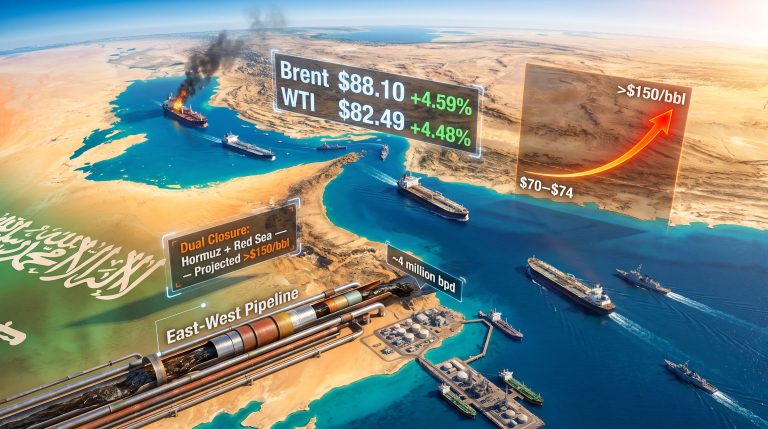
When Middle East tensions escalated in 2026, the effects on this supply architecture were immediate and severe. Direct strikes on smelting infrastructure in the UAE and Bahrain removed an estimated combined 2.43 million tonnes of annual production capacity from global supply. War-risk insurance premiums climbed toward 3% of cargo value, a threshold at which many shipping operators determined Gulf-bound voyages were no longer economically viable.
The Trade Route Collapse and Partial Recovery
The real-time impact on physical trade flows was captured in granular shipping data. Signal Ocean recorded zero bauxite shipments departing for the UAE during March 2026, an effectively complete cessation of trade at that point in the corridor. By April 2026, some cargo movement had resumed at around 126,000 tonnes, but this figure represented more than a 71% decline relative to the equivalent period in 2025.
The UAE's share of global seaborne bauxite trade, typically around 3%, collapsed to just 0.6% during this period. According to analysis from S&P Global, geopolitical risks in the Middle East are also tightening the broader Asian aluminium market, adding another layer of complexity to regional supply chains.
The knock-on effects were felt across European markets as well, with Rotterdam aluminium premiums tracking toward $400-$420 per tonne as the supply disruptions persisted. For US downstream manufacturers, the exposure was also material, given that roughly 20% of US aluminium imports originate from Gulf producers. In addition, US aluminium tariffs have further complicated procurement strategies for affected buyers.
India's Strategic Repositioning as a Processing Hub
One of the less anticipated consequences of Gulf supply disruption was the acceleration of India's role in the upstream aluminium market. As shipments were rerouted away from the UAE, India emerged as an increasingly significant destination for raw bauxite and, crucially, began expanding its alumina export activity in parallel.
| Metric | Data Point | Period |
|---|---|---|
| India bauxite imports | 2.5 million tonnes | Q1 2026 |
| Year-on-year growth | +285% | Q1 2026 vs Q1 2025 |
| India bauxite imports | 781,000 tonnes | April 2026 |
| April year-on-year growth | +24% | April 2026 |
| India alumina exports | +66% increase | January to April 2026 |
The simultaneous surge in Indian bauxite imports and alumina exports suggests more than opportunistic cargo redirection. India appears to be actively leveraging its refining capacity to capture margin at the processing stage, positioning itself as a regional alumina supplier at a moment when Gulf refining infrastructure is constrained. This kind of value chain repositioning, once established, tends to create durable trade relationships that persist beyond the immediate disruption.
Guinea's Export Dynamics: Oversupply at the Mine, Scarcity at the Smelter
The Concentration Risk Embedded in China's Supply Chain
China's raw material dependency on Guinea is one of the most concentrated resource relationships in global commodity markets. During the January to May 2026 period, China imported 82.57 million tonnes of Guinean bauxite, representing year-on-year growth of 24%. Guinea alone supplied approximately 82% of China's total bauxite imports, and together with Australia accounted for more than 97% of China's seaborne bauxite supply.
| Trade Metric | Figure | Period |
|---|---|---|
| Chinese bauxite imports from Guinea | 82.57 million tonnes | January to May 2026 |
| Year-on-year growth | +24% | vs. same period 2025 |
| Guinea's share of China's imported bauxite | ~82% | 2026 |
| Guinea and Australia combined share | >97% | 2026 |
This level of concentration is remarkable by any standard of commodity supply chain management. For a market the size of China's aluminium industry, having more than four-fifths of bauxite imports dependent on a single West African nation creates exposure to sovereign policy risk, logistics disruptions, and political instability that has no short-term mitigation pathway. Moreover, China's commodity demand patterns across multiple raw materials continue to define global trade flows well beyond aluminium alone.
The Price Paradox: Volume Growth Accompanied by Deflation
In a development that illustrates the complexity of upstream aluminium market dynamics, Guinea's export surge produced price deflation rather than inflation. China's average bauxite import price declined by 27%, falling from approximately USD 88 per tonne to USD 64 per tonne, as Guinean export volumes expanded faster than downstream smelting capacity could absorb them. FOB Guinea bauxite prices dropped to USD 32-38 per tonne, the lowest level recorded since March 2022.
This divergence, where bauxite prices are falling while primary aluminium prices face upward pressure from smelter disruptions, is a textbook illustration of how geopolitical shocks can create simultaneous oversupply at one stage of a value chain and acute scarcity at another. Miners in Guinea are receiving less revenue per tonne even as downstream consumers face constrained availability and rising costs.
This upstream-downstream dislocation is not well understood by many market participants. Investors focused solely on LME aluminium prices may miss the compressed margin environment affecting bauxite producers, while those watching bauxite spot prices may underestimate the structural deficit developing at the refined metal level.
The Export Cap Proposal: How One Policy Decision Could Reverse Everything
Perhaps the most consequential development in the Guinea story is not what has already happened, but what may be coming. A proposed annual bauxite export ceiling of 150 million tonnes has introduced significant uncertainty into forward supply planning. The proposal has not been formally enacted, but its existence alone has been sufficient to reshape sentiment and influence forward pricing.
The arithmetic of the proposed cap is striking. If Guinea's exports to China reach approximately 100 million tonnes in the first half of 2026, the ceiling would leave only around 50 million tonnes available for the remainder of the year, before accounting for shipments to any non-Chinese destinations. Vessel capacity modelling by Signal Ocean estimated the reduction could free the equivalent of approximately 46 Capesize vessels from Guinea-China trade routes, a significant displacement of shipping capacity.
The policy risk is amplified by the fact that no short-term substitute for Guinean bauxite exists at the volumes China requires. Indonesian bauxite export restrictions, implemented in 2023, already removed one alternative source from the market. Brazil and Australia represent partial substitutes, but neither can quickly scale to replace Guinean volumes.
China's Structural Production Ceiling: The Amplifier Behind Every Shock
Why 45 Million Tonnes Defines the Market's Upper Boundary
China's domestic aluminium production is structurally capped at approximately 45 million tonnes per year, a limit shaped by regulatory constraints and the energy intensity of primary smelting. This ceiling transforms the market dynamic in a fundamental way: China cannot buffer external supply disruptions through domestic production increases. When Guinea restricts exports or Gulf smelters go offline, China has no domestic reserve capacity to activate.
The consequence is that China has become an increasingly aggressive procurer of overseas raw materials. Its dominance in global seaborne bauxite demand is effectively absolute, accounting for 87.2% of global seaborne bauxite shipments in April 2026. The remaining 12.8% was distributed across multiple destinations:
| Destination | Share of Global Seaborne Bauxite Shipments |
|---|---|
| China | 87.2% |
| India | 3.0% |
| Ireland | 1.9% |
| Canada | 1.6% |
| Mauritius | 1.3% |
| Philippines | 1.1% |
| United States | 1.0% |
| UAE | 0.6% |
China's strategic response to its production ceiling includes deepening bilateral resource agreements with Guinea, expanding port and logistics infrastructure to increase import capacity, and pursuing supply diversification through emerging relationships with Russia and other bauxite-producing nations. These moves reflect a longer-term recognition that domestic capacity constraints make overseas raw material security an existential priority, not merely an economic preference.
Corporate Strategy Under Structural Pressure: The South32-Alcoa Transaction
Reading the Strategic Logic Behind an Unexpected Exit
Against a backdrop of low LME aluminium inventories and growing consensus around a sustained market deficit, South32's decision to divest the majority of its aluminium operations to Alcoa in a transaction valued at up to USD 5.6 billion, including a USD 750 million price-linked earn-out, represents one of the more counterintuitive corporate moves of 2026.
The strategic reasoning centres on energy cost trajectories rather than commodity price expectations. Primary aluminium smelting is among the most energy-intensive industrial processes in existence, with electricity typically representing 30-40% of total production costs. For operators without long-term, fixed-price power contracts, rising energy costs driven by Middle East conflict and broader supply disruptions can erode margins even when LME prices are rising. South Africa's power contract dynamics were specifically noted as a contributing factor in the investment strategy reassessment.
South32's exit from aluminium during a period of supply deficit and rising prices reflects a broader corporate reassessment of whether long-term energy cost trajectories and geopolitical operating risks outweigh near-term commodity price upside. It is a bet on cost structure, not commodity direction.
What Alcoa's Acquisition Reveals About the Future of Integrated Production
For Alcoa, the transaction represents a deliberate consolidation of mine-to-metal control at a moment when supply chain fragmentation is becoming a competitive disadvantage. Indeed, Alcoa's aluminium strategy has consistently prioritised upstream integration as a long-term competitive advantage.
| Transaction Metric | Detail |
|---|---|
| Total transaction value | Up to USD 5.6 billion |
| Price-linked earn-out | USD 750 million |
| Expected synergies | ~USD 900 million |
| Alcoa bauxite production share pre-deal | 8.5% of global output |
| Alcoa bauxite production share post-deal | 13% of global output |
The jump from 8.5% to 13% of global bauxite production is not simply a scale play. In a geopolitically fragmented supply environment, owning the full value chain from mine to metal functions as a risk management tool that cannot be replicated through supply contracts alone. Integrated producers can redirect internal feedstock flows when external trade corridors are disrupted, a capability that is becoming increasingly valuable as geopolitical volatility normalises.
The broader industry trend is a bifurcation between producers with captive, low-cost power and integrated raw material access, and those relying on market-priced energy and spot bauxite procurement. Capital is flowing visibly toward the former and away from the latter, a structural realignment that will reshape the competitive landscape of primary aluminium production over the coming decade. Consequently, leading aluminium producers are repositioning their asset portfolios accordingly.
The next major ASX story will hit our subscribers first
Key Takeaways for Investors and Industry Participants
The convergence of forces reshaping the upstream aluminium market geopolitics in 2026 is not a collection of isolated events. It is a coherent pattern driven by structural forces that are unlikely to reverse quickly. According to Wood Mackenzie's short-term outlook assessment, rising market risk is fundamentally altering how analysts model near-term supply and demand balances across the sector.
-
Maritime security has become an aluminium supply variable. The Strait of Hormuz disruption demonstrated that physical trade route integrity determines supply availability as much as production capacity does.
-
Guinea's policy posture carries global pricing power. A single export policy decision in Conakry can move bauxite spot prices, reshape global vessel routing, and alter alumina availability across multiple continents simultaneously.
-
China's 45-million-tonne ceiling amplifies every shock. Without domestic buffer capacity, China's raw material dependency means any upstream disruption has a multiplied effect on global supply-demand balances.
-
Corporate strategy is being rewritten around energy and geopolitical risk, not commodity cycles. The South32-Alcoa transaction is an early signal of how asset ownership decisions in primary aluminium are being restructured.
-
The upstream-downstream price dislocation creates analytical complexity. Bauxite price deflation and primary aluminium price inflation can coexist, creating a market environment where standard price signal interpretation breaks down.
Disclaimer: This article contains forward-looking statements, market projections, and analytical commentary based on publicly available data and industry reporting as of mid-2026. It does not constitute financial or investment advice. Commodity markets are subject to rapid change, and readers should conduct their own due diligence before making investment decisions.
Frequently Asked Questions: Upstream Aluminium Market Geopolitics
What is the upstream aluminium market?
The upstream aluminium market covers bauxite extraction, alumina refining, and primary smelting. Disruptions at any of these stages cascade through the entire value chain, ultimately affecting the price and availability of aluminium in fabricated products and end-use applications.
Why does the Strait of Hormuz matter for aluminium supply?
Approximately three-quarters of GCC smelting capacity depends on alumina imports transiting this maritime corridor. Any disruption through conflict, insurance cost escalation, or shipping rerouting directly threatens GCC production continuity and creates ripple effects across global supply balances.
How dominant is Guinea in global bauxite supply?
Guinea supplies approximately 82% of China's bauxite imports and, together with Australia, accounts for more than 97% of China's total bauxite import volume. This concentration makes any Guinean policy shift or operational disruption a global market event with immediate pricing consequences.
What would a Guinean bauxite export cap mean for aluminium prices?
If the proposed 150-million-tonne annual ceiling were enforced, available supply to China in the second half of 2026 could fall to approximately 50 million tonnes, a significant constraint relative to current consumption rates. This would likely reverse the recent bauxite price deflation trend and create upward pressure throughout the aluminium value chain.
Why is China's domestic production ceiling strategically significant?
China cannot expand beyond approximately 45 million tonnes per year due to regulatory and energy constraints. This makes it structurally dependent on overseas raw material flows, meaning every geopolitical disruption to Guinea, Australia, or key maritime corridors is amplified in its global market impact.
Want to Track the Next Major Mineral Discovery Before the Market Moves?
Discovery Alert's proprietary Discovery IQ model delivers real-time alerts on significant ASX mineral discoveries — turning complex commodity data into actionable investment insights for both short-term traders and long-term investors. Start your 14-day free trial today, or explore Discovery Alert's discoveries page to understand how historic mineral finds have generated substantial market returns.