July 18, 2026
The Geopolitics of Price: How Supplier Competition Is Reshaping India's Crude Oil Landscape
Global crude oil markets have rarely operated on pure economics alone. The interplay between pricing strategy, maritime geography, sanctions policy, and refinery configuration creates a layered decision environment where the cheapest barrel is not always the barrel that gets purchased. Nowhere is this complexity more visible in 2026 than in India's crude import market, where Saudi Arabia regaining share in India's crude imports has become one of the defining stories of the year after a prolonged period of competitive displacement by discounted Russian supply.
Understanding why this shift is occurring, and what it signals for the broader Asian oil market, requires looking beyond simple price comparisons to the structural forces that govern how the world's third-largest crude consumer actually makes its sourcing decisions.
When big ASX news breaks, our subscribers know first
How Structurally Dependent Is India on Imported Crude Oil?
India's refining sector is not a flexible system that can pivot quickly between domestic and imported feedstocks. With domestic production consistently covering less than 15% of national petroleum requirements, the country's refineries are engineered around the assumption of continuous, large-scale crude imports. At peak throughput, Indian refineries process in excess of 5 million barrels per day (bpd), making the country one of the largest refining hubs in Asia.
This structural dependency has several important consequences for how India manages its supplier relationships:
- No single exporter can be permitted to gain dominant control, as supply disruption from a concentrated source would create systemic risk across the entire domestic fuels market
- Indian state refiners such as Indian Oil Corporation, Hindustan Petroleum, and Bharat Petroleum operate on thin margin structures that make crude cost differentials of even $0.50 to $1.00 per barrel commercially significant at scale
- The import basket is deliberately diversified across the Middle East, Russia, the Americas, and Africa as an explicit policy of supply chain resilience
Total Indian crude imports are projected at approximately 4.55 million bpd in July 2026, down from 5.09 million bpd in June 2026, according to cargo tracking data from Kpler. The month-on-month decline reflects seasonal refinery maintenance scheduling rather than a structural demand contraction, and volumes are expected to normalise in subsequent months.
Russia's Rise and the Erosion of Saudi Arabia's Position
To understand Saudi Arabia's current recovery trajectory, it is necessary to first understand how deeply it lost ground. Between July 2025 and April 2026, Saudi Arabia supplied an average of 700,000 bpd to India, representing roughly 14.5% of total Indian crude imports. That baseline was already below the kingdom's historical norms in the market, but what followed was a sharper deterioration.
Through May and June 2026, Saudi Arabia's share collapsed to an average of just 7%, effectively halving its presence in the world's fastest-growing major crude import market. The drivers behind this compression were structural rather than episodic.
Why Russian Crude Became India's Default Barrel
The economics of Russian crude for Indian refiners are difficult to argue against on a purely commercial basis. Urals and ESPO blend grades have traded at sustained discounts to Middle Eastern benchmark grades, with price differentials that, at their widest, exceeded $10 to $15 per barrel relative to comparable Saudi Arab Light or Arab Medium grades. Furthermore, Russian oil sanctions have paradoxically deepened these discounts rather than eliminating them, as Moscow has sought to maintain revenue flows to willing buyers.
Over the course of 2025, Russian crude's logistical infrastructure serving Indian buyers also matured significantly. The expansion of shadow tanker fleets, the development of ship-to-ship transfer operations in the waters around Greece and off the Ceuta coast, and the increasing willingness of Indian financial institutions to process rouble-denominated or third-currency trade settlements all reduced the friction costs that had previously offset part of the pricing advantage.
The result was a structural shift in India's import composition:
| Metric | Russia (12-Month Average to June 2026) | Saudi Arabia (Same Period) |
|---|---|---|
| Average supply to India | 1.73 million bpd | 700,000 bpd |
| Estimated market share | ~33-35% | ~14.5% |
| June 2026 shipments | 2.73 million bpd | Significantly reduced |
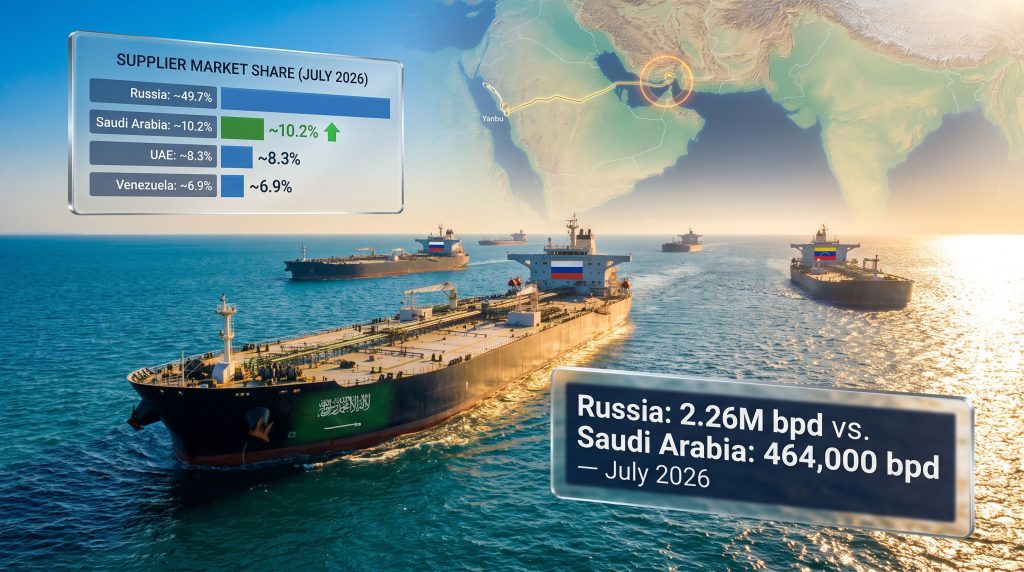
| July 2026 projection | 2.26 million bpd | 464,000 bpd |
Russia's June 2026 figure of 2.73 million bpd is particularly striking, representing nearly 54% of India's total crude imports in that month. Even as volumes ease in July, Russian supply remains well above the preceding twelve-month average, confirming that the prior acceleration was not simply a transient spike.
The Mechanics of Saudi Arabia's Partial Recovery
Saudi Arabia regaining share in India's crude imports is not a passive development. It reflects a deliberate commercial repositioning by Saudi Aramco, executed across multiple dimensions simultaneously.
Official Selling Price Strategy
The most visible lever has been aggressive official selling prices adjustment for Asian buyers. Saudi Aramco sets OSPs monthly relative to the Oman/Dubai benchmark average, and the pricing for Asian-bound grades has been reduced to the lowest relative levels versus benchmark in over two years.
Critically, this included the removal of a $0.30 per barrel premium that had been embedded in Arab Light pricing for Asian buyers, effectively moving Saudi crude to benchmark parity rather than a premium position. This matters beyond the direct cost saving:
"When a major producer eliminates a long-standing structural premium to defend market share, it signals that volume recovery has been elevated above short-term revenue optimisation in the strategic hierarchy. This is a significant pricing posture shift with implications for how competing exporters calibrate their own pricing."
Transit Time as a Competitive Advantage
One dimension of Saudi Arabia's competitive position that is frequently underappreciated in mainstream analysis is the raw logistics advantage it holds over Russia and other distant suppliers. Saudi crude reaches Indian west coast refinery hubs, including Jamnagar, the world's largest refining complex, in approximately three days.
Compare this to:
- Russian Baltic or Arctic shipments, which require transit times of 15 to 25 days depending on routing
- US Gulf Coast cargoes, which take 30 to 35 days to reach Indian ports
- West African grades, which typically require 18 to 22 days
At Indian refinery scale, this transit time difference translates into material working capital implications. Crude in transit is capital tied up earning no return. For a refinery processing 300,000 to 400,000 bpd, reducing transit inventory by even ten days can free up hundreds of millions of dollars in working capital. This is a structural advantage that no pricing formula can fully offset.
The Volume-First Playbook
Saudi Arabia's current approach in India reflects a classic market share recovery strategy employed by dominant producers facing competitive displacement: accept lower near-term margins to restore volume presence, then gradually rebuild pricing power from a stronger market position. This approach was last employed at scale by Saudi Arabia during the 2014 to 2016 period when it maintained elevated production to defend share against US shale producers. Consequently, OPEC market influence continues to shape how these pricing decisions ripple across the broader global supply picture.
India's Full Supplier Landscape in July 2026
The current configuration of India's crude import basket reflects the combined effects of Russian supply dominance, Saudi Arabia's recovery effort, Hormuz disruption, and US diplomatic pressure operating simultaneously.
| Supplier | Estimated July 2026 Volume | Market Share | Direction of Travel |
|---|---|---|---|
| Russia | ~2.26 million bpd | ~49.7% | Easing from June peak; remains dominant |
| Saudi Arabia | ~464,000 bpd | ~10.2% | Recovering from 7% low |
| UAE | ~379,000 bpd | ~8.3% | Stable |
| Venezuela | ~315,000 bpd | ~6.9% | Rising from 281,000 bpd in June |
| United States | ~125,000 bpd | ~2.7% | Declining since US-Iran conflict outbreak |
| Iraq/Kuwait/Qatar | Negligible | Less than 1% | Hormuz-constrained |
Venezuela's emergence as India's fourth-largest supplier merits particular attention. Heavy Venezuelan crude grades are well-matched to the coking and hydrocracking configurations of several Indian refineries, particularly those operated by Reliance Industries. However, Venezuela policy shifts under ongoing US diplomatic pressure add an element of uncertainty to whether these volumes can be sustained at current levels.
The rise in Venezuelan volumes from 281,000 bpd in June to 315,000 bpd in July suggests Indian refiners are actively diversifying away from the Russia-Saudi binary. It is also worth noting that Kpler's lead refining analyst Nikhil Dubey has highlighted that Russian cargo volumes may be underestimated in early-month tracking data, as a significant portion of Russian crude bookings are arranged through traders on short notice rather than through direct long-term contracts.
How the Strait of Hormuz Disruption Reshapes the Competitive Map
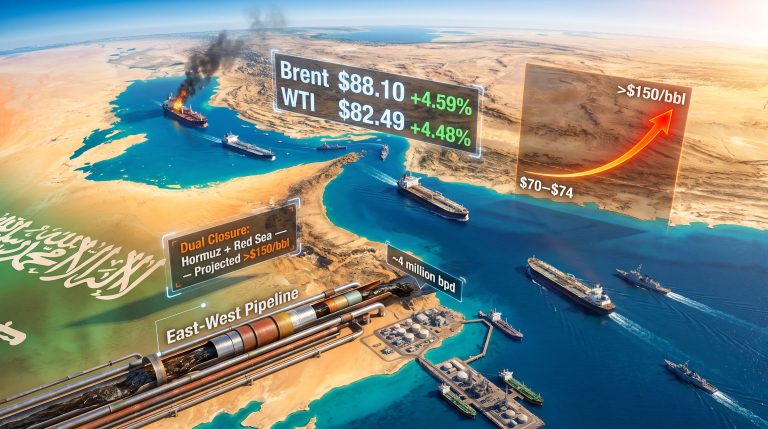
The resumption of US-Iran conflict activity following the outbreak on 28 February 2026 has reintroduced material disruption risk to one of the world's most critical maritime chokepoints. Approximately 20% of global seaborne crude trade transits the Strait of Hormuz, making any sustained disruption to passage a global oil market event rather than simply a regional one.
For India specifically, the Hormuz disruption has eliminated three significant traditional suppliers from the active market:
- Iraq relies entirely on Hormuz-transiting routes for crude exports, with no alternative pipeline infrastructure capable of substituting at meaningful volumes
- Kuwait similarly has no non-Hormuz export corridor and has seen shipments to India fall to negligible levels
- Qatar, though primarily an LNG exporter, also routes its crude exports through the Strait
This is not simply a temporary supply interruption. The infrastructure required to develop alternative export routes for these countries involves multi-year construction timelines and capital expenditures in the billions of dollars. Unless the Strait disruption resolves quickly, the absence of these suppliers from India's import mix will persist.
Saudi Arabia's Infrastructure Edge
This is where Saudi Arabia's East-West Pipeline assumes strategic significance that goes beyond its normal commercial utility. The pipeline connects the kingdom's Eastern Province oil fields to the Red Sea port of Yanbu, providing Saudi Aramco with an export corridor that is entirely independent of Hormuz transit. At full capacity, the pipeline can move approximately 5 million bpd, though it typically operates well below this level.
In an environment where Hormuz-dependent competitors are effectively sidelined, Saudi Arabia's Red Sea export capability becomes a meaningful market share driver without requiring any additional pricing concessions. The disruption paradoxically creates volume uplift opportunities for a supplier that would otherwise be losing ground on price competition alone.
The next major ASX story will hit our subscribers first
US Geopolitical Pressure and India's Calibrated Response
Washington's sustained diplomatic effort to encourage India to reduce Russian crude dependence operates through multiple simultaneous channels. Secondary sanctions risk, trade relationship leverage, and strategic partnership signalling within Quad and Indo-Pacific frameworks all create incentives for Indian policymakers to demonstrate at least measured diversification. Indeed, the broader oil price geopolitics at play across Asia are amplifying pressure on all major importers to reconsider their supply chains.
However, the commercial reality constrains how far and how fast India can respond to this pressure. Russian crude's discount to benchmark pricing remains substantial, and Indian refiners operating in a cost-competitive fuels market cannot simply absorb the premium of switching to more expensive barrels without downstream consequences for retail fuel pricing and refinery profitability.
The approach Indian refiners appear to be pursuing is one of calibrated diversification:
- Incrementally increase Gulf, Venezuelan, and other non-Russian volumes as Saudi Arabia's pricing becomes more competitive
- Maintain Russia as the dominant supplier where the economics remain compelling
- Demonstrate good-faith diversification to US interlocutors without triggering the supply security risks of rapid supplier switching
- Monitor US secondary sanctions evolution carefully, as the definition of sanctionable Russian crude transactions continues to develop
This is a pragmatic rather than ideological approach to energy security, consistent with India's broader foreign policy posture of strategic autonomy.
Three Scenarios for Saudi Arabia's Position in India Through 2026
The trajectory of Saudi Arabia regaining share in India's crude imports over the remainder of 2026 will be shaped by the interaction of pricing dynamics, Hormuz conditions, and Russian supply economics. Three plausible scenarios emerge from current market conditions.
Scenario A: Sustained Recovery to Historical Norms
If Saudi Aramco's OSP adjustments sustain competitive parity with Russian pricing on a delivered cost basis, and Hormuz disruption continues to eliminate Gulf competitors, Saudi Arabia could restore its share to the 13 to 15% range seen in mid-2025. This would require continued OSP discipline and potentially further premium removal on Arab Heavy grades.
Scenario B: Stabilisation at Reduced Equilibrium
A more likely near-term outcome is stabilisation in the 9 to 11% range, with Saudi Arabia recovering from its May-June lows but not fully restoring historical share levels. Russian crude's discount, even if it narrows, may remain sufficient to ensure Russia retains a commanding lead.
Scenario C: Re-displacement Risk
If OPEC+ production quota negotiations result in Saudi Arabia committing to further output restraint while Russian volumes remain elevated, Saudi Arabia could find itself squeezed back toward the 7% level seen at its recent low. This scenario would likely require an escalation in pricing concessions to prevent.
Key Metrics Analysts Are Monitoring
For investors and market watchers tracking India's crude import dynamics, the following data series provide the most actionable early signals:
Supply-Side Indicators
- Monthly Saudi Aramco OSP announcements for Asian buyer grades
- OPEC+ quota compliance reporting and exemption negotiation outcomes
- Kpler and Vortexa tanker booking and voyage data for Russian and Middle Eastern cargoes
Demand-Side Indicators
- Indian refinery utilisation rate data from the Petroleum Planning and Analysis Cell
- Seasonal petroleum product demand patterns in India, which typically strengthen ahead of the monsoon-to-post-monsoon transition
- Indian government energy policy statements on import diversification targets
Geopolitical Indicators
- Strait of Hormuz transit condition reporting from the United Kingdom Maritime Trade Operations
- Evolution of US Treasury secondary sanctions guidance on Russian crude
- Outcomes of India-US bilateral energy dialogue sessions
According to recent reporting from the Economic Times Energy World, India's Saudi oil imports are being tracked at over a six-year high amid sustained pressure on Russian flows, further reinforcing the structural shift currently underway. In addition, trade data compiled by Trading Economics provides granular monthly import volumes that analysts are closely watching for confirmation of the recovery trend.
Disclaimer: This article contains forward-looking estimates, scenario projections, and market analysis based on data available as of July 2026. Crude oil market conditions are subject to rapid change based on geopolitical events, production decisions, and demand fluctuations. Nothing in this article constitutes investment advice. All volume projections from Kpler are subject to revision as vessel-tracking data become more complete.
Want to Stay Ahead of the Next Major Commodity Discovery Before the Market Moves?
While geopolitical forces reshape global energy supply chains, Discovery Alert's proprietary Discovery IQ model scans ASX announcements in real time, instantly identifying significant mineral discoveries across more than 30 commodities — explore historic examples of extraordinary discovery returns or start your 14-day free trial today to position yourself ahead of the broader market.